This is Part 4 of England's Royal Dynasties, our daily series on the kings and queens of England and Britain, from the Anglo-Saxon kingdoms to King Charles III.
In Part 3 we saw Alfred the Great save Wessex from the Viking Great Army, ring it with fortified towns and start calling himself king of the Anglo-Saxons. When he died in October 899, though, most of eastern and northern England was still ruled by Scandinavian settlers. Within forty years that had changed. This part follows the three people who did it: Alfred's son Edward the Elder, his daughter Æthelflæd, Lady of the Mercians, and his grandson Athelstan, the first king to rule the whole of England.
How do we know?
The main source is again the Anglo-Saxon Chronicle, whose versions do not always agree. A separate set of entries, the Mercian Register (or Annals of Æthelflæd), records what was done in Mercia, which the Wessex-centred main text tends to leave out. Dates in this period are muddled in several manuscripts, so historians sometimes differ by a year.
For Athelstan we also have his law codes, his charters and his coins. The fullest story of his life, however, comes from William of Malmesbury, a monk writing in the 1120s, two centuries later. William said he drew on an "ancient volume", perhaps a lost poem. Some historians accept parts of it; others treat it with caution. Where a detail comes only from William, we will say so.
Edward the Elder (r. 899–924): holding on, then pushing north
Edward was probably born in the mid-870s and had fought alongside his father in the Viking wars of the 890s. Succession in Wessex was not automatic, and his first challenge came from inside the family. His cousin Æthelwold, a son of Alfred's older brother Æthelred I, had a claim of his own. In 899 he seized the royal estate at Wimborne in Dorset, then slipped away to Northumbria, where the Danes of York accepted him as their king.
In 902 Æthelwold came south with the East Anglian Danes and raided Mercia. Edward struck back by ravaging East Anglia, and at the Battle of the Holme (902 or 903) the Danes caught his Kentish rearguard. They held the field, but Æthelwold and the Danish king Eohric were both killed, and the threat from within was over.
Then Edward went on the attack. In 909 a joint army from Wessex and Mercia raided Northumbria for five weeks. In 910 the Northumbrian Danes struck back into Mercia and were caught at Tettenhall, near modern Wolverhampton, where several of their leaders died. It was one of the decisive battles of the century, and it broke the power of the York Vikings for a generation.
From about 912 Edward began a slow, methodical conquest of the Danish-ruled lands south of the Humber, using his father's method: build a burh, garrison it, and use it as a base for the next step. Hertford, Witham, Buckingham, Bedford and Towcester followed. In 917 the Danes attacked several of the new forts at once. Edward's armies answered by taking the Danish stronghold at Tempsford, where a Danish king was killed, and storming Colchester. By the end of the year East Anglia and the southern Danelaw had submitted.
Æthelflæd, Lady of the Mercians
Edward did not do this alone. His older sister Æthelflæd, born around 870, had married Æthelred, the ruler of English Mercia, in the 880s. Æthelred was never called king; he was "lord of the Mercians", and he accepted Alfred's overlordship. When he fell ill in the 900s, Æthelflæd appears to have taken over much of the government, and after his death in 911 she ruled alone with the title the sources give her, Myrcna hlæfdige, Lady of the Mercians.
She was a builder first. The Mercian Register lists her new burhs year by year: Bridgnorth in 912, Tamworth and Stafford in 913, Eddisbury and Warwick in 914, Chirbury and Runcorn in 915. Chester had already been refortified in 907. At Tamworth, excavations have found the timber-framed turf rampart and ditch put up in her time, built over older defences that may go back to Offa, the Mercian king we met in Part 2. A 2018 study in Midland History argues that her burhs were not just outposts of her brother's plan but a network of her own, with political, religious and military purposes.
She also fought. In 916 she sent an army into Wales after an abbot was murdered, destroyed a royal site at Llangorse Lake (Brecknock) and took the Welsh king's wife captive. In 917 her forces took Derby, one of the "Five Boroughs" of the Danish Midlands; the Chronicle notes that four of her thegns, "dear to her", were killed inside the gates. Early in 918 Leicester submitted to her without a fight, and the leading men of York promised their allegiance.
She did not live to take it. Æthelflæd died at Tamworth on 12 June 918 and was buried at St Oswald's Priory in Gloucester, a church she and her husband had founded and enriched with the relics of the Northumbrian saint Oswald. Irish annalists, far away, recorded the death of a "most famous queen of the Saxons".
Her daughter Ælfwynn succeeded her, but only briefly. In December 918, says the Mercian Register, she was "deprived of all authority" and taken into Wessex. Edward had taken direct control of Mercia, and the two English kingdoms were now one.
Legend and evidence
Æthelflæd has been rediscovered in recent years through novels, television and the 1,100th-anniversary events of 2018. Some retellings make her a front-line warrior; the sources say she planned campaigns, built forts and sent armies, but never describe her fighting in person. A colourful story of her outwitting Norse attackers at Chester comes from a much later Irish text and is best read as legend. What is certain is that a woman ruled a kingdom in her own right for seven years, and that the West Saxon chroniclers said remarkably little about her.
Edward's last years
With Mercia secure, Edward pushed north to the Humber and the Mersey, building burhs at Nottingham, Thelwall and Manchester. In 920, at Bakewell in the Peak District, the Chronicle says the king of the Scots, the Viking ruler of York, the lord of Bamburgh and the king of Strathclyde all "chose him as father and lord". What this meant in practice is debated; it was probably a recognition of his power rather than a surrender.
Edward died on 17 July 924 at Farndon on the River Dee and was buried in the New Minster at Winchester, which he had completed. He married three times and had more than a dozen children.
Athelstan (r. 924–939): the first king of England
Athelstan was Edward's eldest son, born around 894 to his first partner, Ecgwynn. Whether she was a lawful wife or not was questioned even in the Middle Ages. The royal family's own website notes that Athelstan may have been the son of a mistress. According to William of Malmesbury, Alfred himself honoured the boy with a scarlet cloak, a jewelled belt and a sword, and Athelstan was brought up at Æthelflæd's court in Mercia. That would explain a great deal, because it was Mercia that first chose him as king in 924.
Wessex may have preferred his half-brother Ælfweard, but Ælfweard died only sixteen days after his father. Even so, Athelstan was not crowned until 4 September 925, at Kingston upon Thames, on the border between Wessex and Mercia. The delay suggests opposition in Winchester.
927: Eamont
In January 926 Athelstan married one of his sisters to Sihtric, the Viking king of York. When Sihtric died the next year, Athelstan took York and drove out Sihtric's kinsman Guthfrith. For the first time a southern English king ruled Northumbria directly.
On 12 July 927, at Eamont, near Penrith in modern Cumbria, the Chronicle says the leading rulers of the north met him: Constantine, king of the Scots; Hywel, probably the Welsh king Hywel Dda; Owain, named as king of Gwent, though William of Malmesbury names Owain of Strathclyde; and Ealdred of Bamburgh. They made peace "with pledges and oaths". This meeting is often treated as the birth of the kingdom of England, and 2027 will mark its 1,100th anniversary.
William of Malmesbury adds two more episodes. At Hereford, he says, the Welsh kings agreed to pay a huge yearly tribute, including 20 pounds of gold, 300 pounds of silver and 25,000 oxen, and the River Wye was fixed as a border. At Exeter, Athelstan removed the Cornish from the city and set the River Tamar as Cornwall's boundary. Both stories may be exaggerated, but they fit the picture of a king imposing himself on the whole island.
King of the English, and more
Athelstan's charters call him rex Anglorum, "king of the English", and some go much further. A charter of 934, quoted on the royal family's website, calls him king of the English raised to the throne "of the whole Kingdom of Britain". His coins carried the title rex totius Britanniae, king of all Britain.
The claim was tested. In 934 he invaded Scotland with an army and a fleet. In 937 Constantine of the Scots, Olaf Guthfrithson, the Viking king of Dublin, and Owain of Strathclyde joined forces against him. At Brunanburh Athelstan and his young half-brother Edmund won a crushing victory. A poem in the Chronicle celebrates it, saying that five young kings and seven of Olaf's earls lay dead on the field.
Nobody knows exactly where Brunanburh was. Many historians favour Bromborough on the Wirral peninsula, near Liverpool, on place-name and geographical grounds, and a local group has recovered tenth-century metalwork nearby. That group itself stresses that the battlefield has not been identified, and other scholars argue for sites in Yorkshire, Lancashire or southern Scotland.
Laws, money and towns
Athelstan was one of the most active lawmakers of the Anglo-Saxon period. At royal assemblies at Grately, Exeter, Faversham and Thunderfield he issued codes that tried to curb theft and enforce order. One law insisted on "one coinage throughout the king's realm", and trading was supposed to happen in the burhs, in front of witnesses. A London ordinance from his reign sets out a sort of neighbourhood peace guild for catching thieves. His laws could be harsh: thieves over the age of twelve could be executed. Later in the reign the age was raised to fifteen, because, the law says, the king thought it too cruel to kill people so young.
His large assemblies, attended by Welsh kings as well as English bishops and nobles, mark the start of a single royal government for the whole country.
Relics, books and a European family
Athelstan was a great collector of relics and books, which he gave to churches to win their loyalty. He visited the shrine of St Cuthbert at Chester-le-Street in 934 and gave it a copy of Bede's lives of the saint. That manuscript, now at Corpus Christi College, Cambridge, opens with a picture of the king presenting the book to the saint, often described as the earliest surviving portrait of an English king.
His family reached across Europe. His half-sisters married the Frankish king Charles the Simple, the Frankish duke Hugh the Great and the German king Otto I, later emperor. His court sheltered his nephew Louis, who returned to France as King Louis IV in 936, and, according to Norse sagas written centuries later, the Norwegian prince Hákon.
A darker story
In 933 Athelstan's half-brother Edwin drowned at sea. Later writers claimed the king had him set adrift in a boat without oars after a false accusation of plotting. William of Malmesbury told the story but said he doubted it; the Chronicle simply records the drowning.
Death and legacy
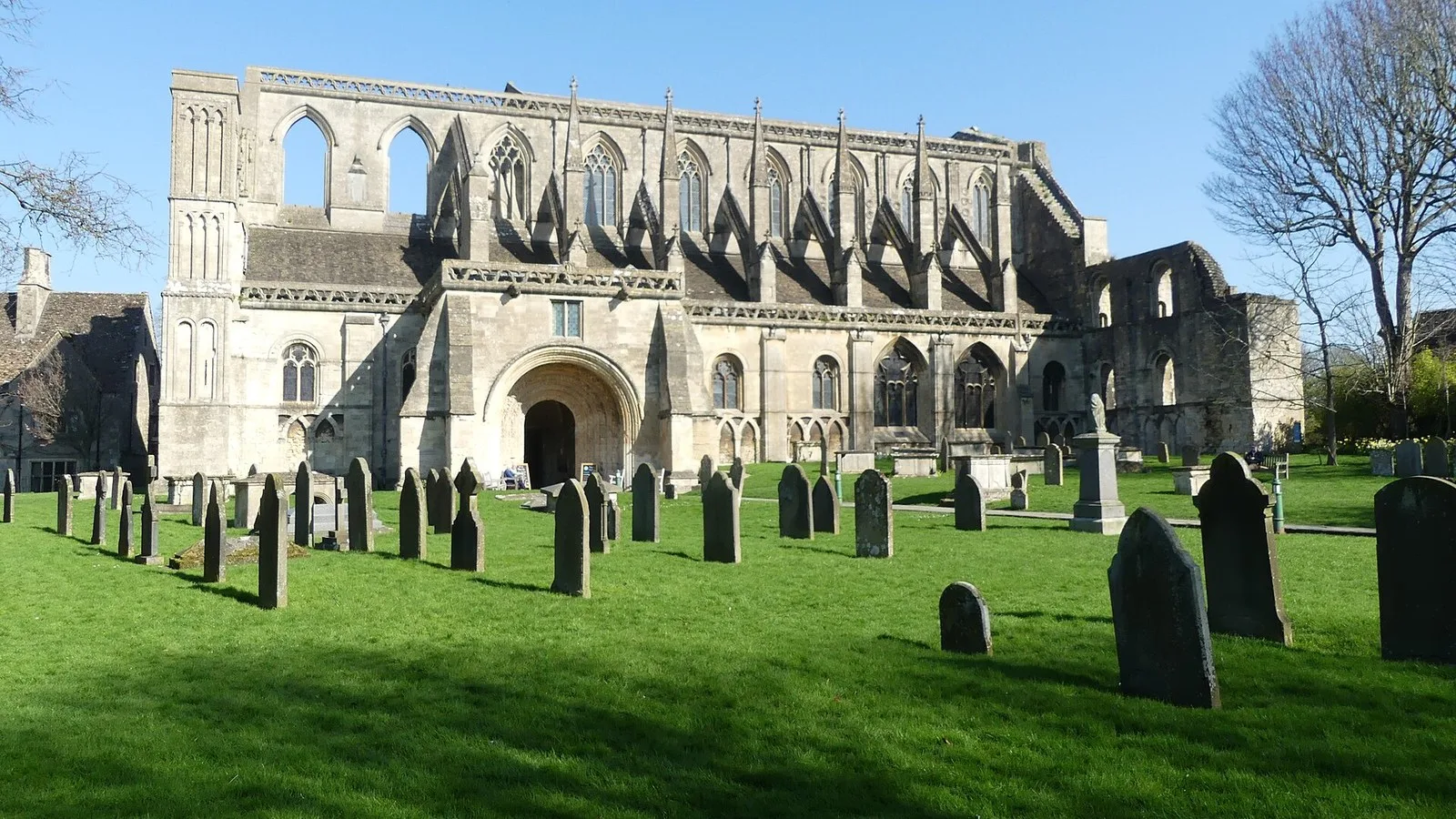
Athelstan died at Gloucester on 27 October 939, aged about 45. He never married and had no children. He chose to be buried not at Winchester with his father but at Malmesbury Abbey in Wiltshire, which he had richly endowed. His remains are lost, but a 15th-century tomb in the abbey still honours him.
His kingdom was more fragile than his titles suggested. Within weeks of his death, Olaf Guthfrithson was back in York, and his half-brothers had to win the north all over again. But the idea was established: one king of the English, one coinage, one set of laws. Every later English and British monarch rules in succession to the kingdom these three people built.
Where to see it today
- Tamworth, Staffordshire: Æthelflæd died here; parts of her burh defences are protected monuments, and a statue of her with the young Athelstan stands near the castle.
- St Oswald's Priory, Gloucester: ruins of the church where she was buried.
- Malmesbury Abbey, Wiltshire: Athelstan's burial place and 15th-century tomb.
- Kingston upon Thames: the Coronation Stone, traditionally linked with Anglo-Saxon coronations.
At a glance
| Rulers | Edward the Elder, king of the Anglo-Saxons 899–924; Æthelflæd, Lady of the Mercians c.911–918; Athelstan, king of the English 924–939 |
| House | House of Wessex |
| Predecessor | Alfred the Great |
| Successor | Athelstan's half-brother Edmund I |
| Key dates | 902 Battle of the Holme; 910 Tettenhall; 913 Tamworth burh; 917 Derby, Tempsford, Colchester; 918 death of Æthelflæd; 920 Bakewell; 924 Edward dies; 925 coronation at Kingston; 927 Eamont; 937 Brunanburh; 939 Athelstan dies |
| Legacy | Conquest of the Danelaw, a united English kingdom, shires and burhs, Athelstan's law codes |
| Next | Edgar the Peaceable to Æthelred the Unready |
Next in the series
Athelstan's death left a young kingdom and a determined Viking enemy in York. In Part 5 we follow his heirs through the struggle for the north to Edgar the Peaceable, whose reign was the high point of Anglo-Saxon kingship, and then to Æthelred the Unready, Danegeld and the return of the Vikings. Until then, browse more on the Anglo-Saxons and medieval history, or go back to Part 1.
Sources
- The Royal Family, Edward 'The Elder' (r. 899–924)
- The Royal Family, Athelstan (r. 924–939)
- The Anglo-Saxon Chronicle, tenth-century entries, Avalon Project, Yale Law School
- Anglo-Saxon Chronicle extracts on Æthelflæd, Fordham University Internet Medieval Sourcebook
- Historic England, Saxon defences, Tamworth (list entry 1006088)
- M. Blake and A. Sargent (2018), 'For the Protection of All the People': Æthelflæd and her Burhs in Northwest Mercia, Midland History 43:2
- BBC History, Athelstan
- Wirral Council (2021), Search for the Battle of Brunanburh: assessment report
Featured image: Malmesbury Abbey in Wiltshire, where Athelstan was buried in 939. Photo by Ruth Sharville, Wikimedia Commons, CC BY-SA 2.0.