This is Part 4 of HorizonDesk's chronological series on Tamil history, from prehistory to modern Tamil Nadu. The previous instalment was Part 3: Keezhadi – An Urban Settlement of the Sangam Age.
On 23 January 2025, at the Anna Centenary Library in Chennai, Tamil Nadu's then Chief Minister M. K. Stalin released a report called Antiquity of Iron: Recent Radiometric Dates from Tamil Nadu and declared: "The Iron Age began on Tamil soil!" The headline number, 3345 BCE, came from charcoal found with iron objects in burial urns at a village called Sivakalai. If correct, it would put iron in south India more than 5,300 years ago, ahead of the accepted evidence for iron smelting anywhere else.
Sivakalai is one of three excavated sites whose dates have challenged the textbooks. Kodumanal, near Erode, was a town of gem-cutters and steel-makers; Porunthal, near Palani, gave up a chieftain's grave with rice in a jar and early Tamil writing. Each date also started an argument. Here is what was found, what was claimed and what critics say.
First, how ancient sites are dated
Most of the numbers below come from two methods:
- Radiocarbon (AMS) dating measures the carbon-14 left in once-living material such as charcoal, grain or bone; accelerator mass spectrometry (AMS) needs only tiny samples. The US firm Beta Analytic tested most samples discussed here.
- Optically stimulated luminescence (OSL) estimates when pottery or sediment was last heated or exposed to light.
Two cautions matter. Radiocarbon results are calibrated into calendar ranges, which the archaeometallurgist David Killick says "should never be quoted as single years", so "3345 BCE" is shorthand for a range. And a date belongs to the sample, not automatically to objects lying near it. Charcoal can come from old wood or be moved by later disturbance, so association is where most arguments start.
The three sites at a glance
| Site | District | Main digs | Key finds | Dates claimed | Status of debate |
|---|---|---|---|---|---|
| Sivakalai (Sivagalai) | Thoothukudi | Tamil Nadu State Department of Archaeology (TNSDA), 2019–22 | 160 urns, 85+ iron objects, paddy, Tamil-Brahmi sherd | Paddy c. 1155 BCE; charcoal with iron 2953–3345 BCE | Rice date widely accepted; 4th-millennium iron dates hotly debated |
| Kodumanal | Erode | 1985–1990, 1998–99, 2012–13, 2020–21 | Bead workshops (beryl, quartz, sapphire), iron and copper furnaces, crucible steel, 500+ inscribed sherds | AMS dates of c. 408–200 BCE; excavator suggests 5th century BCE or earlier | Industrial role well established; earliest date an estimate |
| Porunthal | Dindigul (near Palani) | Pondicherry University, 2009–10 | Cist grave with 2 kg of paddy, 7,500 beads, Tamil-Brahmi on ring stands | Paddy 490 BCE and 450 BCE | Whether the paddy date also dates the script is still contested |
Sivakalai: urns near the Thamirabarani
A teacher's text message
Sivakalai lies about 7 km north of the Thamirabarani river (Porunai in classical Tamil) in Thoothukudi district, about 15 km from both Adichanallur, the urn field covered in Part 2, and Korkai, the old Pandya port. In January 2026 T. Udhayachandran, a former Commissioner of Archaeology, recalled how it began: a text message from Manickam, a part-time teacher in the village, saying objects there needed study.
What the excavators found
The TNSDA dug in 2019–20, 2020–21 and 2021–22 across eight localities: three burial grounds and five habitation mounds. The urn field, locally called Sivakalai-parambu (parambu means a dry, raised stretch of ground), covers about 500 acres. According to the report:
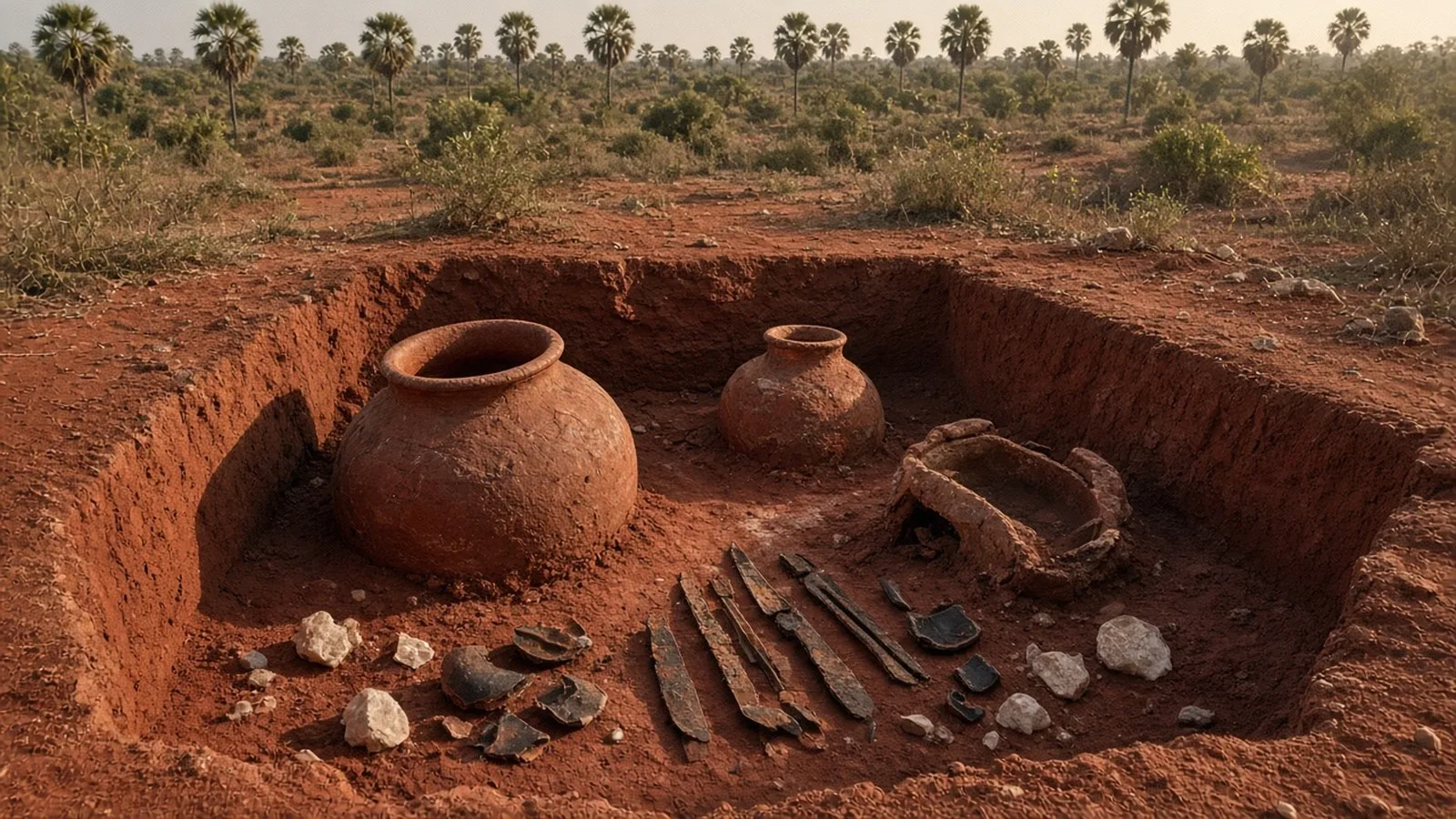
- 24 trenches exposed 160 urns, 151 of red ware and 9 of black-and-red ware, some as tall as 115 cm, a few set in pits cut into the rock.
- More than 85 iron objects, including knives, arrowheads, rings, chisels, axes and swords, lay inside and outside the urns.
- About 750 pots, bowls, lids and ring stands accompanied the dead, many in white-painted black-and-red ware.
- One urn (Trench A2, Urn 3), still sealed by its lid, held skeletal remains, iron objects and paddy (unhusked rice).
From rice to iron: the dates
Beta Analytic dated that paddy to about 1155 BCE in August 2021, and on 9 September Stalin told the Assembly that the Porunai civilisation was 3,200 years old. Charcoal from a habitation trench, found with a sherd inscribed in Tamil-Brahmi (the early script also called Tamili), gave about 685 BCE.
Three further charcoal samples from the graveyard, from contexts with iron objects, produced the startling figures: about 2953 BCE (Trench C3), 3259 BCE (Trench A2, Urn 1) and 3345 BCE (Trench B3, Urn 10). OSL tests on pottery from Urn 1 in Lucknow and Ahmedabad gave about 2459 and 2427 BCE. On those grounds the report placed the introduction of iron in Tamil Nadu in "the first quarter of the 4th millennium BCE".
The case for, and the case for caution
Supporters point to multiple laboratories and full publication of lab results. Killick, asked to review the report, wrote in Frontline that the three dates on rice and millet prove iron was used in Tamil Nadu "by at least 1300 BCE", roughly when it became common in the Hittite state of Anatolia. He saw "no good reason" to reject the three Sivakalai charcoal dates, since all three samples being old charcoal seemed unlikely.
But Killick also raised the larger problem: elsewhere, iron smelting grew out of centuries of copper smelting, yet Tamil Nadu seems to leap from the Neolithic straight to fully developed iron. "Where are the earlier stages? And where are the smelting sites of the same ages?" he asked. Sharada Srinivasan, a sympathetic archaeometallurgist, noted that charcoal carries "old wood" risks that grain does not and called for work on furnaces and slag.
Others went further. The Telegraph reported in January 2025 that the dating studies had yet to be peer-reviewed in a scientific journal, and a Lucknow scientist involved called the OSL results "provisional". Writing in The Wire in August 2025, the author P. A. Krishnan argued that the report does not clearly state the charcoal came from inside sealed urns, that the trench was disturbed, and that the sealed urn in the same trench dated only to 1155 BCE. Killick replied that the report's table places two of the samples inside urns, and that the cemetery may simply have been used for a very long time. Parth R. Chauhan of IISER told the BBC that, if validated through rigorous study, the finds "would certainly rank amongst the world's earliest records".
Sivakalai's finds are now displayed in a dedicated block of the Porunai Archaeological Museum near Palayamkottai, opened on 20 December 2025.
The wider "Antiquity of Iron" picture
The January 2025 report pulled together dates from several sites:
- Mayiladumparai (Krishnagiri): a hill site spanning microlithic tools to medieval inscriptions. Its Iron Age level gave dates of about 2172 and 1615 BCE, announced in May 2022 as "4,200 years" of iron.
- Adichanallur: millet and paddy from urns dated to about 1506–1304 and 1368–1110 BCE; habitation charcoal gave about 2580–2465 BCE.
- Kilnamandi (Tiruvannamalai): a stone-lined grave dated to about 1769–1615 BCE.
- Mangadu and Thelunganur (Salem): steel objects, including a high-carbon steel sword, dated directly to between about 1600 and 900 BCE.
Iron by the 2nd millennium BCE now has solid support; the 4th-millennium claim rests mainly on Sivakalai.
Kodumanal: an industrial town on the Noyyal
Kodumanal sits on the north bank of the Noyyal river in Erode district. It is identified with Kodumanam, praised in the Sangam anthology Pathitruppathu, and lay on the ancient route linking the Chera capital Karur with Muziris, the Chera port on the Kerala coast. After a first ASI dig in 1961, Tamil University excavated in 1985–1990 under Y. Subbarayalu, the TNSDA in 1998–99, K. Rajan's Pondicherry University team in 2012–13 and the TNSDA again in 2020–21, the tenth season. More than 9,000 artefacts have been recovered.
Gems, iron and steel
- Beads: workshops turned sapphire, beryl, quartz, lapis lazuli, agate, carnelian and other stones into tiny drilled beads. A 2013 dig exposed every stage, from quartz blocks and an anvil to kilns and polishing stones. Beryl came from nearby Padiyur, sapphire from Sivanmalai, carnelian and agate from western India and lapis from Afghanistan.
- Iron: a furnace base 115 cm across, with slag and clay blowpipe nozzles (tuyeres), probably reached about 1,300°C; in 2021 two more furnaces and heaps of slag turned up on the riverbed. Ore came from Chennimalai nearby.
- Steel: a crucible furnace for high-carbon steel, the technique behind south India's famed "wootz" steel. The 2025 report dates it to the 6th century BCE, citing Rajan, which is older than the site's published AMS dates.
- Copper, shell and cloth: copper-smelting furnaces, conch-shell bangles and spindle whorls for cotton.
Rajan called it "entirely an industrial site with a minimum agricultural activity". Roman silver coins and Northern Black Polished Ware, a luxury tableware from the Ganges valley, show its reach; see our history of the Roman Empire for the other end of that trade.
Names on pots
By 2013 more than 500 Tamil-Brahmi inscribed sherds had been collected, which Rajan described as the most from any single site in the subcontinent. Most are personal names, such as Saathan, Visaki and Tissan, and one large pot reads Samban Sumanan. Names of Prakrit (north Indian vernacular) origin point to traders from the north.
Dating Kodumanal
Charcoal from depths of 15–120 cm gave AMS dates of about 408 to 200 BCE. Rajan places the busy industrial phase between the 5th and 1st centuries BCE. He has argued that the undated deposit below could push the start to the mid-6th century BCE, an estimate he himself called "hypothetical".
Porunthal: a chieftain's grave near Palani
Rice in a four-legged jar
Porunthal lies about 12 km from the temple town of Palani, in the foothills of the Western Ghats in Dindigul district. In 2009–10 Rajan's team, largely students from six institutions, excavated a habitation mound and four stone-circle graves. One two-chambered cist (a box-like grave built of stone slabs) stood out. It held 14 four-legged jars, from 12 cm to 1 m tall, about 2 kg of paddy in the largest, around 7,500 beads of carnelian, steatite, quartz and agate, iron swords, stirrups and a jar painted with a peacock. It probably belonged to a chieftain or clan leader.
The script debate
Two ring stands carried the same three Tamil-Brahmi letters, read by the epigraphist Iravatham Mahadevan and colleagues as va-y-ra ("diamond"), beside a sign of a bead on a thread. Beta Analytic dated the paddy to 490 BCE and a second sample to 450 BCE. Because the grave goods were laid down together, Rajan argued that Tamil-Brahmi writing existed in the 5th century BCE, two centuries before the emperor Ashoka's Brahmi edicts. Cambridge's Dilip K. Chakrabarti called it "an epoch-making discovery".
Mahadevan said "multiple carbon-dates are needed". Y. Subbarayalu argued that the letter forms belong to about the 1st century BCE or CE, and that vayra is borrowed from Prakrit vajra. The argument continues.
What we can say with confidence
- Iron was in use in Tamil Nadu by at least 1300 BCE, and, in Killick's reading, probably by about 1850–1600 BCE.
- Rice was buried with the dead along the Thamirabarani by about 1155 BCE.
- Places like Kodumanal were making beads, iron and steel for long-distance trade, and their people scratched names on pots in Tamil-Brahmi, by the last centuries BCE.
- Claims of iron in the 4th millennium BCE and of 5th-century BCE writing remain open until more dates and peer-reviewed reports appear.
The stone circles and urns described in Part 1 on Tamil Nadu's megaliths were made by iron-using farmers and craftspeople whose world was wider than once thought. Srinivasan has even suggested links with the Harappan civilisation, an idea that remains speculative.
Next part
Part 5, The Tamil-Brahmi Script and the Earliest Tamil Inscriptions, follows the letters scratched on Kodumanal's pots and carved in the rock shelters of Mangulam near Madurai, and asks when, and how, Tamil first came to be written.
Sources
- K. Rajan and R. Sivanantham (2025), Antiquity of Iron: Recent Radiometric Dates from Tamil Nadu, Tamil Nadu State Department of Archaeology (Tamil Digital Library)
- K. Rajan (2014), Iron Age – Early Historic Transition in South India: An Appraisal, ASI Institute of Archaeology lecture
- IIT Gandhinagar, Antiquity of Iron in Tamil Nadu (talk abstract by K. Rajan and T. Arun Raj)
- The Hindu, Iron Age began in Tamil Nadu in first quarter of 4th millennium BCE: CM Stalin and Sivagalai sheds light on iron's antiquity (2025)
- The Hindu, Porunai civilisation is 3,200 years old, says Stalin (2021)
- The Hindu, Iron Age in T.N. began 4,200 years ago (Mayiladumparai, 2022)
- Frontline, Sharada Srinivasan, Tamil Nadu's discoveries rewrite the Iron Age timeline (2025)
- Frontline, David Killick, Tamil Nadu's metallurgical mystery: The missing Copper Age (2025)
- BBC News, Did Iron Age 'begin' in India? Tamil Nadu dig sparks debate (2025)
- The Telegraph, A Stalin claim that needs to be ironed out (2025)
- The Indian Express, A new study says Iron Age began hundreds of years earlier – in Tamil Nadu (2025)
- The Wire, P. A. Krishnan, Attaching regional pride to archaeological findings only muddies waters (2025)
- DT Next, Sivagalai, wonder womb of Iron Age (2025)
- The Hindu, Stalin inaugurates Porunai Archaeological Museum (2025)
- EdexLive / New Indian Express, Message from teacher led to determining of Tamil Nadu's Iron Age (2026)
- The Hindu, Kodumanal excavation yields a bonanza again (2012) and Kodumanal reveals more hidden gems (2013)
- The Hindu, Kodumanal: How a barren land turned into a treasure trove, Iron smelting units unearthed at Kodumanal and 10th phase of excavation ends at Kodumanal (2021)
- Frontline, Buried history (Porunthal, 2010)
- The Hindu, Palani excavation triggers fresh debate and Porunthal excavations prove existence of Indian scripts in 5th century BC: expert (2011)