This is Part 7 of HorizonDesk's chronological series on Indian history, from the Stone Age to Independence in 1947.
In Part 6 of this series, Vedic culture moved east into the Ganga plains, where tribes settled down as territorial janapadas. In this part those small realms grow into rival states with walled cities, standing armies, tax collectors and India's first coins.
Ancient texts remember sixteen of them as the mahajanapadas, the "great realms". Within about two centuries one of them, Magadha in south Bihar, had swallowed most of the others, from King Bimbisara, a contemporary of the Buddha, to the fabulously rich Nanda kings whose army helped persuade Alexander the Great's soldiers to turn back.
A word on dates: the period is usually said to begin around 600 BCE, but that is a round figure. Almost every date before Alexander's invasion in 326 BCE depends on when the Buddha died, which is still debated.
How do we know about this period?
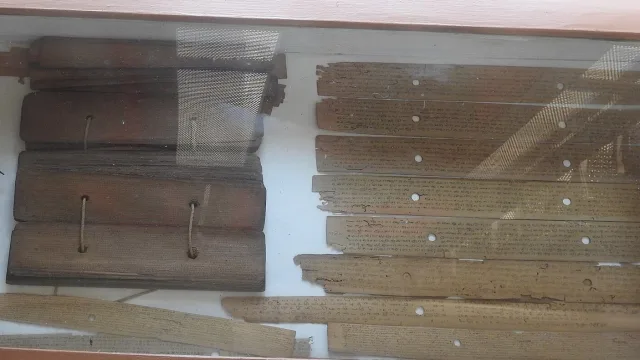
For the first time we can compare several kinds of evidence. Buddhist texts in Pali, especially the Nikayas and the Vinaya Pitaka, were passed down orally and written down centuries later, but they preserve a lively picture of kings, merchants and towns. Jain texts such as the Bhagavati Sutra, and the Puranas, add royal genealogies that often disagree with the Buddhist ones. The grammarian Panini names many janapadas, and Greek and Latin writers such as Arrian, Curtius and Diodorus describe Alexander's campaign. Archaeology supplies fortified cities, a glossy pottery called Northern Black Polished Ware and punch-marked coins. Historians treat stories about individual kings with caution, but the broad picture is consistent.
The sixteen mahajanapadas
The best-known list comes from the Buddhist Anguttara Nikaya, which names sixteen great realms stretching from the north-west frontier to Bengal's edge and south to the Godavari:
- Anga (east Bihar), capital Champa, near Bhagalpur
- Magadha (south Bihar), capital Girivraja or Rajagriha, modern Rajgir
- Kashi, capital Varanasi
- Kosala (Awadh), with Shravasti, Saketa and Ayodhya
- Vajji (Vrijji), a confederacy north of the Ganga, centred on Vaishali
- Malla, centred on Kushinara (Kushinagar) and Pava
- Chedi (eastern Bundelkhand), capital Shuktimati
- Vatsa, capital Kaushambi near Prayagraj
- Kuru, around Delhi and Meerut, capital Indraprastha
- Panchala, capitals Ahichchhatra and Kampilya
- Matsya (around Jaipur), capital Viratanagara, modern Bairat
- Shurasena, capital Mathura
- Ashmaka (Assaka), on the Godavari in the Deccan, capital Potana
- Avanti (Malwa), capitals Ujjayini (Ujjain) and Mahishmati
- Gandhara, capital Takshashila (Taxila)
- Kamboja, a frontier land near Gandhara
"Sixteen" is not an exact census. The Jain Bhagavati Sutra also lists sixteen, but a quite different set: beside Anga, Magadha, Vajji, Malla, Kashi, Kosala and Vatsa it names Vanga (Bengal), Malaya, Malavaka, Ladha and others, apparently reflecting a later, more easterly horizon. As Upinder Singh notes, the lists were drawn up at different times, and many smaller janapadas existed alongside the big ones.
Kings and "republics"
Most mahajanapadas, including Magadha, Kosala, Vatsa and Avanti, were monarchies with hereditary kings who collected regular taxes, kept standing armies and ruled through ministers. The early Dharmasutras said the king should ideally be a Kshatriya and that cultivators, traders and artisans owed him tax.
Others were gana-sanghas, often called "republics", though "oligarchies" is closer. Power lay with an assembly of the heads of the ruling clan, all of whom could call themselves raja, meeting in a hall (santhagara) to debate and, if needed, vote. The best known were the Vajji confederacy of eight or nine clans, led by the Licchavis of Vaishali; the Mallas of Kushinara and Pava, who performed the Buddha's funeral rites; and the Shakyas of Kapilavastu, the Buddha's own clan, who were subordinate to Kosala.
Women, labourers and slaves had no say, so these were not democracies. But the Buddha admired them: in the Mahaparinibbana Sutta he says the Vajjis will prosper as long as they meet often and in harmony and respect their elders and shrines. Both the Buddha and Mahavira were born into gana families.
The second urbanisation
More than a thousand years after the Harappan cities faded, the Ganga valley saw a new wave of city building, the second urbanisation. From roughly the 6th century BCE, Rajagriha, Champa, Shravasti, Kaushambi, Varanasi, Vaishali and Ujjayini grew into fortified towns with ramparts and moats, while Taxila flourished in the north-west. Several of these sites, such as Shravasti, Kaushambi and Kushinagar, feature in our Uttar Pradesh travel guide.
Behind the cities lay a farming surplus: wet rice in the middle Ganga plain, iron tools that became common from about the 6th century BCE, and trade along the river. The texts speak of craft guilds, rich householders (gahapatis) and merchants (setthis) such as Anathapindika of Shravasti, who is said to have bought a park for the Buddha by covering it with coins. Two kinds of object mark this world for archaeologists:
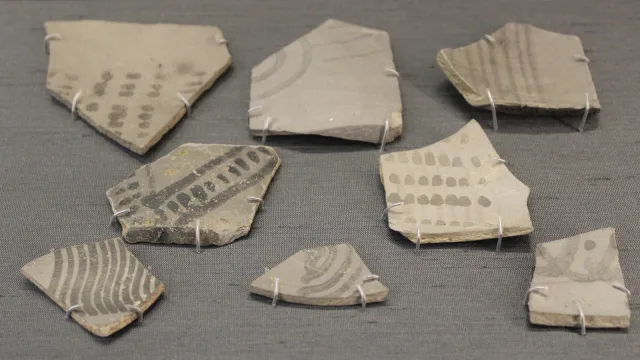
- Northern Black Polished Ware (NBPW), a thin pottery with a mirror-like black or steel-blue gloss, classically dated to about 700–200 BCE, with a peak around 500–300 BCE. It was a prized luxury, sometimes repaired with copper rivets, and has been found from Taxila to Bengal and, through trade, as far south as Kodumanal in Tamil Nadu.
- Punch-marked coins, the subcontinent's first coins: mostly silver pieces of standard weight (karshapanas) stamped with symbols such as suns, wheels, animals and hills. Many scholars date the earliest to around the 6th or 5th century BCE, others later. Magadha became a major issuer.
The Haryankas: Bimbisara and Ajatashatru
By the Buddha's lifetime four monarchies dominated: Magadha, Kosala under Prasenajit, Vatsa under Udayana, and Avanti under Pradyota, nicknamed "the fierce". Kashi had already been absorbed by Kosala, and in the far north-west Gandhara had fallen under the Persian king Darius I.
Bimbisara (traditionally c. 544–492 BCE) of the Haryanka dynasty is the first Magadhan king we see clearly. He conquered Anga, gaining the river port of Champa, and used marriage as diplomacy: Kosaladevi, a sister of Prasenajit, brought revenue from a Kashi village as dowry, and Chellana was a Licchavi princess of Vaishali. He even sent his physician Jivaka to treat Pradyota of Avanti. Both Buddhists and Jains claim him as a patron.
Buddhist tradition says his son Ajatashatru (traditionally c. 492–460 BCE) imprisoned him and starved him to death. Ajatashatru fought his uncle Prasenajit over Kashi until Kosala came into Magadha's orbit, then waged a long war on the Vajjis. The Mahaparinibbana Sutta has his minister Vassakara consult the Buddha about it, and later tradition says Vassakara sowed division among the Vajjis. Jain texts credit Ajatashatru with two war machines, the mahashilakantaka, a stone-hurling catapult, and the rathamusala, a chariot fitted with a mace. To watch the Vajjis across the river he fortified the village of Pataligrama on the Ganga, and Buddhist tradition places the First Buddhist Council at Rajagriha in his reign.
Rajagriha and Pataliputra
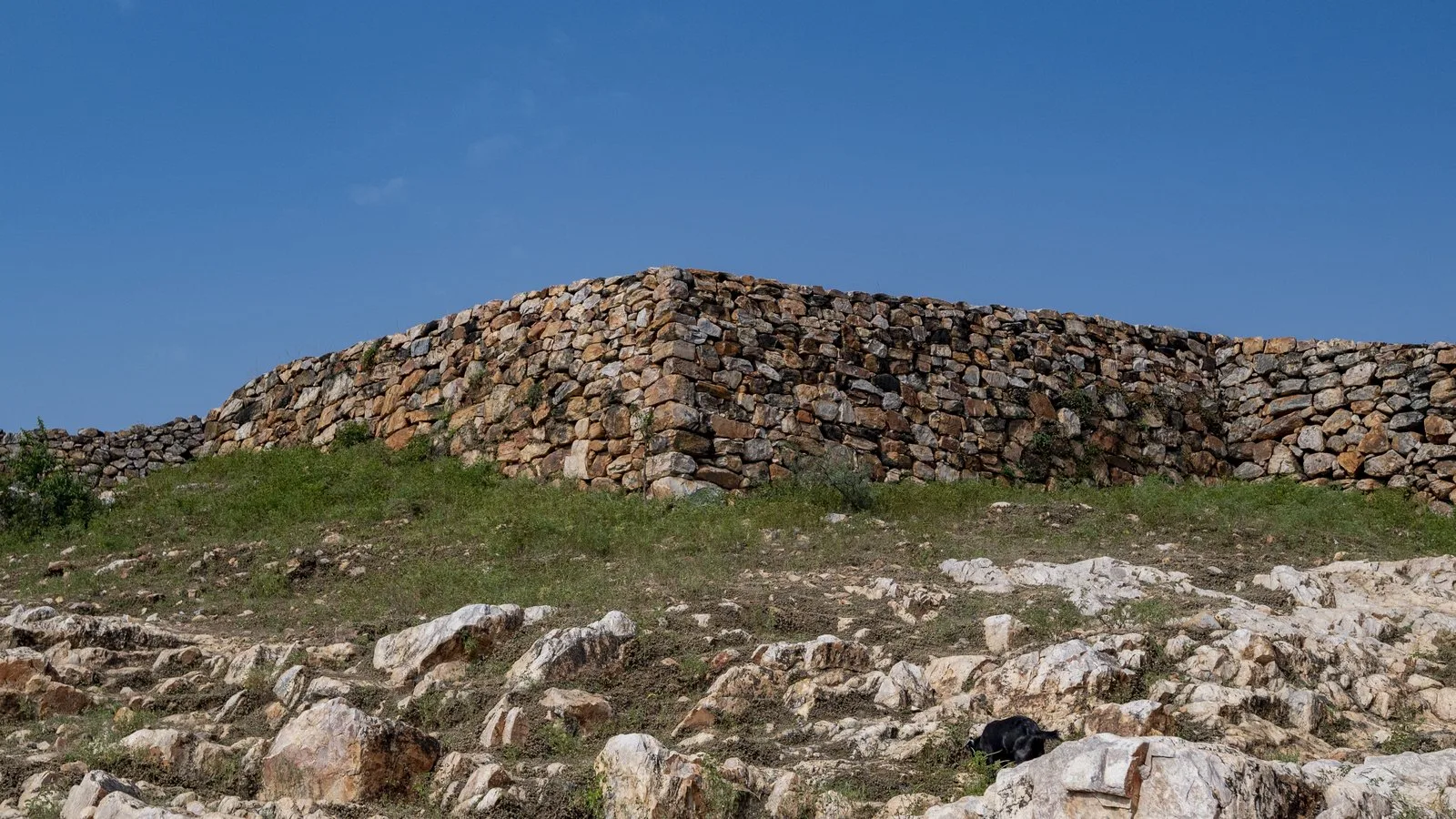
Magadha's first capital, Rajagriha (Rajgir), lay in a valley ringed by five hills. Its Cyclopean Wall, shown in our featured image, is among the oldest surviving fortifications in historic India: the Archaeological Survey of India dates the walls of Old and New Rajagriha to the 6th–5th centuries BCE, built of boulders without mortar, and they are popularly said to run for some 40 km. Rajgir is a short drive from the ruins of Nalanda Mahavihara.
Ajatashatru's son Udayin is traditionally credited with moving the capital to Pataliputra, which grew around Pataligrama beside modern Patna. Set where the Son meets the Ganga, it was both a river fortress and a trading hub, and it went on to be the capital of the Nandas, Mauryas and Guptas.
Shishunagas and Nandas
Buddhist chronicles say that after a run of father-killing kings, the people replaced the Haryankas with an official named Shishunaga. He destroyed the power of the Pradyotas, adding Avanti to Magadha. His son Kalashoka is linked with the Second Buddhist Council at Vaishali.
In the mid-4th century BCE, Mahapadma Nanda seized the throne. All traditions agree he was of low birth: the Puranas call him the son of a Shudra woman, and Jain and Greek accounts make his father a barber. The Puranas also call him sarva-kshatrantaka, "destroyer of all Kshatriyas", and ekarat, "sole sovereign". The later Hathigumpha inscription of Kharavela mentions a canal opened in Kalinga by a "Nandaraja", supporting Nanda rule in Odisha.
The Nandas became bywords for wealth and harsh taxation. The last of them, Dhana Nanda, probably the "Agrammes" of Greek writers, is credited by Curtius with 20,000 cavalry, 200,000 infantry, 2,000 chariots and 3,000 elephants. Even in Tamil country, the Sangam poet Mamulanar compared a great fortune to the treasure the Nandas gathered at Pataliputra and hid beneath the Ganga (Akananuru 265), a poetic allusion rather than a record, but a sign of how far the legend had travelled. Read more in our guide to Sangam literature.
Why Magadha won
Historians such as R. S. Sharma and Romila Thapar point to a combination of advantages:
- Iron. The hills of south Bihar and the nearby Chota Nagpur plateau held rich iron ore, and Anga brought access to more minerals, so Magadha had better weapons and tools.
- Fertile land. The alluvial, monsoon-watered middle Ganga plain grew wet rice and produced large, taxable surpluses.
- Rivers. The Ganga, Son and Gandak were highways for trade and troops, and both capitals were defended by nature: Rajagriha by hills, Pataliputra by water.
- Elephants. Eastern forests supplied timber and war elephants, a heavy striking force that impressed even the Greeks.
- Ambition. Magadha lay at the edge of the Vedic world and was looked down on by older texts; some historians think its less orthodox society let able outsiders such as the Nandas rise.
The problem of the Buddha's dates
The dates above follow the traditional "long chronology", which places the Buddha's death in 544/543 BCE or, in a corrected version, about 486 or 483 BCE. Many scholars now favour a "short chronology" that puts it around 400 BCE. If they are right, Bimbisara and Ajatashatru belong to the 5th century BCE, not the 6th. The firm anchor is Greek: Alexander reached the Beas in 326 BCE, while the Nandas ruled, and they fell around 321 BCE.
Setting the stage
This busy world of cities, coins and debating halls produced new teachers who questioned Vedic ritual: the Buddha, who found enlightenment at Bodh Gaya in Magadha, and Mahavira, born near Vaishali to a Licchavi mother. At the other end of the period, Alexander of Macedon crossed the Indus in 326 BCE and defeated Porus on the Jhelum, but his exhausted troops, reportedly alarmed by tales of the Nanda army, refused to go beyond the Beas. Within a few years, Chandragupta Maurya would take Pataliputra from the Nandas.
Key takeaways
- From roughly the 6th century BCE, janapadas grew into larger states; Buddhist texts list sixteen mahajanapadas, though Jain lists differ.
- Monarchies such as Magadha and Kosala coexisted with gana-sanghas such as the Vajjis, Mallas and Shakyas.
- A second urbanisation brought fortified cities, Northern Black Polished Ware and punch-marked coins.
- Magadha grew under the Haryankas, Shishunagas and Nandas, moving its capital from Rajagriha to Pataliputra.
- Iron, rice land, rivers, elephants and ambitious rulers explain its rise; most dates before 326 BCE are approximate.
Next part
In Part 8, we meet Gautama Buddha, the Shakya prince who left his home, found enlightenment at Bodh Gaya and taught the Middle Way, and follow the birth of Buddhism.
Sources
- Singh, U. (2008), A History of Ancient and Early Medieval India: From the Stone Age to the 12th Century, Pearson, chapter 6
- Thapar, R. (2002), Early India: From the Origins to AD 1300, Penguin and University of California Press
- Sharma, R. S. (2005), India's Ancient Past, Oxford University Press
- Raychaudhuri, H. C. (1923; rev. edn 1996, with commentary by B. N. Mukherjee), Political History of Ancient India, Oxford University Press
- Bechert, H. (ed.) (1991–97), The Dating of the Historical Buddha, Vandenhoeck & Ruprecht
- Encyclopaedia Britannica, Magadha and Nanda dynasty
- World History Encyclopedia, Magadha Kingdom and Bimbisara
- e-PG Pathshala (INFLIBNET), Mahajanapadas, Rise of Magadha, Nandas, Invasion of Alexander
- Archaeological Survey of India, Patna Circle, Monuments details: walls of Old and New Rajagriha
- Kulkarni, C., Ingle, V., Kanungo, A. K. and Roy, O. (2020), Northern Black Polished Ware: A Gazetteer, Heritage: Journal of Multidisciplinary Studies in Archaeology
- Mamulanar, Akananuru 265, lines 4–6 (Sangam anthology)
Featured image: Part of the Cyclopean Wall of ancient Rajagriha (Rajgir, Bihar), a dry-stone fortification of Magadha's first capital. Photo by Indianvagabond, via Wikimedia Commons, CC BY-SA 4.0.