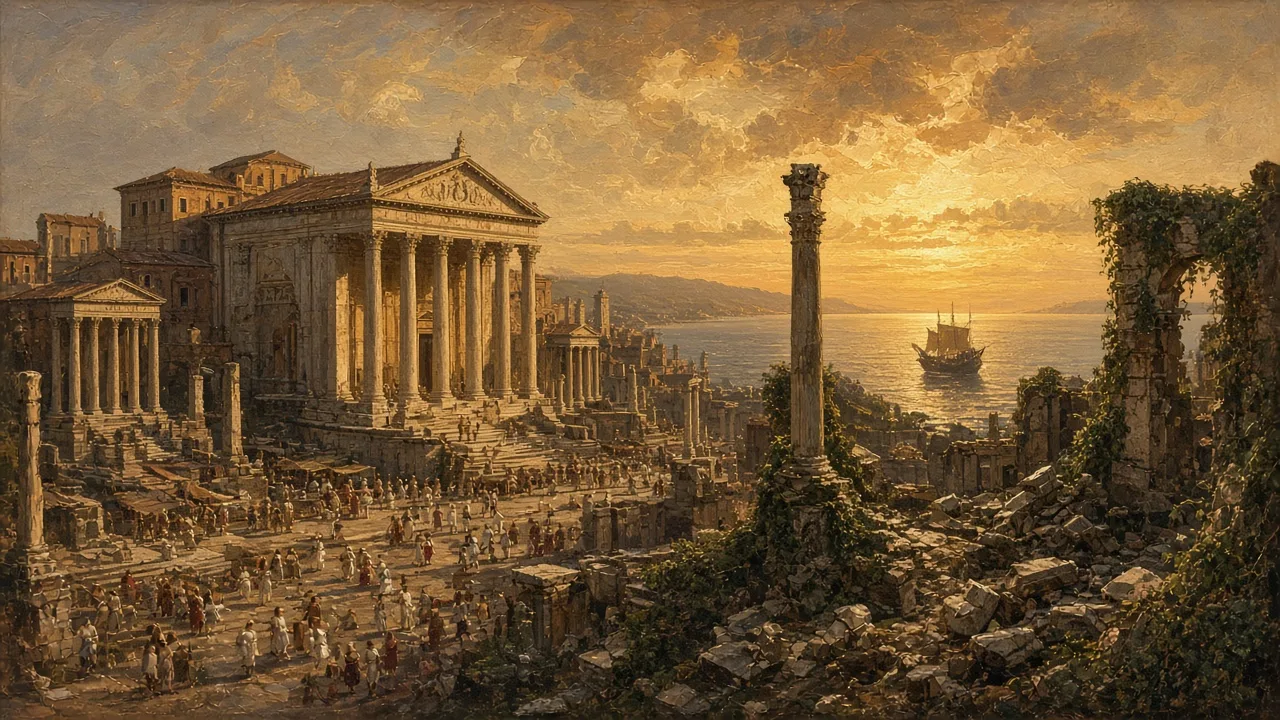
Many of the words you use, the calendar on your phone and even the idea of a written legal code carry traces of ancient Rome. Over roughly a thousand years, a small settlement on the Tiber River in central Italy grew into an empire that stretched from Britain to Egypt and from Spain to Mesopotamia. Then, in the western half of that empire, it fell apart. How Rome rose, why it declined and what its long story still teaches is one of history's great case studies in power, money and overreach. It even has a surprising chapter written on the pepper coasts of South India.
From village to Republic
Roman tradition dated the city's founding to 753 BCE, a date that belongs to legend rather than hard evidence. According to the same tradition, Rome was ruled by kings until about 509 BCE, when the last king was expelled and the Republic was established. Power now rested with elected magistrates, led by two consuls, and the Senate, an assembly of leading citizens.
The Republic was built for war. Rome gradually brought the Italian peninsula under its control and then fought three Punic Wars (264 to 146 BCE) against Carthage, its great rival in North Africa. Victory left Rome the dominant power in the western Mediterranean, and conquests in Greece and the eastern Mediterranean followed. Britannica notes one key to Rome's success: unlike many ancient city-states, it gradually incorporated conquered peoples, eventually extending Roman citizenship to allies and subjects.
From Republic to Empire
Conquest brought wealth, slaves and huge armies loyal to their generals rather than to the state. The last century of the Republic was marked by civil wars between ambitious commanders. Julius Caesar won the most famous of them, made himself dictator and was assassinated in 44 BCE. His adopted heir, Octavian, defeated his rivals and in 27 BCE received the title Augustus. Historians treat that year as the start of the Roman Empire, although Augustus carefully kept the outward forms of the Republic.
What followed was the Pax Romana, a long period of relative peace and prosperity often dated from Augustus to the death of Marcus Aurelius in 180 CE. Under Emperor Trajan, the empire reached its greatest territorial extent in 117 CE. Its population at its peak is uncertain; estimates vary, with many historians suggesting somewhere in the range of 50 to 70 million people or more. Roads, aqueducts, a common currency and Roman law tied this vast area together.
Cracks in the system
From the 3rd century CE, the empire entered a long period of crisis. Between 235 and 284 CE, emperors rose and fell in rapid succession, many of them killed by their own troops. Pressure grew on the frontiers from Germanic peoples in the north and the Sasanian Persian empire in the east. To pay armies, emperors repeatedly reduced the precious-metal content of coins, which fuelled inflation and eroded trust in money.
Emperor Diocletian (reigned 284 to 305) restored order by dividing administration among several co-rulers. Constantine later backed Christianity and founded a new capital, Constantinople, dedicated in 330 CE. After the death of Theodosius I in 395, the empire was permanently divided into eastern and western halves.
The fall of the West
The western empire was poorer, harder to defend and increasingly dependent on non-Roman soldiers. The Visigoths sacked Rome in 410, and the Vandals did so again in 455. In 476, the Germanic commander Odoacer deposed the young western emperor Romulus Augustulus, a date traditionally used to mark the end of the Western Roman Empire.
Historians have long debated why it fell, and most now point to a mix of causes rather than a single one: civil wars and unstable succession, financial strain, military pressure, migrations and the way power and money shifted east. Many also stress that the "fall" was a gradual transformation, as Roman law, Latin and the Church lived on in the new kingdoms of the West. The eastern half, known to historians as the Byzantine Empire, survived for nearly another thousand years until Constantinople fell to the Ottomans in 1453.
Timeline: key moments
- 753 BCE: Traditional (legendary) date for the founding of Rome.
- c. 509 BCE: The Republic is established, according to Roman tradition.
- 264-146 BCE: The Punic Wars against Carthage.
- 44 BCE: Julius Caesar is assassinated.
- 27 BCE: Octavian becomes Augustus, the first emperor.
- 117 CE: The empire reaches its greatest extent under Trajan.
- 330 CE: Constantinople is dedicated as a new capital.
- 395 CE: The empire is permanently divided into East and West.
- 410 CE: The Visigoths sack Rome.
- 476 CE: The last western emperor is deposed.
- 1453: Constantinople falls to the Ottomans.
The India connection
Rome and India were linked by one of the busiest trade routes of the ancient world. Once Rome controlled Egypt from 30 BCE, merchants sailed from Red Sea ports across the Arabian Sea, using the monsoon winds, to reach ports on India's west coast. The most famous was Muziris on the Malabar coast, generally linked with excavations at Pattanam in Kerala, which exported black pepper in large quantities. On the east coast, excavations at Arikamedu near Puducherry have turned up Roman pottery and wine jars. Tamil Sangam poetry also describes foreign "Yavana" ships arriving with gold and leaving with pepper.
Rome's appetite for Indian pepper, spices, textiles and gems was so large that Pliny the Elder complained about the outflow of money to India, estimating it at 50 million sesterces a year. Scholars caution that Pliny's figure was rhetorical and not a full balance-of-trade calculation, but large hoards of Roman gold and silver coins found in South India confirm that the trade was real and substantial.
Why it matters today
- Overreach is expensive. Defending very long frontiers strained Rome's finances and manpower, a lesson every large power still faces.
- Money needs trust. Repeated coin debasement in the 3rd century shows how quickly inflation can follow when governments print, or dilute, their way out of trouble.
- Institutions matter. Unclear rules for succession made coups and civil wars routine, weakening the state from within.
- Globalisation is ancient. The Indian Ocean trade that linked Kerala's pepper to Roman dinner tables was an early version of today's global supply chains.
- Legacies outlast empires. Latin-based languages, legal ideas, the 12-month calendar and architectural styles still shape the modern world.
Frequently asked questions
When did the Roman Empire begin and end?
The Roman Empire is usually dated from 27 BCE, when Octavian became Augustus. The Western Empire is traditionally said to have ended in 476 CE, while the Eastern (Byzantine) Empire lasted until 1453.
What was the main reason the Roman Empire fell?
There was no single cause. Historians point to a combination of civil wars, unstable leadership, financial strain, military pressure on the frontiers and the shift of wealth and power to the East.
Did Rome trade with India?
Yes. From the 1st century BCE, Roman-era merchants traded with Indian ports such as Muziris, buying pepper, spices, textiles and gems. Roman coin hoards and pottery found in South India are evidence of this trade.