This is Part 3 of England's Royal Dynasties, our daily series on the kings and queens of England and Britain, from the Anglo-Saxon kingdoms to King Charles III.
In Part 2 we saw Egbert of Wessex break Mercia's grip on southern England, just as Viking raiders began to hit the coasts. His grandson inherited the consequences. Alfred (r. 871–899) came to the throne in the middle of a war he looked likely to lose, spent a winter hiding in the Somerset marshes, and ended his life as the only English monarch commonly called "the Great".
How do we know about Alfred?
Alfred is far better documented than Offa or Egbert, but almost everything comes from his own court. The Anglo-Saxon Chronicle, a year-by-year record in Old English, was first compiled in Wessex in the early 890s, probably with royal encouragement. Asser, a Welsh churchman from St David's, wrote a Latin Life of King Alfred in 893, while the king was still alive. Both are invaluable, and both are friendly accounts.
The youngest son
Alfred was born in 848 or 849 at Wantage (then in Berkshire, now Oxfordshire), the youngest son of King Æthelwulf of Wessex and his wife Osburh. With four older brothers, nobody expected him to rule. As a small boy he was taken to Rome, where, says the Chronicle, Pope Leo IV "hallowed him as king"; a papal letter suggests he was really given the honorary rank of a Roman consul. Asser's story that he won a book of English poems from his mother by learning it first was written to show a scholar-king in the making.
Wessex did not pass simply from father to eldest son; the most capable adult of the royal family usually ruled. Æthelbald, Æthelberht and Æthelred held the throne in turn between 856 and 871, and each died young.
The Great Heathen Army
The raids of Egbert's day became something different in 865, when a large Viking force landed in East Anglia. The Chronicle calls it the micel here, the "great army"; modern writers often call it the Great Heathen Army.
Within five years the army had shattered the old kingdoms described in Part 1. It took York in 866 and killed two rival Northumbrian kings in 867. In 869 it killed King Edmund of East Anglia, soon venerated as a martyr at Bury St Edmunds. In 874 Mercia lost its king.
In late 870 the army turned on Wessex. Early 871 brought a run of battles, among them Ashdown on the Berkshire Downs, where, according to Asser, Alfred led the attack "like a wild boar" while King Æthelred was still at Mass. Shortly after Easter Æthelred died, and Alfred, aged about 22, became king, passing over Æthelred's young sons. Within a month he was beaten at Wilton and paid the Vikings to leave.
878: the marshes and Edington
The pause did not last. From 875 a force under Guthrum pressed Wessex again, and in January 878, over Twelfth Night, it made a surprise winter attack on the royal estate at Chippenham in Wiltshire. Many West Saxons submitted. Alfred, says the Chronicle, went "with a small force" into the woods and fens and built a stronghold at Athelney, a low island in the marshes of the Somerset Levels.
This is where the most famous story about Alfred is set: sheltering in a herdsman's hut, the king forgets the loaves he was told to watch, and is scolded when they burn. There is no contemporary evidence for it. The tale first appears in a Life of St Neot written a century or more after his death.
What the sources do record is a remarkable recovery. In May 878 Alfred rode to "Egbert's Stone", east of Selwood Forest, where the men of Somerset, Wiltshire and part of Hampshire met him, and Asser says they greeted him "as one risen from the dead". Days later he defeated Guthrum at Edington (Ethandun) in Wiltshire and besieged his army until it surrendered. Guthrum agreed to be baptised, with Alfred as his godfather, taking the Christian name Æthelstan. The ceremony was at Aller and the celebrations at Wedmore, hence the "Treaty of Wedmore" of older books, though no treaty text from 878 survives.
Guthrum's army withdrew to East Anglia and settled there. A short treaty between "King Alfred and King Guthrum", probably from the 880s, does survive. It fixes a boundary running up the Thames, the River Lea and the Ouse and along the old Roman road Watling Street. The lands north and east of it later came to be called the Danelaw, where Scandinavian custom shaped law and place names ending in -by and -thorpe.
Burhs, a rotating army and ships
Alfred's lasting military achievement was to make Wessex hard to surprise again. He built a network of fortified towns called burhs, the origin of the English word "borough". A document known as the Burghal Hidage lists about thirty of them, from Hastings and Southwark to Exeter and Winchester, and sets out how many men each needed: one man per hide of land, four men for every pole (about 5 metres) of wall. Few places in Wessex were more than about 20 miles, a day's march, from a refuge. Some, such as Wallingford and Wareham, still show their planned street grids and earth ramparts.
The Chronicle also says Alfred divided his army so that half the men were in the field while the other half stayed at home, which made long campaigns possible. In 896 he ordered new warships, "almost twice as long" as the Danish ones, some with 60 oars or more, built to his own design. The Victorian title "father of the Royal Navy" claims far more than the evidence supports.
London and "the English"
In 886, the Chronicle reports, Alfred "occupied London" (or "restored" it, depending on the translation), and "all the English people that were not under subjection to the Danes submitted to him". He handed the city to Æthelred, Lord of the Mercians, who married Alfred's daughter Æthelflæd. The trading settlement of Lundenwic, around today's Covent Garden, gave way to a new town inside the old Roman walls.
Alfred's charters from the 880s style him "king of the Anglo-Saxons" (Angulsaxonum rex), and the royal family's website notes that by the 890s his coins and charters called him king of the English. This was a new idea: one king for all English people who were not under Danish rule, West Saxon and Mercian alike. Alfred never ruled all of England, but he made the idea thinkable.
The last test came in 892, when two Viking armies, one led by Hæsten, crossed from the Continent. Edward and Æthelred fought them at Farnham, Benfleet and Buttington, and Alfred blocked the River Lea to trap their ships above London. In 896 the armies broke up. The system had worked.
Laws and learning
Around the 890s Alfred issued a law code, the domboc ("book of judgements"). It opens with biblical law, then sets his decrees alongside the older laws of King Ine of Wessex. Alfred says he chose the laws of his predecessors that he liked, rejected others "with the advice of my councillors", and dared not add many of his own.
Learning mattered to him almost as much as defence. In his preface to a translation of Pope Gregory's Pastoral Care, Alfred complains that learning had decayed so badly that very few men south of the Humber could understand their church services or translate a letter from Latin into English. He gathered scholars from Mercia, Wales and the Continent, among them Asser and Plegmund, whom he made Archbishop of Canterbury, and proposed that free-born young men should learn to read English.
The Pastoral Care translation is almost certainly his; versions of Boethius, Augustine and the first fifty Psalms are traditionally credited to him too. How much he wrote himself is debated; some scholars now picture a royal workshop rather than a lone author-king.
Alfred also sent alms abroad. The Chronicle for 883 says two envoys, Sighelm and Æthelstan, took his gifts to Rome "and also to India, to St Thomas and St Bartholomew". The apostle Thomas was believed to be buried at Mylapore in today's Chennai. Whether the envoys really reached India is uncertain, and some historians suspect a scribe's confusion, but it is a striking early English mention of India.
Family and death
Asser describes a painful illness that struck Alfred at his wedding feast in 868 and never fully left him; modern guesses such as Crohn's disease are speculation.
He married Ealhswith, from a Mercian noble family, in 868. Their children included Æthelflæd and the future King Edward the Elder.
Alfred died on 26 October 899, aged about 50, and was buried at Winchester. His remains were later moved to Hyde Abbey, destroyed after the Dissolution of the Monasteries. In 2014 the University of Winchester reported that a fragment of pelvis from Hyde Abbey, radiocarbon-dated to 895–1017, probably belonged to either Alfred or Edward the Elder.
Places to visit
- Winchester: the City Museum, the marked-out plan of the Old Minster beside the cathedral, and Hyde Abbey Gardens.
- Athelney and the Somerset Levels: a monument of 1801 stands on the low island of Alfred's refuge.
- The Alfred Jewel, Ashmolean Museum, Oxford: gold, enamel and rock crystal, ploughed up near Athelney in 1693, with the inscription "Alfred ordered me to be made". It was probably the handle of a reading pointer.
- King Alfred's Tower, Stourhead: an 18th-century folly on the hill traditionally linked with Egbert's Stone.
How he is remembered: legend vs evidence
Alfred's reputation began with his own propaganda and kept growing. Medieval writers added the cakes and a story that Alfred visited the Viking camp disguised as a minstrel; there is no evidence for either. Oxford's University College once claimed him as its founder. The title "the Great" seems to have become common only from around the 16th century.
In the 18th century Alfred became a patriotic symbol. "Rule, Britannia!" was first performed in 1740 in a masque called Alfred. The Victorians made him the model English king, a founder of navy, law, schools and liberty, and in 1901 a bronze statue by Hamo Thornycroft was unveiled in Winchester to mark what was then thought to be the thousandth anniversary of his death. The TV series The Last Kingdom keeps the story popular, with plenty of fiction.
The evidence supports something more modest but still impressive: a king who survived near-defeat, built a defensive system that held, gave Wessex a vision of one English people, and promoted learning in English. He did not unite England; his children and grandchildren did that. But he made the kingdom they built possible.
At a glance
| Reign | King of Wessex 871–899; from the 880s styled "king of the Anglo-Saxons" |
| House | House of Wessex |
| Predecessor | His brother Æthelred I |
| Successor | His son Edward the Elder |
| Key dates | 865 Great Heathen Army lands; 871 Ashdown and accession; 878 Chippenham, Athelney, Edington; 886 London; 892–896 last Viking wars; 899 death |
| Legacy | Burhs, the law code, translations into English, the idea of a single English kingdom |
| Next | Edward the Elder, Æthelflæd and Athelstan |
Next in the series
Alfred left a strong Wessex, not a united England. In Part 4 we follow his son Edward the Elder, his daughter Æthelflæd, Lady of the Mercians, who fortified towns and led armies, and his grandson Athelstan, who in 927 became the first king to rule all of England. Until then, browse more on the Anglo-Saxons and medieval history.
Sources
- The Royal Family, Alfred 'The Great' (r. 871–899)
- The Anglo-Saxon Chronicle, ninth-century entries, Avalon Project, Yale Law School
- Asser, Life of King Alfred (extracts), Fordham University Internet Medieval Sourcebook
- Ashmolean Museum, Oxford, The Alfred Jewel
- BBC History, Alfred the Great
- BBC News (2014), Bone fragment 'could be King Alfred or son Edward'
- Current Archaeology (2014), Remains of King Alfred or his son found in Winchester?
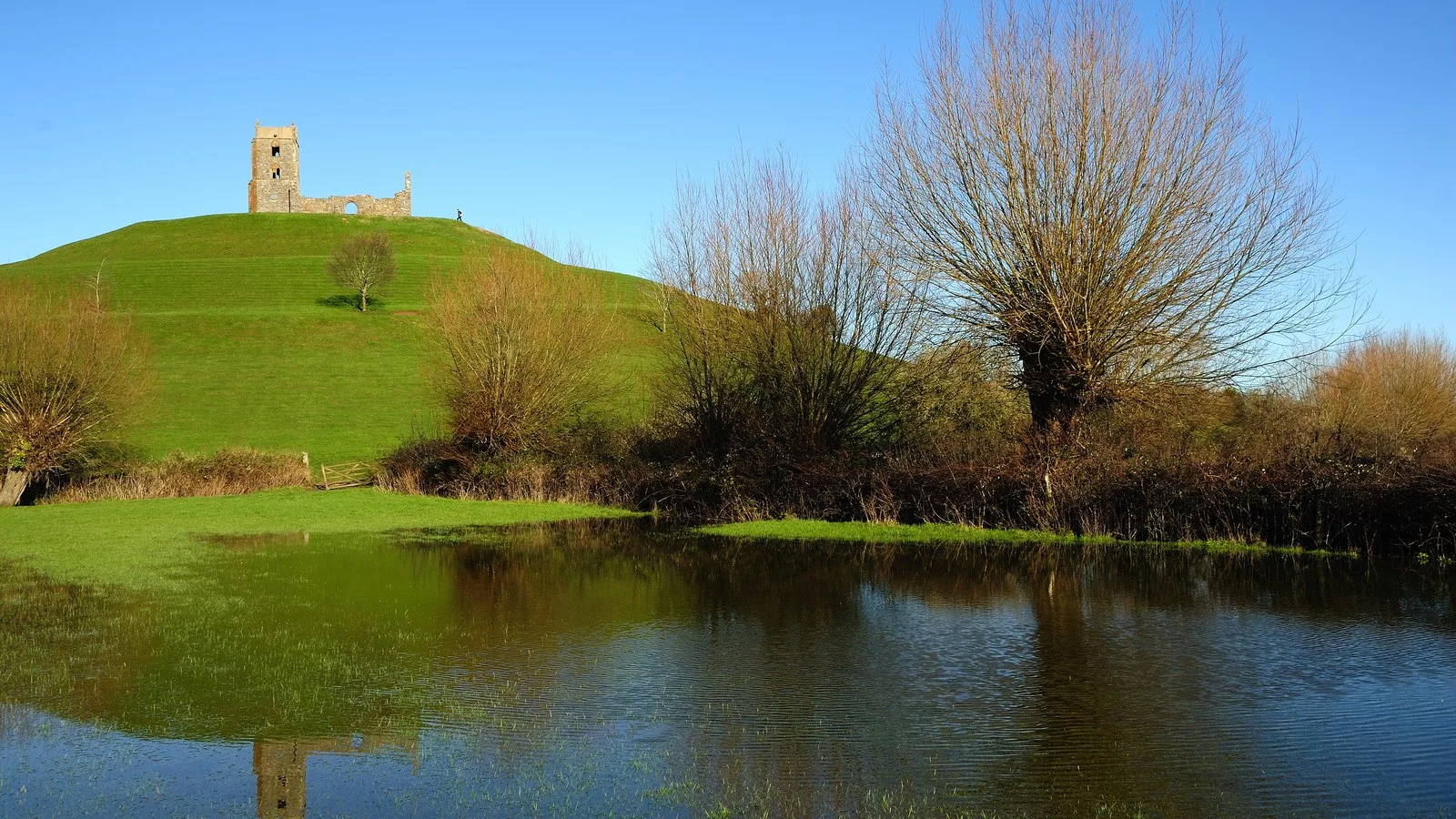
Featured image: Burrow Mump and the ruined St Michael's Church above the flooded Somerset Levels, a few miles from Athelney. Photo by Saffron Blaze, Wikimedia Commons, CC BY-SA 3.0.