This is Part 2 of England's Royal Dynasties, our daily series on the kings and queens of England and Britain, from the Anglo-Saxon kingdoms to King Charles III.
In Part 1 we watched Roman Britain dissolve into rival Anglo-Saxon kingdoms. By the eighth century two of them were pulling ahead: Mercia, in the Midlands, and Wessex, in the south and west. This part follows the Mercian kings who came closest to ruling all the southern English, above all Offa (757–796), and the West Saxon king who broke their power, Egbert (802–839), grandfather of Alfred the Great.
No contemporary biography of either man survives. We rely on charters (royal land grants), coins, letters, earthworks and the Anglo-Saxon Chronicle, compiled in Alfred's Wessex and naturally flattering to the West Saxons.
Mercia on top: Æthelbald
Mercia's rise began before Offa. Æthelbald ruled from 716 to 757, and Bede noted in 731 that every kingdom south of the Humber was subject to him. In 757 he was murdered by his own bodyguard at Seckington, near the Mercian royal centre of Tamworth, and buried at Repton. A rival, Beornred, seized the throne, but within months he was driven out by Offa, a distant cousin who traced his descent from the family of Penda, the warlord we met in Part 1.
Offa: building a supremacy
Charters show Offa tightening his grip step by step. Smaller peoples such as the Hwicce of the Worcester region lost their kings, whose heirs appear as mere ealdormen (royal governors). Sussex and Kent came under Mercian lordship; Kent rebelled, and there is no sign of an independent Kentish king from the mid-780s until Offa's death. Wessex was handled through marriage: in 789 Offa's daughter Eadburh married the West Saxon king Beorhtric, and another daughter married King Æthelred of Northumbria.
The most notorious episode came in 794, when, the Chronicle states bluntly, Offa had Æthelberht, king of East Anglia, beheaded. Later legend claimed the young king had come to marry Offa's daughter and that Queen Cynethryth plotted his death; Æthelberht became a saint, and Hereford Cathedral is dedicated to him. These details come from much later saints' lives.
A puzzling document called the Tribal Hidage lists 35 peoples south of the Humber, each assessed in "hides" (a unit of land supporting one household): Mercia at 30,000, Wessex at 100,000. It may be a tribute list for a Mercian overlord, but its date and purpose are debated.
Offa's Dyke: frontier, statement or both?
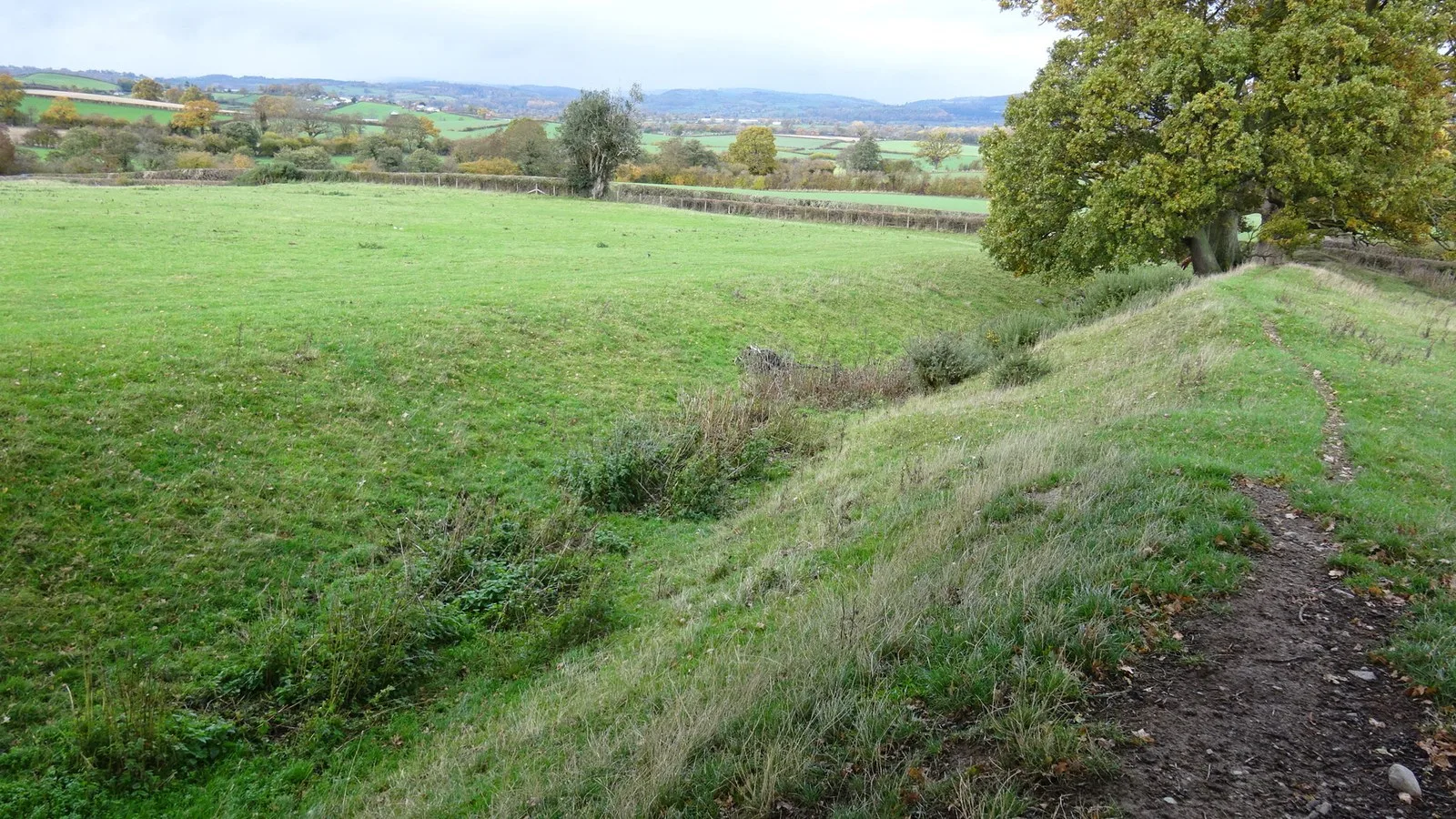
Offa's best-known legacy is the earthwork that bears his name: a bank with a ditch on its western side through the borderlands of England and Wales. The key written evidence is Alfred's biographer Asser, writing about a century later, who says Offa had a great dyke built between Wales and Mercia from sea to sea. Today's Offa's Dyke Path runs 177 miles (285 km) from near Chepstow to Prestatyn.
Almost everything else is debated:
- Purpose: defensive barrier, agreed boundary, a way to control raiding and trade, or a vast statement of Mercian power. Many scholars think it was several of these at once.
- Extent: it is far from continuous today; gaps may once have been closed by rivers or forest, or never built.
- Date: in 2014 the Clwyd-Powys Archaeological Trust reported radiocarbon dates of 430–652 from turf beneath the bank at Chirk, suggesting at least that stretch may predate Offa. Later work has not settled it; Offa may have consolidated older earthworks into one great line.
Coins, a queen and an archbishop
Offa's reign transformed English money. The small, thick silver coins of earlier generations gave way to a broad, thin silver penny modelled on the new Frankish coinage, carrying the king's name and the moneyer's. Kentish kings may have pioneered it, but under Offa the penny became the standard coin of southern England for some 500 years.
Some coins carry Roman-style portraits. Others bear the name of his queen, Cynethryth: the British Museum describes them as the only English coins struck for a queen consort, probably because Offa was copying Roman emperors who had done the same. The museum also holds a gold coin copying an Abbasid dinar of the 770s, Arabic inscription and all, with the words OFFA REX added.
In the Church, Offa disliked having Mercian bishops answer to the Archbishop of Canterbury in Kent. He persuaded the pope to create a third English archbishopric at Lichfield, and in 787 Hygeberht became its archbishop. The same council saw Offa's son Ecgfrith consecrated as king alongside his father, the first recorded royal consecration in England. Offa was planning a dynasty.
Offa and Charlemagne
Around 790, according to a Frankish monastic chronicle, Charlemagne proposed that his son marry one of Offa's daughters; Offa demanded that Ecgfrith marry Charlemagne's daughter too, and the angry Frankish king briefly closed his ports to English merchants. By 796 relations were warm again. A surviving letter from Charlemagne calls Offa his "dearest brother", promises protection to English pilgrims and traders, asks merchants to pay the customary tolls, and sends gifts including a sword and silk cloaks.
"King of the English"?
Some charters call Offa rex Anglorum, "king of the English", and the royal family's website still says he was the first ruler so called. Modern historians are cautious: the grandest titles mostly appear in charters that survive only in later copies, some suspected of being improved or forged, while his coins and most reliable charters call him king of the Mercians. He was overlord of the south, not king of a united England.
After Offa: Coenwulf
Offa died in July 796; Ecgfrith survived him by only about five months. Alcuin, the Northumbrian scholar at Charlemagne's court, suggested in a letter that the blood Offa had shed to secure his son's throne had brought ruin instead.
A distant kinsman, Coenwulf (796–821), took over and crushed a Kentish revolt in 798; its leader, Eadberht Præn, was blinded and mutilated, says the Chronicle. But in 803 Coenwulf let the Lichfield archbishopric lapse, restoring Canterbury's authority with papal approval. After his death Mercia slid into succession disputes.
Egbert: the exile returns
Egbert (Old English Ecgberht) was probably the son of Ealhmund, briefly a king in Kent, and his family claimed West Saxon royal descent, which made him a threat to Beorhtric and Offa. The Chronicle says the two drove him into exile in Francia; the story that he spent it at Charlemagne's court learning statecraft comes from the twelfth-century writer William of Malmesbury and cannot be verified.
When Beorhtric died in 802, Egbert returned and took the throne. On the day of his accession, says the Chronicle, a Mercian-backed force crossed the Thames at Kempsford and was beaten by the men of Wiltshire.
Ellendun, 825: the turning point
In 825 the Mercian king Beornwulf attacked and was defeated by Egbert at Ellendun, today Wroughton near Swindon. The historian Frank Stenton counted it among the most decisive battles in English history. Egbert's son Æthelwulf marched into Kent, and Kent, Surrey, Sussex and Essex submitted to Wessex; the East Angles rose and killed Beornwulf.
In 829 Egbert conquered Mercia itself, drove out King Wiglaf and minted coins in London as king of the Mercians. The Northumbrians met him at Dore, near Sheffield, and submitted. (In this stretch the Chronicle's dates run about two years early; it puts these events in 823 and 827.)
"The eighth bretwalda"
At this point the Chronicle calls Egbert the eighth bretwalda, after seven earlier overlords from Ælle of Sussex to Oswiu of Northumbria. The oldest manuscript reads bretwalda, others brytenwealda: probably "ruler of Britain" or "wide ruler". Whether it was ever a real office is debated; most historians see an honorific, and the list is selective, leaving out the Mercian overlords Penda, Æthelbald and Offa. Written in Alfred's Wessex, it makes Egbert heir to a line of great kings and Mercia a footnote.
Mercia lost again, and the Vikings arrive
In 830 Wiglaf recovered Mercia, which stayed independent for another generation, though Wessex kept the south-east, with Æthelwulf as sub-king of Kent.
Meanwhile, Scandinavian raiders had killed a royal reeve at Portland in Dorset under Beorhtric, and in 793 they sacked the monastery of Lindisfarne, usually dated 8 June. In the 830s raids hit Kent and the south coast, and Egbert was beaten by the crews of 35 ships at Carhampton in Somerset. In 838 he won his last victory at Hingston Down in Cornwall over Danes and Cornish Britons. He died in 839 and, by tradition, was buried at Winchester.
Places to visit
- Offa's Dyke: walk sections near Knighton, home of the Offa's Dyke Centre, or near Chirk and Clun.
- All Saints, Brixworth (Northamptonshire): one of the largest surviving Anglo-Saxon churches, built partly with reused Roman brick.
- St Wystan's, Repton (Derbyshire): a crypt linked to Mercian royal burials, including Æthelbald's.
- Lichfield Cathedral: seat of Offa's short-lived archbishopric; the carved "Lichfield Angel" of about 800 is displayed there.
- Winchester Cathedral: mortuary chests bear the names of Egbert and other early kings, though the bones were mixed long ago.
- The Staffordshire Hoard (Birmingham and Stoke-on-Trent): Mercian gold found near Lichfield in 2009, but buried around 650–675, a century before Offa.
- The British Museum, London: pennies of Offa and Cynethryth and Offa's Arabic-inscribed gold coin.
How they are remembered: legend vs evidence
Offa suffered from being a Mercian in a story written by West Saxons. For centuries he was remembered mainly for his Dyke and for monkish legends, such as Æthelberht's murder and the claim that he founded St Albans Abbey in penance. Modern scholarship, using coins and charters, sees an innovator in kingship, money and diplomacy.
Egbert had the opposite fortune. From medieval chroniclers to Tudor writers and Victorian schoolbooks, he was often hailed as the "first king of England", with 827 offered as the kingdom's birth date. The evidence does not support that: he held Mercia for barely a year, never ruled Northumbria directly and never called himself king of England. A single English kingdom came only in the tenth century, under his descendants. His real achievement was to make Wessex the strongest kingdom and found a line that endured; through Alfred, and later Henry I's queen Matilda, today's royal family descends from him.
At a glance
| Offa | King of Mercia 757–796; predecessor Æthelbald (after Beornred's brief rule); successor Ecgfrith |
| Egbert | King of Wessex 802–839; predecessor Beorhtric; successor his son Æthelwulf |
| Houses | Mercian royal line (Offa); House of Wessex (Egbert) |
| Key dates | 787 Lichfield archbishopric; 793 Lindisfarne raid; 796 Offa dies; 825 Ellendun; 829 Egbert conquers Mercia; 830 Mercia lost; 838 Hingston Down; 839 Egbert dies |
| Legacy | Offa's Dyke, the silver penny; Wessex's rise and Alfred's line |
| Next | Alfred the Great |
Next in the series
Egbert's grandson inherited a kingdom under siege. In Part 3 we meet Alfred the Great: the Viking Great Army, the retreat to the Somerset marshes, the fortified burhs and the first idea of a single "England". Until then, explore more on the Anglo-Saxons, or see the empire Offa's coins imitated in the rise and fall of the Roman Empire.
Sources
- The Royal Family, Offa (r. 757–796)
- The Royal Family, Egbert, King of Wessex (r. 802–839)
- The Anglo-Saxon Chronicle, eighth-century entries, Avalon Project, Yale Law School
- The Anglo-Saxon Chronicle, ninth-century entries, Avalon Project, Yale Law School
- Charlemagne, Letter to Offa, king of Mercia (796), Fordham University Internet Medieval Sourcebook
- The British Museum (BM Images), Silver coin of Cynethryth, wife of Offa of Mercia
- BBC News (2014), Offa's Dyke evidence at Chirk suggests earlier build
- Birmingham Museums, The discovery of the Staffordshire Hoard
Featured image: Offa's Dyke near Montgomery, Shropshire. Photo by Rosser1954, Wikimedia Commons, CC BY-SA 4.0.