This is Part 3 of HorizonDesk's chronological series on Indian history, from the Stone Age to Independence in 1947.
In Part 2 of this series, we watched the first farmers of Mehrgarh build mud-brick villages, grow barley and herd humped zebu cattle. Over the following millennia, those village traditions grew into something far larger. By about 2600 BCE, the plains of the Indus and its neighbouring rivers held planned cities with straight streets, covered drains, standard bricks and weights, and a script that nobody has yet been able to read.
This is the Harappan, or Indus Valley, Civilisation. Along with Mesopotamia and Egypt, it is one of the world's three earliest urban civilisations, and it covered more ground than either. Its decline gets a part of its own next time.
A civilisation found by accident
For centuries the Indus cities were forgotten. In the 1850s, contractors building the Lahore–Multan railway carted away bricks from the mounds at Harappa as track ballast. Alexander Cunningham, the first head of the Archaeological Survey of India (ASI), published an unusual stamp seal from the site in 1875, but no one realised how old it was.
That changed in the early 1920s. In 1921, Daya Ram Sahni of the ASI began excavating at Harappa. In 1922, R. D. Banerji, investigating a Buddhist stupa on a mound near the Indus in Sindh, found much older remains beneath it at Mohenjo-daro, about 600 km to the south-west. ASI Director-General Sir John Marshall saw that the seals, pottery and bricks from the two sites matched. On 20 September 1924, he announced in the Illustrated London News that a previously unknown Bronze Age civilisation had been found.
After Partition in 1947, both cities lay in Pakistan, and Indian archaeologists went on to find hundreds of sites in Gujarat, Rajasthan, Haryana and Punjab. UNESCO counts more than 1,000 Harappan sites, from Sutkagen Dor near the Iran border to the upper Yamuna and the Gulf of Khambhat.
Some Indian scholars prefer the name "Sindhu-Sarasvati Civilisation", because many sites lie along the dried-up Ghaggar-Hakra river, which they identify with the Rigveda's Sarasvati. That identification is debated.
How old? Early, Mature and Late
Dates for the Harappan world are usually divided into three broad phases, though the exact boundaries vary by region and author:
- Early Harappan (roughly 3300–2600 BCE): regional farming towns such as those of the Ravi and Kot Diji phases begin to share pottery styles, early signs and craft techniques.
- Mature Harappan (roughly 2600–1900 BCE): the great cities flourish, with standardised bricks, weights, seals and script across a vast area. This is the phase most people mean by "the Indus civilisation".
- Late Harappan (roughly 1900–1300 BCE): the big cities shrink or are abandoned, and the culture breaks up into regional traditions.
Claims of much earlier beginnings at some Indian sites remain provisional.
The great sites
- Harappa (Punjab, Pakistan): the type site. Excavations since 1986 by the Harappa Archaeological Research Project, led by Richard Meadow and Jonathan Mark Kenoyer, have traced its growth from village to city.
- Mohenjo-daro (Sindh, Pakistan): the best-preserved Indus city and a UNESCO World Heritage Site since 1980. Its population at its peak has been estimated at around 35,000–40,000, though such figures are educated guesses.
- Dholavira (Kutch, Gujarat): discovered in 1968 and excavated by the ASI under R. S. Bisht between 1989 and 2005. It was inscribed as a UNESCO World Heritage Site in July 2021, becoming India's 40th. Built largely of stone on the arid island of Khadir, it is famous for its reservoirs for storing scarce water and a ten-sign inscription, the "signboard", found near its northern gateway.
- Lothal (Gujarat): excavated by S. R. Rao in the 1950s. It has a large brick basin that Rao interpreted as a dockyard. Critics argued it was a water reservoir, but a 2024 study from IIT Gandhinagar, using satellite data and old river channels, linked Lothal to a former course of the Sabarmati and supported the dockyard reading.
- Kalibangan (Rajasthan): on the Ghaggar, excavated by B. B. Lal and B. K. Thapar in the 1960s. It preserved an Early Harappan ploughed field with criss-cross furrows, and what the excavators described as fire altars.
- Rakhigarhi (Haryana): a cluster of mounds that, by some estimates, makes it the largest known Harappan site, at around 350 hectares. Area figures vary with how many mounds are counted.
- Ganweriwala (Cholistan, Pakistan): a large, barely excavated site between Harappa and Mohenjo-daro, possibly another major centre.
Planned cities and serious plumbing
What strikes visitors most is the planning. Main streets at Mohenjo-daro run roughly north–south and east–west, dividing the city into blocks. Houses were built of fired or mud bricks in a consistent proportion of about 1:2:4 for thickness, width and length, a standard used across hundreds of kilometres.
Many houses had a private bathing area and a toilet. Wastewater ran from them into brick drains along the streets, which were covered with bricks or stone slabs and had inspection points where they could be cleaned. Water came from wells; Mohenjo-daro alone has hundreds, many inside houses. Few ancient cities anywhere gave ordinary households this level of sanitation.
Many cities had a raised western mound, which early archaeologists called the "citadel", and a larger lower town.
The Great Bath and the "granary" debate
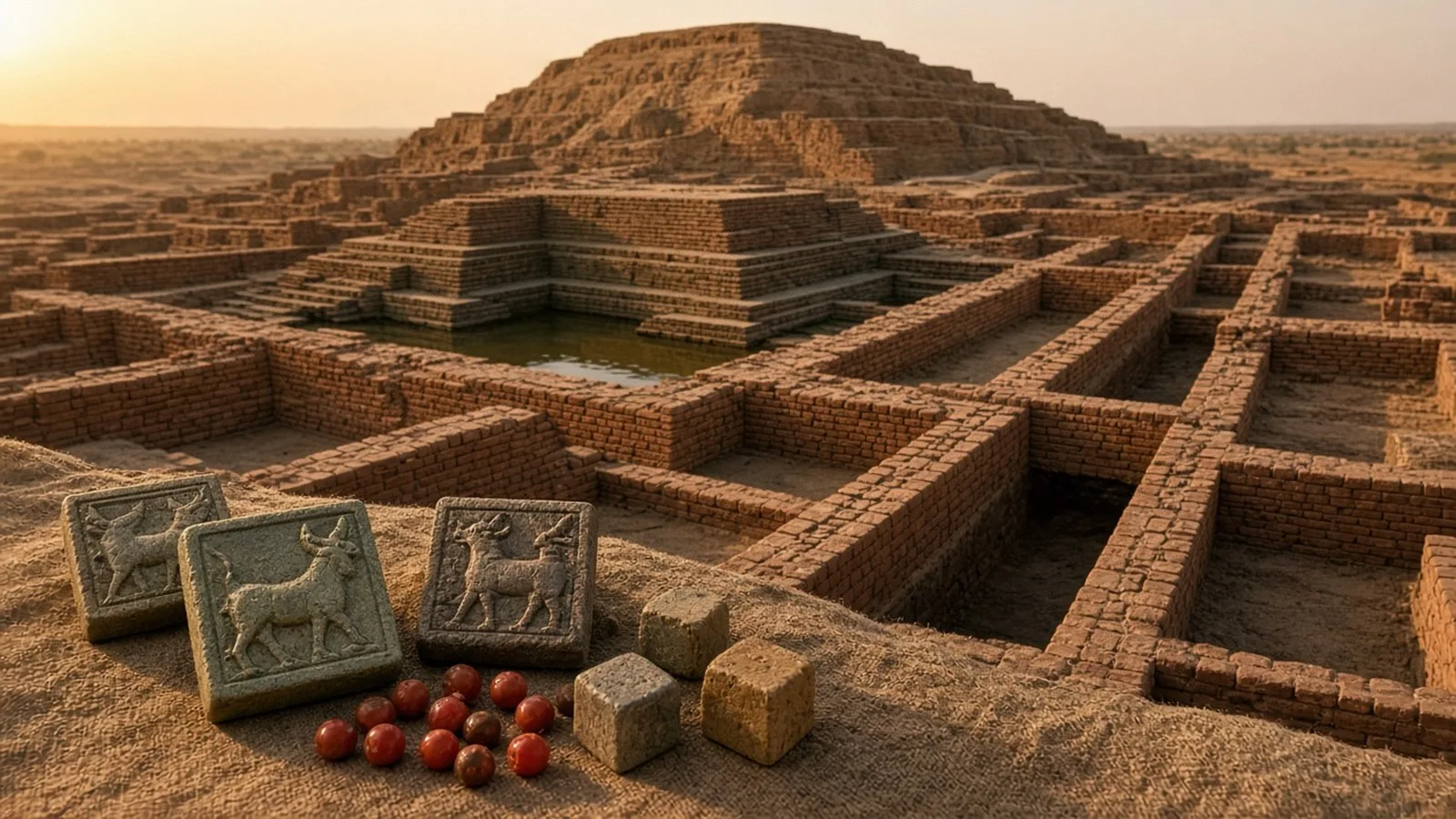
On the citadel mound at Mohenjo-daro sits the Great Bath, which Kenoyer describes as the earliest known public water tank in the ancient world. The pool measures about 12 m by 7 m and is up to 2.4 m deep. Staircases lead down at each end. Its builders made it watertight with tightly fitted bricks set on edge in gypsum plaster, backed by a thick layer of bitumen (natural tar). A nearby room contains a well that may have helped fill it. Most scholars think it served ritual bathing and purification, but no text confirms this.
Next to it stands a massive brick foundation that Sir Mortimer Wheeler identified around 1950 as a "Great Granary", a label also applied to a building at Harappa. Later research has been sceptical. Kenoyer points out that no charred grain, storage jars or sealed bundles have been found there, and suggests calling the Mohenjo-daro building a "Great Hall" of uncertain use. At Harappa, renewed excavations found no evidence that the so-called granary stored grain. Some scholars still defend a storage role, so the question remains open.
Seals, beads and bronze
Harappan craftspeople were among the most skilled of the Bronze Age. Their best-known objects are small square stamp seals, usually carved from steatite (soapstone) and fired. Most show an animal, most often a one-horned bull called the "unicorn", with a short line of script above. They were probably pressed into clay to seal goods, marking ownership or authority.
Workers drilled long carnelian beads with special stone drills and made faience, shell bangles and gold jewellery. Metalworkers cast copper and bronze, including the "Dancing Girl" from Mohenjo-daro, now in New Delhi's National Museum. The steatite bust nicknamed the "Priest-King" is in Karachi; the name is a modern guess. Farmers grew wheat, barley, pulses and early cotton.
Weights that matched across a vast region
Trade inside the civilisation relied on a standard set of weights. These were usually small cubes of chert, polished and carefully graded. According to Kenoyer, the smaller weights double in a sequence of 1, 2, 4, 8, 16, 32 and 64, and the most common, the 16 unit, weighs about 13.7 grams. Above that the system switches to decimal steps such as 160, 200, 320 and 640. The same standard appears across the Harappan world, a sign of shared rules over a very large area.
Meluhha: trade with Mesopotamia
The Harappans traded well beyond the Indus. Cuneiform texts from Mesopotamia, in present-day Iraq, mention a land called Meluhha, which most scholars identify with the Indus region. Sargon of Akkad, who ruled around the 24th–23rd centuries BCE, boasted that ships from Meluhha, Magan (Oman) and Dilmun (Bahrain) moored at the quay of his capital. Mesopotamian texts list goods from Meluhha such as carnelian, ivory, fine woods and gold. A cylinder seal now in the Louvre belonged to a man named Shu-ilishu, described as an interpreter of the Meluhhan language.
The archaeology fits: Indus seals, etched carnelian beads and cubic weights have been found in Mesopotamia and around the Persian Gulf. Seafaring in the Bronze Age was busy: around the same time, a merchant ship sank off the Turkish coast in what is now considered the world's oldest known shipwreck. The Indus cities were also contemporary with Old Kingdom Egypt, whose rulers were building the pyramids of Giza around 2600–2500 BCE.
An undeciphered script
The Indus script appears on seals, tablets, pottery and a few larger objects. Iravatham Mahadevan's 1977 concordance, published by the ASI, listed 417 signs. Other researchers count anywhere from about 400 to more than 600, depending on how they treat variants. The texts are frustratingly short: the average is about five signs, and the longest known texts have only 26. Most scholars agree it was usually written from right to left.
Without a bilingual inscription like Egypt's Rosetta Stone, no decipherment has won general acceptance. Asko Parpola and Mahadevan argued for an early Dravidian language; others propose Indo-Aryan, Munda or a lost language. In 2004, Steve Farmer, Richard Sproat and Michael Witzel argued that the signs did not encode language at all, while a 2009 statistical study in Science by Rajesh Rao and colleagues found patterns typical of language. The debate continues.
Gods, rituals and the "Pashupati" seal
Without readable texts, Harappan religion has to be inferred from objects. One Mohenjo-daro seal shows a horned figure seated in what looks like a yogic posture, surrounded by animals. Marshall called it a "proto-Shiva", linking it to Shiva as Pashupati, lord of animals. Many scholars disagree: the art historian Doris Srinivasan argued it may be a bull-man deity, and Harappa.com notes such figures are rare and their meaning unproven. Female figurines, pipal-leaf motifs, the Great Bath and fire altars point to ritual life, but their links to later Indian religion are still argued over.
Who were the Harappans? The Rakhigarhi genome
In 2019, a team led by Vasant Shinde of Deccan College and the geneticist David Reich of Harvard published in Cell the first ancient genome from the Indus civilisation. It came from a woman buried at Rakhigarhi between about 2800 and 2300 BCE. The authors modelled her ancestry as mostly from a lineage related to ancient Iranians, separate from the plateau's early farmers, mixed with ancestry linked to South and Southeast Asian hunter-gatherers. She showed little or no ancestry from Steppe pastoralists, which is common in South Asia today.
The study rests on one individual and partial DNA. Its implications for later migrations and languages are widely debated, and more ancient DNA will be needed for firm conclusions.
Cities without kings?
Perhaps the biggest mystery is politics. Mesopotamia and Egypt left palaces, royal tombs and inscriptions praising kings. The Harappan cities have produced no clear palaces, no lavish royal burials and no images of rulers in battle, although differences in house size and craft goods show that some people had more wealth than others.
Scholars have proposed city-states run by councils of merchants, landowners or ritual leaders; a single large state; or a looser network held together by trade and shared customs. Until the script is read, the answer will remain uncertain.
Next part
Around 1900 BCE, the great Indus cities began to empty. In Part 4, we look at the decline of the Harappan Civilisation: climate change and a weakening monsoon, shifting rivers, the drying of the Ghaggar-Hakra, failing trade, and why the old "Aryan invasion" explanation is no longer accepted.
Sources
- Encyclopaedia Britannica, Indus civilization (by F. R. Allchin and editors)
- UNESCO World Heritage Centre, Dholavira: a Harappan City and Archaeological Ruins at Moenjodaro
- Kenoyer, J. M., "Great Bath" Mohenjo-daro and the "Granary", Harappa.com
- Kenoyer, J. M., An Ancient Indus Valley Metropolis, Harappa.com
- Kenoyer, J. M. (2008), Indus urbanism: new perspectives on its origin and character, Sackler Colloquium, National Academy of Sciences
- Kenoyer, J. M. (2010), Measuring the Harappan world: insights into the Indus order and cosmology, in The Archaeology of Measurement
- Harappa.com, Cubical weights
- Shinde, V. et al. (2019), An ancient Harappan genome lacks ancestry from Steppe pastoralists or Iranian farmers, Cell 179: 729–735
- Penn Museum, Expedition 48(1), Shu-ilishu's cylinder seal
- Mahadevan, I. (1977), The Indus Script: Texts, Concordance and Tables, ASI Memoir 77 (Roja Muthiah Research Library)
- Rao, R. P. N. et al. (2009), Entropic evidence for linguistic structure in the Indus script, Science 324: 1165
- Farmer, S., Sproat, R. and Witzel, M. (2004), The collapse of the Indus-script thesis, Electronic Journal of Vedic Studies 11(2)
- Srinivasan, D. (1975–76), The so-called proto-Śiva seal from Mohenjo-daro: an iconological assessment, Archives of Asian Art 29
- Harappa.com, How common is the yogi figure (possibly a proto-Shiva figure) across Indus sites?
- IIT Gandhinagar (2024), Reevaluating the Lothal dockyard theory
- The Hindu (2014), Rakhigarhi, the biggest Harappan site
- Encyclopaedia Britannica, Kalibangan and Lothal
- Crawford, H. (2012), Meluhha, The Encyclopedia of Ancient History