This is Part 1 of HorizonDesk's chronological series on Tamil history, from prehistory to modern Tamil Nadu.
Long before cities, kings or scripts, the land that is now Tamil Nadu was home to people who shaped stone. Their story is told in hand-axes buried in the Kortallayar river clays, tools left in rock shelters in the Allikulli hills, tiny microliths scattered across red "teri" sand dunes in the far south, and Iron Age graves built of massive stones. The modern study of Indian prehistory itself began here, near Chennai – a fact that still surprises many readers.
This instalment introduces prehistoric Tamil Nadu through Attirampakkam, Gudiyam, the Poondi site museum, a brief look at teri microliths and Neolithic Paiyampalli, and the Iron Age megalithic burials. Dates come from scientific methods; where they are still debated, that is flagged.
How archaeologists divide the Stone Age
Prehistory is usually split into three broad stages, named after the tools people made:
- Palaeolithic (Old Stone Age): subdivided into the Lower Palaeolithic (large tools such as hand-axes and cleavers), the Middle Palaeolithic (smaller tools made from carefully prepared flakes) and the Upper Palaeolithic (blades and more specialised tools).
- Mesolithic: marked by microliths, tiny stone pieces set into wooden or bone handles to make arrows, sickles and knives.
- Neolithic (New Stone Age): polished or ground stone axes, pottery, domesticated animals, cultivated crops and settled villages.
These labels are not neat boxes on a timeline. Technologies overlapped and appeared at different times in different regions. In parts of southern Tamil Nadu, excavations suggest microlithic horizons were followed fairly directly by Iron Age levels, while sites such as Paiyampalli in the north show a clearer Neolithic phase. The dates below come from luminescence, radiocarbon and cosmogenic-nuclide dating, and each carries a margin of error.
Foote, Pallavaram and the birth of Indian prehistory
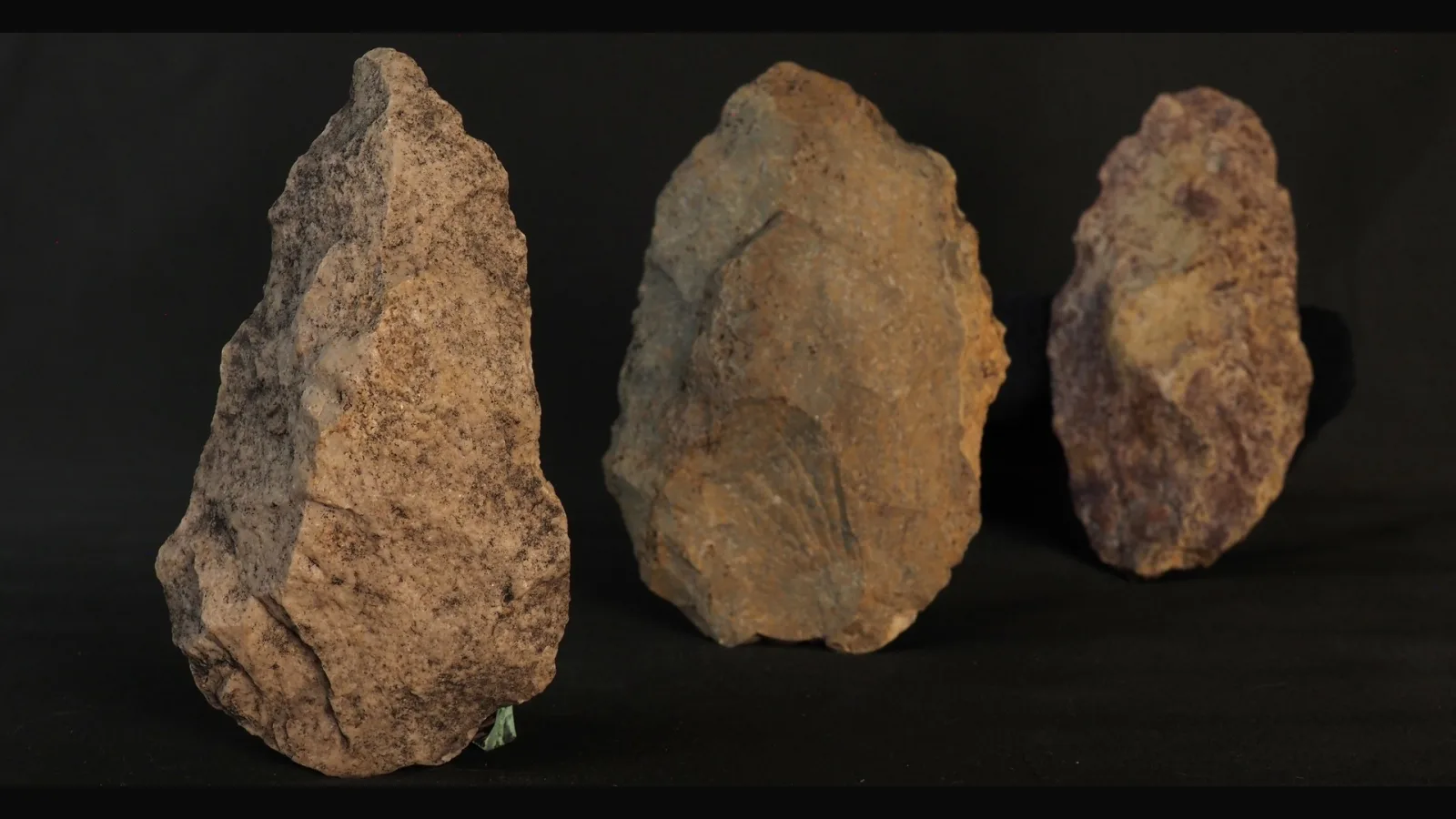
On 30 May 1863 the geologist Robert Bruce Foote picked up a quartzite hand-axe at Pallavaram, then on the outskirts of Madras (today's Chennai). It was the first recognised Palaeolithic tool in India. Later that year Foote and his colleague William King found many more tools at Attirampakkam (also spelled Athirampakkam), in the Kortallayar river basin in present-day Tiruvallur district, about 60 km north-west of Chennai.
More than 120 Palaeolithic sites are now known in the Kortallayar and Araniyar basins. They include open-air scatters and rock shelters at Attirampakkam, Gudiyam, Poondi, Vadamadurai and Neyveli. After Foote's death in 1912, research slowed for about two decades. Interest returned in the 1930s with V. D. Krishnaswami and the Yale–Cambridge expedition, then again with Archaeological Survey of India (ASI) excavations in the 1960s. From the late 1990s, systematic work by Shanti Pappu and colleagues put the region back on the world map of human origins research.
For the wider Indian Stone Age story – including the Soan tradition, the Toba ash debate and Bhimbetka's rock art – see our companion Indian History Part 1. This article stays focused on Tamil Nadu.
Attirampakkam: tools about 1.5 million years old
Attirampakkam became famous again in 2011. A team led by Shanti Pappu of the Sharma Centre for Heritage Education in Chennai reported in Science that the site's oldest Acheulean layers are no younger than 1.07 million years and gave a pooled average age of about 1.51 million years (plus or minus 0.07 million). The team dated the burial of the artefacts themselves using aluminium-26 and beryllium-10 isotopes, supported by palaeomagnetic evidence.
The Acheulean tradition, named after Saint-Acheul in France but originating in Africa, is known for teardrop-shaped hand-axes and cleavers. Its makers were earlier hominins, most likely Homo erectus or a related form, not our own species (Homo sapiens). At Attirampakkam the tools are largely of quartzite and often little abraded, which suggests they were buried near where they were made or used. They may have served for butchering and for working plant foods, though direct proof is lacking.
The result matters because textbooks once placed the arrival of Acheulean technology in South Asia around 600,000–500,000 years ago. Attirampakkam pushes that horizon far earlier and shows bifacial toolmakers in South India before the same technology is well attested in Europe. The authors themselves stress that more securely dated sites are needed to map how the technology spread.
A second breakthrough: the Middle Palaeolithic
Attirampakkam produced another major result in 2018. In Nature, Kumar Akhilesh, Shanti Pappu and colleagues used luminescence dating to show that the shift away from large Acheulean bifaces towards smaller flake tools, including the Levallois technique of preparing a core so that a flake of planned shape could be struck off, began there around 385,000 years ago (with an uncertainty of about 64,000 years) and continued until about 172,000 years ago.
That is far earlier than once presumed for South Asia and roughly contemporary with similar changes in Africa and Europe. The authors argued it challenges models that tie India's Middle Palaeolithic only to modern humans arriving after about 125,000 years ago. Who made these tools is unknown: no hominin fossils were found with them. Tools alone cannot name the species.
Gudiyam shelters and the Poondi museum
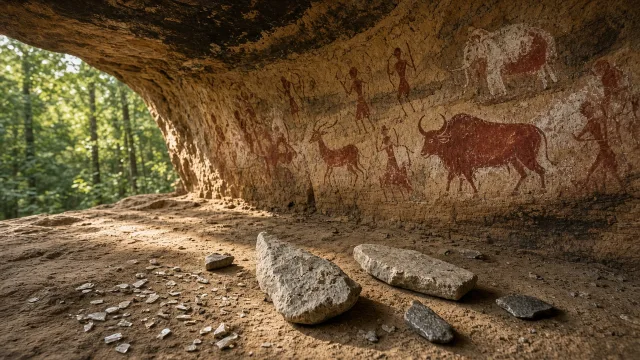
A short distance away, in the Allikulli (Allikuzhi) hills, the Gudiyam rock shelters were excavated by the ASI Prehistory Branch in 1962–63 and 1963–64. The main cave forms a natural amphitheatre about 15 m high at the mouth, narrowing to roughly 1.2 m at the rear, cut into Satyavedu Formation boulder-conglomerate. Excavation recovered post-Acheulean to Middle Stone Age (Middle Palaeolithic) assemblages from the ancient floor up through silty layers. Foote had drawn attention to the area; later work by Swami (1976) and Pappu (1996, 2001), and tool studies by Jayaswal, refined the picture.
Finds from Attirampakkam, Gudiyam and other local sites are displayed at the Tamil Nadu State Department of Archaeology's Pre-Historic Site Museum at Poondi, established in 1985. The museum shows Palaeolithic implements, Neolithic celts, megalithic sarcophagi and storage pots, Black-and-Red Ware, fossil snail and wood, a three-legged urn, iron tools and terracotta tuyeres used in iron smelting. The department describes it as India's only site museum devoted specifically to the region's Palaeolithic culture. Poondi is also known for its reservoir, one of Chennai's water sources; the same Tiruvallur landscape links easily to a day trip that includes other coastal heritage.
Teri microliths and Neolithic Paiyampalli
Microliths – small, often geometric stone pieces a few centimetres long – carpet parts of the red "teri" sand dunes of Thoothukudi and Tirunelveli districts, with Sawyerpuram (Sawayarpuram) among the best-known finds. Foote collected them but classed them as Neolithic. Later work by A. Aiyappan (1945) and by F. E. Zeuner and Bridget Allchin (1956) recognised their Mesolithic character. A Government Museum, Chennai report places the Sawyerpuram industry around 4000 BCE, while noting that the chronology of South Indian microliths is still unsettled. Later palaeoenvironmental studies suggest occupation of the teri sands after the last glacial period into the mid-Holocene, ending by roughly 4000 years ago. Stratified microliths have also been excavated at Mangudi (Tirunelveli) and Tiruthangal (Virudhunagar).
In the north, Paiyampalli in Tirupattur district (formerly North Arcot) was excavated by the ASI under S. R. Rao in 1964–65 and 1967–68. It revealed Neolithic pit dwellings with thatched roofs, ground stone axes, bone tools, short blades and handmade grey pottery, followed by an overlap with the Iron Age megalithic culture. Radiocarbon dates place the Neolithic phase in the second millennium BCE; one widely cited figure is 1390 BCE (± 200 years), with a later megalithic date around 315 BCE (± 100). Charred horse gram and green gram point to early cultivation of pulses still grown in the region.
Iron Age megalithic burials
The most widespread prehistoric monuments in Tamil Nadu are megalithic burials – graves or memorials built with large stones. Thousands are recorded in Krishnagiri, Dharmapuri, Salem, Erode, Madurai, Sivaganga, Tirunelveli and other districts. Main types include:
- Cairn circles: a ring of boulders enclosing a rubble cairn, often over a pit or cist.
- Dolmens and dolmenoid cists: slab-built chambers, sometimes with a circular porthole; regional forms such as the Mallachandram-type dolmens of Krishnagiri are distinctive.
- Stone circles and menhirs: upright stones that may mark graves or boundaries.
- Sarcophagi: clay or stone coffins, some with legs, some boat-shaped.
- Urn burials: large pots holding bones and grave goods – especially important in the far south, and the subject of Part 2 at Adichanallur.
These monuments are typically associated with Black-and-Red Ware (BRW): pottery fired so that the interior is black and the exterior red. Iron swords, arrowheads, axes, bangles and beads are common finds. At some sites, iron slag and tuyeres show local smelting.
Chronology is still debated. Older surveys often placed South Indian megaliths roughly between 1000 BCE and 300 CE; many northern Tamil Nadu sites cluster between about 300 BCE and 600 CE. Recent dating programmes at Sivakalai, Kodumanal, Porunthal, Adichanallur, Mayiladumparai and related sites have pushed some iron use and burial traditions earlier. Those dates are scientific estimates with error margins, and specialists continue to argue over methods and interpretation. Because BRW remained in use for a long time, pottery alone cannot cleanly separate the Iron Age from the Early Historic period.
Megaliths were not only tombs. They preserve evidence of belief, metallurgy and long-distance exchange – shells, beads and metal objects sometimes point to coastal and inland networks, the same kind of connectivity that later fed routes remembered in the Silk Road story. Most monuments, however, remain unexcavated; surface collection and illegal digging have already destroyed information.
Why prehistoric Tamil Nadu still matters
Prehistory covers more than 99% of the time humans and earlier hominins have lived in Tamil Nadu. When Egypt's pharaohs raised the pyramids at Giza, around 4,500 years ago, people here were still using polished stone axes and, later, burying their dead under megaliths with iron. The stone temples of later centuries – from rock-cut caves in the tradition of Ajanta and Ellora to sculpted temple complexes such as Khajuraho – rest on a far older relationship between people and stone that began on this same landscape.
Attirampakkam and Gudiyam show that a chapter of global human-origins research was written within a day's travel of Chennai. That chapter is still being revised every time a new date or trench is published.
Next part
In Part 2 we turn to Adichanallur in Tirunelveli district and the Iron Age urn burials of the far south: from F. Jagor's 1876 discovery and Alexander Rea's 1905 excavation to recent AMS and luminescence dates – what the urns contained, and what iron weapons and human remains suggest about the people who filled them.
Sources
- Pappu, S. et al. (2011), Early Pleistocene presence of Acheulian hominins in South India, Science 331: 1596–1599
- Akhilesh, K. et al. (2018), Early Middle Palaeolithic culture in India around 385–172 ka reframes Out of Africa models, Nature 554: 97–101
- The Hindu, Acheulian stone tools discovered near Chennai
- The Hindu, Stone tools offer insights into history of human evolution
- Tamil Nadu State Department of Archaeology, Pre-Historic Site Museum, Tiruvallur (Poondi)
- The Hindu, A walk down the history lane (Poondi museum)
- Government Museum, Chennai, Excavations in Tamil Nadu – An Archaeological Report
- Venkatasubbaiah, P. C., Neolithic culture of Tamil Nadu (Paiyampalli excavation details), Tamil University
- Archaeological Survey of India, Excavations at Adichchanallur
- National Mission on Monuments and Antiquities, Gudiyam cave
- Haricharan, S. et al., Can the tinai help understand the Iron Age–Early Historic landscape of Tamilnadu?