This is Part 5 of HorizonDesk's chronological series on Indian history, from the Stone Age to Independence in 1947.
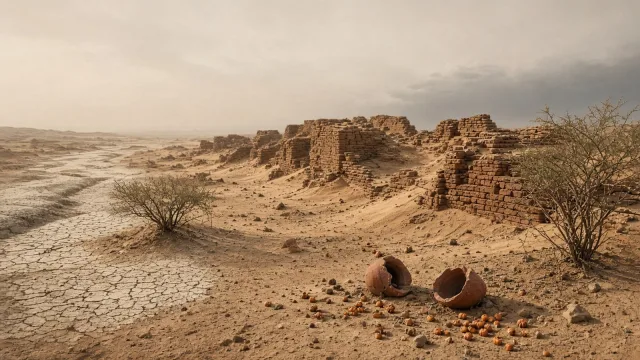
In Part 4 of this series, we watched the great Harappan cities slowly empty after about 1900 BCE as the climate shifted, rivers moved and long-distance trade dried up. The centuries that followed left no grand cities. They left something very different: sacred poetry memorised and passed down by mouth for more than three thousand years.
That poetry is the Rigveda, and the period it describes is usually called the Early Vedic Age, roughly 1500 to 1000 BCE. This part looks at what the Rigveda tells us about its people's herds, wars, assemblies and gods, and where scholars still disagree.
How do we know anything about the Early Vedic Age?
Almost everything comes from one text. The Harappans left cities without readable words; the early Vedic people left words with little archaeology firmly tied to them. The Rigveda is a collection of ritual hymns, not a chronicle, so historians read it for incidental details: the rivers it names, its animals and crops, its metals and the quarrels between clans.
The dates are an estimate. The most widely used scholarly range puts the composition of the Rigveda between about 1500 and 1200 BCE, with the latest hymns perhaps a little after that. The estimate rests mainly on language: Vedic Sanskrit is very close to the Old Iranian of the Avesta, the Zoroastrian scripture. A treaty of about 1380 BCE between the Hittite king Suppiluliuma I and the Mitanni kingdom of northern Syria calls on Mitra, Varuna, Indra and the Nasatyas, all Rigvedic gods, as witnesses, showing that an Indo-Aryan language was already known in West Asia by then.
Some Indian scholars argue for much earlier dates, placing the Rigveda in the third or even fourth millennium BCE and linking it with the Harappan civilisation itself. Most linguists and historians do not accept this, partly because the Rigveda's central horses and spoked-wheel chariots fit the second millennium better than the Mature Harappan period.
The Rigveda: a library held in memory
The Rigveda has 1,028 hymns (suktas) with about 10,600 verses, arranged in ten books called mandalas. Books 2 to 7, the "family books", are each linked with one family of poet-priests and are generally considered the oldest layer. Books 1 and 10 are thought to be the youngest, and Book 9 is devoted entirely to Soma, a sacred plant and the drink pressed from it.
For many centuries the hymns were not written down at all; the oldest surviving manuscripts are only a few hundred years old. Families of reciters preserved them by memory, learning each hymn straight through, word by word (padapatha) and in patterns that repeat and reverse word pairs, such as jata and ghana. Any slip broke the pattern, so errors were easy to catch, and reciters in Kerala, Maharashtra and Tamil Nadu still agree almost syllable for syllable.
UNESCO lists the tradition of Vedic chanting as Intangible Cultural Heritage (inscribed in 2008), and Rigveda manuscripts held at the Bhandarkar Oriental Research Institute in Pune joined its Memory of the World Register in 2007.
Who were the Vedic people?
The composers called themselves Arya, roughly "noble" or "one of us": people who shared their language and rituals. It was a cultural and linguistic label, not a racial one; the "Aryan race" was a modern European distortion of the word.
Where the Indo-Aryan language came from is one of the most debated questions in Indian history. There are two main positions:
- The migration view, held by most international linguists and many historians, says that speakers of early Indo-Aryan entered the subcontinent from Central Asia in several waves during the second millennium BCE, mixing with the people already living there rather than conquering them in a single invasion. Supporters point to links with Iranian and European languages and to ancient DNA: a large 2019 study led by Vagheesh Narasimhan found that steppe-related ancestry arrived gradually during the second millennium BCE, after the Mature Harappan period.
- The indigenous view, sometimes called "Out of India", is held by a number of Indian scholars. It argues that Vedic culture developed within India, perhaps out of the Harappan world, and that the language spread outward. Supporters point to the lack of clear archaeological evidence for newcomers and to cultural continuities.
As we saw in Part 4, the old idea of a violent "Aryan invasion" that destroyed the Harappan cities has been abandoned by almost all specialists. The live debate is about gradual movement and mixing, and confident claims from either side deserve caution.
The land of seven rivers
The Rigveda's geography is centred on the north-west: today's eastern Afghanistan, Khyber Pakhtunkhwa, and above all the Punjab, on both sides of the modern India–Pakistan border. The hymns speak of Sapta Sindhava, "the seven rivers". A famous hymn in Book 10, the Nadistuti or "praise of rivers", lists them roughly from east to west. They include the Ganga and Yamuna, the Sutlej (Shutudri), Ravi (Parushni), Chenab (Asikni), Jhelum (Vitasta), Beas (Vipash) and the Sindhu, or Indus, itself. Travel the five rivers of modern Punjab, as in our Punjab travel guide, and you cross the Rigvedic heartland.
The Ganga appears only once or twice, so the Gangetic plain lay at the edge of this world. The river praised most lavishly is the Sarasvati, "best of mothers and rivers". Many scholars identify it with the Ghaggar–Hakra system of Haryana, Rajasthan and Cholistan; others with the Helmand in Afghanistan, whose old Iranian name, Haraxvaiti, is the same word. Sarasvati later became the goddess of learning.
Cattle, horses and chariots
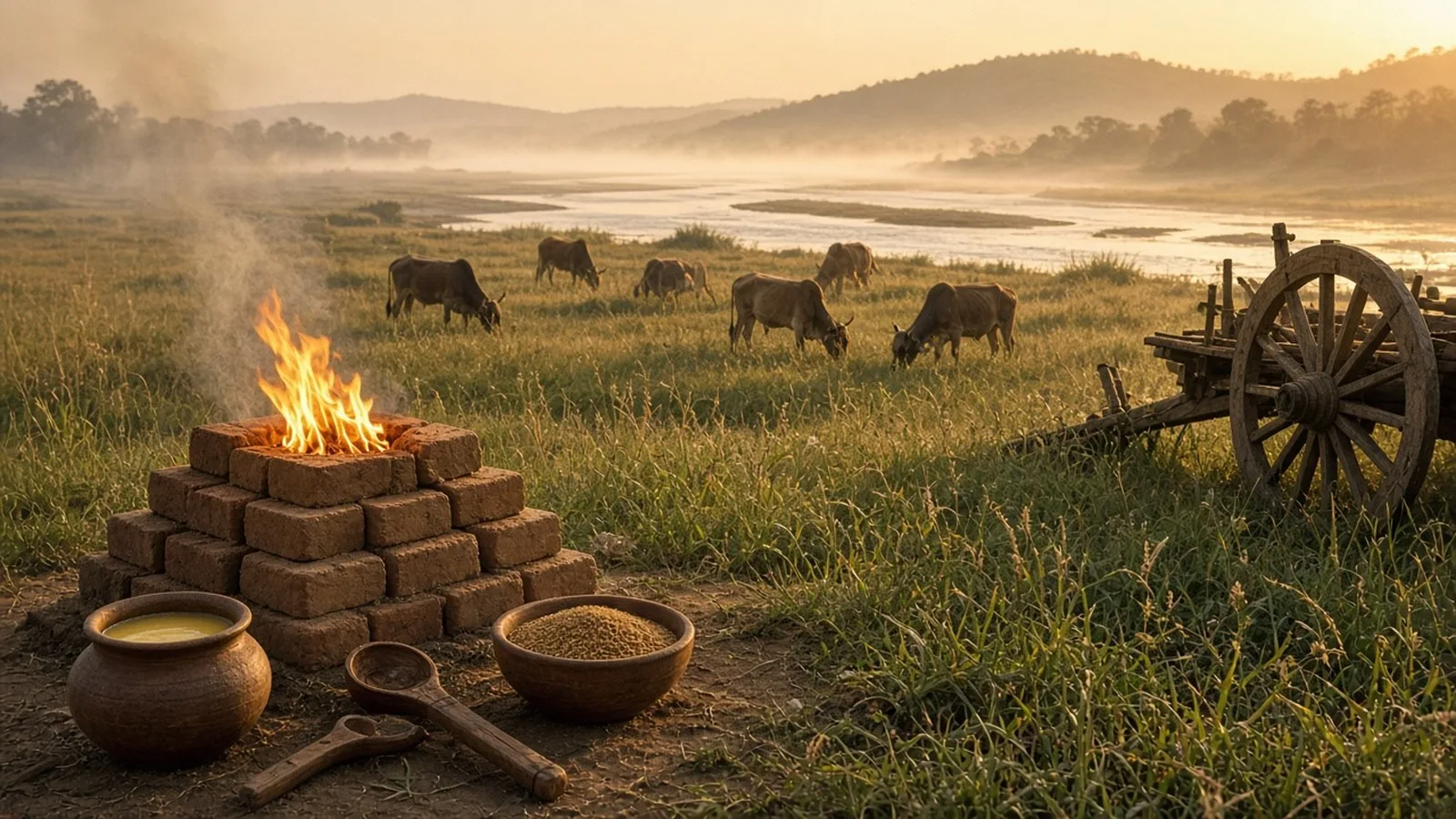
Early Vedic society was mainly pastoral. Wealth was counted in cattle, and the hymns are full of prayers for cows, milk and ghee. The word gavishti, literally "search for cows", came to mean a battle, a reminder that cattle raids were a normal part of life. A chief could be called gopati, "lord of cows".
Farming mattered less than it would later; the main grain is yava, usually understood as barley. The horse was prestigious rather than common, tied to the light spoked-wheel chariot, racing, war and the gods. The metal ayas most likely meant copper or bronze; iron belongs to the later Vedic period. People lived in villages and seasonal camps of wood, reed and mud, with carpenters, chariot makers, potters, weavers and smiths, and traded mostly by barter.
Tribes, chiefs and the Battle of the Ten Kings
The basic political unit was the tribe, or jana. The Rigveda names many of them, including the Bharatas, Purus, Yadus, Turvashas, Anus and Druhyus. Below the jana came the vish (clan), grama (a band of families, later a village) and kula (family). India's name "Bharat" goes back to one of these tribes.
The leader was the rajan, best understood as a tribal chief rather than a king with a kingdom. He led in war and protected people and cattle, receiving bali, largely voluntary offerings rather than regular taxes. Tribal assemblies checked his power: the sabha, apparently a smaller council of elders, and the samiti, a wider gathering of the tribe. The purohita (chief priest and adviser) and senani (army leader) were key figures.
The best-known event of the period is the Battle of the Ten Kings (Dasharajna), described in hymns of Book 7. Sudas, chief of the Bharatas, guided by the priest Vasishtha, defeated a coalition of ten tribes on the banks of the Parushni, the modern Ravi. The coalition is linked with Vishvamitra, a rival priest. The details cannot be checked, but the hymns vividly show tribal rivalry, shifting alliances and priests as political players.
Society, varna and women
The Rigveda draws a sharp line between the Arya and the Dasa or Dasyu, described as people with different rituals and speech who did not worship Indra. Scholars disagree whether they were earlier inhabitants, rival Indo-Aryan groups or both. Later dasa came to mean "servant", suggesting some were absorbed in a subordinate position.
The four-fold varna order of Brahmana, Kshatriya, Vaishya and Shudra appears only once in the Rigveda, in the Purusha Sukta (Book 10, hymn 90), which describes the four varnas emerging from the body of a cosmic being. Because Book 10 is late, most historians see the system as taking shape only at the end of the period. Earlier hymns suggest a more fluid society, in which one poet says his father was a physician and his mother ground grain.
Women appear more prominently in the Rigveda than in many later texts. Several hymns are attributed to women composers, including Lopamudra, Ghosha and Apala, and women took part in rituals alongside their husbands. Historians caution against romanticising this: the society was patriarchal, prayers ask mainly for sons, and the women we hear of came from elite families.
Gods, fire and sacrifice
Early Vedic religion had no known temples or images. Worship centred on the yajna, a fire sacrifice in which ghee, grain, milk and Soma were offered while priests recited hymns.
- Indra, the warrior god of storms, who slays the serpent Vritra and releases the waters, receives about a quarter of all the hymns.
- Agni, fire, the messenger who carries offerings to the gods, is the next most important, with around two hundred hymns. The very first hymn of the Rigveda is addressed to him.
- Soma, both a god and a ritual drink whose plant source is still unknown.
- Varuna, guardian of rita, the cosmic and moral order that keeps the seasons turning and holds people to their word. It foreshadows the later idea of dharma.
- Others include Surya (the sun), Ushas (dawn), the Maruts (storm gods), the Ashvins (twin healers) and Rudra, later merged into Shiva.
Not all Rigvedic thought is ritual formula. The Gayatri mantra (Book 3, hymn 62, verse 10), still recited daily by millions, is a prayer to the sun god Savitr. The Nasadiya Sukta (Book 10, hymn 129), the "hymn of creation", asks how the universe began and ends with startling doubt: perhaps even the one who watches over it from the highest heaven knows, or perhaps it does not know. That questioning spirit points ahead to the Upanishads.
The archaeology puzzle
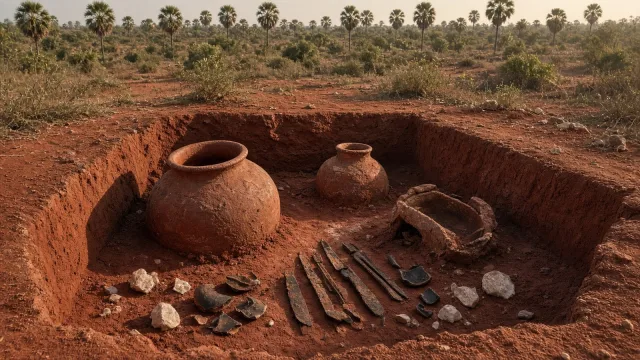
Tying the Rigveda to archaeological sites is hard. Some scholars connect it with the Gandhara Grave culture of Pakistan's Swat valley (roughly 1400–800 BCE) or post-Harappan cultures such as Cemetery H; none of these links is certain. Meanwhile peninsular India followed its own path, with Neolithic and early Iron Age communities that later built the megaliths described in our Tamil history series on prehistoric Tamil Nadu. India in 1200 BCE was a patchwork of cultures, not a single Vedic world.
Why the Early Vedic Age still matters
The Rigveda is one of the oldest religious texts still in living use. Its hymns are recited at weddings and household rituals, and its ideas run through Hinduism, Sanskrit literature and many Indian languages. For historians it is a priceless, if difficult, source on a society in motion: pastoral tribes, chiefs checked by assemblies, priests gaining influence and the first hints of a social order that would harden later.
Key takeaways
- The Early Vedic Age (roughly 1500–1000 BCE) is known mainly from the Rigveda, 1,028 hymns preserved orally with great accuracy.
- Its heartland was the Sapta Sindhu, the land of seven rivers centred on the Punjab, with the Ganga only at its edge.
- Society was pastoral and tribal: cattle meant wealth, chiefs were checked by the sabha and samiti, and warfare often meant cattle raids.
- Religion centred on fire sacrifice to Indra, Agni, Soma and Varuna; the four-varna system appears only in a late hymn.
- The origin of Indo-Aryan speakers is still debated between gradual migration and indigenous development, though the violent invasion idea has been abandoned.
Next part
In Part 6, we move east into the Ganga plains for the Later Vedic Age: the arrival of iron, settled farming kingdoms such as the Kurus and Panchalas, the hardening of varna, grand royal rituals, and the bold philosophical questions of the Upanishads.
Sources
- Jamison, S. W. and Brereton, J. P. (2014), The Rigveda: The Earliest Religious Poetry of India, Oxford University Press
- Thapar, R. (2002), Early India: From the Origins to AD 1300, Penguin and University of California Press
- Singh, U. (2008), A History of Ancient and Early Medieval India: From the Stone Age to the 12th Century, Pearson
- Witzel, M. (1995), "Early Sanskritization: Origins and Development of the Kuru State", Electronic Journal of Vedic Studies 1(4); and "Rgvedic History: Poets, Chieftains and Polities" in G. Erdosy (ed.), The Indo-Aryans of Ancient South Asia, de Gruyter
- Bryant, E. (2001), The Quest for the Origins of Vedic Culture: The Indo-Aryan Migration Debate, Oxford University Press
- Narasimhan, V. M. et al. (2019), The formation of human populations in South and Central Asia, Science
- UNESCO, Tradition of Vedic chanting, Representative List of the Intangible Cultural Heritage of Humanity
- UNESCO, Rigveda manuscripts, Memory of the World Register
- Encyclopaedia Britannica, Rigveda and Vedic religion
- World History Encyclopedia, The Vedas