This is Part 4 of HorizonDesk's chronological series on Indian history, from the Stone Age to Independence in 1947.
In Part 3 of this series, we walked the grid-planned streets of Harappa, Mohenjo-daro and Dholavira, with their covered drains, standard bricks and weights, carved seals and long-distance trade. Those cities were at their height between roughly 2600 and 1900 BCE. Then, over a few centuries, they emptied.
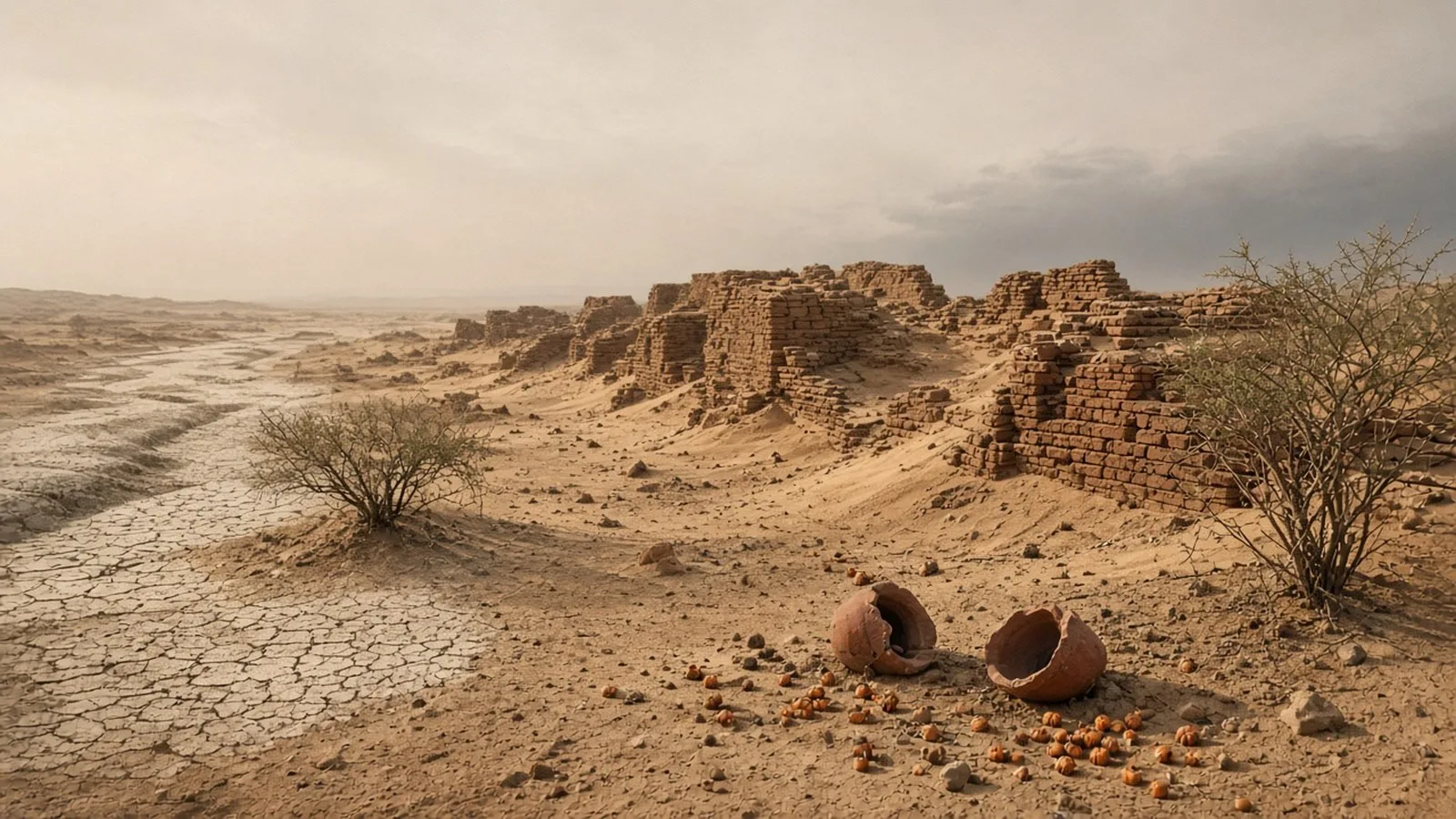
By about 1300 BCE the big cities were gone or reduced to small settlements. The Indus script stopped being written. Standard weights and the classic square seals disappeared. Why did one of the world's first great urban civilisations come apart? For a century, scholars have argued about invaders, floods, failing rivers, a weakening monsoon, collapsing trade and disease. This part looks at each theory and the evidence for and against it.
First, what actually declined?
The word "collapse" can mislead. Archaeologists today usually speak of de-urbanisation or transformation rather than a sudden end. The timeline is roughly this, though exact dates vary from site to site and are still debated:
- Mature Harappan phase (c. 2600–1900 BCE): large planned cities, a shared script, standard weights, uniform seals and trade reaching Mesopotamia.
- Late Harappan or Localisation phase (c. 1900–1300 BCE): the big cities shrink or are abandoned, the script and standard weights fall out of use, and regional cultures take over.
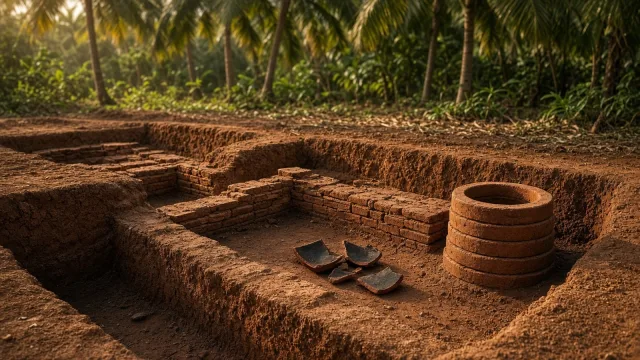
Those regional cultures have their own names. In Punjab there is the Cemetery H culture, named after a burial ground at Harappa, with its distinctive painted pottery. In Sindh there is the Jhukar culture. In Gujarat, sites such as Rangpur show a Late Harappan phase sometimes called Late Sorath. Pottery, farming and many crafts carried on, but the shared urban system that tied a huge region together did not.
Just as important, people did not simply vanish. Surveys show that while sites thinned out in the Cholistan desert of Pakistan and in parts of Sindh, small village settlements multiplied further east, in Haryana and the western Ganga–Yamuna doab, and in Gujarat. The civilisation's population appears to have dispersed into smaller farming communities rather than dying out. That pattern is the key clue every theory has to explain.
Theory 1: An Aryan invasion
The most famous early explanation came from Sir Mortimer Wheeler, Director General of the Archaeological Survey of India in the 1940s. He linked the end of the cities to the Rigveda, which describes the god Indra destroying forts, or pur. In 1947 he wrote that, on circumstantial evidence, "Indra stands accused". He pointed to skeletons found lying in the upper levels of Mohenjo-daro as victims of a final massacre.
This idea has not survived scrutiny. In 1964 the American archaeologist George F. Dales published "The Mythical Massacre at Mohenjo-daro", showing that the skeletons came from different parts of the city and from different time periods, not from one destruction layer. There was no burnt citadel, no layer of weapons and no sign of a final battle. Later studies of the bones found little evidence that most of these people died violently.
Chronology is another problem. Most scholars date the composition of the Rigveda to roughly 1500–1200 BCE, after the cities had already declined, although that dating is itself debated. So the cities were probably fading before Vedic-speaking groups became prominent in the northwest.
It is worth separating the discredited invasion idea from the separate and still-argued question of migration. Ancient DNA studies, notably a large 2019 study led by Vagheesh Narasimhan, found that ancestry linked to Central Asian steppe herders entered South Asia gradually during the second millennium BCE, after the Mature Harappan period. The same year, the first genome sequenced from a Harappan-era skeleton at Rakhigarhi in Haryana (Shinde et al., 2019) showed no steppe ancestry. Many geneticists and historians read this as evidence of later, gradual population movement rather than conquest; some Indian scholars dispute the migration model altogether. Either way, almost no specialist now argues that invaders destroyed the Harappan cities. We will return to the Vedic people in the next part.
Theory 2: A weakening monsoon
The strongest body of new evidence points to climate. Around 4,200 years ago, many parts of the world experienced a prolonged dry spell that climate scientists call the 4.2 kiloyear event. It has been linked to troubles in Egypt's Old Kingdom and the Akkadian Empire in Mesopotamia, and its timing overlaps with the start of the Harappan decline.
Several Indian records support a drying trend. A 2014 study by Yama Dixit, David Hodell and Cameron Petrie examined sediments from Kotla Dahar, a former lake in Haryana, and found evidence of an abrupt weakening of the summer monsoon about 4,100 years ago. A 2017 study of cave stalagmites led by Gayatri Kathayat linked monsoon variability over thousands of years with changes in Indian civilisation, including a drier phase around this time. Liviu Giosan and colleagues, working on the river landscapes of the Indus plain, argued in 2012 that a gradual decline in monsoon rains reduced the floods that farmers depended on.
A later paper by Giosan's team (2018) added a twist. It suggested that while the summer monsoon weakened, winter rains in the Himalayan foothills held up better, and that this may help explain why settlements moved north-east towards the foothills and the Ganga plain.
Archaeobotanical work fits this picture of adaptation. Harappan farmers had long grown wheat and barley in winter, but many sites also show summer crops such as millets and rice, which can cope with more variable rain. Smaller, more flexible villages would have managed uncertain rainfall better than big cities that needed steady surpluses.
The climate theory has limits. Dating is often too coarse to say whether a dry spell came just before a site was abandoned. Different regions responded differently, and climate stress does not automatically cause a society to break up. Most researchers see the monsoon as a powerful pressure, not a single switch.
Theory 3: Rivers that moved, flooded or dried up
The Harappan world depended on rivers, and rivers on alluvial plains do not stay put. Many Harappan sites lie along the dry bed of the Ghaggar–Hakra river system, which flows today only during the monsoon. Many people identify it with the Sarasvati of the Rigveda, an identification that is widely discussed and sometimes politically charged.
An older view held that this river dried up when Himalayan tributaries such as the Sutlej or Yamuna changed course, cutting off its glacier-fed water and leaving its cities stranded. Recent research has complicated this. Giosan's 2012 study argued that by Harappan times the Ghaggar–Hakra was already a monsoon-fed river rather than a great glacier-fed one. A 2017 study in Nature Communications by Ajit Singh, Sanjeev Gupta and colleagues found that the Sutlej had abandoned that channel around 8,000 years ago, well before the cities rose, and that Harappan settlements grew along the old, abandoned river valley. If so, a sudden river capture cannot have been the trigger, though a shrinking monsoon-fed river would still have hurt.
Floods are the other side of the story. Mohenjo-daro shows signs of being rebuilt again and again, and some early researchers, such as Robert Raikes, proposed that tectonic uplift dammed the lower Indus and caused long floods. That theory has found little support. Still, shifts in the Indus and its tributaries could have ruined fields and stranded towns, adding to the stress.
Theory 4: Collapsing trade
Mesopotamian texts refer to a distant land called Meluhha, widely identified with the Indus region, which supplied carnelian, timber, ivory and other goods. Harappan seals and beads have been found in Mesopotamia and the Gulf. These references are common in the later third millennium BCE but become much rarer after about 1900 BCE, and the Gulf trade seems to have been reorganised through middlemen in Dilmun (modern Bahrain).
The loss of this trade would have hit the merchants and elites who needed standard seals and weights, which helps explain why those objects disappeared. But scholars disagree on whether trade declined because the cities were already struggling or whether its loss helped push them over the edge. Mesopotamia itself went through upheaval in this period.
Theory 5: Disease, violence and social stress
Skeletons can tell stories that buildings cannot. Studies led by Gwen Robbins Schug on burials from Harappa found that injuries from violence were more common in the later phases than earlier, and a 2013 follow-up reported signs of infectious diseases, including leprosy and tuberculosis, in Late Harappan remains. The authors linked these to the strains of a changing climate, crowding and weakening social networks. These are findings from a limited number of skeletons, so they should be read with caution, but they suggest life became harder as the urban system unravelled.
The modern view: many causes, slow change
Most specialists, including scholars such as Gregory Possehl, Jonathan Mark Kenoyer and Rita Wright, now favour a combination of causes acting over centuries. A drying climate and a less reliable monsoon put pressure on agriculture. Rivers shifted. Long-distance trade weakened. The elites and institutions that maintained seals, weights, writing and city planning lost their purpose. Families moved to places where farming still worked, especially to the east and south.
Seen this way, the Harappan story is less about a civilisation that died and more about one that broke into smaller, more local ways of living. Archaeological sites from the second millennium BCE, such as those with Ochre Coloured Pottery in the Ganga–Yamuna doab, show village life continuing. Some scholars see Harappan echoes in later Indian crafts, farming methods and even symbols, but such links are hard to prove and remain debated.
For a look at what one of these cities is like to visit today, see our guide to Dholavira, the Harappan city in Kutch. And India's next great wave of city-building, much later in the first millennium BCE, reached the far south too, as our Tamil history series explores in its piece on Keezhadi and Sangam-age urban settlement.
Why the debate still matters
The end of the Indus cities is not just an ancient puzzle. It is one of the best-studied cases of a complex society coping with a changing climate and shifting water supplies in South Asia, the same monsoon-dependent region that holds about a quarter of humanity today. The Harappan lesson, as many researchers see it, is that flexibility helped people survive: those who moved, changed crops and lived in smaller communities carried their way of life forward.
Key takeaways
- The Harappan cities declined gradually between about 1900 and 1300 BCE; people dispersed into villages rather than disappearing.
- The old "Aryan invasion" explanation has been rejected. The separate question of later migration, based on ancient DNA, is still debated.
- Climate evidence for a weakening monsoon around 4,200–4,100 years ago is strong, but it was probably one pressure among several.
- River shifts, falling trade with Mesopotamia, and disease and social stress all likely played a part.
Next part
In Part 5, we move to the Early Vedic Age: who composed the Rigveda, how its pastoral, cattle-rich society was organised, which gods it praised, and what the hymns can and cannot tell us about India in the second millennium BCE.
Sources
- Dales, G. F. (1964), The Mythical Massacre at Mohenjo-daro, Expedition 6(3), Penn Museum
- Giosan, L. et al. (2012), Fluvial landscapes of the Harappan civilization, PNAS
- Dixit, Y., Hodell, D. A. and Petrie, C. A. (2014), Abrupt weakening of the summer monsoon in northwest India ~4100 yr ago, Geology
- Kathayat, G. et al. (2017), The Indian monsoon variability and civilization changes in the Indian subcontinent, Science Advances
- Singh, A. et al. (2017), Counter-intuitive influence of Himalayan river morphodynamics on Indus Civilisation urban settlements, Nature Communications
- Giosan, L. et al. (2018), Neoglacial climate anomalies and the Harappan metamorphosis, Climate of the Past
- Robbins Schug, G. et al. (2012), A peaceful realm? Trauma and social differentiation at Harappa, International Journal of Paleopathology
- Robbins Schug, G. et al. (2013), Infection, disease, and biosocial processes at the end of the Indus Civilization, PLOS ONE
- Narasimhan, V. M. et al. (2019), The formation of human populations in South and Central Asia, Science
- Shinde, V. et al. (2019), An ancient Harappan genome lacks ancestry from steppe pastoralists or Iranian farmers, Cell
- Kenoyer, J. M., Harappa.com, research and essays on the Indus Civilisation
- Possehl, G. L. (2002), The Indus Civilization: A Contemporary Perspective, AltaMira Press; Wright, R. P. (2010), The Ancient Indus: Urbanism, Economy, and Society, Cambridge University Press; Singh, U. (2008), A History of Ancient and Early Medieval India, Pearson