This is Part 2 of HorizonDesk's chronological series on Tamil history, from prehistory to modern Tamil Nadu. If you missed the opening instalment, start with Part 1: Prehistoric Tamil Nadu – Attirampakkam, Gudiyam and the Megalithic Burials.
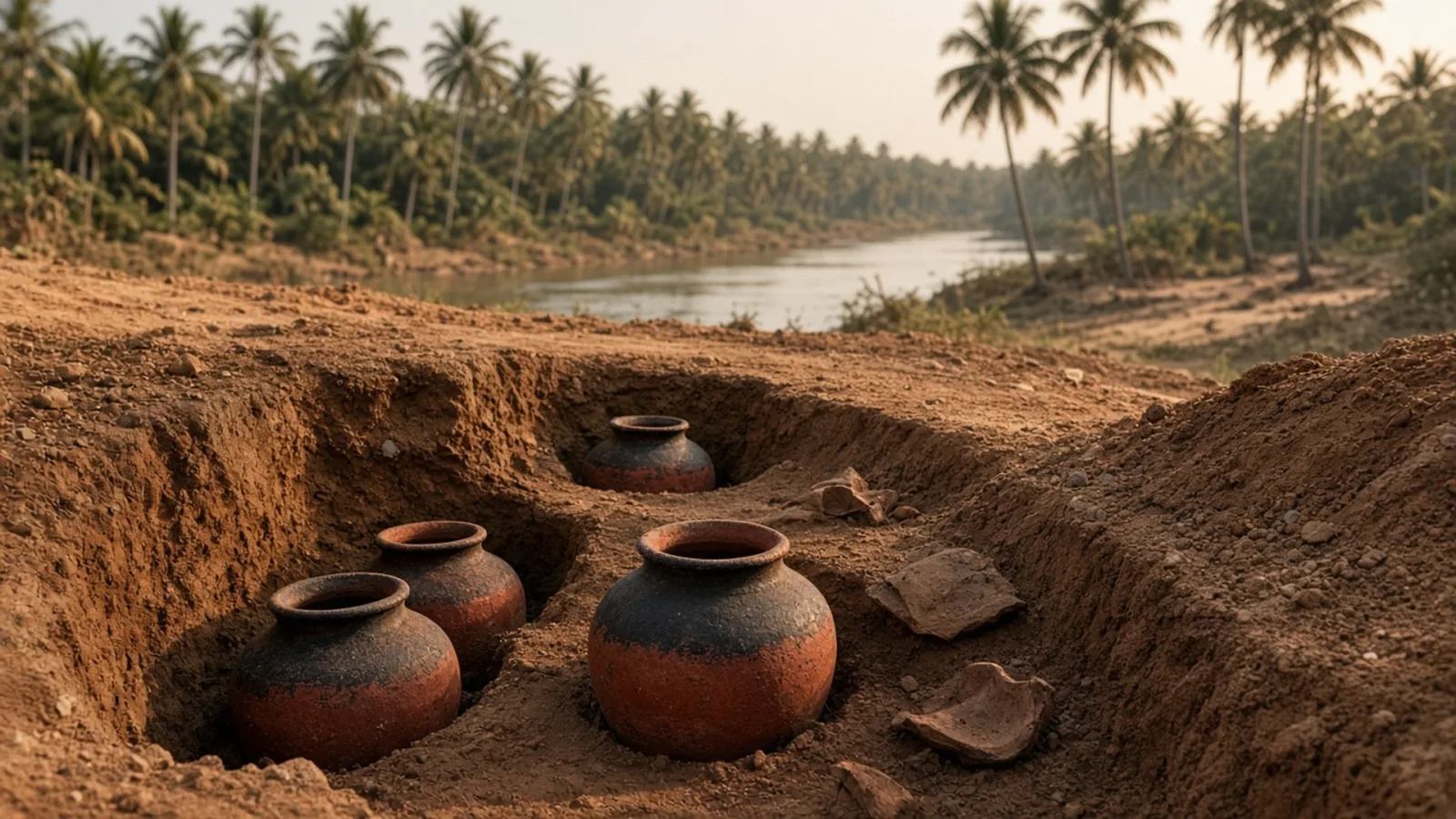
On the road from Tirunelveli to the temple town of Tiruchendur, a low gravel ridge runs along the right bank of the Tamirabarani river. Locals simply call it the parambu (Tamil for a stretch of dry, raised ground). Beneath it lie thousands of large clay burial urns, many of them about 3,000 years old, packed with human bones, iron weapons, bronze bowls, rice husk and, in a few cases, paper-thin bands of gold. This is Adichanallur (also spelled Adichchanallur), one of the largest and best-preserved Iron Age urn cemeteries in South India.
This instalment covers who has dug here since 1876, what they found, and why the dates remain contested.
Where Adichanallur is
Adichanallur lies in Srivaikuntam taluk of Thoothukudi district (older literature says Tirunelveli, or "Tinnevelly"). According to the Archaeological Survey of India (ASI), it sits about 24 km south-east of Tirunelveli and 9 km north of Korkai, the ancient port of the Pandya kings. The ASI protected 114 acres here in 1921, but remains extend beyond that boundary.
Classical Tamil poetry of the Sangam period (roughly the last centuries BCE and first centuries CE) calls the Tamirabarani the Porunai, so the Tamil Nadu government groups the river's sites as the "Porunai civilisation". Rising in the Western Ghats and entering the Gulf of Mannar near Korkai, the river gave Iron Age communities water, fertile soil and a route to the sea.
A site dug for 150 years
| Year | Who | What happened |
|---|---|---|
| 1876 | F. (Fedor) Jagor, Berlin | Collected pottery, iron tools and bones from gravel-mining pits; finds went to Berlin's ethnological museum |
| 1899–1905 | Alexander Rea, ASI | Large-scale excavation; thousands of objects including gold diadems and bronzes |
| 1903–04 | Louis Lapicque, Paris | Further exploration and collections |
| 2004–05 | T. Satyamurthy, ASI | 178 burials exposed in 600 sq m; skeletal remains; habitation traces |
| 2019 | Madurai Bench, Madras High Court | Radiocarbon results filed in court |
| 2020 | Tamil Nadu State Department of Archaeology | Habitation area excavated; Tamil-Brahmi graffiti, terracotta pipes |
| 2021–22 | ASI (team under T. Arun Raj) | Fresh excavation; gold diadem found in 2022 |
| 2023 | ASI | Glass-floored on-site museum opened |
Jagor, Rea and Lapicque
In 1876 the Berlin ethnologist F. Jagor, visiting with district officials, gathered pottery, iron implements and bones from gravel pits and shipped them to Berlin – collecting rather than modern excavation.
Alexander Rea, Superintendent of the ASI's Southern Circle, made a first visit in 1899–1900 and then dug intermittently until 1905. In the ASI's 1902–03 annual report he called Adichanallur "the most extensive prehistoric site as yet discovered in southern if not in the whole of India". Frontline magazine records that his first seasons produced about 1,872 objects, with around 4,000 more later. The Frenchman Louis Lapicque, exploring in 1903–04, judged the dead a "Proto-Dravidian race", a view rooted in the racial anthropology of the day. Rea leaned towards a Pandya-period origin. Most of his collection is in the Government Museum, Chennai, catalogued in his 1915 volume.
What the urns held
Rea's catalogue and the later ASI report give a vivid inventory:
- Urns: large pots set, usually singly, in pits cut into rock or gravel.
- Pottery: Black-and-Red Ware (BRW, fired so the inside is black and the outside red), red ware and lamp stands. Small pots inside the urns held rice and millet husk, perhaps food for the dead.
- Iron: swords, daggers, spearheads, arrowheads and hoe-like tools. Weapons around the urns were usually found point-down, as if thrust into the earth by mourners.
- Bronze: bowls, sieves, lids and bangles, with small figures of buffalo, goat, cockerel, tiger, antelope and elephant on lids and vessels.
- Gold: oval frontlets of thin gold leaf tied across the forehead. Rea's catalogue lists 19 such diadems, mainly from large, deep urns with rich grave goods, suggesting people of rank.
John Marshall, the ASI's Director-General, thought the frontlets too flimsy to wear in life – symbolic substitutes, perhaps, while relatives kept the real jewellery. Locally they were called pattam. Gold does not occur near Adichanallur, so it probably arrived through exchange.
Sangam poetry remembers the custom. In Purananuru 228, a poet asks a potter ("kalanjey kove", "O maker of pots") how he could shape an urn big enough for a great Chola king, unless the earth were his wheel and a mountain his clay. The Tamil phrase mudhumakkal thazhi, "urn of the elders", still carries that memory.
The 2004–05 excavation and the court case
A century after Rea, ASI Superintending Archaeologist T. Satyamurthy excavated two seasons in 2004 and 2005. Within 600 square metres his team exposed 178 burials, from the surface to about 2.2 metres deep. The eventual ASI report sorts them into three phases of a single culture:
- Early phase (29 urns): only large, handmade red-ware urns, with many primary burials, in which the whole body, adult or child, was placed in a crouched position.
- Middle phase (123 urns): red ware plus wheel-made Black-and-Red Ware, mostly secondary burials, in which only selected bones were interred.
- Late phase (19 urns): mostly smaller BRW urns with secondary burials only.
This time there was no gold or bronze; iron was common and copper rare. The skeletons suggest people of medium height and strong build; the report links changes in some skulls to sinus disease from pearl diving, an interpretation rather than proof. Plant remains show rice and green gram were cultivated. A floor level, potter's kiln and bead-making debris were found, though the report admits their link to the cemetery could not be firmly established.
In 2005 Satyamurthy announced a "rudimentary Tamil-Brahmi" inscription inside one urn, tentatively read by epigraphist M. D. Sampath, and suggested a 5th-century BCE date from preliminary thermoluminescence. That clashed with Iravatham Mahadevan, the leading authority on Tamil-Brahmi (Tamil written in the Brahmi script), who dated the earliest inscriptions to the late 3rd or early 2nd century BCE. The reading remains unconfirmed.
The report then stalled. A public-interest case by writer Muthalankurichi Kamarasu led the Madurai Bench of the Madras High Court to order samples dated and the site fenced. The 293-page report, compiled by Sathyabhama Badhreenath, was released online in March 2021, about 16 years after the digging ended.
Dates: what is solid and what is debated
Many numbers circulate for Adichanallur, and they are not equal:
| Sample or study | Result | Caveat |
|---|---|---|
| Preliminary TL/OSL on 2004–05 pottery | Roughly 1500–500 BCE | Errors of ±350 to ±700 years; the ASI report says to treat them "with abundant caution" |
| Rice husk from urns, Beta Analytic, USA (2019) | 905–806 BCE and 791–540 BCE (two samples) | Filed in court in April 2019; the ASI report places the urn burials "broadly between 850–650 BCE" |
| ASI 2021–22 excavation context (AMS) | Back to about 1384 BCE | Cited by metallurgist Sharada Srinivasan from an ASI publication; full scientific publication still awaited |
| Tamil Nadu government's Antiquity of Iron (2025) | Charcoal found with an iron object in the habitation mound: about 2517 BCE | The iron itself was not dated; whether the charcoal dates the iron is strongly disputed |
The radiocarbon dates on rice from inside the urns – the 9th to 6th centuries BCE – are currently the most widely accepted. In January 2025 Chief Minister M. K. Stalin released Antiquity of Iron, by K. Rajan and R. Sivanantham, which argues that iron was in use at nearby Sivakalai by about 3345 BCE and at Adichanallur by about 2517 BCE. Some senior archaeologists hailed a turning point. Critics counter that charcoal and pottery near the iron were dated, not the metal; that some trenches were disturbed; and that one Sivakalai trench yields rice dated 1155 BCE beside charcoal dated 3259 BCE. Until such results are peer-reviewed in international journals and replicated, they are best read as proposed dates.
For scale: if the contested 2517 BCE figure held, it would be roughly contemporary with the Bronze Age ship that sank off Kekova in Turkey, some 4,400–4,700 years ago. Even the conservative 9th-century BCE dates place Adichanallur's rice farmers millennia after South Asia's first farming villages, described in our Indian History Part 2 on Mehrgarh, but well before the Sangam-era cities.
Finding the living: 2020–22
For a century Adichanallur was treated as a cemetery alone. Where did these people live? Between May and September 2020 the Tamil Nadu State Department of Archaeology identified a clear habitation area here, with more than 300 antiquities, 14 urns, terracotta pipes, roof tiles and potsherds bearing Tamil-Brahmi graffiti. Excavation director J. Baskar described three layers: the Early Historic (Sangam) period at the top, the Iron Age beneath, and microlithic Stone Age tools at the bottom.
The state department also worked along the river at Sivakalai (2019–2022) and Korkai (from 2021). At Sivakalai, rice from an intact, lidded urn was dated to 1155 BCE; at Korkai, brick structures, perforated pipes and pearl-oyster remains came to light. Together, cemetery, settlement and port begin to form one riverine landscape – the kind of maritime network that later fed the long-distance trade described in our Silk Road feature.
In October 2021 the ASI returned after 17 years, using GIS to map Rea's old site plans. It reported a Sangam-era lime-mortar floor, a Tamil-Brahmi potsherd and traces of an iron smithy. In August 2022 a team led by V. P. Yathees Kumar found a folded gold diadem in a large urn about 4.4 metres down, with a bronze sieve, a bronze cup, 20 iron objects (including a spear about 1.75 m long) and rice husk – almost exactly what Rea had described.
Visiting the museums
In the Union Budget for 2020–21, India's government named Adichanallur one of five "iconic sites" to be developed with on-site museums, alongside Rakhigarhi, Hastinapur, Sivasagar and Dholavira. It was the first to open: on 5 August 2023 Finance Minister Nirmala Sitharaman inaugurated an on-site museum at "Site B", where urns and skeletal remains lie in place beneath a walk-on toughened-glass floor, and laid the foundation stone for a larger museum about a kilometre away. Reports in 2024 said upkeep suffered after the December 2023 floods, so check before travelling.
The Tamil Nadu government's Porunai Archaeological Museum at Reddiyarpatti near Tirunelveli, built for ₹56.36 crore, opened on 20 December 2025 with finds from Adichanallur, Sivakalai, Korkai and Thulukkarpatti.
What Adichanallur tells us
The solid evidence shows that by the early first millennium BCE a community on the Tamirabarani grew rice, forged iron, cast skilful bronzes and buried some of its dead with gold on their foreheads. Older dates will be settled only when the science is tested in the open.
Next part
In Part 3 we travel north to Keezhadi (Keeladi) in Sivaganga district, an urban settlement of the Sangam age on the Vaigai river: brick buildings, drains, potsherds inscribed in Tamil-Brahmi, and a dating debate of its own.
Sources
- Archaeological Survey of India, Excavations at Adichchanallur (2004–05), compiled by Sathyabhama Badhreenath
- Rea, A. (1915), Catalogue of the Prehistoric Antiquities from Adichanallur and Perumbair, Government Museum, Madras
- Tamil Nadu State Department of Archaeology, Archaeological Excavation at Adichanallur, Thoothukudi District
- The Hindu, Adichanallur site belongs to a period between 905 and 696 BC (2019)
- The Hindu, A golden civilisation beckons from underground at Adichanallur (2022)
- Frontline, Past excavations and A rare inscription (2005)
- The New Indian Express, Habitation site found in Adichanallur excavation (2020)
- The New Indian Express, ASI unearths golden diadem inside ancient burial urn in Adichanallur (2022)
- Press Information Bureau, Finance Minister visits Adichanallur, lays foundation for Iconic Site Museum (2023)
- The Hindu, Sivagalai sheds light on iron's antiquity in Tamil landscape (2025)
- Outlook, Tamil Nadu CM's Iron Age claims: omitting inconvenient questions (critique, 2025)
- The Hindu, Stalin inaugurates Porunai Archaeological Museum (2025)
- Srinivasan, S., in Recent Advances in Archaeological Research (TN State Department of Archaeology proceedings), on high-tin bronzes from Adichanallur and Sivakalai