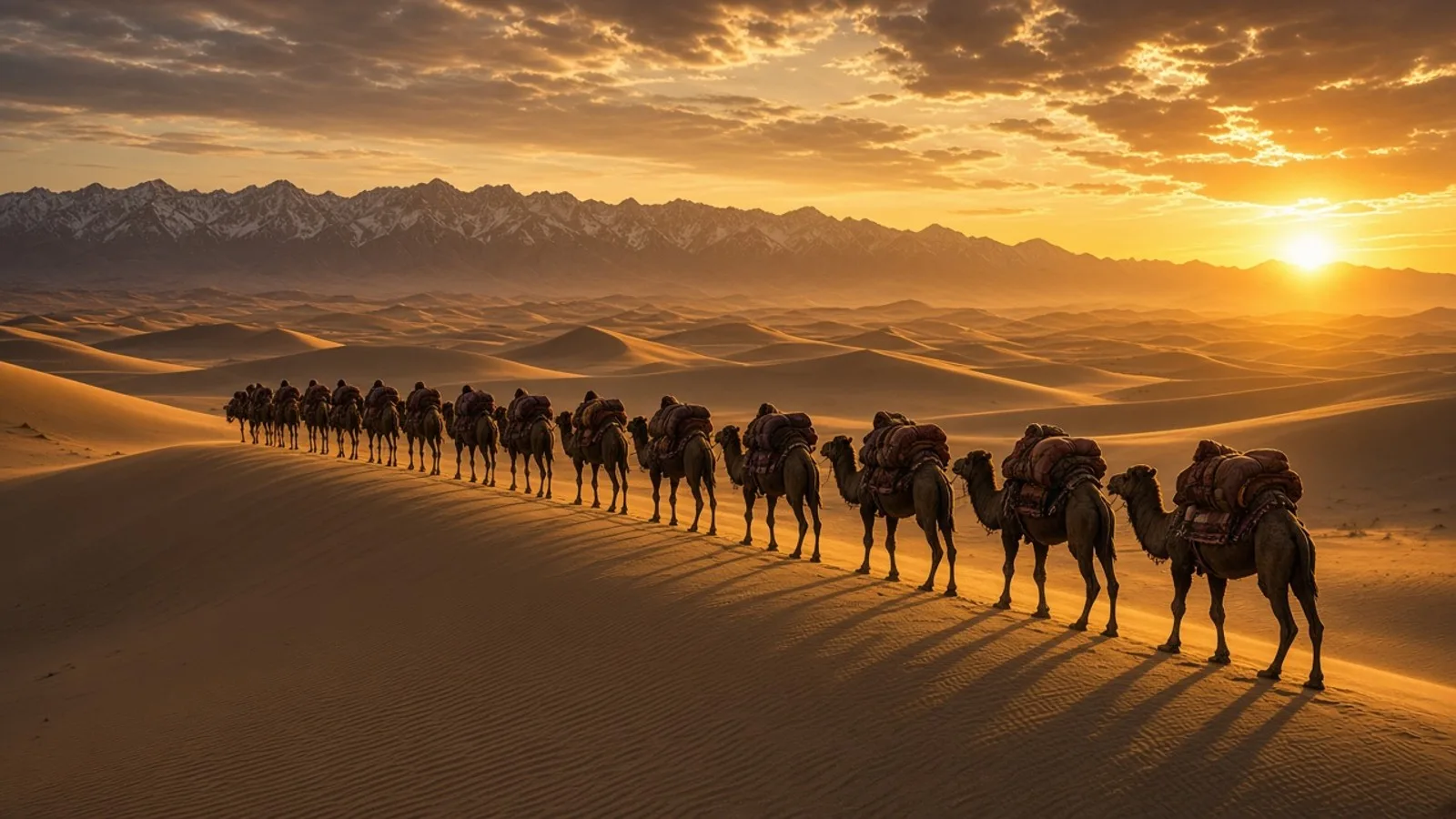
“Silk Road” sounds like one highway. It was not. It was a shifting web of overland routes linking China to Central Asia, Persia, India and the Mediterranean—carrying silk and spices, but also religions, technologies and disease. Peaks under the Tang and the Mongols gave way to maritime dominance. China’s Belt and Road Initiative borrows the metaphor; it is a modern infrastructure politics, not a camel caravan revived.
A Name, Not a Single Road
German geographer Ferdinand von Richthofen popularised “Seidenstraße” (Silk Road) in the nineteenth century. Ancient traders used many tracks through desert oases, mountain passes and steppe corridors. Parallel maritime routes—“Maritime Silk Roads”—moved bulkier cargoes centuries before European steamships.
Goods and Ideas
- Goods: Chinese silk and porcelain; horses from the steppe; glass and gold from the west; Indian textiles, gems and spices via branching routes.
- Faiths: Buddhism spread east into China; Islam, Manichaeism and Nestorian Christianity moved along the same towns.
- Know-how: Paper, printing and navigational ideas diffused over long periods—exact timelines remain scholarly debates.
Indian intellectual history in a classical age: Madras Observatory shows later scientific exchange; older networks fed that curiosity.
Tang Flourishing
Under the Tang dynasty (618–907) China projected power into the western regions and Sogdian merchants knitted oasis cities into a commercial chain. After mid-eighth-century crises, western control weakened and overland trade became more intermittent—never a simple on/off switch.
Mongol Apex
The thirteenth–fourteenth-century Mongol empires created unusual security across Eurasia (Pax Mongolica). Marco Polo’s travels are popularly tied to this era (scholars still argue over details of his account). Mongol policy also boosted sea links; eventually ships outcompeted caravans for bulk long-haul trade.
Decline After Sea Trade
When empires fragmented, banditry and tolls rose. Portuguese and later Dutch and English oceanic routes linked the Atlantic to the Indian Ocean. Overland Silk Road legs shrank toward regional trade. The routes did not “die”; they lost primacy.
Steam-age and canal-age shortcuts finished the job: Suez and Panama made oceans the default global highway. Risk at sea never vanished—see Titanic.
Belt and Road: Modern Echo (Hedged)
Since 2013 China has framed the Belt and Road Initiative as land and maritime corridors of ports, rails and loans—sometimes branded a “New Silk Road.” Hedge carefully: BRI is state-led twenty-first-century infrastructure finance, not a restoration of Tang caravans. The shared idea is Eurasian connectivity; the tools, scale and politics are new. Critics cite debt and influence; supporters cite trade access. History supplies the metaphor, not the blueprint.
Key Periods
| Period | Note |
|---|---|
| Han and after | China–Central Asia links intensify |
| Tang (7th–9th c.) | Major overland flourishing |
| Mongol (13th–14th c.) | Eurasian security peak |
| After 15th c. | Maritime routes dominate |
| 2013– | BRI / “New Silk Road” rhetoric |
Myths and Facts
- “One road”: False—many branches, eras and seas.
- “Only silk”: False—faiths, pathogens, people, ideas.
- “BRI equals the ancient Silk Road”: Metaphor, not identity.
Also: Everest 1953 for another story of routes, empires and ambition.
Final Thoughts
The Silk Road is globalisation before the word existed. Caravans wrote the first draft; container ships wrote the current edition. When politicians invoke silk and sand, check whether they mean history—or a slogan.