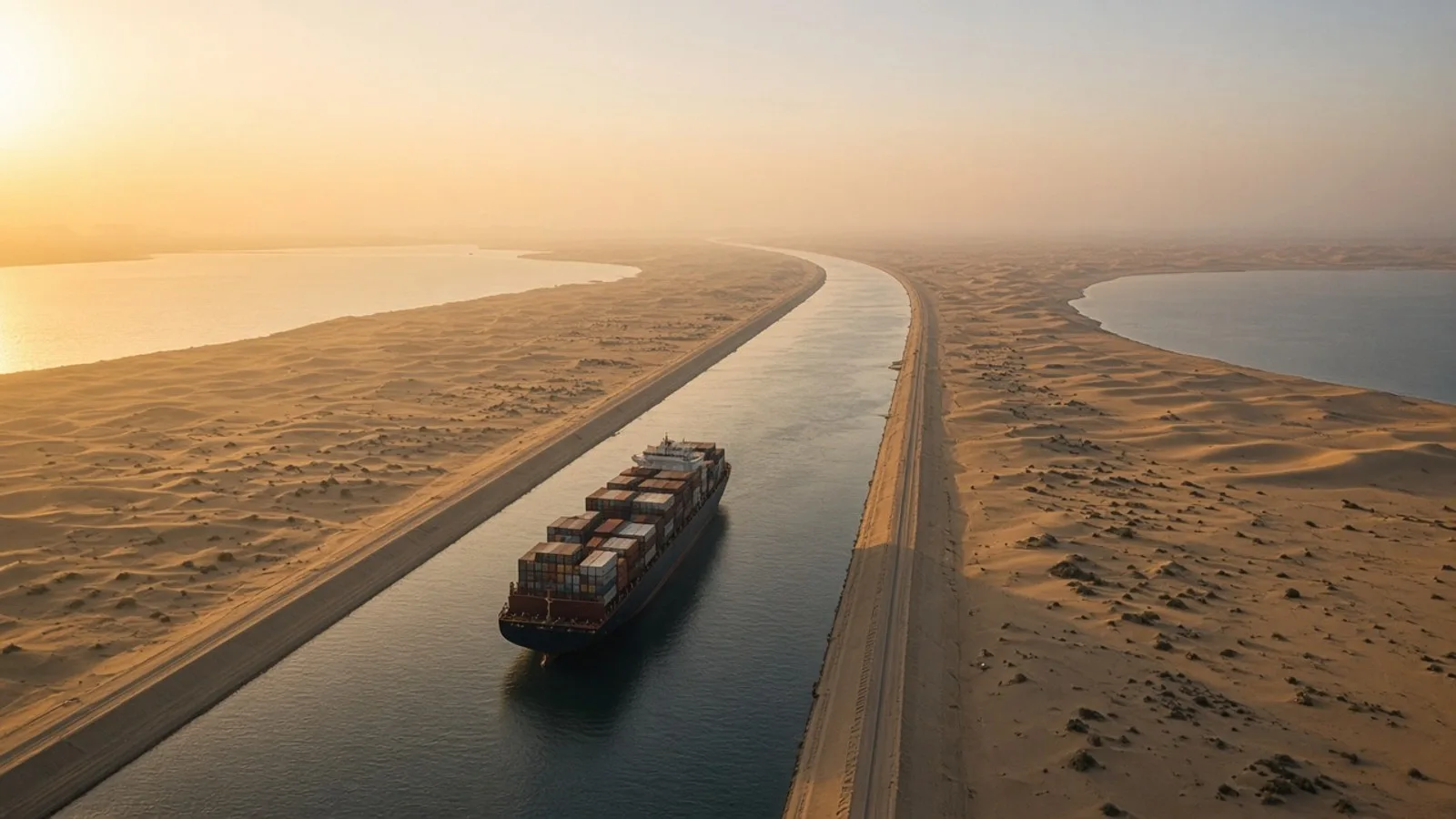
A 193-kilometre trench through the sand of the Isthmus of Suez joins the Mediterranean to the Red Sea. Before 1869, a ship sailing from London to Bombay had to go round Africa by the Cape of Good Hope. Afterwards, the trip was roughly 40 percent shorter. Few works of engineering have redrawn the map of trade so abruptly.
This long read follows the canal from the pharaohs’ Nile–Red Sea canals, through Ferdinand de Lesseps and 1869, British control, Nasser’s nationalisation and the 1956 Suez Crisis, the eight-year closure of 1967–75, the 2015 expansion, the Ever Given blockage of 2021 and the Red Sea shipping crisis, which is still easing in late 2026. Where historians or official sources disagree, we say so.
Ancient Forerunners and Napoleon’s Error
Most ancient canals did not run straight from sea to sea. They linked a branch of the Nile to the Red Sea through the Wadi Tumilat and the Bitter Lakes. Some writers credit a Middle Kingdom pharaoh, often named as Senusret III (nineteenth century BCE), with an early channel. Many historians call that possible but unproven. According to Herodotus, Necho II began a canal around 600 BCE and gave it up after a huge loss of life. Herodotus puts the toll at 120,000, a figure scholars do not take literally. The Persian king Darius I completed or reopened the link around 500 BCE. Stelae he set up along the route, in Old Persian, Elamite, Akkadian and Egyptian, record the work.
Ptolemy II improved the canal in the third century BCE, and the emperor Trajan restored a version in the second century CE. After the Arab conquest of Egypt, ʿAmr ibn al-ʿAs reopened a channel in the 640s to carry grain to Arabia. Arabic sources say the Abbasid caliph al-Mansur closed it in the 760s or 770s; the exact year is debated. After that, camel caravans carried goods across the isthmus for about a thousand years.
Napoleon’s expedition of 1798–1801 revived the idea. His engineer Jacques-Marie Le Père concluded that the Red Sea stood about 10 metres higher than the Mediterranean, which would mean locks or a flooded Delta. The figure was wrong. Surveys in the 1840s showed that the two seas are almost level, so a canal without locks became possible. Engineers Luigi Negrelli and Linant de Bellefonds then drew the plans that shaped the final route.
Ferdinand de Lesseps and the Concession
Ferdinand de Lesseps was a French diplomat, not an engineer. His talents were persistence, contacts and salesmanship. He had known Egypt’s new ruler, Muhammad Saʿid Pasha, since Saʿid’s youth. He won a first concession on 30 November 1854 and a fuller one in 1856. These gave a company the right to build the canal and operate it for 99 years after it opened. Egypt was to receive 15 percent of the net profits.
The Compagnie universelle du canal maritime de Suez was set up in December 1858. French investors bought most of the public shares. Britain saw a French-led project on the route to India as a threat and refused to subscribe. Saʿid took the unsold shares, which left Egypt holding about 44 percent of the company. Historians often trace Egypt’s later debt crisis back to this stake.
Building the Canal, 1859–1869
Work began on 25 April 1859 at the future Port Said. In the early years the company relied on corvée, or forced labour. Egyptian peasants were drafted in rotation, often tens of thousands at a time. They dug by hand in heavy heat with poor water, and cholera spread through the camps.
How many died is one of the canal’s most contested numbers. Egyptian accounts often cite about 120,000 deaths. Many Western historians think the records support thousands to low tens of thousands. No reliable full count exists, but the human cost was clearly very large.
Khedive Ismaʿil moved to limit forced labour under international pressure. In 1864, Napoleon III arbitrated the resulting dispute and made Egypt pay the company heavy compensation, usually given as 84 million francs. After that, steam dredgers did most of the work. The contractors Borel, Lavalley et Cie used huge machines, and by the late 1860s Suez was one of the most mechanised building sites in the world. A freshwater canal from the Nile supplied the camps. The new town of Ismailia grew up halfway along the route.
17 November 1869: The Opening
The canal opened formally on 17 November 1869. Khedive Ismaʿil staged a lavish celebration to present Egypt as a modern state. Empress Eugénie of France led the procession aboard the imperial yacht L’Aigle.
The first canal was about 8 metres deep and about 22 metres wide at the bottom. Traffic was disappointing at first, and the company struggled. Steamships changed that. Sailing ships found the Red Sea winds difficult, but steamers that could refuel at coaling stations used the short route easily. Within a decade, Suez was central to trade between Europe and Asia.
Britain Takes Control: 1875, 1882 and 1888
In November 1875, with Ismaʿil deep in debt, British Prime Minister Benjamin Disraeli bought Egypt’s 176,602 shares, about 44 percent of the company, for nearly £4 million. He used a bridging loan from the Rothschilds and acted before Parliament could approve. The deal gave Britain a large stake but not full ownership.
Egypt’s finances still collapsed, and European creditors took control of its budget. In 1882 a nationalist movement led by Colonel Ahmed ʿUrabi challenged foreign control. Britain invaded and won at Tel el-Kebir on 13 September 1882. The British occupation that followed lasted, in practice, for more than seven decades. Protecting the “highway to India” was one of the main reasons given for staying.
The Convention of Constantinople (1888) declared the canal open to all flags “in time of war as in time of peace.” In practice, Britain closed it to enemy shipping in both World Wars. Egypt became formally independent in 1922, but the 1936 Anglo-Egyptian Treaty still kept British troops in the Canal Zone. For the alliance politics behind those wars, see our Europe before 1914 explainer.
Nationalisation and the 1956 Suez Crisis
Army officers took power in Egypt in the 1952 revolution, and Gamal Abdel Nasser soon became its leader. The last British troops left the Canal Zone in June 1956 under a 1954 agreement. On 19 July 1956 the United States, followed by Britain, withdrew offers to help fund the Aswan High Dam. On 26 July, in a speech in Alexandria, Nasser announced that Egypt was nationalising the canal company. Egypt promised shareholders compensation, and canal revenue was to help pay for the dam.
Britain, France and Israel then made a secret plan, recorded in the Protocol of Sèvres. Israel invaded Sinai on 29 October. Britain and France issued an ultimatum, began bombing Egypt on 31 October, and landed troops at Port Said on 5–6 November. Egypt blocked the canal by sinking dozens of ships, usually counted at about 40 to 50.
The invaders made military progress but suffered a political defeat. President Eisenhower opposed the operation and put financial pressure on sterling. The Soviet Union issued threats, and the UN demanded a ceasefire, which took effect on 6–7 November. Lester Pearson’s plan for UNEF, the first large UN peacekeeping force, won him the 1957 Nobel Peace Prize. Anthony Eden resigned in January 1957. After a UN salvage operation, ships moved again in spring 1957. Sources give March or April, depending on whether they count the first transits or full clearance. The nationalisation stood. Suez is widely seen as the end of Britain’s and France’s ability to act as independent imperial powers.
1967–1975: Eight Years Closed and the “Yellow Fleet”
When the Six-Day War began in June 1967, the canal became the front line between Egyptian and Israeli forces. Fifteen cargo ships were trapped in the Great Bitter Lake. Their crews formed the “Great Bitter Lake Association,” held sports contests and issued unofficial stamps. Because desert sand settled on their decks, they became known as the “Yellow Fleet.” Two West German ships, Münsterland and Nordwind, finally sailed home under their own power in 1975.
The closure pushed shipowners to build supertankers that were too big for the canal and profitable enough to sail around the Cape. On 6 October 1973, Egyptian forces crossed the canal and broke through Israel’s Bar Lev Line. After disengagement agreements, international naval teams cleared mines and wrecks. President Anwar Sadat reopened the canal on 5 June 1975, eight years after it closed.
Widening and the 2015 “New Suez Canal”
Since 1975 the Suez Canal Authority has repeatedly widened and deepened the channel. Loaded ships with a draught of about 20 metres can now pass, and the largest tankers that fit are called “Suezmax.” Ships still travel in scheduled convoys. In August 2015, President Abdel Fattah el-Sisi opened an expansion costing around $8 billion. It added a parallel channel about 35 kilometres long and deepened about 37 kilometres of the existing route. Officials promised that revenue would roughly double by the 2020s. Critics doubted that forecast, and early growth fell short of it. The southern section near Suez remained a single lane.
March 2021: The Ever Given Blockage
On 23 March 2021, in high winds and a sandstorm, the Ever Given ran aground sideways across that single-lane southern section. Operated by Evergreen, the container ship is 400 metres long and can carry about 20,000 TEU. Dredgers, tugs and a spring tide refloated it on 29 March. At the peak, figures of about 370 to more than 400 ships were reported waiting. Lloyd’s List estimated that $9–10 billion of goods normally passed through the canal each day. Egypt held the ship while it pursued compensation, starting with a claim of more than $900 million, and released it in July 2021 after a settlement whose full terms were not disclosed. The incident sped up plans to widen the southern stretch.
The Red Sea Crisis and Why Suez Still Matters
From late 2023, Houthi attacks on merchant ships in the Red Sea pushed the largest container lines to sail around the Cape. That added roughly 10–14 days to Asia–Europe voyages. Reported canal revenue fell from about $10.2 billion in 2023 to about $4 billion in 2024. By fiscal year 2025/26 it had recovered to about $4.67 billion. The Suez Canal Authority reported 1,490 transits and $724 million in revenue for October 2026, its best month since the crisis began. Lloyd’s List data, however, still put tonnage about a third below pre-crisis levels.
The canal usually carries an estimated 12 percent of world seaborne trade. Its tolls are among Egypt’s largest sources of foreign currency. When it closes, freight rates and insurance premiums rise, fuel use increases and deliveries slip. For another engineered link built for empire and trade, see the Pamban Bridge story.
- Length: about 193 km (120 miles), Port Said to Suez, with no locks.
- Construction: 25 April 1859 to 17 November 1869.
- Disraeli’s purchase in 1875: about 44 percent of the shares for nearly £4 million.
- Major closures: 1956–57; 1967–75; 23–29 March 2021.
- Revenue: about $10.2 bn (2023), about $4 bn (2024), about $4.67 bn (FY2025/26).
Timeline
- c. 600 BCE: Necho II begins a Nile–Red Sea canal (according to Herodotus).
- c. 500 BCE: Darius I completes or reopens it.
- 640s CE: ʿAmr ibn al-ʿAs reopens a canal; it is closed in the 760s or 770s.
- 1854–58: Concessions granted and the company founded.
- 25 Apr 1859: Work begins.
- 17 Nov 1869: Official opening.
- 1875 / 1882 / 1888: Britain buys the shares, occupies Egypt, and the Constantinople Convention is signed.
- 26 Jul 1956: Nationalisation; the Suez Crisis follows in Oct–Nov.
- Jun 1967 – 5 Jun 1975: Long closure.
- Aug 2015: Expansion opens.
- 23–29 Mar 2021: Ever Given blockage.
- 2023–2026: Red Sea crisis and partial recovery.
Myths vs Facts
- Myth: Lesseps engineered the canal. Fact: He was a diplomat and promoter. Engineers and contractors did the technical work.
- Myth: Verdi’s Aida premiered at the 1869 opening. Fact: Aida premiered in Cairo on 24 December 1871. The opera house opened in 1869 with Rigoletto.
- Myth: Britain owned the canal after 1875. Fact: Britain held about 44 percent of the shares. Military occupation, not share ownership, gave it physical control.
- Myth: The 1956 invasion succeeded. Fact: The invaders withdrew under U.S., Soviet and UN pressure, and the nationalisation stood.
- Myth: The two seas are at very different levels. Fact: That was Napoleon’s survey error. The canal has no locks.
FAQ
How long does a transit take? Usually around 11 to 16 hours in convoy.
Who owns the canal today? The Egyptian state, through the Suez Canal Authority, created in 1956.
More from HorizonDesk: the Titanic’s full story and Bermuda Triangle myths vs facts.
Final Thoughts
The Suez Canal began as a French promoter’s dream and was dug largely by Egyptian forced labour. It then passed under British control and, after 1956, became a symbol of Egyptian sovereignty. It has been closed by war, blocked by one ship and emptied by attacks hundreds of kilometres away. Each time, the same lesson returns: much of the world economy still depends on one narrow channel through the desert.
Sources
- Encyclopaedia Britannica: “Suez Canal” and “Suez Crisis.”
- Suez Canal Authority: official history and navigation statistics, including its November 2026 statement.
- Herodotus, Histories, Book II, with modern Egyptological commentary.
- Zachary Karabell, Parting the Desert: The Creation of the Suez Canal (2003).
- Keith Kyle, Suez: Britain’s End of Empire in the Middle East.
- U.S. Department of State, Office of the Historian: “The Suez Crisis, 1956.”
- Lloyd’s List and Lloyd’s List Intelligence: reporting on the Ever Given and the Red Sea, 2021–2026.
- Arab News and Al-Monitor: reporting on Suez revenue, 2025–2026.