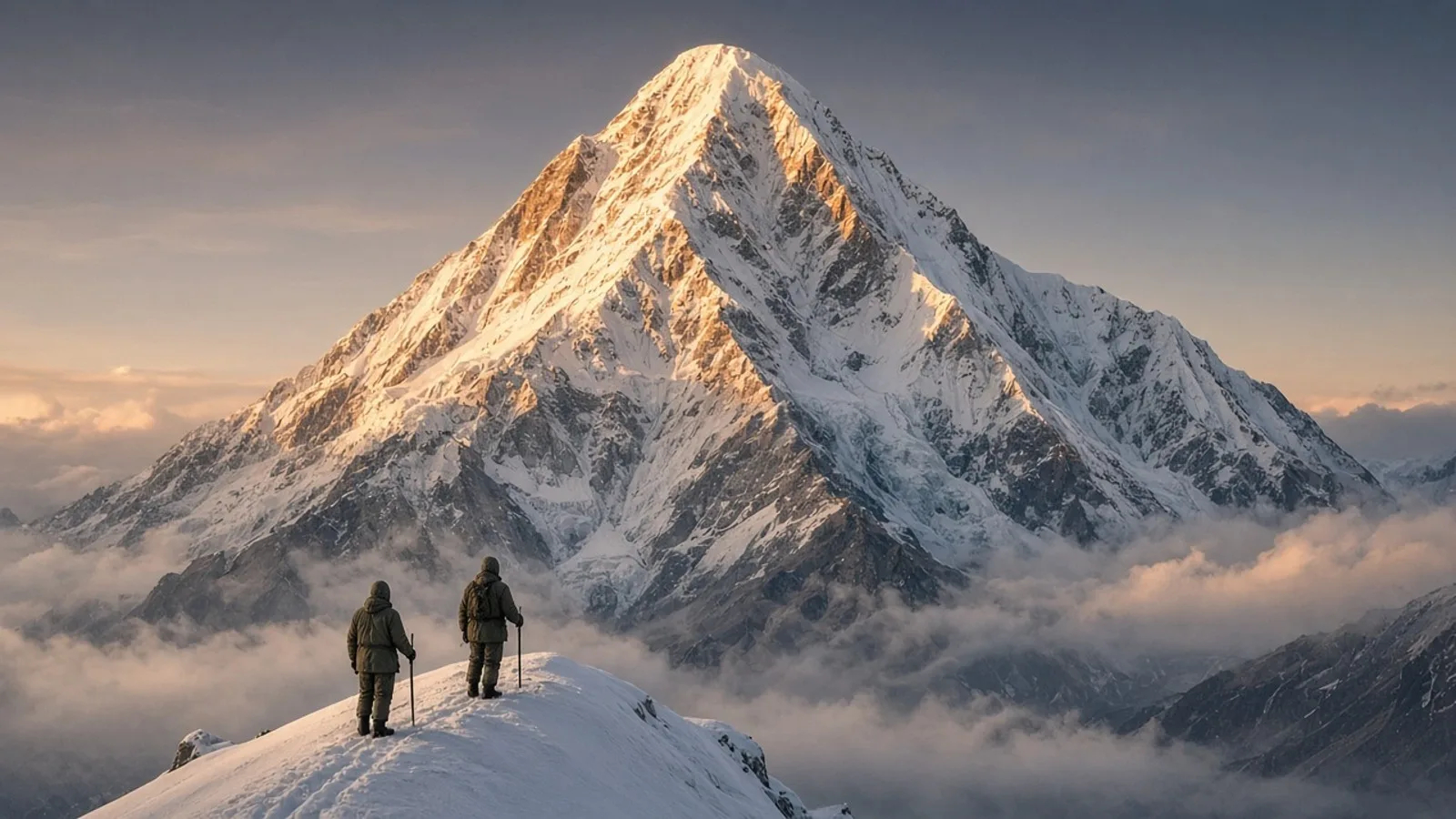
At 11:30 on the morning of 29 May 1953, two climbers stood on the highest point on Earth. One was Edmund Hillary of New Zealand; the other was Tenzing Norgay, the Sherpa mountaineer whose experience on Everest already outstripped almost everyone alive. Below them, cloud filled the valleys. Above, only sky. For the first time in recorded, confirmed history, human beings had reached the summit of Mount Everest and would live to tell the story.
This article follows that first confirmed ascent: John Hunt’s British expedition, earlier attempts including Mallory and Irvine in 1924 (whether they summited remains an open question), the South Col route, the climb day, Tenzing’s summit photograph, the news racing to London for Queen Elizabeth II’s coronation, and the climb’s legacy.
Everest: The Roof of the World
Everest sits on the Nepal–Tibet border. In Nepali it is Sagarmatha; in Tibetan, Chomolungma. For decades popular writing rounded its height at about 8,848 metres (29,029 feet). In 2020 Nepal and China jointly announced a figure of 8,848.86 metres. Older British survey figures once listed 29,002 feet. Heights shift slightly with surveying methods; Everest’s status as the world’s highest mountain does not.
Nineteenth-century officers of the Great Trigonometrical Survey of India identified the peak’s supremacy. It was later named for Sir George Everest. By the early twentieth century, climbing it had become a national and scientific prize—Earth’s “highest first,” decades before the Moon landing.
Mountain logistics in another landscape appear in our history of the Nilgiri Mountain Railway. Surveying and sky-watching in colonial India are covered in the Madras Observatory story.
Earlier Attempts: Mallory to the Swiss
From 1921, British expeditions approached Everest from Tibet. Nepal was closed to foreigners for much of that era.
Mallory and Irvine (1924)
On 8 June 1924, George Mallory and Andrew Irvine pushed along the Northeast Ridge and disappeared into cloud. They never returned. Mallory’s famous answer to “Why climb it?”—“Because it’s there”—became mountaineering lore.
Mallory’s body was found in 1999. Irvine’s has not been conclusively identified. Their camera has not been recovered. Whether they reached the summit is still unknown. Hillary later wrote that he looked for signs of them on top and saw nothing. History records Hillary and Tenzing as the first confirmed summiteers while still honouring Mallory and Irvine’s courage.
The 1952 Swiss Expeditions
Once Nepal opened, the southern approach—the South Col route—became viable. In 1952 Swiss teams, with Tenzing among them, reached near the South Summit with Raymond Lambert. They did not claim the top, but they proved the southern line and left Tenzing uniquely prepared for 1953.
Hunt’s 1953 Expedition
The Joint Himalayan Committee mounted a large British attempt under Colonel John Hunt. Eric Shipton had been associated with earlier leadership discussions; Hunt’s military-style planning won the job. The race was against the monsoon.
Logistics dwarfed the summit pairs: on the order of 350 porters, about twenty Sherpas, and a small climbing team. Oxygen sets, tents, food and rope moved camp by camp up the mountain. New Zealanders Edmund Hillary and George Lowe joined the party. Tenzing Norgay served as a leading Sherpa and summit contender. Expedition member George Band later recalled Hunt’s wish, if feasible, to include a Sherpa in a summit pair—recognition of skill, not tokenism. Tenzing had already been higher than most of the British climbers.
Hillary was a beekeeper by trade and a hardened climber by passion. Tenzing’s Everest résumé stretched back to the 1930s. Their pairing for the second assault was earned on performance and acclimatisation as much as on politics.
The South Col Route
The line they followed is still the standard commercial route:
- Khumbu Icefall: a shifting glacier maze of seracs and crevasses.
- Western Cwm: a high, enclosed snow valley.
- Lhotse Face: a steep ice slope leading toward the col.
- South Col: roughly 7,900–8,000 metres; the high wind-blasted saddle used as a launch pad.
- South Summit, then the Hillary Step, then the true summit.
George Lowe and others cut a path up the Lhotse Face. Closed-circuit and open-circuit oxygen systems were both tested. Above roughly 8,000 metres the body cannot fully acclimatise; bottled oxygen was part of the 1953 plan for the final push.
First Assault: Bourdillon and Evans
Hunt planned two summit attempts. First went Tom Bourdillon and Charles Evans on 26 May. They reached the South Summit—then among the highest points humans had stood—but oxygen-set troubles, exhaustion and the clock forced a turnaround within roughly 100 metres (about 300 feet) of the top. They could see the ridge and the rock step later named the Hillary Step. Their retreat cleared the way, and the lessons, for the second pair.
Closed-circuit sets promised speed but proved fiddly at altitude. Hillary and Tenzing would use open-circuit oxygen. Failure of the first assault was not wasted effort; it was reconnaissance paid for in sweat and risk.
Summit Day: 29 May 1953
Hillary and Tenzing left a high camp (Camp IX) near 8,500 metres after a freezing, nearly sleepless night. They moved off about 6:30 am, reached the South Summit by 9 am, then faced the narrow snow-and-ice ridge and the roughly 12-metre (40-foot) rock step. Hillary jammed upward between rock and ice—the manoeuvre that gave the Hillary Step its name—then brought Tenzing up on the rope.
At 11:30 am they stood on the summit. Hillary later described an Anglo-Saxon handshake followed by Tenzing’s embrace. They stayed about fifteen minutes.
- Hillary photographed Tenzing on the top, flags in hand—the iconic image.
- There is no corresponding summit photo of Hillary; Tenzing was unfamiliar with the camera, and Hillary did not hand it over for a self-portrait.
- Hillary scanned for traces of Mallory and Irvine and found none.
- Small offerings—including a cross from Hunt and sweets or tokens from Tenzing—were left in the snow, according to expedition accounts.
Who stepped first? For years both men publicly stressed a joint arrival. Later testimony and biographies commonly state that Hillary was slightly ahead, with Tenzing confirming as much. The historical consensus: a shared first confirmed ascent, with Hillary a step in front at the end.
On the way down Hillary told George Lowe, “Well, George, we knocked the bastard off.” Photographer Alfred Stobart staged the reveal so base-camp emotion could be filmed—then celebration erupted.
What They Did on Top
The summit is a small, wind-scoured cusp of snow, not a broad plaza. Hillary briefly removed his oxygen mask to work the camera and soon felt clumsy and slow. They looked out over a world of peaks and cloud, then started down before the weather or their gas could trap them.
Tenzing’s summit photograph circled the globe. Conspiracy corners later asked why Hillary’s face was missing from the summit set; the camera logistics answer that question. Diaries, teammates, news despatches and the photograph of Tenzing remain mutually consistent evidence of success.
News for a Coronation
Word moved by runner and radio from base camp. James Morris (later Jan Morris) of The Times got a coded message to London. The story broke on 2 June 1953—the day of Elizabeth II’s coronation. Britain read the double headline as a national omen.
Hillary and Hunt received knighthoods that year. Tenzing, not a Commonwealth citizen, received the British Empire Medal—a lesser imperial honour that still left him a hero in Nepal and India. Debates about his birthplace and nationality (Nepal–Tibet–India connections, Darjeeling ties) followed; this article treats him as the indispensable summit partner he was.
Hillary later devoted much of his life to building schools and hospitals in Nepal and also joined Antarctic exploration. Tenzing died in 1986; Hillary in 2008.
Oxygen, Kit and 1953 Technology
Open-circuit oxygen vents exhaled gas; closed-circuit systems scrubbed carbon dioxide and reused oxygen—lighter in theory, riskier when valves failed, as Evans learned. Boots, gloves and layers were purpose-built for cold. Radios were limited; much communication still depended on runners. Food was simple high-calorie fare. There was no GPS, no helicopter rescue on call, no fixed commercial ropes. Maps, compasses, judgment and trust had to suffice.
Key Numbers at a Glance
| Detail | Note |
|---|---|
| Summit date | 29 May 1953, 11:30 am |
| Summiteers | Edmund Hillary, Tenzing Norgay |
| Leader | Colonel John Hunt |
| Route | South Col (Nepal side) |
| First assault | Bourdillon–Evans, 26 May; South Summit, turned back |
| Traditional height | ~8,848 m / 29,029 ft |
| 2020 survey | 8,848.86 m (Nepal–China) |
| News published | 2 June 1953 (Coronation Day) |
| Mallory–Irvine | 1924; summit unconfirmed |
Legacy
- Psychological barrier: Everest was no longer “unclimbable.” Later decades brought new routes, winter ascents, climbs without bottled oxygen, and wider participation.
- Sherpa centrality: Tenzing’s fame made visible what every Himalayan expedition already knew—Sherpa skill and labour make high success possible.
- Hillary’s service: His Himalayan Trust work tied the summit story to schools and clinics in Khumbu.
- Crowding and waste: Twenty-first-century commercial traffic brought queues, rubbish and ethical fights over guiding and permits. Climate change is altering glaciers and the Icefall.
- Who was “first”? Confirmed first: Hillary and Tenzing. Mallory and Irvine remain an unresolved historical question without summit proof.
Human ambition’s other mid-century summit—space—echoes the same mix of planning and nerve. For a different kind of engineered crossing under storm risk, read the Pamban Bridge history. And for how myth overtakes maritime fact, see the Titanic.
Everest Today: After 1953
Hundreds summit in a busy spring season now. Fixed ropes, forecasts and commercial logistics make the South Col route more predictable than in Hunt’s day—and still deadly. Avalanches, weather windows, altitude illness and human bottlenecks kill climbers most years. Clean-up campaigns and permit rules try to manage waste; details change with Nepalese regulation.
None of that shrinks 29 May 1953. Without GPS, with fragile oxygen gear and a monsoon deadline, a carefully led team put two climbers on the roof of the world. The photograph of Tenzing, flags against an empty sky, still carries that morning.
Timeline
- 1850s: Survey work establishes Everest as the highest peak.
- 1921–24: British Tibetan-side attempts; Mallory and Irvine vanish in 1924.
- 1952: Swiss southern attempts; Tenzing–Lambert high point.
- April–May 1953: Hunt expedition builds the route.
- 26 May 1953: Bourdillon and Evans reach the South Summit; turn back.
- 29 May 1953, 11:30: Hillary and Tenzing summit.
- 2 June 1953: News published on Coronation Day.
- 1999: Mallory’s body found; summit question remains open.
- 2020: Nepal–China height announcement: 8,848.86 m.
Myths and Facts
- “Mallory was first”: Unproven. Possible; not confirmed.
- “Tenzing was only a porter”: False. He was a lead climber and summit partner.
- “Hillary alone summited”: False. Both stood on top.
- “No Hillary photo means fraud”: False. Camera use explains the gap.
- “Everest is easy now”: False. Crowds do not cancel altitude, cold or avalanche risk.
Frequently Asked Questions
Who first climbed Everest?
The first confirmed ascent: Edmund Hillary and Tenzing Norgay, 29 May 1953. Mallory and Irvine’s 1924 attempt is unconfirmed.
Who stepped on the summit first?
Common historical reading: Hillary slightly ahead; both celebrated as joint first confirmed summiteers.
What is the South Col route?
The Nepal-side line via the Khumbu Icefall, Western Cwm, Lhotse Face and South Col—today’s standard commercial path.
Why did the news hit on Coronation Day?
The despatch reached London in time for 2 June 1953 publication. Timing amplified the story; it was not a staged political stunt invented on the mountain.
Does the Hillary Step still look the same?
Climbers reported changes after the 2015 earthquake. Snow and rock geometry on the final ridge can shift over time.
What did Hillary do afterward?
Extensive humanitarian work in Nepal, further exploration including Antarctica, public life as a symbol of the ascent. He died in 2008.
Final Thoughts
The first confirmed Everest summit was never a solo miracle. It was planning, a failed first assault that taught hard lessons, Sherpa mastery, friendship, and two climbers’ last steps on a narrow ridge. Mallory and Irvine’s question may never close. On 29 May 1953, humanity nonetheless stood—documented, photographed, alive—on the roof of the world.