This one-off history feature was prompted by Mr. GK's Tamil podcast conversation with Chennai historian Venkatesh Ramakrishnan (watch on YouTube). The facts below come from the published sources listed at the end, not from the podcast.
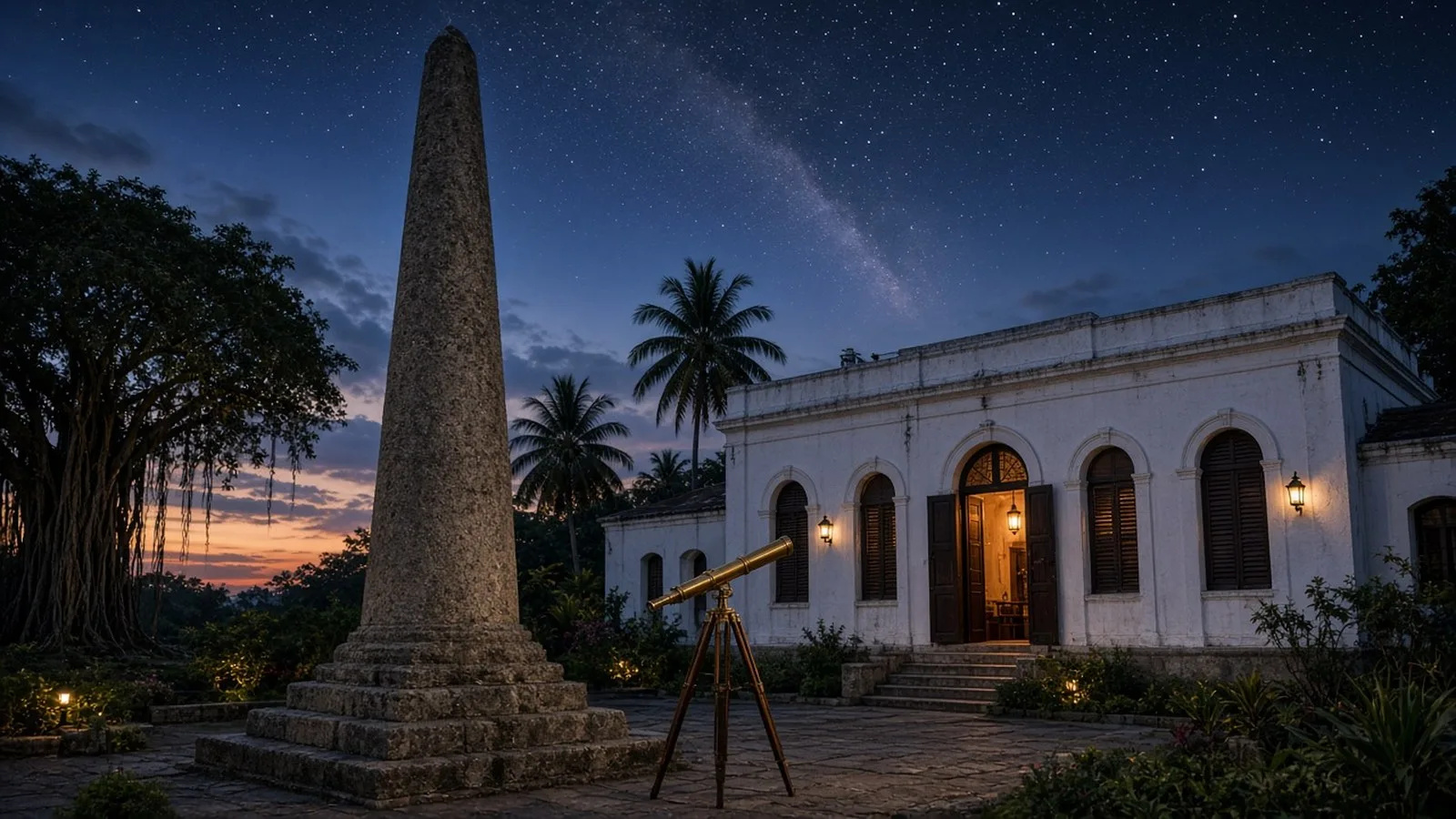
Behind the gates of the Regional Meteorological Centre on College Road, Nungambakkam, stands a tapering granite pillar that most Chennai residents have never seen. It once carried the main telescope of the Madras Observatory, which the Indian Institute of Astrophysics (IIA) describes as the first modern observatory outside Europe. For about a century, astronomers here fixed the longitude of Madras, set railway time, catalogued thousands of stars and kept some of India's oldest weather records. Here is that story, and what you can still see.
A private observatory becomes the Company's (1786-1792)
The observatory began as a private hobby. William Petrie, an East India Company official, set up an observatory at his Madras residence in 1786. His equipment included two 3-inch telescopes, two astronomical clocks and a transit instrument (IIA). You will also see 1787, 1788 or 1792. Using manuscript records at IIA, the historian R. K. Kochhar showed in 1985 that observations began in 1786; 1792 is when the Company's building was finished.
When Petrie left for England in 1789 he gave his instruments to the government. Michael Topping, the Company's marine surveyor, took charge, and Governor Sir Charles Oakeley backed a proper observatory "for promoting the knowledge of Astronomy, Geography and Navigation in India" (IIA). Topping designed the building himself, on the bank of the Cooum river in Nungambakkam, and his assistant John Goldingham supervised the work.
According to Kochhar, the 1792 building was a single room about 65 ft long, 20 ft wide and 14 ft high. At its centre, on its own foundation so footsteps would not shake it, rose a conical granite pier about 18 ft tall and weighing at least 10 tons. It carried the observatory's main instrument and bore the words "Michael Topping, Arch. AC MDCCXCII" (1792).
The astronomers, in order
Kochhar lists nine heads of the observatory at Madras:
- William Petrie (1786-1789): founder, private observatory.
- Michael Topping (1789-1796): designer of the 1792 building.
- John Goldingham (1796-1805 and 1812-1830): longitude, Madras time, the first weather registers. IIA calls him the first official Company astronomer.
- John Warren (1805-1811, acting): revised the Madras longitude.
- T. G. Taylor (1830-1848): the great Madras star catalogue.
- W. S. Jacob (1849-1858): double stars and planets.
- J. F. Tennant (1859-1860): prepared the new transit circle.
- N. R. Pogson (1861-1891): asteroids, variable stars, the 1868 eclipse.
- C. Michie Smith (1891 onwards): moved the astronomy to Kodaikanal.
Some sources give slightly different dates, for example for Topping and Tennant.
Longitude, maps and Madras time
For a seafaring trading company, knowing exactly where Madras lay mattered. Goldingham timed the eclipses of Jupiter's moons to work out the longitude of the observatory. His published values vary slightly between sources (80 degrees 18' 30" E in The Hindu's account, 80 degrees 18' 54" E in Kochhar's). In 1807 John Warren worked out a revised value of 80 degrees 17' 21" E, which Kochhar says was used for all official maps until 1905.
That number mattered for the whole subcontinent. On 10 April 1802 William Lambton began the Great Trigonometrical Survey of India by measuring a 7.5-mile baseline near Madras, between St Thomas Mount and Perumbakkam. IIA notes that the baseline was tied to the Madras longitude, so the accuracy of every later map of India rested partly on the observatory at Nungambakkam. A survey benchmark linked to Lambton's work is reported to stand near the old pillar.
The same work gave Madras its own clock. In 1802 Goldingham fixed Madras Time at about 5 hours 21 minutes ahead of Greenwich (usually given as GMT+5:21:14). From 1884, when Bombay and Calcutta kept their own official times, the railways used Madras Time as a compromise between the two, and timetables printed it beside local time. The Hindu reports that a time gun was fired at Fort St George at noon and 8 pm, and a semaphore near the marine office dropped at 8 am and 2 pm. When Indian Standard Time (GMT+5:30, based on 82 degrees 30' E) replaced Madras Time on 1 January 1906, Madras clocks only had to move forward about nine minutes. According to IMD, the observatory went on supplying the time signal over the telegraph network until 1931. We have not found a reliable source for a time ball at Madras, so this article does not claim one.
Taylor's catalogue: where the "11,000 stars" figure comes from
Thomas Glanville Taylor arrived in 1830 with new instruments by Dollond, including a transit instrument and a mural circle, and worked with Indian assistants. His great work was A General Catalogue of the Principal Fixed Stars, the "Madras General Catalogue", published in Madras in 1844. It gives the positions of 11,015 stars for the epoch 1 January 1835, from observations made between 1830 and 1843.
The Astronomer Royal, George Airy, praised it in 1854 as "the greatest catalogue of modern times" (as quoted in the Dictionary of National Biography). So when you read that Madras catalogued "about 11,000 stars", that is Taylor's catalogue. It is not Pogson's later star catalogue, which was smaller.
Under Taylor, magnetic and hourly weather observations began in 1840. His successor W. S. Jacob concentrated on double stars and the planets. Jacob's claim that irregularities in the double star 70 Ophiuchi pointed to an unseen planet did not hold up.
Pogson's Madras: asteroids, variable stars and an Indian discoverer
Norman Robert Pogson (1829-1891), already famous for the magnitude scale that bears his name (Pogson's ratio, 1856), ran the observatory for thirty years. In 1862 he installed a new transit circle by Troughton and Simms on granite piers built under Tennant. From Madras he discovered five asteroids:
- 67 Asia (17 April 1861)
- 80 Sappho (2 May 1864)
- 87 Sylvia (16 May 1866)
- 107 Camilla (17 November 1868)
- 245 Vera (6 February 1885)
IIA credits the observatory with the discovery of several variable stars, among them W Virginis, U Scorpii, T Sagittarii, Z Virginis, X Capricorni and R Reticuli. The variability of R Reticuli was found in 1867 by Pogson's assistant C. Ragoonathachary (Chintamani Raghunatha Chary), whom IIA describes as making "perhaps the first astronomical discovery by an Indian in recent history". Pogson also compiled a catalogue of about 3,000 stars and a variable-star atlas, published after his death. His daughter Isis Pogson worked as his assistant and later as meteorological reporter.
The 1868 eclipse and the yellow line
The total solar eclipse of 18 August 1868 crossed southern India. The French astronomer Jules Janssen observed it from Guntur, and the next day found he could see the bright lines of the solar prominences without an eclipse. The Madras Observatory sent two parties. One, at Wanparthy, was clouded out; the other, Pogson's at Masulipatam (Machilipatnam), recorded a bright yellow line that he described as coincident with, or very near, the sodium D line.
That line, now called D3, belongs to helium. Janssen and Norman Lockyer, who saw the line from London in October 1868, are usually credited with the discovery, and Lockyer later proposed the name helium. Some historians, notably B. B. Nath and later papers in the Journal of Astronomical History and Heritage, argue that Pogson's careful "at or near D" wording deserves more credit than it got. The fair summary: Pogson recorded the line, but he is not the generally accepted discoverer of helium.
Weather records
The Madras Observatory was a weather station from the start. The Hindu reported in 2001 that Goldingham's earliest meteorological observations date from September 1793, and IMD dates his regular register to 1796. Pogson also served as meteorological reporter to the Madras Government. The Madras Daily Weather Report began in 1893. Climate scientists still use these long series.
The move to Kodaikanal (1899)
Coastal haze and humidity hampered modern astrophysics. Pogson suggested a hill station as early as 1882, and Charles Michie Smith surveyed sites in the Palani and Nilgiri hills. In 1893 the Indian Observatories Committee, chaired by Lord Kelvin, chose Kodaikanal for a new Solar Physics Observatory. The foundation stone was laid in 1895. By March 1899 about a thousand head-loads of books and instruments had been carried up the hill, and the new observatory officially began work on 1 April 1899. John Evershed discovered the Evershed effect there in 1909, and the institution became the Indian Institute of Astrophysics in 1971.
Madras kept the time service and meteorology. In 1931 the old observatory became an ordinary pilot balloon station. Today the site is the Regional Meteorological Centre, Chennai.
What survives today
The 1792 building is gone, but a small enclosure at the RMC campus in Nungambakkam keeps several relics:
- The main granite pillar. IMD gives its height as 15 ft and its weight as about 10 tons. According to Kochhar, translations of the dedication in English, Tamil, Telugu and Urdu were cut into it.
- The Latin dedication. It originally sat over the western door of the observatory and records that the building was dedicated to astronomy at the expense of the East India Company under Governor Charles Oakeley, AD 1792.
- Later pillars linked to the 1860s transit circle and the observatory clocks, and a modern marker for the Madras meridian.
The Tamil and Telugu inscriptions repeat the Company's boast that posterity should know "a thousand years hence" when "the mathematical sciences were first planted by British liberality in Asia". It is worth reading critically in a land with its own long astronomical tradition. Accounts differ on which languages appear on which stone.
How to see it: the pillar is inside a working government meteorological campus on College Road, Nungambakkam, not a ticketed monument. Contact the Regional Meteorological Centre in advance for permission, go during office hours, and ask before taking photographs. Planning a wider trip? Our Tamil Nadu travel guide and weekend getaways from Chennai cover the wider region. Kodaikanal is a long but rewarding drive.
Timeline
| Year | Event |
|---|---|
| 1786 | William Petrie starts a private observatory at his Madras residence |
| 1789 | Petrie leaves for England and gives his instruments to the government; Michael Topping takes charge |
| 1792 | Observatory building with its granite pier completed at Nungambakkam |
| 1793 | Earliest surviving weather observations (Goldingham) |
| 1802 | Madras Time fixed; Lambton begins the Great Trigonometrical Survey with a baseline near Madras (10 April) |
| 1830 | T. G. Taylor arrives with new Dollond instruments |
| 1844 | Taylor's Madras General Catalogue (11,015 stars) published |
| 1861 | Pogson takes over; discovers asteroid 67 Asia |
| 1867 | Ragoonathachary finds the variability of R Reticuli |
| 1868 | Total solar eclipse: Pogson at Masulipatam, Janssen at Guntur |
| 1884 | Madras Time becomes de facto railway time |
| 1893 | Kodaikanal chosen for a Solar Physics Observatory; Madras Daily Weather Report begins |
| 1899 | Kodaikanal Observatory officially begins work (1 April) |
| 1906 | Indian Standard Time replaces Madras Time (1 January) |
| 1931 | Madras becomes a pilot balloon station; time signal service ends there |
For the wider scientific background, see our explainers on the Scientific Revolution and on the Age of Exploration, when the longitude problem first became urgent.
FAQ
When was the Madras Observatory founded?
Petrie's private observations began in 1786; the Company's Nungambakkam building was completed in 1792.
Who catalogued 11,000 stars at Madras?
T. G. Taylor, in his Madras General Catalogue of 1844 (11,015 stars).
Did the Madras Observatory discover helium?
Not by the usual account. Pogson recorded the yellow line in 1868, but Janssen and Lockyer are credited with the discovery.
Why did astronomy move to Kodaikanal?
The clearer hill air suited solar physics far better than coastal Madras.
Can I visit the granite pillar?
Only with prior permission from the Regional Meteorological Centre, Nungambakkam.
Sources
- Indian Institute of Astrophysics, History and Directors of Madras Observatory
- R. K. Kochhar, "Madras Observatory: The beginning", Bull. Astr. Soc. India 13 (1985) 162-168, PDF via NASA ADS
- R. K. Kochhar, "Madras Observatory: Buildings and instruments", Bull. Astr. Soc. India 13 (1985) 287-302, PDF via NASA ADS
- IMD Chennai, Madras Observatory (archived)
- The Hindu, When Madras clocked the time (2014)
- The Hindu, Madras Observatory feature (2001, archived)
- The Hindu, 100 years of weather forecasting in Chennai (2022)
- N. Kameswara Rao, A. Vagiswari and C. Birdie, "Charles Michie Smith - founder of the Kodaikanal (Solar Physics) Observatory", Current Science 106 (2014), arXiv
- AAS Historical Astronomy Division, The Discovery of Helium (2022)
- Dictionary of National Biography, Taylor, Thomas Glanville
- Wikipedia: Madras Observatory, Norman Pogson, Great Trigonometrical Survey, Madras Time