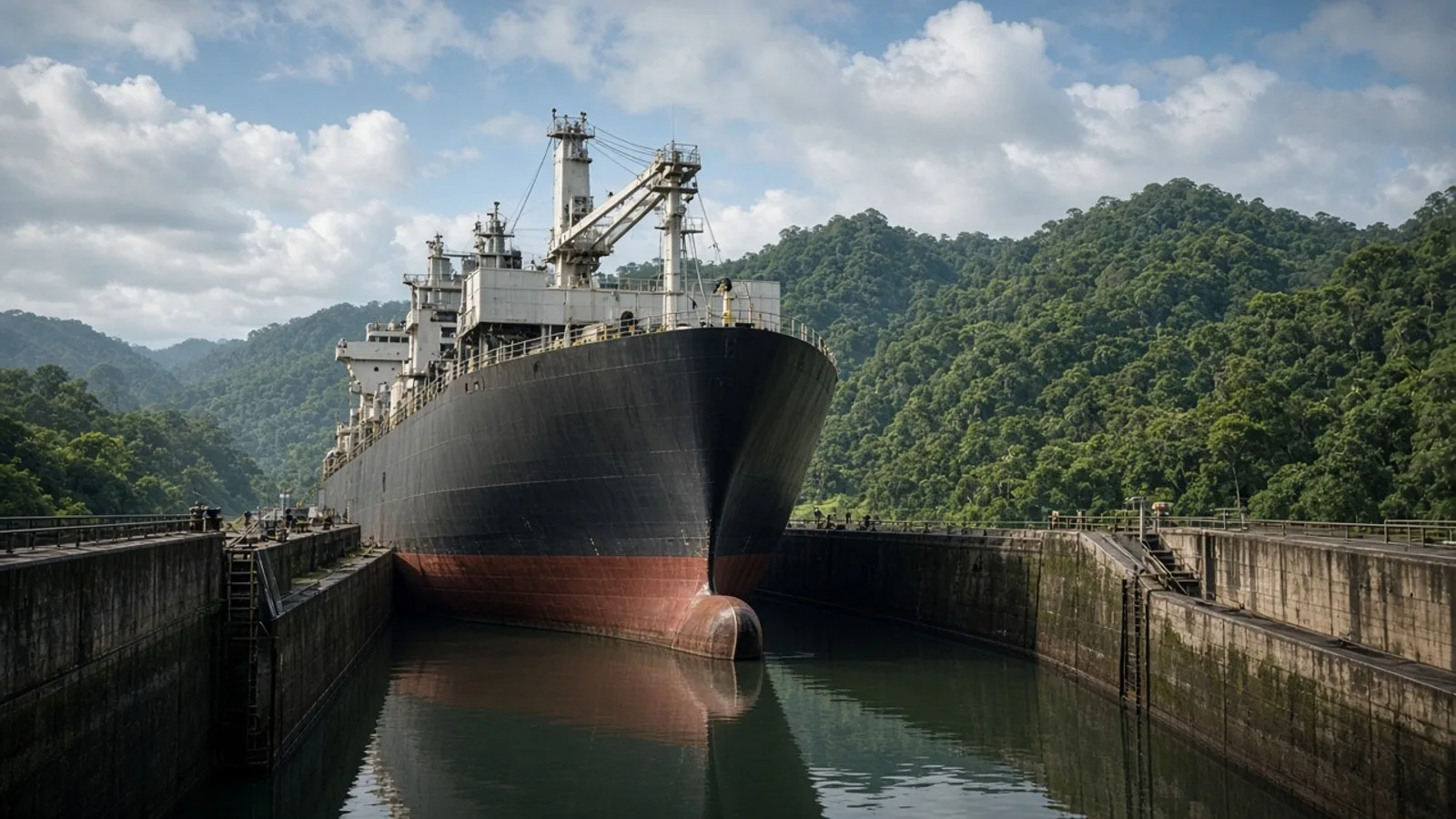
Between two oceans, a lock canal lifts ships over the Continental Divide. The Panama Canal turned Cape Horn from a necessity into a detour. Its history is a cautionary sequel to Suez: French failure, U.S. completion, mosquitoes and Dr Gorgas, the 1914 opening, the 1977 Torrijos–Carter Treaties, Panamanian control from 1999 and the 2016 expanded locks.
Why Panama?
The Central American isthmus is a thin waist of land. A canal here saves the lethal southern tip of South America. Nineteenth-century commerce and navies wanted that shortcut as badly as they wanted Suez.
The French Attempt
Fresh from Suez, Ferdinand de Lesseps backed a sea-level canal through Panama in the 1880s. Jungle rain, unstable hills, bankrupt finance and tropical disease crushed the company by 1889. Death toll estimates run into the tens of thousands under French management—figures vary by source. A political scandal followed in France. Lesson: Suez’s flat desert was not Panama’s geology.
The American Dig
After Panama’s 1903 separation from Colombia, the United States took over under a treaty widely criticised as one-sided toward Washington. Work began in 1904. Two choices decided success:
- A lock canal, not sea-level, using Gatun Lake and the Culebra (Gaillard) Cut.
- Mosquito control under Col. William C. Gorgas, applying yellow-fever science to drain breeding sites and slash malaria and yellow fever.
John Stevens built railroads and infrastructure; George W. Goethals drove the project to finish. The French crane boat Alexandre La Valley transited the length in January 1914; commercial opening came on 15 August 1914 with SS Ancon. World War I muted any grand celebration.
Sea shortcuts and their politics also shaped Eurasia: see the Suez Canal longform in this series, plus Pamban Bridge.
From Zone to Panama Canal Authority
The Canal Zone remained under U.S. authority for most of the twentieth century—a permanent grievance in Panamanian politics. The 1977 Torrijos–Carter Treaties set a transfer timetable. At noon on 31 December 1999 Panama assumed full operation. Today the Autoridad del Canal de Panamá (ACP) runs the waterway as a commercial state enterprise serving thousands of transits a year.
Expansion, 2016
Construction on a third lane of locks began in 2007. Commercial operations started on 26 June 2016, admitting larger Neopanamax ships. The project deepened channels, raised lake operating levels and added water-saving basins. Climate and rainfall now share headlines with geopolitics: Gatun Lake’s level can throttle daily bookings.
Key Numbers
| Detail | Note |
|---|---|
| French effort | ~1880–1889; failed |
| U.S. construction | 1904–1914 |
| Opening | 15 August 1914 |
| Torrijos–Carter | 1977; full hand-over 31 Dec 1999 |
| Expanded locks | 26 June 2016 |
Why It Matters
Panama and Suez are twin choke points of container globalisation. Droughts, draught limits and politics can reroute fleets around Cape Horn or the Cape of Good Hope at huge cost. Engineering here was never only concrete—it was public health, diplomacy and freshwater.
Related: Titanic, Bermuda Triangle, Kekova shipwreck.
Timeline
- 1880s: French failure
- 1903–04: Panamanian independence; U.S. start
- 15 Aug 1914: Opening
- 1977: Torrijos–Carter Treaties
- 31 Dec 1999: Full Panamanian control
- 26 Jun 2016: Expanded locks open
Final Thoughts
Panama proved that copying Suez was not enough. Locks, lakes and larviciding won where sea-level ambition died—and the canal’s politics took another eighty-five years to catch up with its geography.