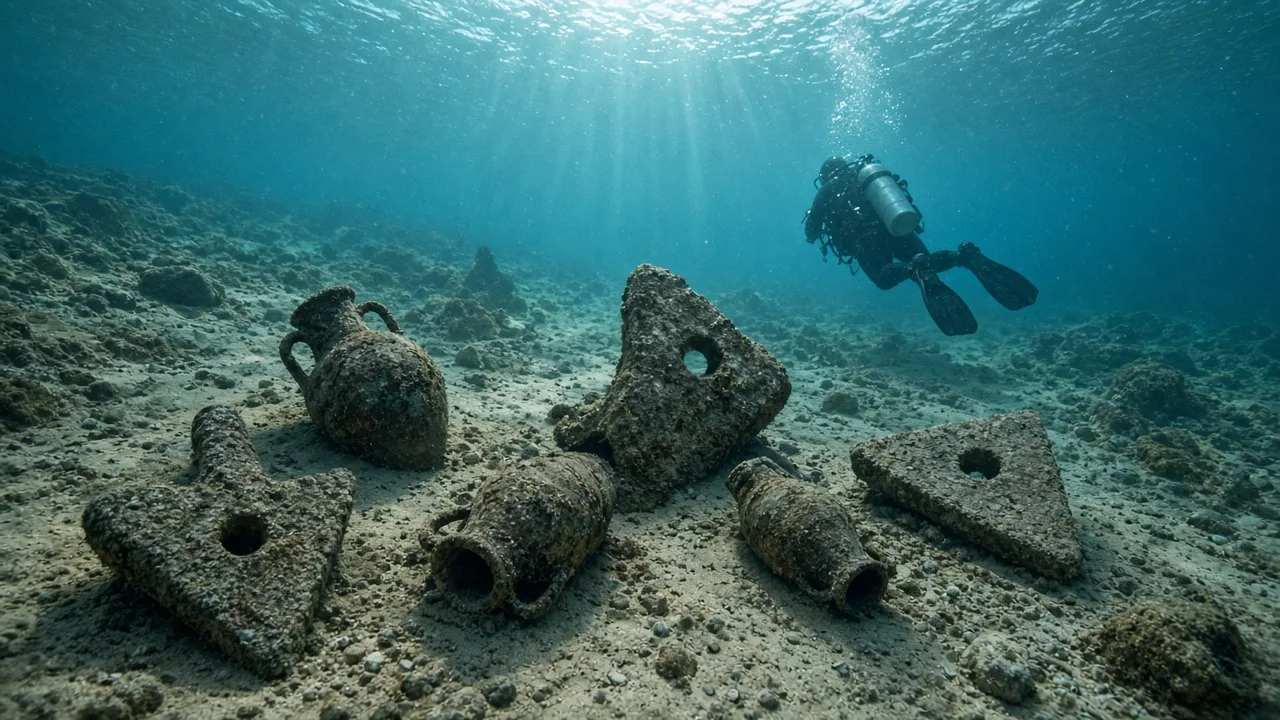
Archaeologists in Turkey say they have found the oldest shipwreck ever discovered, a small trading vessel that sank off Kekova Island in the Mediterranean between 4,400 and 4,700 years ago. That places it in the Early Bronze Age, around the same time the Great Pyramid of Giza was being built.
The discovery was highlighted this week by Turkey's culture minister and reported by the BBC and Scientific American. If the dating holds, it beats the previous record holder by several centuries.
Here is what was found, how it was dated, and why it matters for the history of ancient trade.
What the divers found
The wreck lies close to the shore of Kekova Island in Antalya province, on Turkey's southern coast. Its remains are scattered across an underwater slope about 30 metres below the surface, according to the BBC.
The ship's wooden hull has not survived. What remains is its cargo and equipment:
- Three large stone anchors. The BBC notes that ships carried spares on long voyages.
- Ceramic storage jars called amphorae. The BBC reported more than 30 jars at the site, while Scientific American described around 18 remarkably intact containers. Some carry finely etched symbols whose meaning is not yet clear.
The archaeologists estimate the ship was about 10 metres long and was a trading vessel carrying goods across the Mediterranean.
The expedition was led by Professor Hakan Öniz of Akdeniz University and the Mediterranean Archaeology Association. "The shipwreck is a time capsule at the bottom of the sea," he told the BBC. Scientific American reports that the team first spotted the wreck in 2024 as a blip on their sonar screen.
How do you date a ship with no wood?
Normally, archaeologists might use radiocarbon dating on a ship's timbers. With no wood left, that was not possible here.
Instead, the team compared the shape and style of the amphorae with jars of known age. The Kekova jars are distinctive, with two handles, a ridge around the middle and a flat base. Öniz told the BBC this design matched amphorae found in Egypt and the Middle East that are known to be 4,400 to 4,700 years old.
"Comparing the decoration techniques… we can definitely say our wreck is Early Bronze Age. This is 100%," he said.
Dating by pottery style is a long-established method, but it gives a range rather than a precise year. Further study of the cargo could refine the estimate.
Residue still inside the jars
One of the most exciting finds is what was left inside. Dr Karin Sowada, an archaeologist at Macquarie University in Australia who examined the recovered jars, told the BBC that some still contained a viscous, glossy residue.
"I looked inside and nearly fainted. I could not believe how much [residue] was visible," she said.
The team is now testing the residue to find out what the ship was carrying. "It could be olive oil, it could be wine, it could be tree resins," Sowada said. She added that the jars may also have been reused many times, so the residue might come from an earlier use rather than the final voyage.
Where was the ship going?
According to the BBC, the archaeologists believe the ship began its journey somewhere on the eastern coast of the Mediterranean. They think it was heading either to Troy, in what is now north-western Turkey, or to the Minoan people on Crete.
Scientific American reports that the researchers, in a study published earlier this year, said the crew were likely sailing west when disaster struck. The waters around Kekova have strong currents that can become treacherous in the wind, and the area holds hundreds of wrecks from many periods.
Most wrecks found in this region date to Roman or Byzantine times, roughly 1,500 to 2,000 years ago, Scientific American notes. A wreck more than twice that age is extremely rare.
How it compares with earlier records
The BBC reports that the previous record for the world's oldest shipwreck was held by a wreck off Dokos, an island in southern Greece, dated to about 4,200 years ago.
The oldest known intact shipwreck, with its wooden structure preserved, was found in the Black Sea off Bulgaria and dates to about 2,400 years ago.
Why it matters
The Early Bronze Age was a period when cities, kingdoms and long-distance trade were taking shape across the eastern Mediterranean, Egypt and Mesopotamia. Ancient Egypt was in its Old Kingdom, the era of the great pyramids that we explored in our history of the pyramids of Giza and the people who built them.
Most of what we know about trade in this period comes from objects found on land. A ship and its cargo offer something different: a snapshot of a single voyage, showing what was traded, how it was packed and which routes sailors used. Turkey's culture minister, Mehmet Nuri Ersoy, said the find sheds light "on the deep-rooted history of maritime trade along the Anatolian coasts," as quoted by Scientific American.
Sea trade linked distant cultures long before the better-known networks of later centuries, such as the overland Silk Road or the ocean voyages of the Age of Exploration. The Kekova wreck pushes direct physical evidence of Mediterranean seafaring trade back even further.
A human story
Öniz said diving on the wreck makes him think about the people connected to it. "We are the first humans who [have] touched these objects after 5,000 years," he told the BBC. "We are always thinking of the sailors... the producers of the amphora and the person who carried the amphora on their shoulders to the ship."
What happens next
The recovered artefacts are being conserved after thousands of years underwater. The wreck is owned by the Turkish Ministry of Culture, and Ersoy said the finds will go on display at the new Mediterranean Underwater Archaeology Museum in Antalya when it opens in the coming months.
The key scientific step now is analysing the residue in the jars. Identifying the cargo could reveal much more about what Bronze Age traders valued and where it came from.