In just over a decade, a young king from a small kingdom in northern Greece marched his army across three continents, toppled the mighty Persian Empire and reached the rivers of Punjab. Alexander III of Macedon, better known as Alexander the Great, never lost a major battle, yet his empire broke apart almost as soon as he died. His story, including his famous encounter with the Indian king Porus on the Jhelum River in 326 BCE, still shapes how both Europe and India think about conquest, courage and the limits of power.
A prince trained for war
Alexander was born in 356 BCE in Pella, the capital of Macedonia, the son of King Philip II and Olympias. Philip had turned Macedonia into the strongest military power in Greece, built around a disciplined infantry phalanx armed with long pikes and a powerful cavalry. As a teenager, Alexander was taught by the philosopher Aristotle, and he fought alongside his father at the Battle of Chaeronea in 338 BCE.
When Philip was assassinated in 336 BCE, the 20-year-old Alexander quickly secured the throne, crushed rebellions in Greece and took over his father's plan to invade the Persian Empire, then the largest state in the world.
Conquering Persia
In 334 BCE, Alexander crossed into Asia Minor (modern Turkey) with an army that Britannica estimates at around 30,000 infantry and over 5,000 cavalry. He won his first battle against Persian forces at the Granicus River, then defeated the Persian king Darius III at Issus in 333 BCE. He took the coastal cities of the eastern Mediterranean, including Tyre after a seven-month siege, and entered Egypt in late 332 BCE, where he was welcomed as a liberator and founded the city of Alexandria.
In 331 BCE, he won a decisive victory over Darius at Gaugamela in northern Mesopotamia. Babylon, Susa and Persepolis fell, and the royal palace at Persepolis was burned. Darius was killed by his own nobles in 330 BCE, and Alexander claimed his place as king of Asia. He then spent several hard years subduing Central Asia, where he married Roxana, a Bactrian noblewoman.
The campaign in Punjab and the Battle of the Hydaspes
In 327 BCE, Alexander crossed the Hindu Kush into the Indian subcontinent. Many local rulers chose to submit. Ambhi, the ruler of Taxila (called Taxiles or Omphis by the Greeks), allied with Alexander, partly to gain support against his rival Porus, who ruled the lands between the Hydaspes (Jhelum) and Acesines (Chenab) rivers. Little is known about Porus except from Greek and Roman writers, and Indian sources of the period do not mention the campaign.
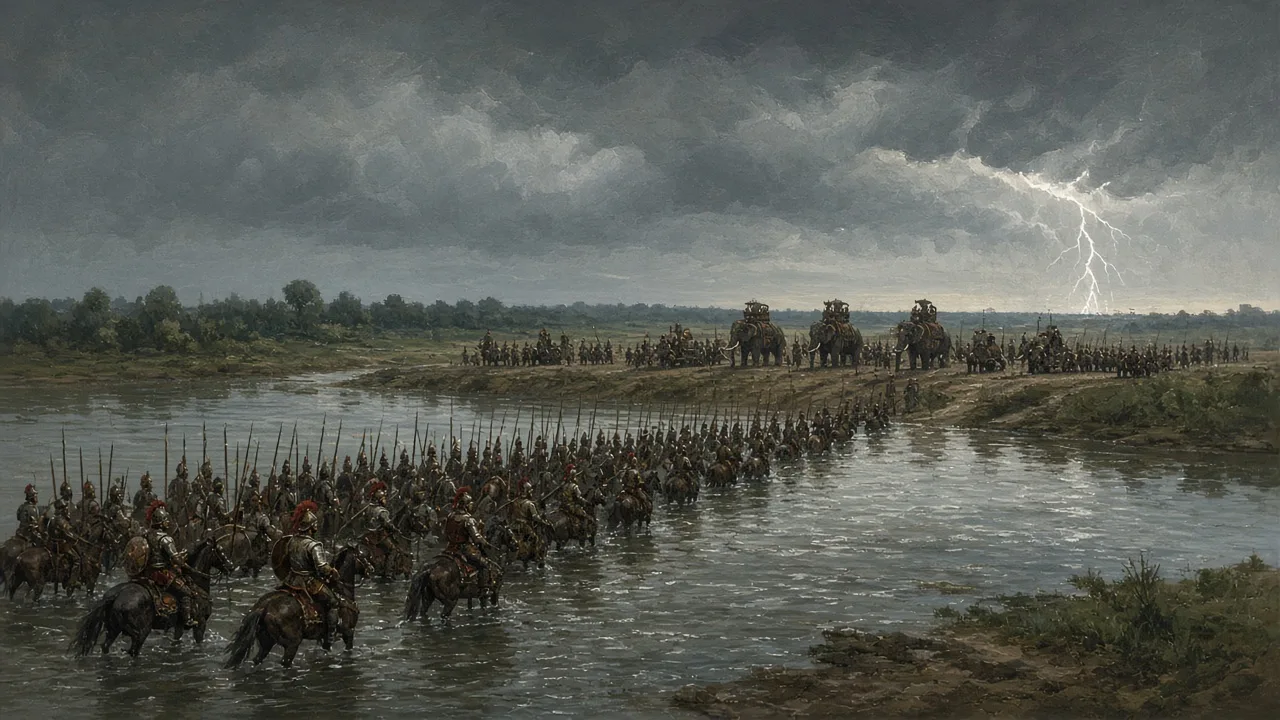
In 326 BCE, the two armies faced each other across the swollen Jhelum, in what is now north-eastern Pakistan. Britannica puts Alexander's force at about 40,000 and Porus's at about 30,000, with chariots and war elephants, though ancient and modern estimates vary. Alexander kept Porus guessing with repeated feints, then crossed the river upstream during a night storm. In the battle that followed, his cavalry attacked the flanks while his infantry used their long pikes against the elephants. Rain and mud hampered Porus's chariots, and his army was defeated.
What happened next became legend. According to the Greek accounts, Porus, though wounded, carried himself with such dignity that he asked to be treated as a king. Alexander not only spared him but confirmed him as ruler of his lands and even added territory. Alexander founded two cities near the battlefield, Nicaea and Bucephala, the latter named after his famous horse, which died there.
The army says no
Alexander wanted to press further east towards the Ganges plains, home to the powerful Nanda kingdom. But at the Hyphasis (Beas) River, his exhausted troops, after years of marching and monsoon rains, refused to go on. Alexander reluctantly turned back. He sailed down the Jhelum and the Indus to the Arabian Sea, fighting fierce battles along the way; he was badly wounded while storming a town of the Malli. His march back through the Gedrosian desert (modern Balochistan) cost many lives.
Back in Babylon, Alexander fell ill after a banquet and died in June 323 BCE, aged 32. The cause of his death remains uncertain. He left no adult heir, and his generals, known as the Diadochi or "successors", fought over his empire and divided it into rival kingdoms, including Ptolemaic Egypt and the Seleucid Empire in Asia.
Timeline: key moments
- 356 BCE: Alexander is born in Pella, Macedonia.
- 336 BCE: He becomes king after Philip II is assassinated.
- 334 BCE: He invades Asia and wins at the Granicus.
- 333 BCE: He defeats Darius III at Issus.
- 332-331 BCE: He takes Egypt and founds Alexandria.
- 331 BCE: Victory at Gaugamela opens the Persian heartland.
- 327 BCE: He crosses the Hindu Kush into the Indian subcontinent.
- 326 BCE: The Battle of the Hydaspes (Jhelum) against Porus; the army refuses to cross the Beas.
- 323 BCE: Alexander dies in Babylon.
The India connection
Alexander's stay in the subcontinent lasted only about two years, but its effects were long-lasting. Britannica notes that some historians believe his invasion helped convince Chandragupta Maurya that India needed a strong, unified monarchy; within a few years, Chandragupta founded the Mauryan Empire. Around 305 to 303 BCE, he faced Alexander's former general Seleucus and reached a settlement in which, according to ancient writers, Seleucus ceded territory in the north-west in exchange for elephants. Seleucus later sent an ambassador, Megasthenes, whose account of India survives in fragments.
Greek influence lingered. Indo-Greek kings ruled parts of the north-west for generations, and Gandhara art blended Greek and Indian styles in its images of the Buddha. In Indian popular memory, Porus became a symbol of courage in defeat, while "Sikandar" entered local languages as a byword for a conqueror.
Why it matters today
- Logistics win wars. Alexander's success depended as much on supply, engineering and speed as on battlefield genius.
- Soldiers have limits. The mutiny on the Beas is a classic lesson in leadership: even the most successful commander needs the consent of his troops.
- Empires need succession plans. Without a clear heir or institutions, Alexander's empire fragmented almost at once.
- Sources shape stories. Almost everything we know about Porus comes from Greek and Roman writers, often writing centuries later.
- Cultures mix after conquest. From Gandhara art to coinage, the Greek-Indian encounter left a lasting cultural legacy.
Frequently asked questions
When did Alexander the Great invade India?
Alexander crossed the Hindu Kush in 327 BCE and campaigned in the north-west of the subcontinent until about 325 BCE. His main battle, against Porus on the Hydaspes (Jhelum) River, took place in 326 BCE.
Who won the battle between Alexander and Porus?
Alexander won the Battle of the Hydaspes in 326 BCE. But he was impressed by Porus, spared his life and allowed him to continue ruling, even adding territory to his kingdom.
Why did Alexander turn back from India?
His army, exhausted after years of campaigning and heavy monsoon rains, refused to go beyond the Beas (Hyphasis) River. Faced with the mutiny, Alexander agreed to return west.