This is Part 6 of HorizonDesk's chronological series on Indian history, from the Stone Age to Independence in 1947.
In Part 5 of this series, we met the cattle-herding tribes of the Rigveda in the Punjab, the "land of seven rivers", where chiefs were checked by tribal assemblies and the Ganga was only a distant name. Over the next few centuries that world moved east and settled down.
Historians call this phase the Later Vedic Age, roughly 1000 to 600 BCE (some scholars prefer about 1100 to 500 BCE, and every date here is approximate). It saw iron come into use, farming villages spread across the Ganga plains, chiefs turn into kings and the four-varna order harden. It also produced the Upanishads, some of the most daring philosophical texts of the ancient world.
How do we know about the Later Vedic Age?
Our main evidence is again sacred texts, memorised by priestly schools and written down much later, but this time we also have archaeology from hundreds of village sites in Haryana and western Uttar Pradesh.
The texts fall into several layers, broadly in this order:
- The other three Vedas. The Samaveda is a book of chants, mostly Rigvedic verses set to melodies for the Soma sacrifice. The Yajurveda holds the formulas priests spoke during rituals, in "Black" (Krishna) and "White" (Shukla) branches. The Atharvaveda mixes charms against disease and snakebite and spells for love and victory with hymns on kingship and the cosmos, a rare glimpse of everyday hopes and fears.
- The Brahmanas, prose texts such as the Aitareya and Shatapatha Brahmana, which explain each ritual act and are full of myths and social detail.
- The Aranyakas, or "forest books", which reflect on the hidden meaning of the rituals, and
- The Upanishads, which turn from ritual towards questions about the self and ultimate reality. The oldest of them, the Brihadaranyaka and Chandogya, are usually dated to around the seventh and sixth centuries BCE, before the time of the Buddha.
Moving east: the Ganga–Yamuna doab
The geography of the later texts is strikingly different from the Rigveda's. Their centre lies in the land between the Sarasvati and Drishadvati rivers in Haryana, around Kurukshetra, and in the Ganga–Yamuna doab, the fertile strip between the two rivers in western Uttar Pradesh. The texts call the land of the Arya Aryavarta, a region that expanded steadily eastward.
The Shatapatha Brahmana preserves a famous story about this movement. Videgha Mathava, a chief, carried the sacred fire Agni Vaishvanara in his mouth from the banks of the Sarasvati eastwards, as the fire burned along the land, until they reached the Sadanira river, probably the Gandak in Bihar. Beyond it lay marshy country that the fire had not "tasted"; once brahmins had made it fit for sacrifice, it became Videha. Historians read it as a memory of Vedic culture spreading east by clearing and settling land.
By the end of the period the texts know the Kosala and Kashi in the middle Ganga valley, the Videha in north Bihar and, further east, Magadha, still regarded as outside the proper Aryan world. Places such as Mathura, an important Painted Grey Ware site, and Kashi, today's Varanasi, appear in our Uttar Pradesh travel guide.
Kuru and Panchala: the first kingdoms
The most powerful people of the age were the Kurus, formed out of the Rigvedic Bharatas and Purus, and their eastern neighbours the Panchalas, a confederation of smaller tribes in the middle doab. The Kurus held the Kurukshetra region and the upper doab; tradition links them with Hastinapur, and the Panchalas with places such as Kampilya and Ahichchhatra.
The Indologist Michael Witzel argued in an influential 1995 paper that the Kuru realm, under kings such as Parikshit and Janamejaya, was the first "state" in South Asia after the Harappans: its rulers reorganised ritual, collected hymns into the Vedic collections we know, and used the varna order to bind society together. Others, such as Romila Thapar, prefer to see lineage-based chiefdoms gradually becoming kingdoms. Both readings agree on the direction of change.
These names are familiar from the Mahabharata, set in this same Kuru land. But the epic was composed and expanded over many centuries, roughly 400 BCE to 400 CE, and historians do not treat it as a record of Vedic events. Excavations at Hastinapur in the 1950s, led by B. B. Lal, found a Painted Grey Ware village, apparently ended by a Ganga flood, with modest houses of mud and reed rather than epic palaces.
The texts call these territories janapada, "where the people (jana) set foot": loyalty was moving from tribe to territory. By about 600 BCE they would grow into the larger mahajanapadas.
Kings, rituals and the fading assemblies
The Later Vedic rajan is no longer just a war leader. Kingship tended to become hereditary, and the king was surrounded by officials called ratnins ("jewels"), including the priest, the army commander, the treasurer and the collector of shares. The old voluntary bali was turning into regular dues from the clansmen.
A king proved his status through grand public sacrifices that lasted days or months, used up vast wealth and required many priests:
- Rajasuya, the royal consecration, in which the king was anointed and took part in ritual episodes such as a mock cattle raid and a game of dice.
- Vajapeya, the "drink of strength", which included a chariot race that the sacrificer was ritually bound to win.
- Ashvamedha, the horse sacrifice: a consecrated horse roamed for a year, guarded by armed men, and lands it crossed unchallenged were claimed by the king.
These rituals also strengthened the priests, in a partnership of brahma (priestly power) and kshatra (royal power). Meanwhile the tribal assemblies weakened: the vidatha disappears, and the sabha and samiti, still praised in the Atharvaveda as "the two daughters of Prajapati", seem to have become narrower councils of nobles and priests.
Iron, grey pottery and rice
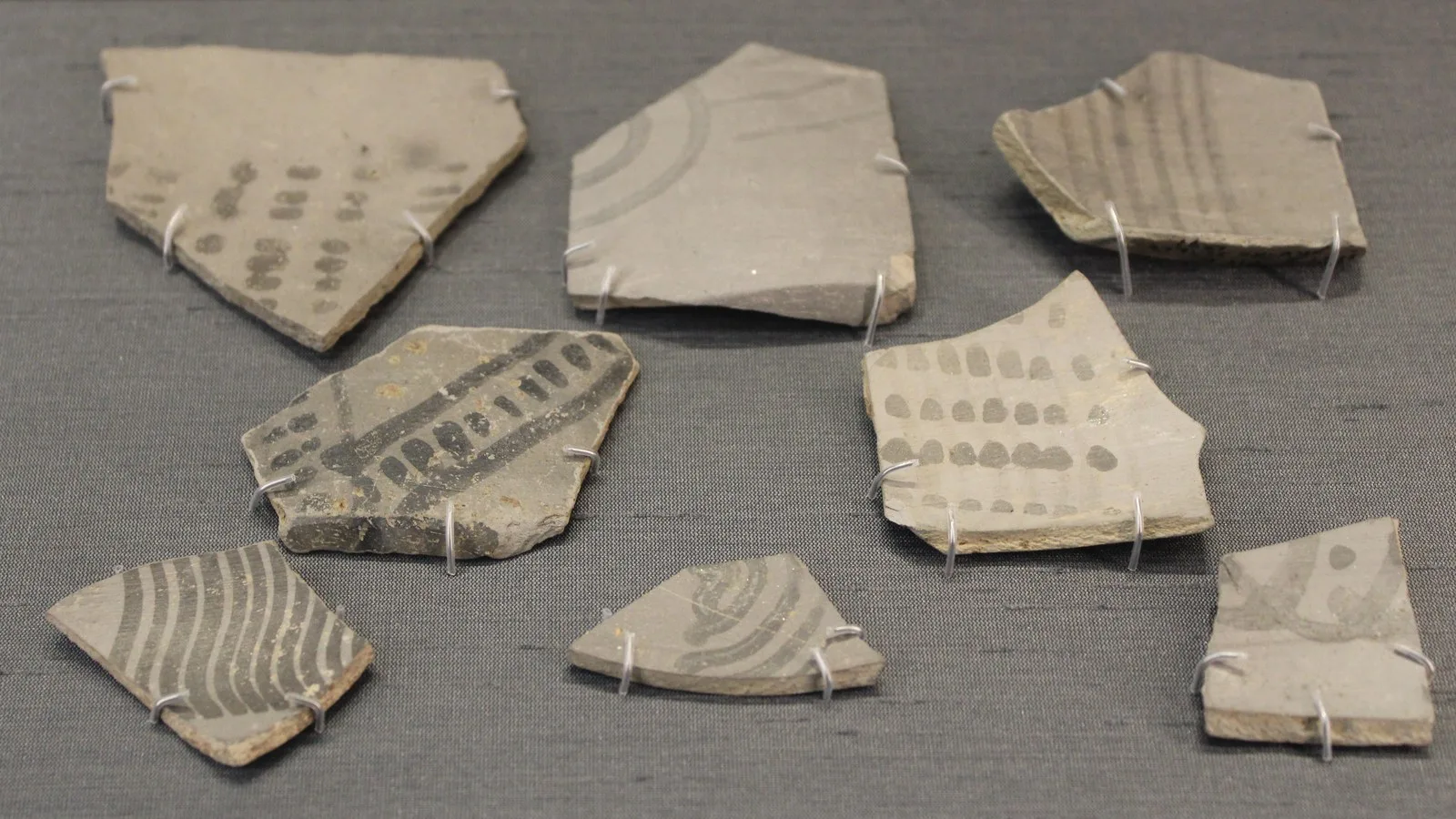
The Later Vedic texts mention a new metal, krishna ayas or shyama ayas, "the dark metal", generally understood as iron. Archaeology confirms that iron was in use in north India at this time. At sites of the Painted Grey Ware (PGW) culture, named after its fine grey pottery painted with black lines, dots and circles, excavators have found iron arrowheads, spearheads, knives, nails and tongs. Atranjikhera in Etah district, on the Kali Nadi, is a classic example, with PGW levels dated very roughly to 1200–600 BCE. Well over a thousand PGW sites are now known.
Two debates run through this evidence. Linking PGW with the Later Vedic people is a reasonable hypothesis because the areas overlap, but pottery does not tell us what language anyone spoke. And the old idea that iron axes cleared the Ganga forests is now doubted: iron tools are fairly scarce in PGW levels and become common only from about the sixth century BCE. Rakesh Tewari's excavations at Malhar and Raja Nal-ka-Tila, on the edge of the central Ganga plain and the Vindhyas, even suggest iron-working there well before 1000 BCE, though those dates are debated.
What is clear is that farming became central. The texts speak of large ox-drawn ploughs and list barley, wheat, lentils and vrihi, rice, which has also been found at Atranjikhera and other sites. Cattle remained precious, but people now lived in settled villages of wattle and daub, occupied for centuries, and the texts name many crafts, from smiths to jewellers.
Varna hardens
The four varnas that appear only once in the Rigveda now become a firm framework. The Brahmanas describe Brahmins and Kshatriyas as the dominant pair, with the Vaishyas, the farming and herding commoners, as the source of tribute, and the Shudras at the bottom as servants of the other three. Rituals were tailored to each varna, and the upper three were increasingly described as "twice-born", initiated through the sacred thread ceremony (upanayana). The gotra, or exogamous lineage, also appears in this period.
Written by priests, the texts describe an ideal more than everyday reality, and the Upanishads themselves show Kshatriya kings teaching Brahmins. Even so, this is when birth-based hierarchy became deeply rooted.
The four ashramas, or stages of life (student, householder, forest-dweller and renouncer), are often attributed to the Vedic Age. In fact the Chandogya Upanishad only hints at something similar; the system took its classic form later, in the Dharmasutras. The ideal of renunciation, however, was clearly gaining ground.
Women: a narrowing world, with exceptions
Most historians think women's position declined after the Rigvedic period: they were increasingly excluded from assemblies, and some Brahmana passages call daughters a source of sorrow. Yet the Brihadaranyaka Upanishad also records Gargi Vachaknavi questioning the sage Yajnavalkya before King Janaka's court so persistently that he warns her not to ask too much, and Maitreyi, Yajnavalkya's wife, who chooses his teaching on immortality over a share of his wealth. They were remembered as exceptional, not typical.
The Upanishads: the inward turn
The word upanishad is often explained as "sitting down near" a teacher, implying secret teaching. Tradition counts 108 Upanishads, of which about a dozen are considered principal. Where the Brahmanas asked how a ritual worked, the Upanishads asked what lay behind the ritual, the world and the person performing it.
Their key ideas include:
- Brahman, the single reality underlying the whole universe.
- Atman, the true inner self, which several Upanishads identify with Brahman. In the Chandogya Upanishad, the teacher Uddalaka Aruni explains this to his son Shvetaketu with homely examples, salt dissolved in water and the tiny seed inside a banyan fruit, ending each lesson with the words tat tvam asi, "that is how you are" (often rendered "you are that").
- Samsara and karma: the idea that beings are reborn again and again, and that their actions shape their next life. "As a person acts, so does he become," says the Brihadaranyaka. Strikingly, in both the Brihadaranyaka and the Chandogya, a key teaching on rebirth comes from a Kshatriya, King Pravahana Jaivali of Panchala, who says it had never before reached Brahmins.
- Moksha, liberation from the cycle of rebirth, through knowledge of the self rather than through sacrifice alone.
The great voice of the Brihadaranyaka is Yajnavalkya, who wins a debate at Janaka's court in Videha and teaches that the self cannot be grasped as an object, only described as neti neti, "not this, not this".
Scholars debate why these ideas emerged now: some link them to the settled society of the Ganga plain, others to debates among ritual specialists or to wandering ascetics outside the Vedic fold. Whatever their origins, the questions of karma, rebirth and liberation would soon be taken in new directions by the Buddha, who found enlightenment at Bodh Gaya, and by Mahavira, and they still shape Hindu, Buddhist and Jain thought today.
Meanwhile in the south
Peninsular India, barely known to these texts, followed its own path, with megalithic burials and iron of its own. At Adichanallur on the Tamirabarani, rice from inside burial urns has been radiocarbon-dated to roughly the ninth to sixth centuries BCE, which overlaps with the Later Vedic Age. Claims of much earlier iron in Tamil Nadu are still being debated. Either way, India in 800 BCE had several Iron Age worlds, not one.
Key takeaways
- The Later Vedic Age (roughly 1000–600 BCE) is known from the later Vedas, Brahmanas, Aranyakas, early Upanishads and archaeology.
- Vedic culture shifted east to Kurukshetra and the Ganga–Yamuna doab, where the Kuru and Panchala realms emerged and tribes became territorial janapadas.
- Kings grew stronger through grand rituals such as the Rajasuya, Vajapeya and Ashvamedha, while the sabha and samiti lost influence.
- Iron, Painted Grey Ware villages and rice farming mark the period, though iron's role in clearing the Ganga plain is debated.
- Varna hardened, women's public role narrowed, and the Upanishads introduced Brahman, Atman, karma, samsara and moksha.
Next part
In Part 7, we follow these janapadas as they grow into the Sixteen Mahajanapadas: rival kingdoms and republics with cities, coins and armies, and the rise of Magadha, the kingdom that would one day unite much of India.
Sources
- Thapar, R. (2002), Early India: From the Origins to AD 1300, Penguin and University of California Press
- Singh, U. (2008), A History of Ancient and Early Medieval India: From the Stone Age to the 12th Century, Pearson
- Sharma, R. S. (2005), India's Ancient Past, Oxford University Press
- Olivelle, P. (1996), Upanisads, Oxford World's Classics; and (1993), The Asrama System: The History and Hermeneutics of a Religious Institution, Oxford University Press
- Witzel, M. (1995), Early Sanskritization: Origins and Development of the Kuru State, Electronic Journal of Vedic Studies 1(4)
- Tewari, R. (2003), The origins of iron working in India: new evidence from the Central Ganga Plain and the Eastern Vindhyas, Antiquity
- Gaur, R. C. (1983), Excavations at Atranjikhera: Early Civilization of the Upper Ganga Basin, Motilal Banarsidass
- Encyclopaedia Britannica, India: the Early and Later Vedic periods
- e-PG Pathshala (INFLIBNET), Iron Age: Society and Economy
- World History Encyclopedia, Upanishads
- Internet Encyclopedia of Philosophy, Upanisads
Featured image: Fragments of Painted Grey Ware, about 1000 BCE, from Hastinapura and Radhakund in Uttar Pradesh and Panipat and Tilpat in Haryana, in the British Museum. Photo by Zunkir, via Wikimedia Commons, CC BY-SA 4.0.