This is Part 16 of Wonders of India, our series on India's UNESCO World Heritage Sites. Start from Part 1: Taj Mahal or read the previous part, Part 15: Mahabodhi Temple.
Long before Oxford or Bologna, students travelled thousands of kilometres to study at Nalanda in Bihar. Its red-brick ruins are what remains of one of the oldest and greatest residential universities in the world.
At a glance
- Location: Nalanda district, Bihar, about 90 km from Patna
- Founded: 5th century CE, under the Gupta dynasty
- Active: for about 800 years, until the late 12th century
- UNESCO World Heritage Site: since 2016 (Archaeological Site of Nalanda Mahavihara)
History
Nalanda grew from a Buddhist monastery into a vast university, supported by the Gupta kings, later by King Harshavardhana and then the Pala dynasty. At its height it is said to have housed thousands of students and teachers. The Chinese monk Xuanzang studied here in the 7th century and left a detailed account, and his compatriot Yijing followed soon after. Students came from China, Korea, Tibet, Central Asia and Southeast Asia.
Nalanda taught Buddhist philosophy alongside logic, grammar, medicine, mathematics and astronomy. Its great library, known as Dharmaganja, is said to have occupied several multi-storey buildings. The university declined in the late 12th century; its destruction is traditionally attributed to the forces of Bakhtiyar Khilji around 1193. The ruins were excavated by the Archaeological Survey of India in the 20th century.
What to see
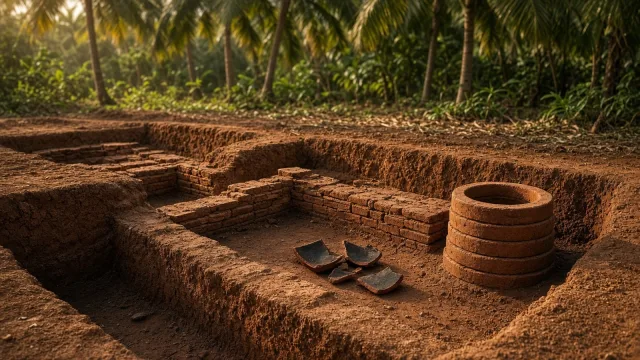
- Monasteries (viharas): rows of student cells around courtyards, with lecture platforms and wells.
- Temple 3 (Sariputta Stupa): a massive terraced structure surrounded by votive stupas.
- Temples 2 and 12-14: with fine stucco and sculpted panels.
- Nalanda Archaeological Museum: sculptures, seals and finds from the site.
- Xuanzang Memorial Hall: honouring the famous Chinese pilgrim-scholar.
Visiting Nalanda
- Timings: roughly 9 am to 5 pm.
- Tickets: around ₹40 for Indian citizens and ₹600 for foreign nationals.
- Getting there: about 12 km from Rajgir and 2.5 hours by road from Patna; Rajgir and Nalanda have railway stations.
- Best time: October to March.
Tips
- Hire a guide to bring the ruins to life; the scale is hard to grasp without context.
- Combine with Rajgir (Vulture's Peak and the glass skywalk) and Bodh Gaya.
Did you know?
A new Nalanda University was established near the ancient site by an Act of Parliament in 2010, and its new campus was inaugurated in 2024, reviving the name as an international centre of learning.
Ticket prices and timings are set by the Archaeological Survey of India (ASI) and can change; online tickets are usually slightly cheaper. Check the ASI website before you visit.
Next in Wonders of India: the Ramappa Temple.