Over the last nine parts of Europe on a Budget, we covered planning, paperwork, flights, trains, stays, food, sightseeing, best-value cities and money. Now let's put it all together. This two-week route links four great cities in Central Europe, a region with rich history, good transport and costs well below Western Europe's big capitals.
Route: Kraków (3 nights) → Prague (4 nights) → Vienna (2 nights, with a day in Bratislava) → Budapest (4 nights). That is 13 nights, 14 days.
Getting there
Book an open-jaw ticket: fly into Kraków and out of Budapest (see Part 3). If flights to Kraków are expensive, consider flying into a nearby hub and taking a train or bus.
Days 1 to 3: Kraków
- Day 1: Arrive, take a free walking tour of the Old Town and Main Market Square, and see the Cloth Hall.
- Day 2: Wawel Hill and Castle area, then the Kazimierz district for street food, synagogues and cafés.
- Day 3: A day trip to the Wieliczka Salt Mine, or a sombre but important visit to the Auschwitz-Birkenau Memorial. Book official tickets well in advance.
Budget tip: eat at a traditional milk bar (bar mleczny) for very cheap Polish meals.
Days 4 to 7: Prague
Travel: Kraków to Prague by train or long-distance bus takes most of a day. A night train is also an option on this route, saving a night's accommodation.
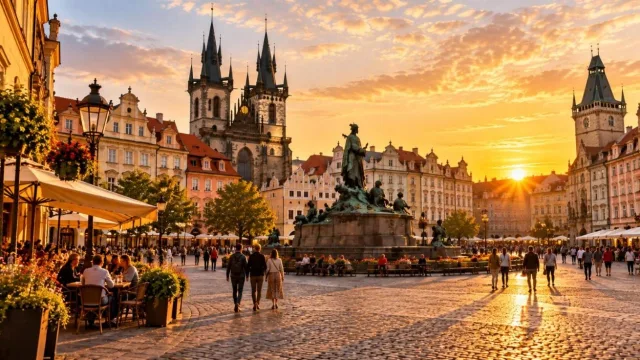
- Day 4: Arrive and stroll the Old Town Square and Charles Bridge in the evening when it is quieter.
- Day 5: Prague Castle area and Malá Strana, then walk up to a viewpoint for sunset.
- Day 6: Explore Vinohrady and Žižkov neighbourhoods, Letná Park and a riverside beer garden.
- Day 7: Day trip to Kutná Hora by train, or a slow day in museums and markets.
Budget tip: stay outside the historic centre near a tram or metro line. For more ideas, see our Prague travel guide.
Days 8 and 9: Vienna and Bratislava
Travel: Prague to Vienna by train or bus in about four to five hours.
- Day 8: The Ringstrasse, St Stephen's Cathedral, the Hofburg area and a coffee house. Many palace gardens and parks are free.
- Day 9: Take a cheap regional train to Bratislava, about an hour away, for its compact old town and castle views, then return to Vienna.
Budget tip: Vienna is the most expensive stop. Keep it short, eat at markets such as the Naschmarkt area and at sausage stands, and book accommodation early.
Days 10 to 13: Budapest
Travel: Vienna to Budapest by train or bus in about two and a half to three hours.
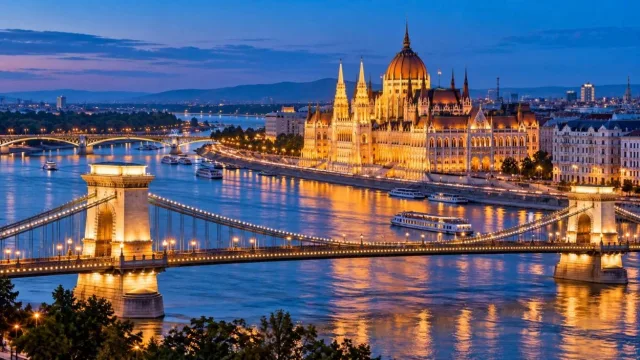
- Day 10: Arrive and walk along the Danube to the Parliament area and the Shoes on the Danube Bank memorial.
- Day 11: Buda Castle district and Fisherman's Bastion area, then Gellért Hill for views.
- Day 12: A thermal bath morning, the Great Market Hall for lunch and an evening in the old Jewish quarter.
- Day 13: Day trip to Szentendre or the Danube Bend, or a relaxed day on Margaret Island.
Day 14: Departure
Fly home from Budapest. Use public transport to the airport rather than a taxi.
Sample budget per person
Rough daily costs, excluding international flights, for a budget-comfortable traveller using private hostel rooms or simple guesthouses:
- Accommodation: roughly €30 to €60 per night per person, higher in Vienna.
- Food: roughly €20 to €35 per day.
- Local transport: roughly €3 to €8 per day.
- Sightseeing: roughly €5 to €20 per day on average.
- Intercity trains and buses for the whole route: roughly €80 to €150 if booked ahead.
That puts a typical two-week trip at very roughly €1,000 to €1,700 per person before international flights and insurance. Shoestring travellers using dorms and cooking can spend less; couples sharing rooms save on accommodation.
Ways to make it even cheaper
- Travel in shoulder season (Part 1).
- Use night trains or buses for one or two legs (Part 4).
- Choose rooms with kitchen access (Part 5).
- Make lunch your main meal (Part 6).
- Use free walking tours and free sights (Part 7).
- Pay in local currency: złoty, koruna and forint in three of the four countries (Part 9).
Final thoughts
Budget travel is not about missing out. It is about spending on the experiences that matter to you and saving everywhere else. With good planning, Europe is far more affordable than its reputation suggests. Thank you for following Europe on a Budget, and enjoy the journey.
Europe on a Budget: the full series
- Part 1: Plan Your Trip and Set a Budget
- Part 2: Visas, Insurance and Paperwork
- Part 3: Finding Cheap Flights
- Part 4: Trains, Buses and Rail Passes
- Part 5: Budget Accommodation
- Part 6: Eat Well for Less
- Part 7: Free and Cheap Sightseeing
- Part 8: The Best-Value Cities
- Part 9: Money, Cards and Fees
- Part 10: A Two-Week Budget Itinerary (you are here)
Prices, fares, fees and entry rules change often. Treat the ranges here as rough guides and check official websites before you book or travel.