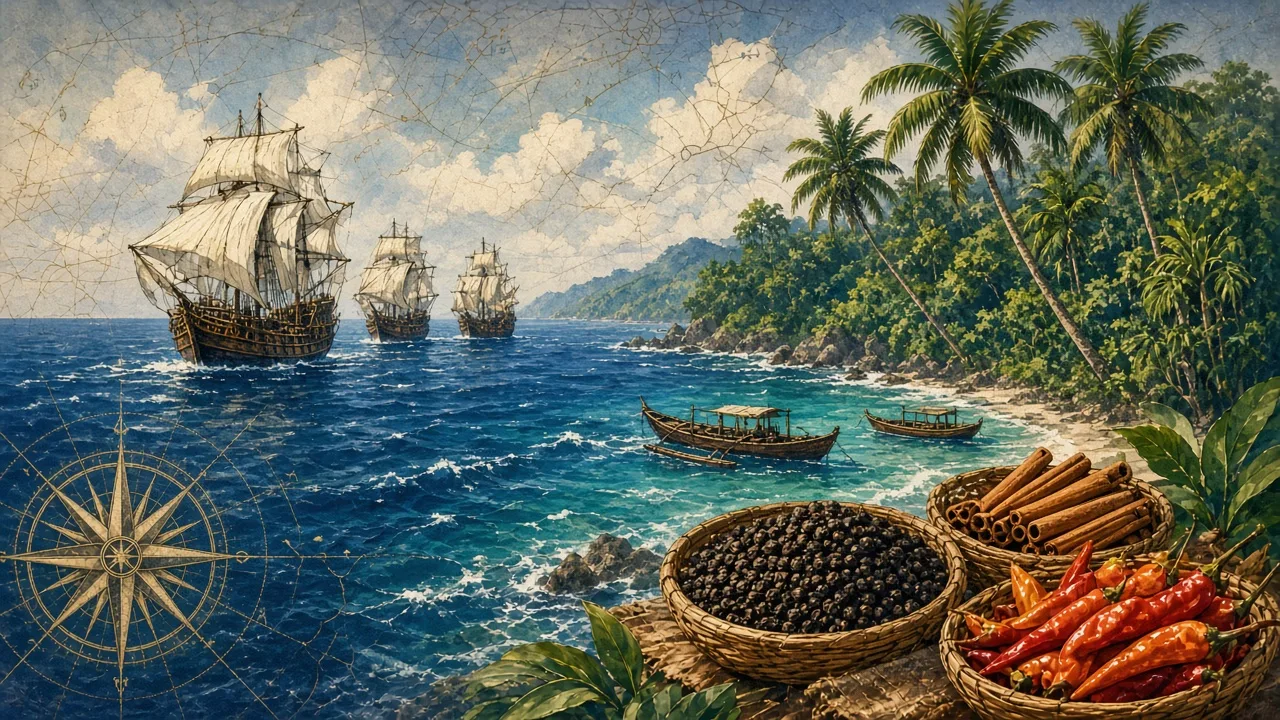
In the space of about 30 years at the end of the 15th century, a handful of European voyages redrew the map of the world. Christopher Columbus crossed the Atlantic in 1492. Vasco da Gama sailed around Africa and reached the Indian coast at Calicut in 1498. Less than three decades later, the survivors of Ferdinand Magellan's expedition completed the first circumnavigation of the globe. For India, this era was not a story of "discovery" but of new arrivals at an already thriving trading coast, arrivals whose impact would be felt for centuries. Here is what happened, and why the Age of Exploration is often described as the birth of a truly global economy.
Why Europe went looking
In the 15th century, Asian goods such as pepper, cinnamon, cloves, silk and cotton textiles were in huge demand in Europe. They usually reached the Mediterranean via long chains of Asian, Arab and Venetian intermediaries, each adding their margin. Britannica notes that the Portuguese aimed to open a sea route to Asia partly to outflank the Muslim merchants who then dominated trade with India.
Several things made long ocean voyages more feasible: improved ship designs such as the caravel, better navigational tools and growing knowledge of Atlantic winds and currents. Rulers in Portugal and Spain were willing to fund risky expeditions in the hope of huge returns, a little like venture investors betting on long shots.
Columbus sails west
Christopher Columbus, a Genoese navigator sponsored by the Spanish monarchs, believed he could reach Asia by sailing west. He badly underestimated the size of the globe. On October 12, 1492, his fleet reached an island in the Bahamas, beginning sustained contact between Europe and the Americas. Columbus made several more voyages and to the end insisted he had reached the edges of Asia, which is why the Caribbean islands came to be called the "West Indies" and Indigenous Americans were mislabelled "Indians".
For the Indigenous peoples of the Americas, the consequences were catastrophic. Conquest, forced labour and especially diseases brought from Europe caused enormous loss of life over the following century.
Dividing the world on paper
Spain and Portugal quickly moved to avoid conflict over new lands. On June 7, 1494, they signed the Treaty of Tordesillas, which, according to Britannica, drew a north-south line 370 leagues west of the Cape Verde islands. Lands to the east were allotted to Portugal and lands to the west to Spain. Other European powers never accepted this division, but it shaped early colonial empires, including Portugal's claim to Brazil.
Vasco da Gama reaches Calicut
The Portuguese had been inching down the African coast for decades. Bartolomeu Dias rounded the southern tip of Africa in 1488, proving that a sea route into the Indian Ocean existed. Then, as Britannica describes, Vasco da Gama left Lisbon on July 8, 1497, with four vessels. After a long loop through the South Atlantic, his fleet rounded the Cape of Good Hope in November 1497 and worked its way up the East African coast.
At Malindi, in present-day Kenya, a Gujarati pilot who knew the route to Calicut joined the expedition. After a crossing of the Arabian Sea of about 23 days, the fleet reached Calicut, on the Malabar coast of today's Kerala, on May 20, 1498.
The welcome was less than glorious. Britannica notes that the Zamorin, the ruler of Calicut, was unimpressed by da Gama's modest gifts and cheap trade goods, which suited West African markets but held little appeal in a sophisticated Indian port. Da Gama failed to conclude a treaty. The return journey was gruelling: he sailed against the monsoon, and many of his crew died of scurvy. Of the original crew of about 170, only 55 survived, yet the spices he brought back proved the route could be enormously profitable.
Around the world
In 1519, Ferdinand Magellan, a Portuguese navigator sailing for Spain, set out to reach the Spice Islands by heading west. Magellan himself was killed in the Philippines in 1521, but Juan Sebastián Elcano led the ship Victoria home. When it reached Spain in September 1522, it completed the first circumnavigation of the Earth. National Geographic notes that of about 240 men who started the voyage, only 18 finished it aboard the Victoria.
Timeline: key moments
- 1488: Bartolomeu Dias rounds the southern tip of Africa.
- October 12, 1492: Columbus's fleet reaches the Bahamas.
- June 7, 1494: Spain and Portugal sign the Treaty of Tordesillas.
- July 8, 1497: Vasco da Gama sails from Lisbon.
- May 20, 1498: Da Gama reaches Calicut, on India's Malabar coast.
- 1519: Magellan's expedition sets out from Spain.
- September 1522: The Victoria completes the first circumnavigation with 18 survivors.
- 1524: Vasco da Gama dies in Cochin (Kochi) during his third voyage to India.
What the voyages changed
- The Columbian Exchange. Plants, animals, people and diseases crossed the Atlantic in both directions. Crops from the Americas, such as chillies, potatoes, tomatoes, maize and groundnuts, eventually transformed diets worldwide, including Indian cuisine. It is hard to imagine Indian food today without chillies, which arrived via these new trade links.
- A new trade order in the Indian Ocean. The Portuguese set up fortified trading posts, including at Goa, which they captured in 1510, and tried to control spice shipping by force. Later the Dutch, English and French followed, with the English East India Company eventually becoming a colonial power in India.
- Silver and global money. Silver from Spanish mines in the Americas flowed through global trade, much of it ending up in Asia, linking world economies in new ways.
- Colonialism and slavery. The darker legacy includes the conquest of the Americas and the transatlantic slave trade, which forcibly transported millions of Africans.
Why it matters today
The Age of Exploration is, in many ways, the origin story of globalisation.
- Supply chains and sea lanes. Around 1500, control of ocean routes became a source of wealth and power. Today, sea lanes such as the Strait of Hormuz, the Red Sea and the Strait of Malacca still carry a large share of world trade, and disruptions there move oil and freight prices.
- Kerala's long global story. Calicut (Kozhikode) and Kochi were already international ports before da Gama arrived. Their history is a reminder that India was a central player in world trade, not a passive destination.
- High-risk, high-reward bets. These voyages were financed like startups: most backers accepted that ships might never return. That mindset later shaped joint-stock companies such as the East India Company, an ancestor of modern corporations.
- The human cost of growth. The era's wealth came with conquest, epidemics and slavery. Remembering that side matters when we talk about trade and development.
- Your plate is a history lesson. The next time you eat aloo, tomato chutney or anything with green chillies, you are tasting the Columbian Exchange.