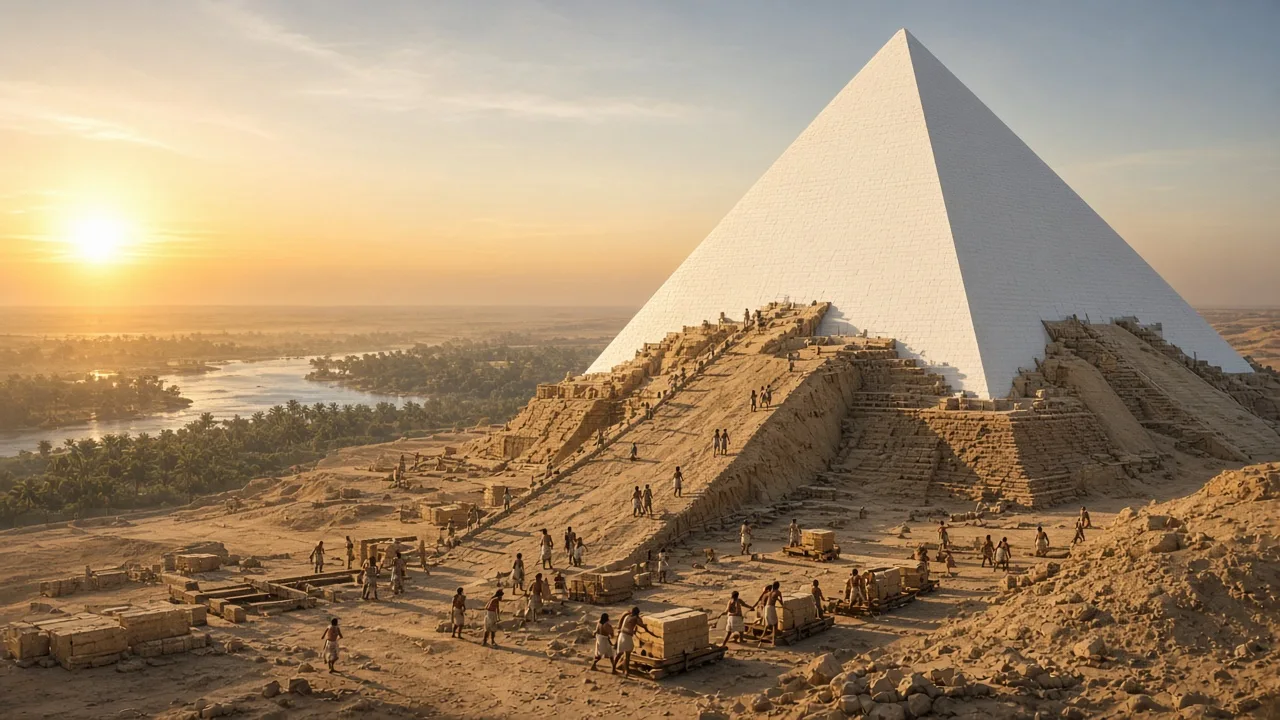
Few images say "ancient history" as clearly as the pyramids of Giza rising out of the desert near Cairo. Built about 4,500 years ago, they were already ancient when Alexander the Great and Julius Caesar visited Egypt, and they remain the only one of the Seven Wonders of the Ancient World still standing. But the pyramids are more than giant tombs. They tell the story of a state that could organise tens of thousands of people, feed them, move millions of tonnes of stone and plan on a scale few societies have matched. Later, Egypt's ports also traded with India.
A kingdom made by the Nile
Egypt's civilisation grew along a narrow ribbon of fertile land watered by the Nile. Each year, the river flooded and left behind rich black silt, allowing farmers to grow surplus grain in an otherwise desert landscape. Around 3100 BCE, Upper (southern) and Lower (northern) Egypt were united under a single king, according to Egyptian tradition. Memphis, near modern Cairo, became the early capital, and the king, later called the pharaoh, was seen as a link between the gods and the people.
Historians divide the next three millennia into the Old, Middle and New Kingdoms, separated by periods of division. The great age of pyramid building belongs to the Old Kingdom.
From step pyramid to true pyramid
Early kings were buried in flat-topped mud-brick tombs called mastabas. The big leap came under King Djoser of the 3rd dynasty, in about the 27th century BCE. His architect, traditionally named as Imhotep, stacked six stone layers of decreasing size at Saqqara to create the Step Pyramid, about 62 metres high and the tallest building of its time.
Later kings experimented with the shape. Sneferu, the first king of the 4th dynasty, built several pyramids at Meidum and Dahshur, including the Bent Pyramid, whose angle changes partway up, and the Red Pyramid, often described as the first successful smooth-sided "true" pyramid. These trials paved the way for the masterpiece built by his son.
The Great Pyramid of Giza
Three 4th-dynasty kings built the main pyramids on the Giza plateau, dated by Britannica to roughly 2575 to 2465 BCE: Khufu, his son Khafre and later Menkaure. Khufu's Great Pyramid is the largest. Each side of its base averages about 230 metres, and it originally stood about 147 metres tall; having lost its outer casing of polished white limestone, it now stands at about 138 metres. Britannica estimates that around 2.3 million stone blocks went into the structure, and its sides are aligned remarkably closely with the four cardinal directions. Near Khafre's pyramid lies the Great Sphinx, a lion with a human head, carved from the bedrock.
Inside, the Giza pyramids are mostly solid stone with narrow passages and small burial chambers. No mummies of the kings have been found in them, and any treasure was plundered in ancient or medieval times.
Who built them, and how?
The popular image of armies of slaves building the pyramids is not supported by the evidence. Excavations from the late 1980s onwards uncovered workers' settlements, bakeries and the tombs of labourers near the pyramids, suggesting that skilled crews and Egyptian labourers did the work, probably organised by the state and rewarded with food and lodging. The Greek historian Herodotus, writing some 2,000 years later, claimed the Great Pyramid took 20 years and 100,000 men. Modern estimates vary, and some archaeologists suggest a permanent workforce of perhaps 20,000 people, supported by bakers, doctors and other staff.
How the stones were raised is still debated. Most experts think some combination of ramps, sledges and levers was used, with blocks cut from nearby quarries and finer stone and granite brought by boat along the Nile. Either way, it required careful planning and a well-run administration.
After the pyramids
Pyramids grew smaller after the 4th dynasty, partly as the costs became harder to bear. By the New Kingdom, from around 1550 BCE, pharaohs were buried in hidden rock-cut tombs in the Valley of the Kings near Thebes (modern Luxor). The most famous of these, the tomb of Tutankhamun, was found largely intact in 1922.
Egypt later fell under foreign rulers. Alexander the Great arrived in 332 BCE, and after his death the Ptolemaic dynasty, of Macedonian origin, ruled from Alexandria. After Cleopatra VII died in 30 BCE, Egypt became a Roman province. Hieroglyphs were only deciphered again in the 1820s, by Jean-François Champollion, with the help of the Rosetta Stone.
Timeline: key moments
- c. 3100 BCE: Upper and Lower Egypt are united, by tradition under one king.
- c. 27th century BCE: Djoser's Step Pyramid is built at Saqqara.
- c. 2575-2465 BCE: The 4th dynasty builds the Giza pyramids (dates are approximate).
- c. 1550 BCE: The New Kingdom begins; royal tombs move to the Valley of the Kings.
- 332 BCE: Alexander the Great takes Egypt.
- 30 BCE: Cleopatra VII dies and Egypt becomes a Roman province.
- 1822: Champollion announces his breakthrough in reading hieroglyphs.
- 1922: Tutankhamun's tomb is discovered.
- 1979: Memphis and its Necropolis, including Giza, becomes a UNESCO World Heritage site.
The India connection
Around the time Egypt's pyramids were being built, the cities of the Indus Valley (Harappan) civilisation, such as Harappa and Mohenjo-daro, were flourishing in what is now Pakistan and north-western India. Both were early river civilisations that depended on floods, planned building and long-distance trade.
The later link is more direct. Under the Ptolemies and then the Romans, Egyptian Red Sea ports such as Berenike handled ships carrying pepper, textiles, gems and ivory from India. Goods were carried by camel across the desert to the Nile and on to Alexandria. In 2023, Egyptian authorities announced that a Polish-American team had found a marble statue of the Buddha at Berenike, along with other evidence that archaeologists say points to a settled Indian merchant community there in Roman times. It is a striking reminder that Egypt and India were linked long before the age of European empires.
Why it matters today
- Big projects need strong institutions. The pyramids show what a state can do when it can plan, tax, feed and organise people at scale.
- Myths can outlive evidence. The "slave-built pyramids" story persisted for centuries until archaeology told a more complex story about organised workers.
- Heritage drives economies. Giza remains a major draw for tourism, one of Egypt's important sources of income.
- Ancient globalisation was real. The Red Sea trade that linked Egypt with Indian ports was an early version of today's global supply chains.
Frequently asked questions
How old are the pyramids of Giza?
The Giza pyramids were built during Egypt's 4th dynasty, roughly between 2575 and 2465 BCE, which makes them about 4,500 years old. Exact dates are approximate.
Were the pyramids built by slaves?
The evidence suggests not. Archaeologists have found workers' villages, bakeries and tombs near the pyramids, indicating that Egyptian labourers and skilled crews built them, probably organised and supported by the state.
Did ancient Egypt trade with India?
Yes. Especially under Ptolemaic and Roman rule, Red Sea ports such as Berenike received ships carrying pepper, textiles and gems from India. A Buddha statue found at Berenike points to Indian merchants living there.