In the summer of 1945, as World War II was ending, delegates from 50 countries gathered in San Francisco to sign a charter for a new world organisation. Its goal, set out in the opening words of the Charter, was to save future generations from the scourge of war. The United Nations came into being on 24 October 1945. It has never been perfect, but it has become the world's most important forum for diplomacy, development and human rights. India, though still under British rule at the time, was among its founding members and has played a notable part in its story ever since.
Learning from the League of Nations
The UN was not the first attempt at a global peace organisation. After World War I, the League of Nations was created in 1920. It had some successes, but it lacked strong enforcement powers, the United States never joined, and major powers left or ignored it. It could not stop Japanese, Italian and German aggression in the 1930s, and World War II showed its failure.
From wartime alliance to world body
The idea of a new organisation grew during the war itself. In August 1941, US President Franklin D. Roosevelt and British Prime Minister Winston Churchill issued the Atlantic Charter, setting out principles for a post-war world. On 1 January 1942, representatives of 26 nations fighting the Axis powers signed the Declaration by United Nations, the first official use of the name "United Nations", which is credited to Roosevelt. India was among the original signatories.
Detailed plans followed. At Dumbarton Oaks in Washington in 1944, representatives of China, the Soviet Union, the United Kingdom and the United States drafted proposals for the new body's structure. At Yalta in February 1945, Roosevelt, Churchill and Stalin agreed on voting arrangements in the Security Council, including the veto for its permanent members.
The San Francisco Conference
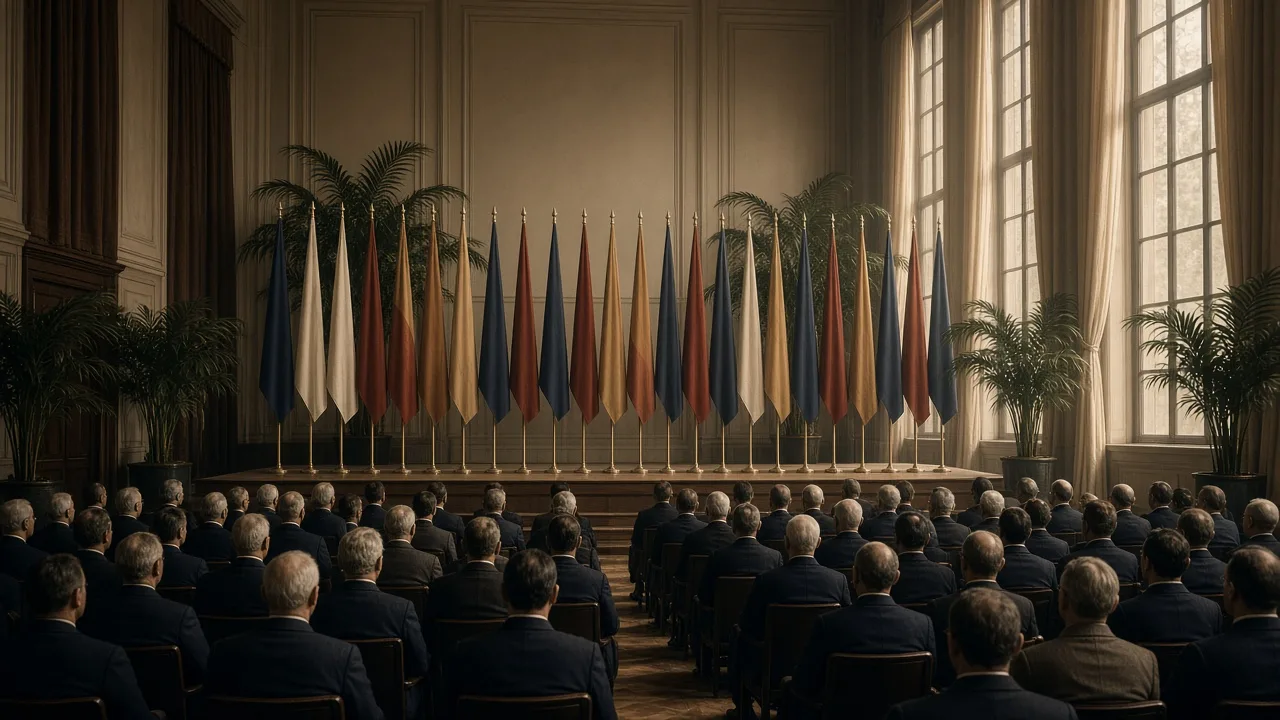
The United Nations Conference on International Organization met in San Francisco from 25 April to 26 June 1945. Delegates from 50 countries debated and refined the draft Charter, often late into the night. Smaller countries pushed for a stronger General Assembly and for more attention to economic and social issues and human rights.
On 26 June 1945, the delegates signed the Charter. Poland, which had not been represented at the conference, signed later, on 15 October, becoming one of the 51 original member states. The UN officially came into existence on 24 October 1945, once the Charter had been ratified by China, France, the Soviet Union, the United Kingdom, the United States and a majority of the other signatories. That date is now celebrated every year as United Nations Day. The first General Assembly met in London in January 1946.
How the UN was designed
The Charter created six main organs: the General Assembly, where every member has one vote; the Security Council, with five permanent members holding a veto and elected non-permanent members; the Economic and Social Council; the Trusteeship Council; the International Court of Justice; and the Secretariat, headed by the Secretary-General. Specialised agencies and programmes, from UNICEF to the World Health Organization, grew around this core. In 1948, the General Assembly adopted the Universal Declaration of Human Rights. Membership has grown from 51 to 193 states, largely as former colonies in Asia and Africa gained independence.
Timeline: key moments
- 1920: The League of Nations is founded.
- August 1941: The Atlantic Charter is issued.
- 1 January 1942: The Declaration by United Nations is signed by 26 nations, including India.
- 1944: The Dumbarton Oaks talks draft the UN's structure.
- February 1945: The Yalta Conference agrees on Security Council voting.
- 25 April-26 June 1945: The San Francisco Conference drafts and signs the Charter.
- 24 October 1945: The UN Charter enters into force.
- 30 October 1945: India ratifies the Charter.
- January 1946: The first General Assembly meets in London.
- 10 December 1948: The Universal Declaration of Human Rights is adopted.
The India connection
India is one of the UN's 51 founding members, even though it only became independent in August 1947. It signed the Declaration by United Nations in 1942, and at San Francisco its delegation was led by Sir A. Ramaswami Mudaliar, who signed the Charter on 26 June 1945. India ratified it on 30 October 1945. Mudaliar went on to serve as the first President of the UN Economic and Social Council in 1946.
Indian women also left their mark. As India's delegate to the UN Commission on Human Rights, Hansa Mehta is credited with helping change the wording of the Universal Declaration's first article from "All men are born free and equal" to "All human beings are born free and equal". Vijaya Lakshmi Pandit, who led India's delegation in 1946, later became the first woman President of the UN General Assembly in 1953.
India used the new forum from the start. In 1946, it asked the very first session of the General Assembly to consider the treatment of people of Indian origin in South Africa, beginning a long UN campaign against racial discrimination. Since the 1950s, India has also been one of the largest contributors of troops to UN peacekeeping missions.
Why it matters today
- Rules need institutions. The UN provides a permanent place where all states can talk, even when they disagree sharply.
- Power still shapes outcomes. The veto held by five permanent members reflects the balance of 1945, and India is among many countries calling for Security Council reform.
- Peace is broader than ending wars. Health, food, refugees, climate and human rights all became part of the UN's work.
- Words can change norms. The language of the Universal Declaration, shaped partly by Indian delegates, still underpins human-rights law.
- Membership reflects decolonisation. The UN's growth from 51 to 193 members mirrors the end of empires, including Britain's rule over India.
Frequently asked questions
When was the United Nations founded?
The UN Charter was signed in San Francisco on 26 June 1945 and entered into force on 24 October 1945, the date celebrated as United Nations Day.
Was India a founding member of the UN?
Yes. India signed the Declaration by United Nations in 1942, signed the UN Charter on 26 June 1945 and ratified it on 30 October 1945, making it one of the 51 original members, even before independence.
How many countries founded the United Nations?
Fifty countries signed the Charter at San Francisco on 26 June 1945. Poland signed later in 1945, bringing the total number of original members to 51.