This is Part 18 of HorizonDesk's chronological series on Tamil history, from prehistory to modern Tamil Nadu. The previous instalment was Part 17: The Early Pandyas of Madurai (First Empire).
Between roughly the 6th and 9th centuries CE, while Pallava and Pandya kings fought over the Tamil country, wandering poet-saints walked from shrine to shrine singing Tamil hymns of intense, personal love for God. The Shaiva saints, devoted to Shiva, are called Nayanmars (or Nayanars, "leaders"). The Vaishnava saints, devoted to Vishnu, are the Alvars, "those immersed" in God. Their movement is known as bhakti, loving devotion. It reshaped Tamil religion, temples, music and literature, and its songs are still sung every day. Many scholars regard it as the first large popular devotional movement in Hinduism.
Most of what we know about the saints' lives comes from hagiographies written centuries later. This part therefore separates what the hymns say, what inscriptions confirm and what later tradition added.
The bhakti movement at a glance
| Question | Short answer |
|---|---|
| Period | c. 6th–9th centuries CE (dates debated) |
| Shaiva saints | 63 Nayanmars, plus Manikkavasagar |
| Vaishnava saints | 12 Alvars |
| Shaiva scripture | Tevaram (books 1–7 of the 12-book Tirumurai) |
| Vaishnava scripture | Nalayira Divya Prabandham, "the 4,000 sacred verses" |
| Compilers | Nambi Andar Nambi and Nathamuni, c. 10th century |
| Sacred geography | About 274 Shiva shrines in the Tevaram; 108 Vishnu divya desams |
Why bhakti, and why then?
Devotion was not new: Sangam poems already praised Murugan and Mal (Vishnu). What was new was the scale: hundreds of hymns in everyday Tamil, each addressed to God in a particular local temple and sung by crowds. The saints' rivals were Jainism and Buddhism, which had enjoyed royal favour in the Kalabhra period. Some historians read bhakti as popular social protest. Kamil Zvelebil was sceptical: by his estimate, about a third of the poets whose origins are known were Brahmins and another third came from ruling families. He saw it as a religious movement first, helped by the direct, musical Tamil of its hymns.
The Nayanmars: servants of Shiva
The number 63 goes back to the saint Sundarar. In his Tiruttondattokai ("list of the holy servants"), sung at Tiruvarur, he named the devotees he honoured; adding Sundarar himself gives the classic 63. They range from kings to a potter, a hunter and an outcaste labourer.
The three Tevaram poets
- Appar (Tirunavukkarasar), early 7th century. He came from a Vellala (farming) family of Tiruvamur and became a Jain monk named Dharmasena before returning to Shaivism. Tradition says he won over the Pallava king Mahendravarman I (Part 14). One of his best-known lines declares: "We are subject to no one; we do not fear death."
- Sambandar (Tirugnanasambandar), 7th century. A Brahmin child prodigy from Sirkazhi, said to have begun singing at three. He toured with the lute (yazh) player Tiruneelakanta Yazhppanar, from the bard (panar) community. He met Siruthondar, identified with Paranjothi, the Pallava general who sacked Vatapi in 642 (Part 15), the main anchor for his date. Tradition says he died at about 16, on his wedding day.
- Sundarar (Sundaramurti), 8th century. A temple-priest Brahmin of Tirunavalur who called Shiva his "friend". His companion Cheraman Perumal, a Chera king, is also among the 63.
About 4,158 verses of Sambandar, 3,066 of Appar and 1,026 of Sundarar survive, according to Tamil Virtual Academy.
Karaikkal Ammaiyar and other women
Karaikkal Ammaiyar, a merchant's wife from Karaikkal, is probably the earliest Shaiva bhakti poet; Zvelebil dates her to about 550 CE. In the legend she sheds her beauty and becomes a skeletal pey (ghoul) who watches Shiva dance in the cremation ground at Tiruvalangadu. The 63 also include Mangayarkkarasi, the Pandya queen who brought Sambandar to Madurai, and Isaignaniyar, Sundarar's mother.
Manikkavasagar
Manikkavasagar ("he whose words are rubies") wrote the Tiruvasagam, 656 hymns by Zvelebil's count, and the Tirukkovaiyar. Tradition makes him a minister of a Pandya king who spent royal money on a temple instead of horses. With the three Tevaram poets he forms the Nalvar, "the four" Shaiva teachers, but he is not one of the 63, since Sundarar does not name him. His date is the most disputed of all. Some Tamil scholars put him before the Tevaram poets, even in the 3rd or 4th century. Most historians now prefer the 9th century, often around Varaguna II's reign (from 862). They point to Sundarar's silence, his mature theology and a reference to Chidambaram's reclining-Vishnu shrine.
The twelve books of the Tirumurai
| Book | Contents |
|---|---|
| 1–3 | Sambandar (Tevaram) |
| 4–6 | Appar (Tevaram) |
| 7 | Sundarar (Tevaram) |
| 8 | Manikkavasagar |
| 9 | Tiruvisaippa and Tiruppallandu, nine poets including the Chola king Gandaraditya |
| 10 | Tirumular's Tirumandiram |
| 11 | Mixed works, including Karaikkal Ammaiyar and Nambi Andar Nambi |
| 12 | Sekkizhar's Periya Puranam |
Compiling the hymns
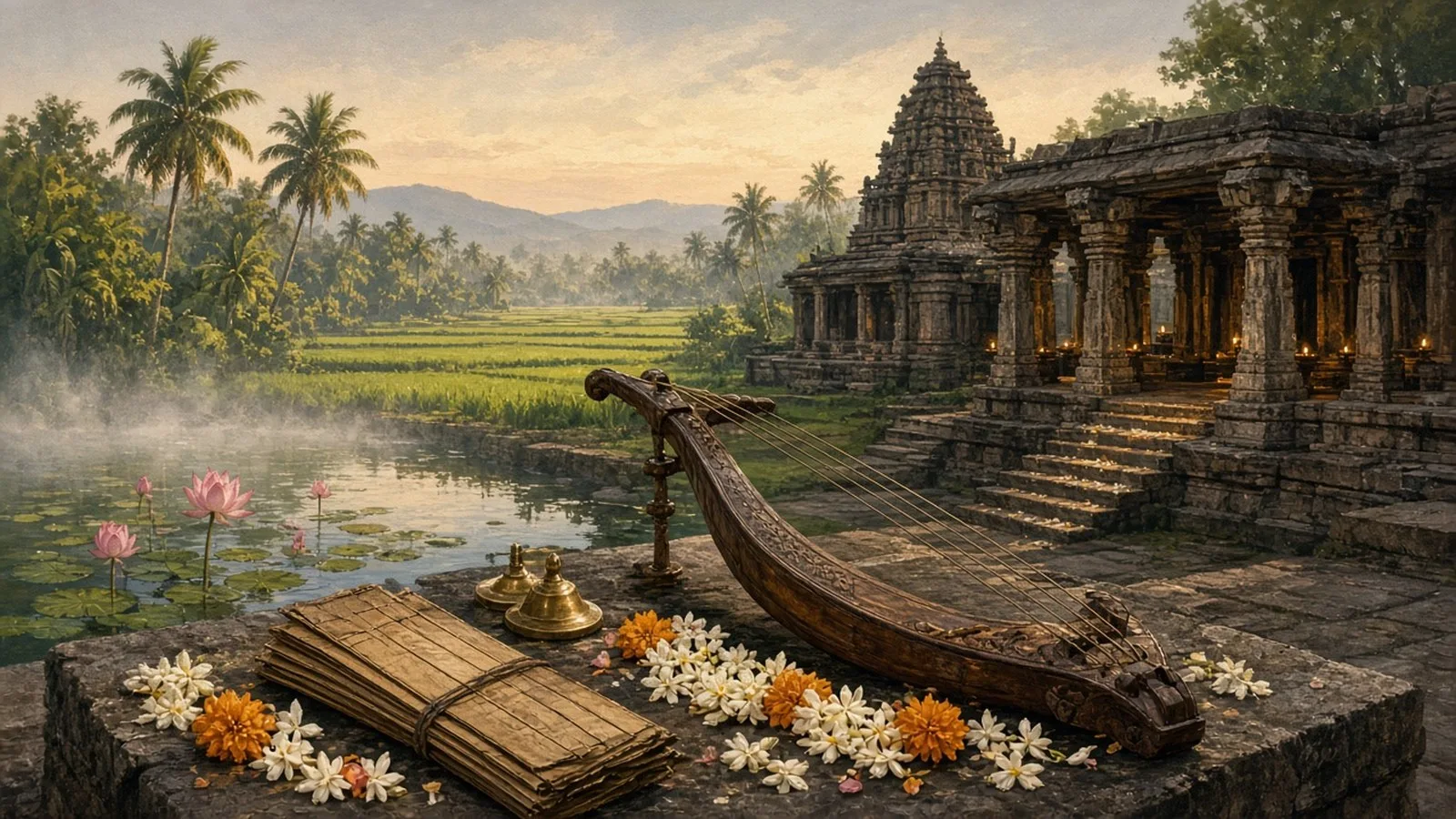
A later legend says a Chola king found the Tevaram palm leaves locked in a chamber of the Chidambaram temple, half eaten by white ants, and had the scholar Nambi Andar Nambi arrange them. Tradition names Rajaraja I. Zvelebil, noting that Nambi mentions the death of Aditya I (c. 907), placed him in the early 10th century. Either way, the hymns were well established by Rajaraja's time. An inscription at his Thanjavur temple pays 48 men to sing the Tiruppadiyam (Tevaram hymns), with two drummers, and several of the singers were named after the Tevaram poets.
In the 12th century Sekkizhar, a minister of Kulottunga II, told the lives of the 63 in the Periya Puranam, more than 4,000 verses long. It is a masterpiece of Tamil narrative, but as history it is late, devout and full of miracles.
The twelve Alvars
| Alvar | Background (traditional) | Best-known work |
|---|---|---|
| Poigai, Bhutam, Pey | The "first three"; legend sets their meeting at Tirukkovalur | Three Tiruvantadi |
| Tirumazhisai | Near today's Chennai | Tiruchanda Viruttam |
| Nammalvar | Vellala of Tirukkurugur (Alvar Tirunagari) | Tiruvaymozhi (1,102 verses) |
| Madhurakavi | Brahmin disciple of Nammalvar | Kanninun Siruttambu |
| Kulasekhara | Chera king | Perumal Tirumozhi |
| Periyalvar | Brahmin of Srivilliputhur | Tiruppallandu |
| Andal | Periyalvar's foster daughter, the only woman Alvar | Tiruppavai, Nachiyar Tirumozhi |
| Tondaradippodi | Temple servant at Srirangam | Tirumalai |
| Tiruppan | From the panar bard community | Amalanadhipiran |
| Tirumangai | Chieftain-warrior | Periya Tirumozhi, the largest single contribution |
Andal's 30-verse Tiruppavai imagines cowherd girls rising before dawn in the month of Margazhi (mid-December to mid-January) to wake Krishna. Her Nachiyar Tirumozhi is frankly bridal love poetry for Vishnu. Nammalvar's Tiruvaymozhi, called the "Tamil Veda" by Vaishnavas, became central to Ramanuja's Sri Vaishnava tradition. A. K. Ramanujan's Hymns for the Drowning brought it to readers worldwide.
Dating the Alvars
Tradition places the Alvars thousands of years BCE; historians do not. Tirumangai praises the Pallava king Nandivarman II (c. 731–796) in his hymn on Kanchi's Vaikuntha Perumal temple (Part 16), so he belongs to the 8th century. Tradition links Periyalvar with a Pandya called Srivallabha, often taken to be Srimara Srivallabha (c. 815–862). Most scholars put the first three Alvars around the 6th–7th centuries and Nammalvar in the 8th or 9th, but the sequence is still argued.
Nathamuni and the 4,000 verses
Nathamuni of Kattumannarkoil, usually dated to the 10th century, compiled the Divya Prabandham. Sri Vaishnava tradition says he heard a decad of Nammalvar at Kumbakonam that called itself ten verses "of a thousand" and went to Alvar Tirunagari in search of the rest. There, the story goes, Nammalvar appeared to him in a vision and gave him every hymn. Tamil Virtual Academy counts 3,776 verses by the twelve Alvars; traditional reckonings reach 4,000 by adding later works such as the Ramanuja Nurrandadi. Nathamuni is also credited with setting the verses to music, the origin of the Araiyar sevai song-and-gesture performance still held at Srirangam, Srivilliputhur and Alvar Tirunagari.
Sacred geography
Bhakti tied God to place. The Tevaram praises about 274 Shiva temples, called padal petra sthalams ("shrines that received songs"); some counts reach 276. Most of them lie in the Kaveri delta. The Alvars sang of 108 divya desams ("divine places") of Vishnu, two of them heavenly, with Srirangam first among them. Pilgrimage routes, festivals and the later Chola rebuilding of brick shrines in stone followed this map.
Kings, saints and rival faiths
- Mahendravarman I (Pallava) turned from Jainism to Shaivism under Appar's influence, according to the Periya Puranam. A Tiruchirappalli cave inscription is usually read as recording his turn to Shiva.
- Ninrasir Nedumaran (Pandya), usually identified with Arikesari Maravarman, was cured by Sambandar and won back from Jainism (see Part 17).
- Royal saints: the early Chola Kochengannan, Cheraman Perumal and Kulasekhara Alvar were themselves kings.
The hymns are openly hostile to Jains and Buddhists: in many of Sambandar's hymns one verse mocks their monks, and Vaishnava saints such as Tondaradippodi are just as harsh. The hagiographies go further. They describe Sambandar defeating Jain teachers at Madurai in ordeals by fire and water, followed by the impaling of 8,000 Jains. That story appears only in later works, Nambi Andar Nambi's poems and the Periya Puranam, written centuries after the events. Historians such as Nilakanta Sastri treat it as unhistorical, so it is best read as sectarian legend. Jain shrines and inscriptions continued in the Tamil country, and Buddhism survived at Nagapattinam into Chola times.
Caste, gender and devotion
The saints taught that devotion mattered more than birth. Their ranks include the hunter Kannappar, who offered his own eyes to Shiva; Nandanar, from the Pulaiyar community then treated as "untouchable"; Tiruppan Alvar; and the potter Tiruneelakantar. Two of the movement's greatest poets, Karaikkal Ammaiyar and Andal, were women. Zvelebil cautioned that this was a "spiritual democracy" among devotees, not social equality. In the Periya Puranam, Nandanar must still pass through fire before entering the Chidambaram shrine.
Music: the pann tradition
The Tevaram was made to be sung. Sambandar's and Sundarar's books are arranged by melodic mode, called pann. The tradition counts about two dozen panns, forerunners of later ragas. Temple singers called oduvars still perform them, though a 2020 report in The Hindu counted only about 120 traditionally trained oduvars, fewer than half the number of Tevaram shrines.
Legacy
- Living scripture: every Margazhi, Andal's Tiruppavai and Manikkavasagar's Tiruvempavai are sung at dawn in Tamil homes and temples.
- Philosophy: Ramanuja's Sri Vaishnavism and the later Shaiva Siddhanta school both built on these hymns.
- Art: Chola bronzes of Appar, Sambandar, Sundarar, Manikkavasagar and Andal stand in temples and museums worldwide.
- Across India: Friedhelm Hardy argued that Alvar love poetry shaped the Sanskrit Bhagavata Purana.
- Abroad: Thailand's royal Brahmin ceremony Triyampavai-Tripavai, held each December–January, takes its name from Tiruvempavai and Tiruppavai.
Timeline
| Date (approx.) | Development | How firm? |
|---|---|---|
| c. 550 CE | Karaikkal Ammaiyar | Scholarly estimate |
| 6th–7th century | First three Alvars | Debated |
| Early 7th century | Appar; Mahendravarman I turns to Shaivism | Fairly firm |
| 642 CE | Sack of Vatapi; Siruthondar–Sambandar link | Date firm; link is tradition |
| 7th century | Sambandar at Madurai | Tradition; date debated |
| 8th century | Sundarar; Tirumangai praises Nandivarman II | Fairly firm |
| 8th–9th century | Nammalvar, Periyalvar, Andal | Debated |
| 9th century (majority view) | Manikkavasagar | Strongly debated |
| c. 10th century | Nathamuni and Nambi Andar Nambi compile the hymns | Dates debated |
| Before 1014 CE | Rajaraja I appoints 48 Tevaram singers at Thanjavur | Firm |
| 12th century | Sekkizhar's Periya Puranam | Firm |
What we can say with confidence
- Confident: Tamil Shaiva and Vaishnava devotional poetry flourished between about the 6th and 9th centuries; the Tevaram and Divya Prabandham survive as large, sung collections compiled around the 10th century; Rajaraja I paid Tevaram singers at Thanjavur; the Periya Puranam dates from the 12th century.
- Uncertain: the exact dates of most saints, especially Manikkavasagar and the Alvars; how far the royal conversion stories are historical; the impalement story, which most historians reject; which Chola king "found" the Tirumurai.
Next part
Part 19, Vijayalaya and the Revival of the Chola Dynasty, follows how a minor chieftain took Thanjavur around 850 CE and began the Chola rise that would eclipse the Pallavas and Pandyas.
Sources
- K. A. Nilakanta Sastri, A History of South India
- Indira Viswanathan Peterson, Poems to Siva: The Hymns of the Tamil Saints
- Kamil Zvelebil, The Smile of Murugan, chapter 12, "Śaiva Bhakti—Two Approaches"
- Friedhelm Hardy, Viraha-Bhakti: The Early History of Kṛṣṇa Devotion in South India
- A. K. Ramanujan (trans.), Hymns for the Drowning: Poems for Viṣṇu by Nammalvar
- Vidya Dehejia, Slaves of the Lord: The Path of the Tamil Saints
- South Indian Inscriptions II, nos. 63–65, Rajarajesvara temple, Thanjavur (the Tiruppadiyam singers)
- Project Madurai: Sambandar's Tevaram, Book 1; Tiruvasagam; Nalayira Divya Prabandham (Tamil texts); Kausalya Hart, English translation of the Divya Prabandham, part 1
- Tamil Virtual Academy: Nalayira Divya Prabandham; Shaiva bhakti literature (Tamil)
- Shaivam.org: Periya Puranam: The Life of the 63 Nayanmars; Information on Periyapuranam
- Indica Today, Manikkavacagar: The Saiva Saint (the dating debate)
- The Hindu: Nathamuni, the saviour; Dance of Devotion (Araiyar sevai); Exclusive Thirumurai Thevaram patashala in Chidambaram
- Nathan McGovern, The Trīyampawāi-Trīppawāi of Thailand and the Tamil Traditions of Mārkaḻi, Journal of the Siam Society 108 (2020); Thailand Foundation, Triyampavai-Tripavai: The Swing Ceremony