This is Part 23 of 47 in HorizonDesk's chronological series on Indian history, from the Stone Age to Independence in 1947. It follows Part 22: The Tripartite Struggle for Kannauj.
While the Palas, Pratiharas and Rashtrakutas wore each other down over Kannauj, a small family in the Kaveri delta was quietly rising. Within about 150 years these Cholas controlled most of south India, Sri Lanka and the Maldives, sent an army to the Ganga, raided ports in Sumatra and the Malay Peninsula, and exchanged embassies with Song China. Their temples at Thanjavur, Gangaikondacholapuram and Darasuram are still in worship today.
The record is unusually rich: thousands of Tamil inscriptions, copper-plate grants such as the Larger Leiden and Tiruvalangadu plates, and royal praise preambles called meykirti. But they were written for the kings, so conquest claims need care. Reign dates below follow Britannica and K. A. Nilakanta Sastri; some vary by a year or two in other works.
Vijayalaya and the Chola revival
The Cholas were an old name, known from Ashoka's edicts and Sangam poetry, but from about the 4th to the 9th century they were minor chiefs around Uraiyur while the Pallavas and Pandyas dominated the south.
Around 850 a chief named Vijayalaya (c. 850 to c. 870) captured Thanjavur from the Muttaraiyar chiefs, who were vassals of the Pallavas, and built a temple there to the goddess Nisumbhasudani. This is taken as the start of the imperial Chola line. His son Aditya I (c. 870 to 907) fought on the Pallava side against the Pandyas, then turned on his overlord, defeated the Pallava king Aparajita and took over Tondaimandalam, the old Pallava country around Kanchi.
Parantaka I and the shock of Takkolam
Parantaka I (907 to c. 955) took the title Maduraikonda, "who took Madurai". Between about 910 and 942 he defeated the Pandya king and his Sri Lankan allies, and united the Chola and Pandya lands. Two of his inscriptions at Uttaramerur, dated 919 and 921, describe how a village assembly chose its committees, which we return to below.
Then came disaster. The Rashtrakuta king Krishna III, allied with the Western Ganga ruler Butuga II, invaded the Chola north. At the Battle of Takkolam in 949, near Arakkonam, the Chola crown prince Rajaditya was killed on his war elephant, reportedly shot by Butuga. Krishna III occupied Tondaimandalam and the Cholas lost much of the north for a generation.
Three confused decades followed: short reigns by Gandaraditya, Arinjaya, Sundara Chola (Parantaka II) and Uttama Chola, and the murder of the heir Aditya II around 969. Gandaraditya's widow Sembiyan Mahadevi rebuilt many brick temples in stone and commissioned fine bronzes. When the Rashtrakutas themselves fell in 973 (Part 21), the way was open for a revival.
Rajaraja I (985 to 1014): building an empire
Sundara Chola's younger son Arulmolivarman took the throne in 985 as Rajaraja I, "king of kings". His reign of nearly thirty years turned a regional kingdom into an empire. HorizonDesk's Tamil history series covers him in detail in Tamil History Part 20: Rajaraja Chola I, his conquests and the Big Temple; here is the outline.
- Kandalur Salai (c. 988): his earliest boast, repeated in the meykirti, is that he "destroyed the ships at Kandalur Salai", on the Kerala coast near present-day Thiruvananthapuram. Whether the salai was a college with armed students, a military school or a harbour is debated.
- The south and west: he subdued the Pandyas and the Chera (Kerala) country, and by about 1000 had annexed Gangavadi in southern Karnataka and the Nolambavadi region.
- Sri Lanka (c. 993): a Chola army sacked Anuradhapura, and northern Sri Lanka became a Chola province governed from Polonnaruwa, renamed Jananathamangalam.
- Vengi and the Chalukyas: he backed the Eastern Chalukya prince Saktivarman in coastal Andhra and married his daughter Kundavai to the next ruler, Vimaladitya. This marriage alliance would shape the dynasty's future.
- The Maldives: late in his reign his records claim the "old islands of the sea, numbering twelve thousand", usually identified with the Maldives and Lakshadweep.
Rajaraja also had a long view. Around 1001 he ordered a survey and reassessment of land across the core territories, carried out by an officer called Kuravan Ulagalandan ("who measured the world"), and he regrouped districts into larger units called valanadu. He was a devoted Shaiva but tolerant: the Anaimangalam (Larger Leiden) plates record that he allowed the Sailendra king of Srivijaya to build the Chudamani Vihara, a Buddhist monastery, at Nagapattinam, and endowed it with a village, a grant completed by his son.
The Brihadisvara temple at Thanjavur
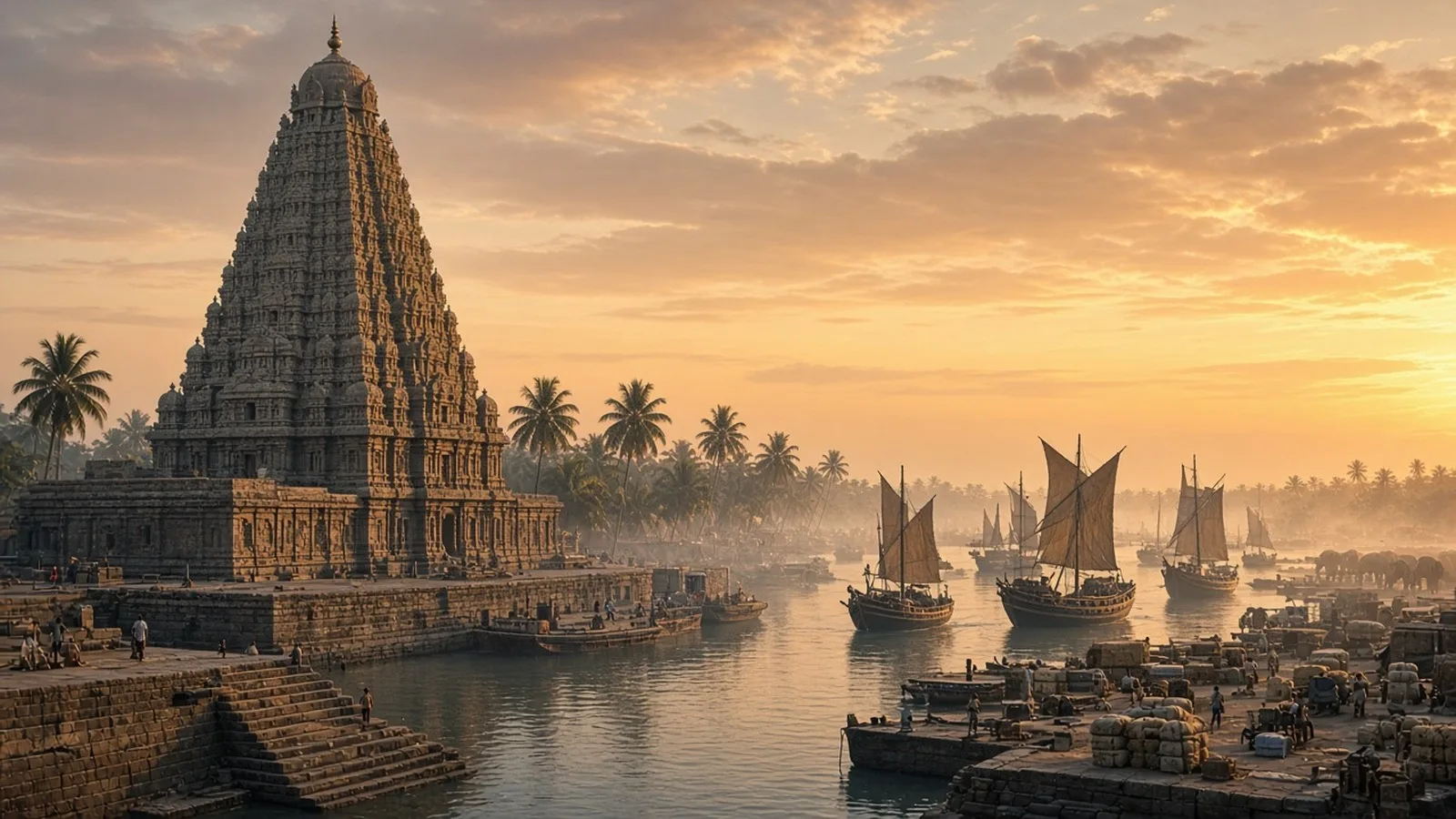
Rajaraja's masterpiece is the Brihadisvara (Rajarajesvaram, the "Big Temple") at Thanjavur, completed around 1010. Its granite vimana rises in thirteen tiers to roughly 60 to 66 metres (sources differ), then India's tallest. Its capstone is traditionally put at about 80 tonnes.
The temple is also an archive. Its walls carry long inscriptions listing Rajaraja's gifts of gold, jewels and bronzes, the villages assigned to supply it, the shepherds who kept its lamps burning, and some 400 women attached to the temple as dancers, with the street and house each received. UNESCO inscribed it in 1987, and extended the site in 2004 as the Great Living Chola Temples, adding Gangaikondacholapuram and the Airavatesvara temple at Darasuram; our Great Living Chola Temples guide covers how to visit.
Rajendra I (1014 to 1044): from the Ganga to Kedah
Rajaraja's son Rajendra I had been co-ruler since 1012 and pushed the empire to its widest. Our Tamil History Part 21: Rajendra Chola I and Srivijaya tells his story in full.
- Sri Lanka: around 1017 to 1018 he completed the conquest of the island and carried off King Mahinda V to the Chola country, as the Sinhalese chronicle Culavamsa also records.
- The Deccan: he fought the Western Chalukya Jayasimha II, notably at Maski around 1020, with no lasting conquest.
- The Ganga expedition (c. 1019 to 1023): a Chola army marched north through Kalinga (Odisha) and, according to his records, defeated several eastern kings, among them the Pala ruler Mahipala I of Bengal, and reached the Ganga. Water from the river was brought back, and Rajendra took the title Gangaikonda Chola, "the Chola who took the Ganga". It was a victory parade more than a conquest: no northern territory was held.
To mark it he built a new capital, Gangaikondacholapuram, in today's Ariyalur district, with a great Shiva temple modelled on Thanjavur but with a gracefully curved vimana, and a huge reservoir, the Cholagangam, described as a "liquid pillar of victory".
The 1025 raid on Srivijaya
Rajendra's most famous campaign was overseas. Srivijaya, a Malay maritime power based in southeast Sumatra, controlled the Straits of Malacca and the route to China. Rajendra's Tamil inscriptions, describing a campaign of about 1025, list the places his fleet struck: Srivijaya itself (near Palembang), Kadaram (Kedah on the Malay Peninsula), Pannai, Malaiyur, Ilangasoka (Langkasuka), Tamralinga, Ilamuridesam (northern Sumatra, around Aceh) and Manakkavaram (the Nicobars), and says the Srivijaya king Sangrama Vijayottungavarman was captured with his treasure. Rajendra added the title Kadaram-konda.
Historians agree it was a raid, not an occupation, but disagree on why it happened. Nilakanta Sastri suggested Srivijaya was obstructing Chola merchants on the China route. Hermann Kulke, Tansen Sen and others in the volume Nagapattinam to Suvarnadwipa (2009) weigh trade, rivalry for prestige at the Song court, and royal ambition to equal the conquests of legend. Scale is also uncertain: the list may combine several actions, and there is little Southeast Asian evidence for the attack. Relations recovered: around 1068 Virarajendra sent a fleet to Kedah, apparently to help a Srivijaya prince.
How the Chola kingdom was run
The king stood at the top, assisted by officers whose titles appear in inscriptions, with territory divided into mandalam (provinces), valanadu and nadu. Below that, much of daily government lay with local bodies.
- The ur: the assembly of landholders in an ordinary village.
- The sabha or mahasabha: the assembly of a brahmadeya, a village granted to Brahmins.
- The nagaram: the merchant body of a market town.
- The nadu: a locality of several villages, which the historian Y. Subbarayalu showed to be the basic agrarian unit.
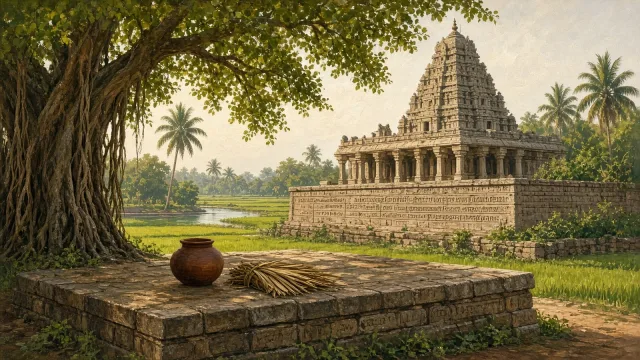
The Uttaramerur inscriptions describe a sabha choosing committee members by lot: names written on palm leaves were put in a pot (kudavolai) and drawn by a child, with qualifications on property, age and learning, and bars on those who had not rendered accounts. For more, see Tamil History Part 22: Chola administration and Uttaramerur. Only property-owning men took part, but it was real local self-government.
How strong was the centre? Nilakanta Sastri described a powerful, centralised monarchy on the Byzantine model. In 1980 Burton Stein argued instead for a "segmentary state", in which the king's real power ran only in the Kaveri core and outlying areas were tied to him mainly by ritual. Noboru Karashima, Subbarayalu and others, using the land surveys and revenue records, find a more bureaucratic state than Stein allowed, especially under Rajaraja and Rajendra. Most scholars now sit between the two.
Merchants, guilds and Song China
Chola power and sea trade grew together. Merchant guilds operated across the Bay of Bengal: the Ainnurruvar ("Five Hundred of Ayyavole"), the Manigramam and the Nanadesis. Tamil inscriptions of these guilds have been found in Sri Lanka, at Barus in Sumatra (dated 1088), in southern Thailand and at Quanzhou in China, where a Tamil-Chinese inscription of 1281 records a Shiva temple. Kenneth Hall has traced how they linked temple, market and port.
Song Chinese records list missions from "Zhunian" (Chola) in 1015, 1020 and 1033, and a large mission in 1077 under Kulottunga I. Nagapattinam was the leading Chola port, exporting textiles, pepper and gems and importing Chinese silk, porcelain and copper coins.
Kulottunga I and the Chalukya-Chola union
After Rajendra, his sons Rajadhiraja, Rajendra II and Virarajendra fought a long war with the Western Chalukyas; Rajadhiraja was killed at the battle of Koppam in 1054. When the direct line ended in a palace crisis in 1070, the Eastern Chalukya prince Rajendra, a grandson of Rajendra I through his mother, took the throne as Kulottunga I (1070 to 1122). He united Vengi and the Chola country, gave up costly Deccan wars, lost Sri Lanka to Vijayabahu I, and was remembered as Sungam tavirtta Chola, "the Chola who abolished tolls".
Later Cholas and decline to 1279
The 12th century was culturally brilliant: the Airavatesvara temple at Darasuram under Rajaraja II, Sekkilar's Periya Puranam, and the poets Ottakkuttar and Kamban. But power drained to feudatories. From about 1216 the Pandyas under Maravarman Sundara Pandya invaded; the Hoysalas of Karnataka intervened, first as allies and then as rivals; and the Kadava chief Kopperunjinga even captured Rajaraja III for a time in the 1230s. After Jatavarman Sundara Pandya's victories around 1257, the Cholas were a minor power. The last known king, Rajendra III, disappears from the records in 1279.
Key takeaways
- Vijayalaya took Thanjavur around 850; Parantaka I united the Chola and Pandya lands, but lost the north at Takkolam in 949.
- Rajaraja I (985 to 1014) conquered Kerala, northern Sri Lanka and the Maldives, surveyed the land and built the Brihadisvara temple around 1010.
- Rajendra I sent an army to the Ganga, defeating Mahipala I, built Gangaikondacholapuram and raided Srivijaya around 1025; the motives are still debated.
- Local assemblies (ur, sabha, nagaram, nadu) ran much of daily life; historians debate whether the state was centralised or "segmentary".
- Guilds like the Ainnurruvar and missions to Song China linked the Cholas to a Bay of Bengal trading world; Kulottunga I united the Chalukya and Chola lines, and the dynasty ended in 1279.
Next part
In Part 24, we go back north to The Rajputs and Early Medieval North India, from the Chandelas to the Chauhans.
Sources
- Encyclopaedia Britannica, Chola dynasty
- Encyclopaedia Britannica, Rajaraja I
- UNESCO World Heritage Centre, Great Living Chola Temples
- Archaeological Survey of India, Trichy Circle, Brihadisvara temple, Thanjavur, and Gangaikondacholapuram
- Nilakanta Sastri, K. A. (1955), The Colas, 2nd edition, University of Madras
- Nilakanta Sastri, K. A. (1955), A History of South India, Oxford University Press
- Kulke, H., Kesavapany, K. and Sakhuja, V. (eds.) (2009), Nagapattinam to Suvarnadwipa: Reflections on the Chola Naval Expeditions to Southeast Asia, Institute of Southeast Asian Studies, Singapore
- Hall, K. R. (1980), Trade and Statecraft in the Age of the Colas, Abhinav Publications
- Stein, B. (1980), Peasant State and Society in Medieval South India, Oxford University Press
- Karashima, N. (ed.) (2014), A Concise History of South India: Issues and Interpretations, Oxford University Press
- Subbarayalu, Y. (1973), Political Geography of the Chola Country, Tamil Nadu State Department of Archaeology
- Sen, T. (2003), Buddhism, Diplomacy, and Trade: The Realignment of Sino-Indian Relations, 600-1400, University of Hawaii Press
- Thapar, R. (2002), Early India: From the Origins to AD 1300, University of California Press