This is Part 22 of HorizonDesk's chronological series on Tamil history, from prehistory to modern Tamil Nadu. The previous instalment was Part 21: Rajendra Chola I, Gangaikonda Cholapuram and the Naval Expedition to Srivijaya.
The last two parts followed Chola kings to war. This one stays at home: how did a dynasty based in the Kaveri delta collect taxes, settle disputes and keep irrigation tanks working across a large territory?
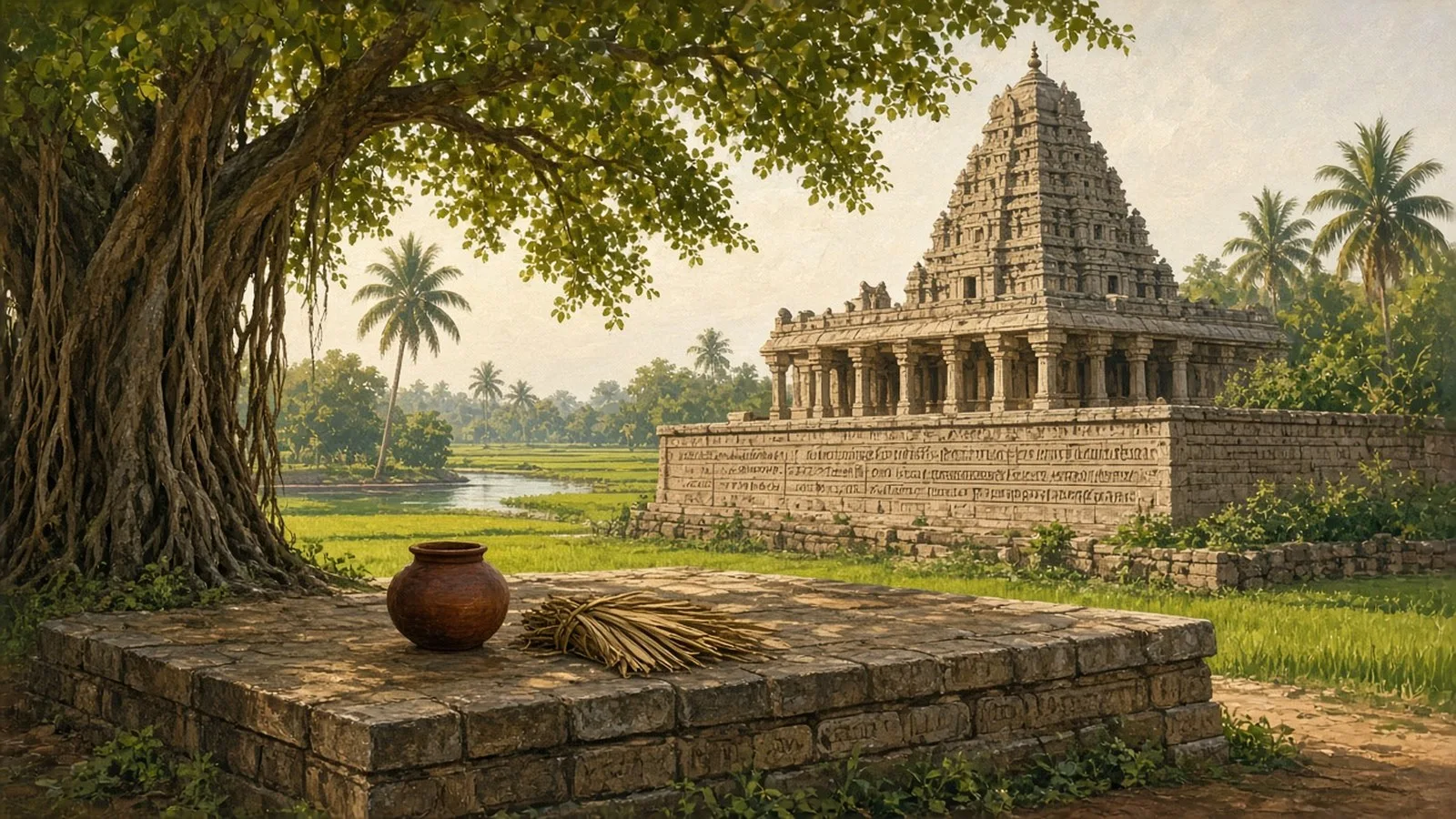
Some of the best evidence comes from one village. On the walls of the Vaikuntha Perumal temple at Uthiramerur, about 30 km south of Kanchipuram, the local assembly carved the rules it used to pick its committees in the reign of Parantaka I (907–955). The rules cover wards, qualifications, disqualifications, a draw of palm-leaf tickets from a pot, terms of office and the auditing of accounts. Few records of local government from medieval Asia are as detailed. They are also easy to over-sell.
Chola government at a glance
| Level | Tamil term | What it was |
|---|---|---|
| Kingdom | rajyam, the king and his court | The king, his heir, ministers and the officials who drafted and sent royal orders |
| Province | mandalam | A large region, often an older kingdom, such as Cholamandalam (the delta) or Tondaimandalam (around Kanchipuram) |
| Division | valanadu | A group of nadus, introduced on a large scale under Rajaraja I around 1001 |
| Locality | nadu (in Tondaimandalam also grouped into kottams) | A cluster of villages sharing a river or tank system, with its own assembly of leading farmers |
| Village or town | ur, sabha, nagaram | Assemblies of ordinary landholders, of Brahmin landholders, and of merchants |
The king and his court
At the top sat the king, also the patron of the great temples (see Part 20 on Rajaraja I). Inscriptions show him giving orders orally from a named palace hall. A secretary, the tirumandira olai, wrote the order down; senior officers checked it and sent it to the local assembly, which often had it carved in stone.
Officials appear in two broad grades, perundaram (higher) and sirudaram (lower), and many were rewarded with land and titles rather than salaries. The revenue department, puravuvari-tinaikkalam, kept registers of land and its tax liability. How much this machinery really controlled is debated; we return to that below.
Uthiramerur: a Brahmin village with a long memory
Uthiramerur was not a typical village. It began as a brahmadeya, land granted by a king to Brahmins learned in the Vedas. According to the epigraphist R. Nagaswamy, the Pallava king Nandivarman II founded it around 750 CE as Uttaramerur chaturvedimangalam (a settlement of Brahmins versed in the four Vedas). For more on the Pallavas of Kanchi, see Part 16 of this series.
When the Cholas took over the Kanchipuram region in the early tenth century, the village was prosperous and run by its own assembly, the mahasabha. Its Vishnu temple, the Vaikuntha Perumal, served as public building as well as place of worship.
What the inscriptions say
There are two related records, both from the reign of Parantaka I, who calls himself Parakesarivarman, who conquered Madurai.
- The first, from his 12th regnal year (usually given as c. 919 CE), sets out an election procedure.
- The second, from the 16th day of his 14th regnal year (usually c. 921 CE), revises it in more detail. That a revision was needed within two years suggests the first system ran into trouble, though the record does not say what went wrong.
Books give the dates as 917/919, 919/921 or 920/922, depending on how Parantaka's accession in 907 is counted. Older works spell the place Uttaramerur.
The second record says it was made "in accordance with the royal letter", with a royal officer, Karanjai Kondaya Kramavitta Bhattan, sitting with the assembly. That detail matters for the debate about how independent village assemblies were.
Thirty wards and a pot
The village was divided into 30 wards (kudumbu) spread across 12 streets. People in each ward wrote the names of qualified men on palm leaves (olai). The leaves for each ward were tied into a bundle with a label and placed in a pot (kudam). That is where the name kudavolai, "pot-leaf", comes from.
On selection day the whole assembly, young and old, met in the hall, with every temple priest in the village required to attend. The oldest priest stood up and showed the pot so everyone could see it was empty except for the bundles. A young boy, too young to understand what was going on, picked out a bundle, mixed its leaves in another pot and drew one. The arbitrator (madhyastha) took the leaf on his open palm, so no one could suspect a swap, and read the name aloud. The priests read it after him. That man became the member for the ward.
This is a lottery among qualified candidates (sortition), not a vote between rivals. The closest Western parallel is ancient Athens, which drew many officials by lot.
Who could stand
To have his name put in the pot, a man had to:
- own more than a quarter veli of tax-paying land (a veli is a little under 7 acres, but its size varied locally);
- live in a house built on his own site;
- be over 35 and under 70;
- know the Mantra Brahmana (a Vedic text) well enough to teach it;
- as an alternative to rules 1 and 4, own at least one-eighth veli and have learnt one Veda and one of the four bhashyas (commentaries), well enough to explain it;
- be "conversant with business", virtuous, honestly earning and "pure in mind";
- not have served on any committee in the previous three years.
Who could not
The exclusions show what worried the assembly:
- anyone who had served on a committee and not submitted his accounts, along with a long list of his relatives, from father and sons to in-laws;
- anyone guilty of incest or of the "great sins" of Hindu law, and their relatives;
- anyone who had stolen another's property, been "foolhardy", or eaten forbidden food, even if he had later done penance;
- in the revised rules, those guilty of forgery and anyone who had been punished by being made to ride a donkey, a public humiliation.
Several of these bans were for life.
The committees
The 30 men drawn were split into committees (variyam) for a term of 360 days:
| Committee | Members | Main job |
|---|---|---|
| Samvatsara variyam (annual committee) | 12 | General oversight and disputes; chosen from those older and more learned, who had already served on the garden and tank committees |
| Thotta variyam (garden committee) | 12 | Gardens, orchards and cultivated land |
| Eri variyam (tank committee) | 6 | Irrigation tanks, the lifeline of dry Tondaimandalam agriculture |
| Pon variyam (gold committee) | chosen the same way | Testing gold and handling coin |
| Panchavara variyam | chosen the same way | Probably a revenue or levy committee; its exact role is debated |
Any member found guilty of wrongdoing was to be removed at once, and accountants could serve again only after their accounts were passed. The record closes by saying the rules would last "as long as the moon and the sun endure".
Sabha, ur and nagaram
Uthiramerur shows only one kind of assembly. Chola villages and towns had at least three:
- The ur was the assembly of landholders in an ordinary agricultural village, mostly non-Brahmin peasant landowners. Most villages were of this kind.
- The sabha (or mahasabha) met only in brahmadeya villages like Uthiramerur, and only Brahmin landholders sat in it.
- The nagaram was the body of merchants in market towns, which handled trade and market dues.
Above them was the nadu, a locality of several villages whose leading landholders (the nattar) met as a group. The historians Noboru Karashima and Y. Subbarayalu showed how important the nadu was; Subbarayalu's Political Geography of the Chola Country (1973) mapped these localities, many following river channels and tank systems. Around 1001, Rajaraja I grouped nadus into larger valanadus, often named after his own titles, and these sat within mandalams.
Land survey and revenue
Rajaraja's government began a great land survey around 1001, credited to an officer titled Ulagalandan, "the one who measured the world". Fields were measured, classified and assessed, and many inscriptions copy entries from the registers. Kulottunga I carried out another survey around 1086, the same year England's Norman kings began the comparable Domesday survey.
Land revenue was a share of the produce, paid mostly in paddy and sometimes in gold or coin, on top of dozens of smaller dues and labour obligations. Land given to temples or Brahmins was often tax-free. Village assemblies usually answered for the village's dues as a group, which helps explain their careful accounts.
The temple as an institution
A large Chola temple was landlord, employer, bank and school. Its inscriptions record gifts of land and livestock, loans to village assemblies at interest, and hundreds of employees, from priests and musicians to accountants and lamp-keepers. The great temples of Thanjavur and Gangaikonda Cholapuram, now part of the UNESCO-listed Great Living Chola Temples, drew grain and gold from villages far away. At Uthiramerur, too, the temple displayed the assembly's laws.
Centralised state or "segmentary" state?
Historians read this evidence in very different ways.
- The centralised view. K. A. Nilakanta Sastri, in The Colas (1935–37; second edition 1955), described a strong bureaucratic monarchy with an "almost Byzantine" court and self-governing villages under royal oversight.
- The segmentary view. Burton Stein, in Peasant State and Society in Medieval South India (1980), argued that the Chola king's real authority was mainly ritual outside the Kaveri core. On this view, power rested with peasant localities (the nadus) and their alliance with Brahmins and temples.
- The middle ground. Karashima, Subbarayalu and others, working through thousands of inscriptions, describe a state that grew more organised under Rajaraja and Rajendra, with real officials, surveys and registers, but that worked through local bodies rather than replacing them.
Uthiramerur fits more than one view. The assembly wrote its own detailed rules, but it did so "according to the royal letter" with a royal officer present.
Was it democracy?
In recent years Uthiramerur has been held up as proof of ancient Indian democracy, including by Prime Minister Narendra Modi. The rules do show some striking ideas: fixed terms, a ban on immediate re-election, disqualification for corruption, public audit of accounts and a transparent draw.
But it is fairer to call it a self-governing oligarchy of qualified Brahmin landholders. Women, the landless, tenants, labourers and non-Brahmins had no place in the sabha. Members were chosen by lot, not by voters choosing between candidates. How the far more common ur assemblies chose their members is much less well recorded. Uthiramerur is a remarkable record of accountable local government, not a medieval form of universal suffrage.
Timeline
| Date | Event | Certainty |
|---|---|---|
| c. 750 | Pallava Nandivarman II founds Uttaramerur chaturvedimangalam | Traditional, based on inscriptions |
| 907 | Parantaka I becomes Chola king | Firm |
| c. 919 | First Uthiramerur election rules (12th regnal year) | Approximate |
| c. 921 | Revised rules (14th regnal year) | Approximate |
| 985 | Rajaraja I becomes king | Firm |
| c. 1001 | Land survey and valanadu reorganisation | Fairly firm |
| c. 1086 | Resurvey under Kulottunga I | Approximate |
| c. 1904 | V. Venkayya's English translation published in the government's epigraphy reports | Fairly firm |
What we can say with confidence
- Confident: a Brahmin village assembly at Uthiramerur, acting on a royal order, carved detailed rules for choosing committees by lot in Parantaka I's reign; the Chola state ran through nested units (mandalam, valanadu, nadu, village); Rajaraja I ordered a major land survey.
- Debated: the exact dates of the two records; how typical Uthiramerur was; the role of some committees; how centralised the state was.
Next part
Part 23, The Later Cholas: Kulothunga I to the Decline of the Dynasty, follows the Chalukya-Chola line from Kulottunga I's accession in 1070 to the slow fall of the dynasty.
Sources
- K. A. Nilakanta Sastri, The Colas (2nd ed., University of Madras, 1955), chapters on central and local government
- K. A. Nilakanta Sastri, A History of South India
- Y. Subbarayalu, Political Geography of the Chola Country (Tamil Nadu State Department of Archaeology, 1973)
- Burton Stein, Peasant State and Society in Medieval South India (Oxford University Press, 1980)
- Tamil Nadu State Election Commission, Ancient epigraphical inscription on elections: Vaikuntha Perumal Temple, Uthiramerur
- Government of Tamil Nadu, Rural Development Department, English translation of the Uttaramerur inscription (annexure, PDF)
- The Hindu, Uttaramerur model of democracy (interview with R. Nagaswamy)
- The Hindu, Millennium inscriptions shed light on polling system of Tamils
- The Hindu, Writing on the wall
- BBC News Tamil, The Uthiramerur inscription cited by PM Modi (Tamil)
- Tamil Virtual Academy, Village administration under the later Cholas: committees and kudavolai (Tamil)