This is Part 4 of World Wars, our series on the First and Second World Wars, from the July Crisis of 1914 to the world that emerged in 1945. New parts appear every Monday, Wednesday and Friday.
In Part 3 we watched Germany's plan for a quick victory fail on the Marne and the Western Front harden into trenches by Christmas 1914. This part moves thousands of kilometres east, to the Indian Ocean, where in the same autumn a single German cruiser captured merchant ships almost at will, set fire to the oil tanks of Madras (Chennai) and left a word in everyday Tamil that outlived the war by a century.
A cruiser cut off from home
When war broke out in August 1914, Germany had a small overseas naval force, the East Asia Squadron under Vice-Admiral Maximilian von Spee, based at Tsingtao (Qingdao), a German-leased territory on the Chinese coast. With Japan about to join the Allies and the Royal Navy far stronger at sea, von Spee decided to take his heavy cruisers across the Pacific towards South America and, eventually, home.
One ship went the other way. The light cruiser SMS Emden, commissioned in 1909, was fast for her day, carried ten 10.5 cm (4.1-inch) guns and had three tall funnels. Her captain, Fregattenkapitän Karl von Müller, argued that a single cruiser loose in the Indian Ocean could do far more damage than one more ship in the squadron. In mid-August, at a meeting in the Mariana Islands, von Spee agreed and detached Emden, with a collier (a coal supply ship) to keep her going.
A commerce raider is a warship that hunts enemy merchant shipping rather than enemy fleets, and it must keep moving, because every port it is seen near becomes a trap. Emden slipped past the neutral Dutch East Indies (now Indonesia) into the Bay of Bengal in early September, where British ships still sailed their usual routes, lit up and unescorted.
Raiding the Bay of Bengal
Between 10 and 14 September 1914 Emden worked the shipping lane between Colombo and Calcutta (Kolkata). She took the Greek collier Pontoporos, then British steamers including Indus, Lovat, Killin, Diplomat, Trabboch and Clan Matheson. An Imperial War Museums (IWM) photograph shows the Killin stopped by Emden on 13 September, with her stores being removed before she was sunk.
Müller won a reputation for correctness: crews were taken off before their ships were sunk, held on a captured vessel (the Kabinga served as a "prison ship") and then released. That also meant the British soon knew what was happening. Shipping out of Calcutta was halted, war-risk insurance rates rose sharply, and exports such as jute and tea were disrupted. Accounts differ on the final tally, because some ships were captured and released while others were used as colliers and sunk later. The Royal Australian Navy puts it at 25 Allied steamers captured or sunk, plus two warships; other counts are in the low twenties.
The night of 22 September 1914
By late September British and Allied cruisers were closing in from the east. Müller decided on a stroke that no ordinary commerce raider would try: a dash across the bay to bombard Madras, the capital of the Madras Presidency, before turning south.
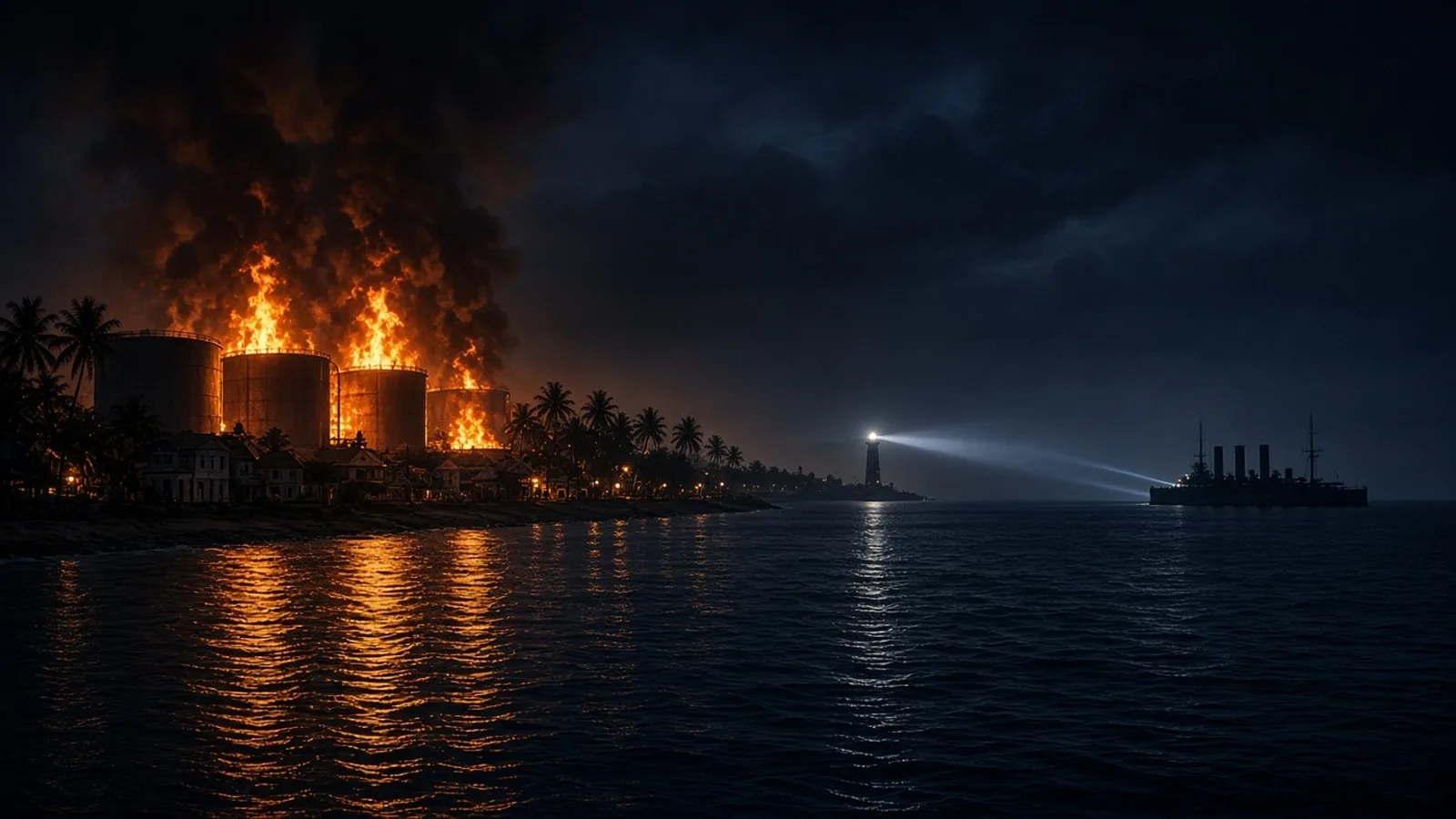
The city was not expecting him. It was the third day of Navaratri, and the harbour lights and the lighthouse were burning as usual, which helped Emden's navigators. At around 9.30 pm (accounts give times from about 9.20 to 9.45), Emden stopped roughly 2,500-3,000 yards (about 2.5 km) offshore, switched on her searchlights and opened fire on the white storage tanks of the Burmah Oil Company, close to the harbour and the High Court.
The bombardment lasted perhaps half an hour; most sources say about 125-130 shells were fired. Two tanks burst into flames and burned through the night. Estimates of the fuel lost range from about 346,000-350,000 gallons to more than 400,000, and Frontline puts Burmah Oil's loss at about £30,000. Ranging shots also hit the merchant ship Chupra in the harbour, and shells and fragments landed across the city: the Port Trust's buildings, the Madras Sailing Club, the High Court's compound wall, the National Bank of India's new building, and streets as far inland as Vepery, Nungambakkam and Poonamallee High Road. The shore batteries replied with a handful of rounds that missed.
Casualty figures are uncertain. A contemporary account in The Indian Review, quoted by The Hindu, gives three dead and 13 injured, and the New York Times reported three Indians killed. Later accounts usually give five dead, mostly sailors on the ships in harbour, and around two dozen wounded. The human cost was small; the shock was not.
Müller later explained the attack as a demonstration meant to impress the Indian population, disrupt British trade and damage British prestige. A burning tank farm visible for miles out at sea did all three.
Panic, rumour and a new word
News of the shelling was at first kept out of the papers; The Hindu has noted that it did not report the raid on the next day or the day after, probably under official pressure. Rumour filled the gap. Stories spread that the ship would return, and according to The Hindu's later reconstruction, thousands of people left the city every day in the following weeks, packing Central Station and leaving by road on carts and on foot. Prices rose and land values fell. Cheap popular song-books (gujili books) about the attack appeared, which the historian S. Theodore Baskaran has suggested were partly meant to reassure people that the British still had things in hand.
What is certain is the word. In Tamil, and in Madras Bashai (the city's street Tamil), "Emden" (எம்டன்) came to mean someone formidable: a daring, resourceful operator in some uses, a strict elder or a bully in others. "Avan thaan Emden" ("he's an Emden") was a common phrase, and R.K. Narayan wrote a short story called Emden about a domineering old man. Few foreign warships have entered an Indian language this way.
The raid belongs to a longer story of the city that we have told elsewhere on HorizonDesk, in Chennai's firsts, from flight to trams and the stories on our Madras history tag page.
Ceylon, Diego Garcia and Penang
From Madras, Emden steamed south past Pondicherry (Puducherry) and down the coast of Ceylon (Sri Lanka), taking more ships near Colombo and around the Maldives and Laccadive Islands (Lakshadweep). At remote Diego Garcia, the islanders had reportedly not yet heard of the war, and Emden coaled in peace. According to Frontline, one of the ships sunk in this phase was carrying the "Cities" exhibition of the Scottish town planner Patrick Geddes, which was on its way to India.
Müller's boldest move came next. Before dawn on 28 October 1914, with a dummy fourth funnel rigged to make her look like a British cruiser, Emden entered the harbour of Penang in British Malaya. There she torpedoed and shelled the Russian cruiser Zhemchug, which blew up and sank; Russian losses are usually given as over 80 killed and more than 100 wounded. On the way out Emden sank the French destroyer Mousquet, then stopped to pick up survivors before escaping. Penang showed that not even an Allied harbour was safe.
The end at Cocos, 9 November 1914
Müller's last target was the cable and wireless station on Direction Island in the Cocos (Keeling) Islands, a vital link in the telegraph network between Australia, Asia and Britain. On the morning of 9 November he landed a party of about 50 men under his first officer, Kapitänleutnant Hellmuth von Mücke, to wreck it. Before the station's transmitter was silenced, its staff sent out a call for help.
By chance, the first convoy carrying Australian and New Zealand troops to the war was passing about 50 nautical miles away. Its escort detached the Australian light cruiser HMAS Sydney under Captain John Glossop. Emden fired first and hit Sydney early, but the Australian ship was faster and carried heavier 6-inch guns, and Glossop kept his distance. After about two hours Emden was burning, her funnels and foremast shot away. Müller ran her aground on North Keeling Island to save lives.
According to the Royal Australian Navy, Emden had 316 men aboard and lost 134 killed and 65 wounded; other sources give 130-131 dead. Sydney lost four killed and about a dozen to 16 wounded. Müller and the survivors became prisoners of war. The battle was celebrated in Australia as the new navy's first victory, and it removed the last immediate threat to troop convoys crossing the Indian Ocean.
The Ayesha escape
Von Mücke's landing party watched the battle from Direction Island. Rather than surrender, they seized an old schooner, the Ayesha, and sailed away that evening. They reached Padang in the Dutch East Indies, transferred to a German merchant ship, landed in Yemen and travelled on through Arabia to Constantinople (Istanbul), arriving in mid-1915. Von Mücke's account, The "Ayesha", became a bestseller in Germany. The Kaiser later allowed Emden's crew to add "Emden" to their surnames, so Müller became Müller-Emden.
Myth vs evidence: what historians debate
- How much damage did the raid do? In physical terms, little: a few oil tanks, some buildings and a handful of lives. Its real effect was economic and psychological, in shipping halted, insurance raised and confidence in the Royal Navy shaken across India.
- "The last gentleman of war"? Müller's care for prisoners is well documented and was praised even in Britain. But his raid still killed civilians and sailors, and chivalry did not change its purpose: to hurt the British war economy.
- Chempakaraman Pillai. A popular story in Tamil Nadu and Kerala says that the Indian revolutionary Chempakaraman Pillai, who was working with the Germans in Europe, was on board Emden and guided her guns at Madras. His family and many Indian accounts repeat it. But no German record supports it: the German historian Joachim Bautze told a Chennai audience he had never seen Pillai's name in the sources, and Madras historians S. Muthiah and Sriram V. have called the claim unproven. Pillai's work for Indian independence in Germany is real; his presence on Emden remains a legend.
- Panic or calm? Not everyone remembered a mass exodus. The cricket writer K.N. Prabhu told the Madras chronicler S. Muthiah he had heard that the 1914 shelling caused far less panic than the Japanese bombs near the harbour in 1943. With the press censored, the scale of the flight cannot be measured precisely.
Traces in Chennai and beyond
The most visible memorial is a small plaque on the eastern side of the Madras High Court compound wall, near Parry's Corner, marking where an Emden shell struck in 1914. According to Frontline, a similar plaque at Clive's Battery in Royapuram was lost when the area was redeveloped, and some recovered shells have been displayed at the Fort St George Museum. Far away, one of Emden's guns stands in Hyde Park in Sydney, and the Australian War Memorial in Canberra holds Emden relics. The wreck itself lay on North Keeling's reef for decades before the sea broke it up.
At a glance: the cruise of the Emden, 1914
| Dates | Detached mid-August 1914; Bay of Bengal raids from 10 September; Madras 22 September; Penang 28 October; destroyed 9 November 1914 |
| Places | Bay of Bengal, Madras (Chennai), Ceylon (Sri Lanka), Diego Garcia, Penang (Malaysia), Cocos (Keeling) Islands |
| Sides | Germany against Britain and its empire, Australia, Russia, France and Japan |
| Commanders | Karl von Müller and Hellmuth von Mücke (Emden); John Glossop (HMAS Sydney) |
| Ships taken | About 21-25 merchant ships captured or sunk (counts vary), plus the cruiser Zhemchug and destroyer Mousquet |
| Madras raid | About 125-130 shells; two Burmah Oil tanks burned; 3-5 killed and roughly 13-26 wounded, depending on the source |
| Outcome | Emden wrecked at North Keeling; about 130-134 of her crew killed; landing party escapes on the Ayesha |
| Legacy | The Tamil word "Emden"; High Court plaque in Chennai; Australia's first naval victory |
Next in the series
Part 5: Indian Soldiers in the First World War: From Flanders to Mesopotamia. More than a million Indians served overseas in the war. Next, we follow them from the trenches of Flanders to Mesopotamia, East Africa and Gallipoli, and look at what India was promised in return.
Sources
- The battle between HMAS Sydney and SMS Emden, Royal Australian Navy
- The Sydney-Emden Engagement, Australian War Memorial
- SS Killin stopped by SMS Emden in the Bay of Bengal, 13 September 1914, Imperial War Museums (HU 57273)
- The bombardment of Madras on the 22nd September 1914 by the German cruiser Emden, Imperial War Museums (1914 pamphlet with Madras Mail extract)
- Emden, the raider, Frontline (2014)
- Discovered: Pictures of Madras after Emden struck, The Hindu (2012)
- Sriram V., 'Chempakaraman Pillai: the mystery man on the German cruiser Emden', The Hindu (2024)
- Hellmuth von Mücke, The "Ayesha" (English translation, 1917), Project Gutenberg