This is Part 24 of 47 in HorizonDesk's chronological series on Indian history, from the Stone Age to Independence in 1947. It follows Part 23: The Imperial Cholas: Rajaraja, Rajendra and a Maritime Empire.
While the Cholas were building an empire across the Bay of Bengal, north India was breaking into a patchwork of regional kingdoms. Between roughly 700 and 1200, ruling families such as the Pratiharas, Chahamanas (Chauhans), Paramaras, Chandelas, Chaulukyas (Solankis), Gahadavalas, Kalachuris and Tomaras fought, married and made treaties with each other across Rajasthan, Gujarat, Malwa, Bundelkhand and the Ganga plain. Many of them came to be called Rajputs, and they left behind some of India's finest temples, forts and step-wells.
The period is wrapped in later legend, so this part separates what inscriptions tell us from what bards and nationalist writers added later. Dates follow Britannica and standard histories; many are approximate.
Who were the Rajputs?
The word comes from the Sanskrit rajaputra, "son of a king". In early inscriptions it meant a prince or a minor noble, often a landholder serving a greater king. Only gradually, and especially from about the 12th century onwards, did "Rajput" become the name of a group of clans claiming Kshatriya (warrior) status. Many of the dynasties in this part did not call themselves Rajputs at all; they called themselves Kshatriyas and traced their descent from the sun, the moon or a famous sage.
Where these families came from is one of the most debated questions in Indian history, and the honest answer is that there is no single origin.
- The Agnikula legend: in its best-known form, from the bardic epic Prithviraj Raso, the sage Vasishtha performed a fire sacrifice on Mount Abu to fight demons, and four warriors rose from the flames: the founders of the Pratihara, Chaulukya, Paramara and Chahamana clans. An earlier version, in Padmagupta's Navasahasankacharita of around 1000, gives a fire-born hero to the Paramaras alone. Historians treat it as a myth of status, not a record of events; most of these dynasties' own inscriptions give quite different genealogies.
- Foreign-origin theories: colonial writers such as James Tod linked the Rajputs to Scythians, and V. A. Smith and D. R. Bhandarkar argued that some clans descended from Central Asian groups, including the Huns and the Gurjaras, who were absorbed into Indian society after the 5th and 6th centuries. On this reading the fire ritual was a symbolic purification. Britannica still holds that some Central Asian groups, as well as indigenous tribal lineages, were probably absorbed this way; critics reply that the evidence for wholesale foreign descent is thin.
- Indigenous-origin views: C. V. Vaidya, G. H. Ojha and others argued that the Rajputs descended from the old Kshatriyas of epic tradition, a view that also rests largely on later genealogies.
- Rajputisation as a process: the view most scholars now prefer, associated with B. D. Chattopadhyaya, is that "Rajput" was a status achieved over time. Local lineages, tribal chiefs, migrant warrior groups, officials and even some Brahmin families rose by acquiring land, building forts and temples, patronising Brahmins and bards, and marrying into established families. Genealogies linking them to the sun or moon, or to the sacred fire, were composed to confirm that new rank.
This view shifts the question from "which race were they?" to "how did families become kings?", which inscriptions can actually answer.
The Gurjara-Pratiharas: the background
The largest of these early states was that of the Gurjara-Pratiharas, whose rise and long contest with the Palas and Rashtrakutas we followed in Part 22: The Tripartite Struggle for Kannauj. Nagabhata I is credited with holding back Arab armies in the 730s, and under Mihira Bhoja (c. 836 to 885) and Mahendrapala I the empire reached from Punjab to Bengal, with its capital at Kannauj.
After a Rashtrakuta raid on Kannauj around 916, Pratihara power weakened. Their feudatories began to act on their own. When Mahmud of Ghazni reached Kannauj in 1018, the Pratihara king Rajyapala fled, and the dynasty soon faded. Out of that vacuum came the kingdoms below.
The Chahamanas (Chauhans) of Shakambhari and Ajmer
The Chahamanas began as Pratihara feudatories around Shakambhari (Sambhar Lake) in Rajasthan. Ajayaraja founded Ajmer (Ajayameru) in the early 12th century, and Vigraharaja IV (c. 1150 to 1164) extended their power north and, according to the Bijolia inscription of 1170, took Dhillika, that is, Delhi, from the Tomaras.
The best-known Chauhan is Prithviraj III, Prithviraj Chauhan (r. c. 1178 to 1192). He defeated the Chandela king Paramardi around 1182, an event recorded in the Madanpur inscriptions and later turned into the Alha and Udal ballads. In 1191, at the First Battle of Tarain near Thanesar, he defeated Muhammad Ghori. The next year, at the Second Battle of Tarain in 1192, he lost and was captured and killed. That story belongs to Part 25.
The Paramaras of Malwa and King Bhoja
The Paramaras rose as Rashtrakuta feudatories in Malwa and became independent in the 10th century under Siyaka and the poet-king Munja (Vakpati II). Their capital was Dhara (Dhar in Madhya Pradesh).
Their most famous ruler, Bhoja (c. 1010 to 1055), became a byword for the ideal scholar-king. Works on poetics, grammar and architecture are attributed to him, including the Samarangana Sutradhara, a building treatise. The great unfinished Bhojeshwar temple at Bhojpur, near Bhopal, with its huge stone linga, is linked to his reign. He fought the Chaulukyas, the Kalachuris and the Western Chalukyas, but late in life he was defeated by an alliance of the Chaulukya Bhima I and the Kalachuri Lakshmikarna, and Dhara was sacked.
The Chandelas and Khajuraho
The Chandelas (Chandellas) of Jejakabhukti, roughly Bundelkhand, began as Pratihara vassals. Yashovarman (c. 925 to 950) captured the fort of Kalinjar, and Dhanga (c. 950 to 1002) made the kingdom fully independent.
They are remembered above all for Khajuraho. UNESCO notes that the temples were built as the dynasty reached its peak between 950 and 1050, and that only about 20 of them remain, Hindu and Jain, in three groups. The Lakshmana temple (c. 954), the Vishvanatha (c. 1002) and the Kandariya Mahadeva (c. 1030) show the mature Nagara style: a high terrace, a sequence of halls leading to the sanctum, and a main spire, or shikhara, surrounded by clusters of smaller spires that rise like a mountain range. The sculpture ranges from gods and dancers to everyday scenes and the famous erotic panels, whose meaning is still debated. Khajuraho was inscribed as a World Heritage Site in 1986; our Khajuraho travel guide covers how to visit.
The Chaulukyas (Solankis) of Gujarat
The Chaulukyas, also called Solankis, ruled Gujarat from Anahilapataka (Patan) from the mid-10th century, when Mularaja founded the line. In 1025 to 1026 Mahmud of Ghazni raided and plundered the temple of Somnath on the Saurashtra coast during the reign of Bhima I. Yet Gujarat recovered quickly. The Sun temple at Modhera, with its stepped tank and carved halls, carries an inscription usually dated to 1026 to 1027, and the Vimala Vasahi Jain temple at Mount Abu was built in 1031 by Bhima's minister Vimala.
Bhima's queen Udayamati is credited with the Rani ki Vav, the queen's step-well at Patan, a World Heritage Site since 2014; see our Rani ki Vav guide. Under Jayasimha Siddharaja (c. 1092 to 1142) and Kumarapala (c. 1143 to 1172) the kingdom reached its height. The Jain scholar Hemachandra wrote grammar, poetry and history at their court, and Kumarapala rebuilt the Somnath temple around 1169.
Gahadavalas, Kalachuris and Tomaras
- The Gahadavalas took Kannauj and Varanasi around 1090 under Chandradeva. Govindachandra (c. 1114 to 1155) issued more land grants than almost any other king of the age; his minister Lakshmidhara compiled the Krityakalpataru, a digest of Hindu law. Their grants mention a tax called turushkadanda, possibly levied to fund defence against the Turks, though its meaning is debated. The last great Gahadavala, Jayachandra, was defeated and killed by Ghori's army at Chandawar in 1194.
- The Kalachuris of Tripuri, near Jabalpur, peaked under Gangeyadeva and his son Lakshmikarna (c. 1041 to 1073), who campaigned from Gujarat to Bengal and took part in the defeat of Bhoja.
- The Tomaras held the Delhi region. Tradition credits Anangapala Tomar with founding Delhi, and a short inscription naming him is scratched on the Iron Pillar, which was moved to the site. The fortified town later known as Lal Kot is usually dated to the Tomaras in the 11th century; the Chauhans enlarged it into Qila Rai Pithora after taking Delhi. Its ruins sit around the Qutub complex; see our Qutub Minar guide.
Kings, samantas and the "Indian feudalism" debate
How did these kingdoms work? Below each king stood a chain of samantas, subordinate chiefs who paid tribute, sent troops, attended court and used grand titles of their own. Kings also granted land and villages to Brahmins, temples and officers, often with rights to collect revenue.
In Indian Feudalism (1965), the historian R. S. Sharma argued that these grants broke up central authority and tied peasants to landlords, while a decline in long-distance trade, coinage and towns made the economy more local, a pattern he compared to medieval Europe. Critics pushed back. D. C. Sircar questioned the reading of the land grants; Harbans Mukhia asked in 1981 whether there had been feudalism in India at all, since peasants kept much control over production; and B. D. Chattopadhyaya and Hermann Kulke described an "integrative" process in which new states expanded agriculture, settled Brahmins in frontier areas and drew local chiefs into a wider political order. Most historians now accept that power was shared and layered, while doubting that the European label fits.
Temples, forts and literature
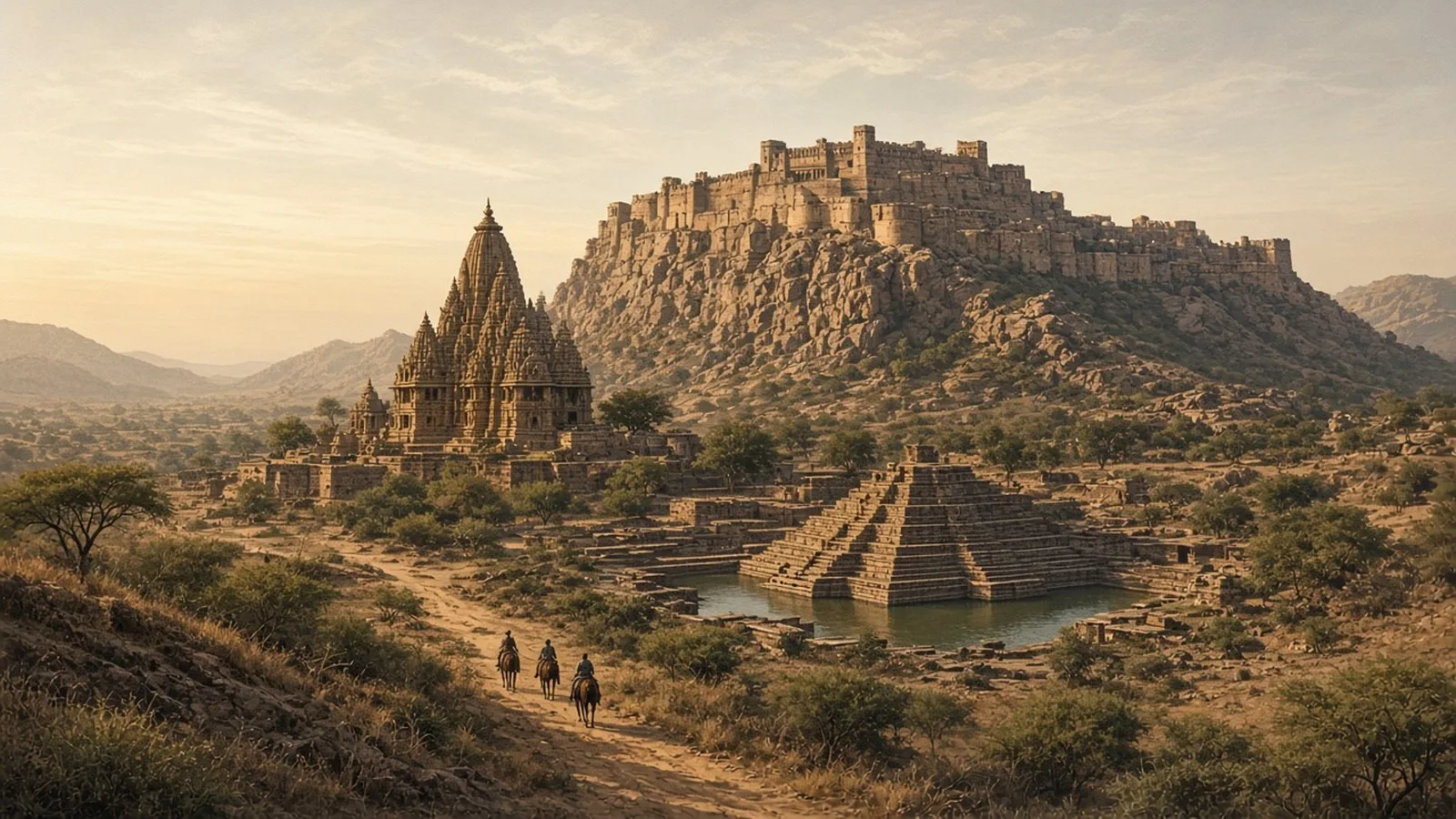
The period produced the classic north Indian Nagara temple, built in stone with a curved spire. Regional schools flourished: the sandstone temples of Khajuraho, the Solanki temples and step-wells of Gujarat, the marble Jain temples at Mount Abu, and the temples of Osian. Hill forts such as Chittor, Kalinjar, Gwalior and Ranthambore became centres of royal power.
Literature was largely in Sanskrit, with Prakrit and Apabhramsha alongside. Bilhana, Hemachandra and the Kashmiri historian Kalhana, whose Rajatarangini (c. 1148 to 1149) is the nearest thing to a critical history from the age, all wrote in this period. The Prithviraj Raso, attributed to Prithviraj's court poet Chand Bardai, is the most famous text about the Rajputs, but it needs great care: its surviving versions differ widely in length, contain later language and anachronisms, and most scholars date the text as we have it to the 16th or 17th century, long after Prithviraj. The Sanskrit Prithvirajavijaya by Jayanaka, composed during the king's lifetime, is a far more reliable source, though it too is a court poem.
Setting the stage for the Turks
By 1000, Turkish rulers in Ghazni were raiding into Punjab and the Ganga plain. The northern kingdoms were rich and militarily capable, as the First Battle of Tarain showed, but divided by constant wars with each other. Historians also point to Turkish mounted archers and a more centralised command; older explanations that blamed caste or "decadence" are now rejected.
Key takeaways
- The Agnikula fire legend is a later myth of status; most scholars now see Rajput origins as diverse and Rajput rank as something achieved over time.
- After the Pratiharas declined, regional dynasties such as the Chauhans, Paramaras, Chandelas, Chaulukyas, Gahadavalas, Kalachuris and Tomaras divided the north.
- They left Khajuraho, Modhera, Rani ki Vav and great hill forts, and patrons such as Bhoja and Hemachandra's royal hosts.
- Historians still debate whether the samanta and land-grant system amounted to "Indian feudalism", and how to read late bardic texts such as the Prithviraj Raso.
Next part
In Part 25, we turn to Arab and Turkish Arrivals: Sindh, Mahmud of Ghazni and Muhammad Ghori, from the Arab conquest of Sindh in 712 to the battles of Tarain.
Sources
- Encyclopaedia Britannica, Rajput
- Encyclopaedia Britannica, Prithviraja III
- UNESCO World Heritage Centre, Khajuraho Group of Monuments
- UNESCO World Heritage Centre, Rani-ki-Vav (the Queen's Stepwell) at Patan, Gujarat
- Archaeological Survey of India, Bhopal and Vadodara Circles, Khajuraho Group of Monuments and Sun Temple, Modhera
- Chattopadhyaya, B. D. (1994), The Making of Early Medieval India, Oxford University Press
- Sharma, R. S. (1965), Indian Feudalism: c. 300 to 1200, University of Calcutta
- Mukhia, H. (1981), "Was There Feudalism in Indian History?", Journal of Peasant Studies 8(3)
- Kulke, H. (ed.) (1995), The State in India, 1000 to 1700, Oxford University Press
- Singh, U. (2008), A History of Ancient and Early Medieval India, Pearson Longman
- Thapar, R. (2002), Early India: From the Origins to AD 1300, University of California Press
- Talbot, C. (2016), The Last Hindu Emperor: Prithviraj Chauhan and the Indian Past, 1200 to 2000, Cambridge University Press