This is Part 17 of HorizonDesk's chronological series on Tamil history, from prehistory to modern Tamil Nadu. The previous instalment was Part 16: The Later Pallavas and the Kailasanathar Temple of Kanchi.
While the Pallavas were building temples at Kanchi, a second Tamil power was rising in the far south, on the Vaigai river at Madurai. The Pandyas were one of the three crowned dynasties of the Sangam age, but after the obscure Kalabhra interlude they had to win their kingdom back. From the late 6th century a line of kings did exactly that, then pushed into Kongu (the Coimbatore–Salem uplands), Kerala, the Kaveri delta and even Sri Lanka. Historians call this the "First Pandyan Empire", to distinguish it from a second, 13th-century revival. It ended around 920 CE, when the Cholas took Madurai. Reign dates are estimates that can differ by decades between scholars.
The early Pandyas at a glance
| Question | Short answer |
|---|---|
| Period | c. late 6th century to c. 920 CE |
| Capital | Madurai, also called Kudal |
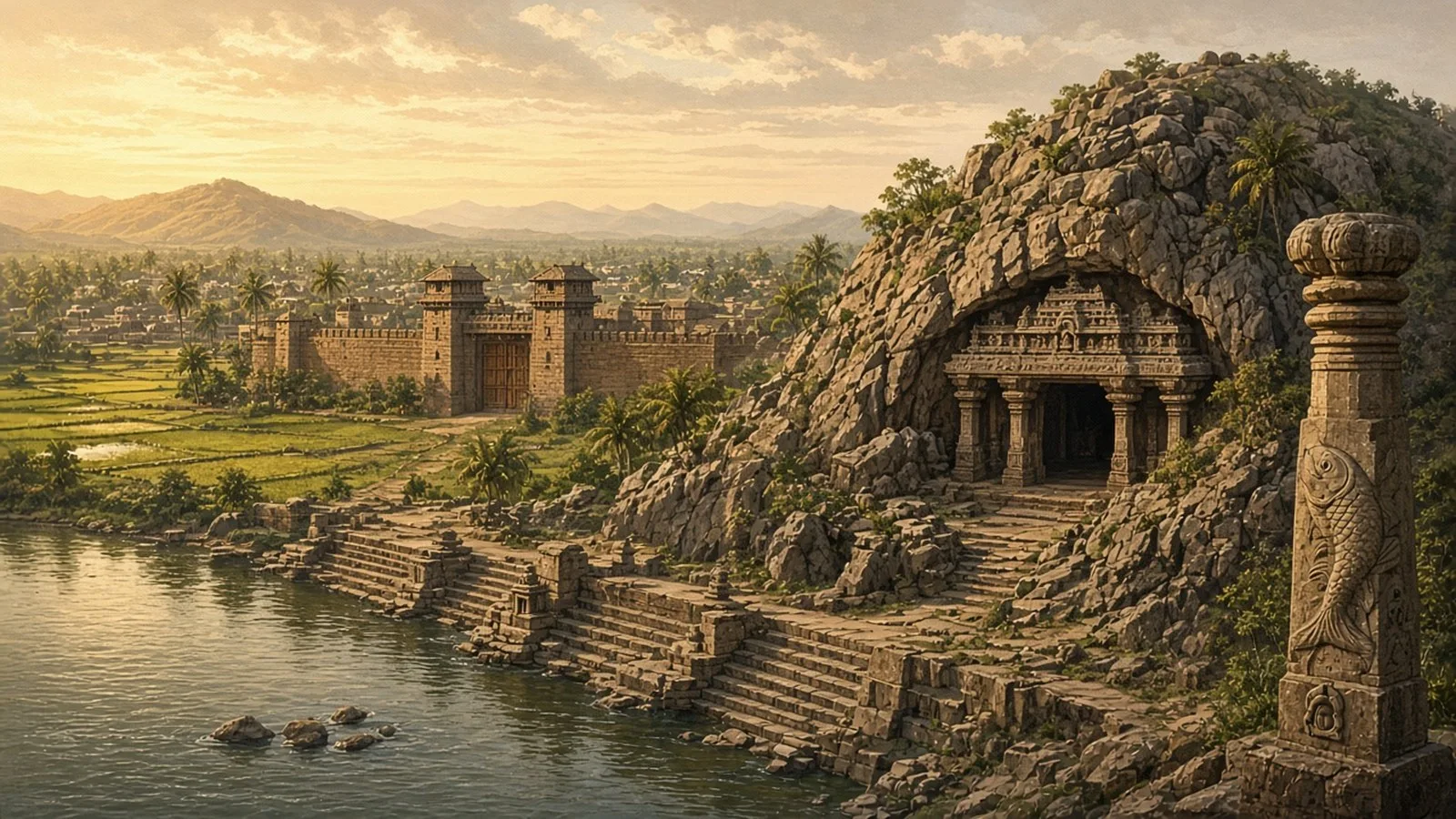
| Royal emblem | The fish (kayal) |
| Main rivals | Pallavas, Kerala and Kongu rulers, Sri Lanka, finally the Cholas |
| Key texts | Copper plates (Velvikudi, Sinnamanur and others), cave inscriptions, Sri Lanka's Culavamsa |
| End | Parantaka I Chola takes Madurai, c. 910–920 CE |
How we know: the copper plates
Most of what we know comes from copper-plate land grants, which open by listing the donor's ancestors and their wars.
- Velvikudi plates: issued in Nedunjadaiyan's third year (c. 768–770). They regrant a village first given by the Sangam king Mudukudumi Peruvaludi and later seized by the Kalabhras, and list the kings from Kadungon onwards.
- Madras Museum plates: from the same king's 17th year.
- Dalavaipuram plates: of Parantaka Viranarayana.
- Larger Sinnamanur plates: from the 16th year of the last king, Rajasimha II, in Sanskrit and Tamil.
The catch is that kings appear mostly under titles, and the titles Maravarman and Jatavarman alternate by generation. Scholars therefore disagree about who is who. K. A. Nilakanta Sastri's sequence is the one used below. Tamil textbooks that follow T. V. Sadasiva Pandarathar add another Rajasimha and a Varaguna I between Nedunjadaiyan and Srimara, so they call the last king Rajasimha III.
| Ruler | Approx. reign | Known for |
|---|---|---|
| Kadungon | c. 575–600 (c. 560–590 or 590–620 in other schemes) | Ends Kalabhra rule |
| Maravarman Avanisulamani | early 7th century | Consolidation |
| Seliyan Sendan | mid-7th century | Title Vanavan after Chera wars |
| Arikesari Maravarman | c. 640–700 (estimates vary) | Start of expansion; victory at Nelveli |
| Kochadaiyan Ranadhira | c. 700–730 | Wars in Kongu and the Ay country |
| Maravarman Rajasimha I | c. 730–765 | Wars with Nandivarman II; Ganga alliance |
| Jatila Parantaka Nedunjadaiyan | c. 765–815 | Height of the empire |
| Srimara Srivallabha | c. 815–862 | Sri Lanka raid; Kudamukku; Tellaru |
| Varaguna II | 862–c. 880s | Defeat at Sripurambiyam |
| Parantaka Viranarayana | c. 880–900 | Dalavaipuram plates |
| Rajasimha II | c. 900–920 | Defeat at Vellur; fall of Madurai |
Kadungon and the revival
The Velvikudi plates credit Kadungon with taking the Pandya country back from the Kalabhras. In the north, Simhavishnu was building up Pallava power at about the same time (see Part 14). His son Avanisulamani and grandson Seliyan Sendan are little more than names; Sendan's title Vanavan suggests wars with the Cheras.
Arikesari Maravarman: the empire begins
Under Sendan's son Arikesari Maravarman, called Arikesari Parankusa in the Sinnamanur plates, the Pandyas began fighting beyond their borders. The plates credit him with victories at Pali, Nelveli and Sennilam, over the Paravas (the coast's pearl-fishing people) and over a Kerala king.
The Shaiva hagiography Periyapuranam honours "Ninra Seer Nedumaran", also remembered as Kun Pandya, the "hunchbacked Pandya". He was a Jain until his Chola queen Mangayarkkarasi and minister Kulachirai brought the boy-saint Sambandar to Madurai, where Sambandar cured the king and won him for Shiva. The poet-saint Sundarar praises Nedumaran as the victor of Nelveli. Because Nelveli is also among Arikesari's victories, most scholars identify the two kings, but the plates never say so directly. The later story of 8,000 Jains impaled after the conversion appears only in later literature, and Sastri himself regarded it as unhistorical. Jainism clearly survived, as Kalugumalai and Sittannavasal show. Sambandar's story belongs to our next part.
Kochadaiyan and Rajasimha I
Arikesari's son Kochadaiyan Ranadhira (c. 700–730) took titles claiming victory over the Cheras, Cholas and Kongu, and the plates say he defeated the Ay chief of the southern hills at Marudur.
His son Maravarman Rajasimha I (c. 730–765) fought the Pallavas hardest. Nilakanta Sastri thought he backed the rival claimant Chitramaya in the Pallava succession crisis described in Part 16. The Velvikudi plates list victories over Nandivarman II at places such as Neduvayal and Kodumbalur, while Pallava records say Nandivarman, besieged at Nandipura, was rescued by his general Udayachandra. Rajasimha then crossed the Kaveri into Malakongam and fought the Chalukya king Kirtivarman II and his Ganga ally at Venbai. Peace followed with a marriage between Rajasimha's son and a Ganga princess.
Nedunjadaiyan: the height of the empire
Rajasimha's son Jatila Parantaka Nedunjadaiyan (c. 765–815), also styled Varaguna Maharaja and Maranjadaiyan, has records from his 3rd to his 43rd regnal year.
- Pallavas: a victory at Pennagadam, south of the Kaveri, and a camp at Arasur on the Pennai river, deep in Pallava country.
- Kongu: he beat the Adigaiman of Tagadur (Dharmapuri), imprisoned the king of western Kongu at Madurai and annexed the region.
- The south: he conquered Venad, attacked the port of Vizhinjam near today's Thiruvananthapuram and subdued the Ay chief.
The Madras Museum plates call him a devout Vaishnava (paramavaishnava), yet Shiva temples received his gifts too.
Ministers and rock-cut shrines
The clearest monuments of the reign were made by the king's officers.
- Anaimalai Narasimha cave: at the foot of the elephant-shaped Yanaimalai hill near Madurai. Its Sanskrit inscription is dated Kali 3871, or 770 CE. The Tamil inscription says the chief minister (uttaramantri) Marankari began the shrine and died before it was finished. His brother Maran Eyinan added the front hall and consecrated it.
- Tirupparankundram: the officer Sattan Ganapati had the cave temple and tank made in Maranjadaiyan's 6th year, and his wife Nakkan Korri built shrines to Durga and Jyeshtha. An inscription there gives Kali 3874, or 773 CE.
Together these dates anchor the start of his reign at c. 765–768.
Srimara Srivallabha: Lanka, Kudamukku and Tellaru
Nedunjadaiyan's son Srimara Srivallabha (c. 815–862), according to the Sinnamanur plates, won at Kunnur and Vizhinjam and routed a coalition of Gangas, Pallavas, Cholas, Kalingas and Magadhas at Kudamukku (Kumbakonam).
Sri Lanka's Culavamsa chronicle adds a Pandya invasion in the reign of Sena I, in which Anuradhapura was sacked and its gold images carried off. The invader is usually identified as Srimara.
His later years went badly. Nandivarman III defeated him at Tellaru, and Nripatunga beat him on the Arisil river. The Culavamsa then describes Sena II's revenge invasion of Madurai, in which the king died of wounds and a Pandya prince was crowned by the Sinhalese commander. Sastri doubted this in 1929 but accepted it in his later A History of South India; the details remain debated.
Varaguna II and Sripurambiyam
Varaguna II's accession in 862 is one of the firmest dates of the period: the Ayyampalaiyam inscription equates Saka 792 with his 8th year. He invaded the Chola country and reached Idavai on the north bank of the Kaveri. At Sripurambiyam near Kumbakonam around 880–885, he was crushed by a coalition of the Pallava Aparajita, the Ganga Prithivipati I, who died in the battle, and the Chola Aditya I. As Part 16 explained, the real winner was Aditya.
A Tiruchendur inscription records a "Varaguna Maharaja" giving the temple 1,400 gold coins, invested with local villages; which Varaguna is disputed.
The fall: Viranarayana and Rajasimha II
Varaguna's younger brother Parantaka Viranarayana (c. 880–900) fought in Kongu and the south and made the gifts recorded in the Dalavaipuram plates.
His son Rajasimha II (c. 900–920) was the last king of the First Empire. He issued the larger Sinnamanur plates and endowed Jain institutions. But Parantaka I, Chola king from 907, was calling himself Maduraikonda, "taker of Madurai", by about 910. Rajasimha's Sri Lankan allies, sent by Kassapa V, were defeated with him at Vellur, c. 915–920 (site unidentified). Rajasimha fled to Sri Lanka, then left his crown and regalia there and withdrew to Kerala, his mother's homeland. Rajendra I Chola recovered them about a century later. Pandya princes fought on, but the First Empire was over.
Running the kingdom
- Officials: the plates name a chief minister (uttaramantri), great feudatories (mahasamantas) and an executive officer (anatti) for each royal order.
- Territory: the land was divided into nadus and kurrams, roughly districts and sub-districts; villages granted to Brahmins were brahmadeyas.
- Boundaries: for a land grant, a female elephant was walked around the village, and its path was marked with stones and planted cactus (kalli).
- Village assemblies: assemblies (sabhas) managed temple endowments; Ambasamudram's received 290 gold coins. An inscription from Manur, near Tirunelveli, dated in Maranjadaiyan's 35th year (c. 800), sets rules for membership in the assembly and fines members who say "nay, nay" to every proposal. It predates the famous Chola-era rules at Uttaramerur by more than a century.
Rock-cut temples of the Pandya country
Archaeologist A. Dayalan calls the Pandya region's cave temples the largest group of early rock-cut architecture in Tamil Nadu, mostly made by local patrons rather than kings, and with monolithic Nandi bulls unknown in Pallava caves.
- Vettuvan Koil, Kalugumalai: an unfinished temple carved down from the top of a granite hill, thought to have been begun around 800 CE under Nedunjadaiyan and nicknamed the "Ellora of the South". Jain relief carvings of the tirthankaras (Jain teachers) line the same hill.
- Anaimalai and Tirupparankundram: the dated ministers' caves described above.
- Sittannavasal: a Jain cave that the Madurai teacher Ilangautaman renovated under Srimara.
- Paraikulam and others: in 2023 Tamil Nadu declared ten early Pandya cave temples protected monuments.
Madurai, city of Kudal
The Velvikudi plates call Madurai "Kudal of mansions and high ramparts". Around it, hills such as Yanaimalai, Tirupparankundram and Samanarmalai held Jain, Shaiva and Vaishnava shrines side by side. Madurai's great temple is mostly much later, but the First Empire fixed the city as the Pandya capital for centuries. The wider story of the three Tamil dynasties is told in our Indian history series.
Timeline
| Date (approx.) | Development | How firm? |
|---|---|---|
| c. 575–590 CE | Kadungon ends Kalabhra rule | Scholarly estimate |
| 7th century | Arikesari Maravarman; Nelveli; Pallava wars begin | Fairly firm; dates debated |
| c. 730–765 CE | Rajasimha I; wars with Nandivarman II; Venbai | Scholarly estimate |
| c. 768–770 CE | Velvikudi plates (Nedunjadaiyan's 3rd year) | Fairly firm |
| 770 CE | Anaimalai inscription (Kali 3871) | Firm |
| 773 CE | Tirupparankundram inscription (Kali 3874) | Firm |
| c. 800 CE | Manur assembly rules; Vettuvan Koil begun | Fairly firm |
| c. 830s–850s | Pandya raid on Sri Lanka; Tellaru | Dates debated |
| 862 CE | Accession of Varaguna II | Firm |
| c. 880–885 CE | Battle of Sripurambiyam | Fairly firm; year debated |
| c. 910 CE | Parantaka I Chola styles himself "taker of Madurai" | Fairly firm |
| c. 915–920 CE | Battle of Vellur; Rajasimha II flees to Sri Lanka | Fairly firm; year debated |
What we can say with confidence
- Confident: Pandya rule revived under Kadungon's line after the Kalabhras, with Madurai as capital; the Velvikudi and Sinnamanur plates give the royal line; the Anaimalai (770) and Tirupparankundram (773) inscriptions belong to Nedunjadaiyan's reign; Varaguna II came to the throne in 862 and lost at Sripurambiyam; Parantaka I Chola took Madurai and Rajasimha II fled to Sri Lanka.
- Uncertain: exact reigns of the early kings; whether Arikesari was Sambandar's Nedumaran; which king each "Varaguna" record belongs to; whether the line includes an extra Rajasimha and Varaguna; the dates of the Sri Lankan wars; where Vellur was.
Next part
Part 18, The Bhakti Movement: Nayanmars and Alvars, turns to the Shaiva and Vaishnava poet-saints who transformed Tamil religious life under the Pallavas and Pandyas, and to their rivalry with Jainism and Buddhism.
Sources
- K. A. Nilakanta Sastri, The Pandyan Kingdom (1929; chapters on "The First Empire") and A History of South India
- H. Krishna Sastri, "Velvikudi Grant of Nedunjadaiyan", Epigraphia Indica XVII
- V. Venkayya, "Madras Museum Plates of Jatilavarman", Indian Antiquary XXII (1893)
- South Indian Inscriptions III, Part IV (Sinnamanur plates)
- South Indian Inscriptions XIV (Pandya inscriptions): introduction and inscriptions 1–25
- SII II, Udayendiram plates of Prithivipati II (nos. 75–76)
- Wilhelm Geiger (trans.), Culavamsa, Part I
- Tamil Virtual Academy, Early Pandya kings (Tamil)
- Sekkizhar, Periyapuranam, The History of Ninrasir Nedumara Nayanar (Shaivam.org)
- The New Indian Express, An 8th-century cave temple for Narasimha near Madurai (2026)
- The Hindu, Kazhugumalai hillock to be declared as protected archaeological monument, Rich in architectural splendour, Pandya period rock-cut cave temple at Paraikulam declared a protected monument, Study uncovers interesting details of cave temple architecture and V. Vedachalam, Jain caves of Madurai
- Frontline, Southern connection