This one-off history feature was prompted by Mr. GK's Tamil podcast conversation with Chennai historian Venkatesh Ramakrishnan (watch on YouTube). The facts below come from the published sources listed at the end, not from the podcast.
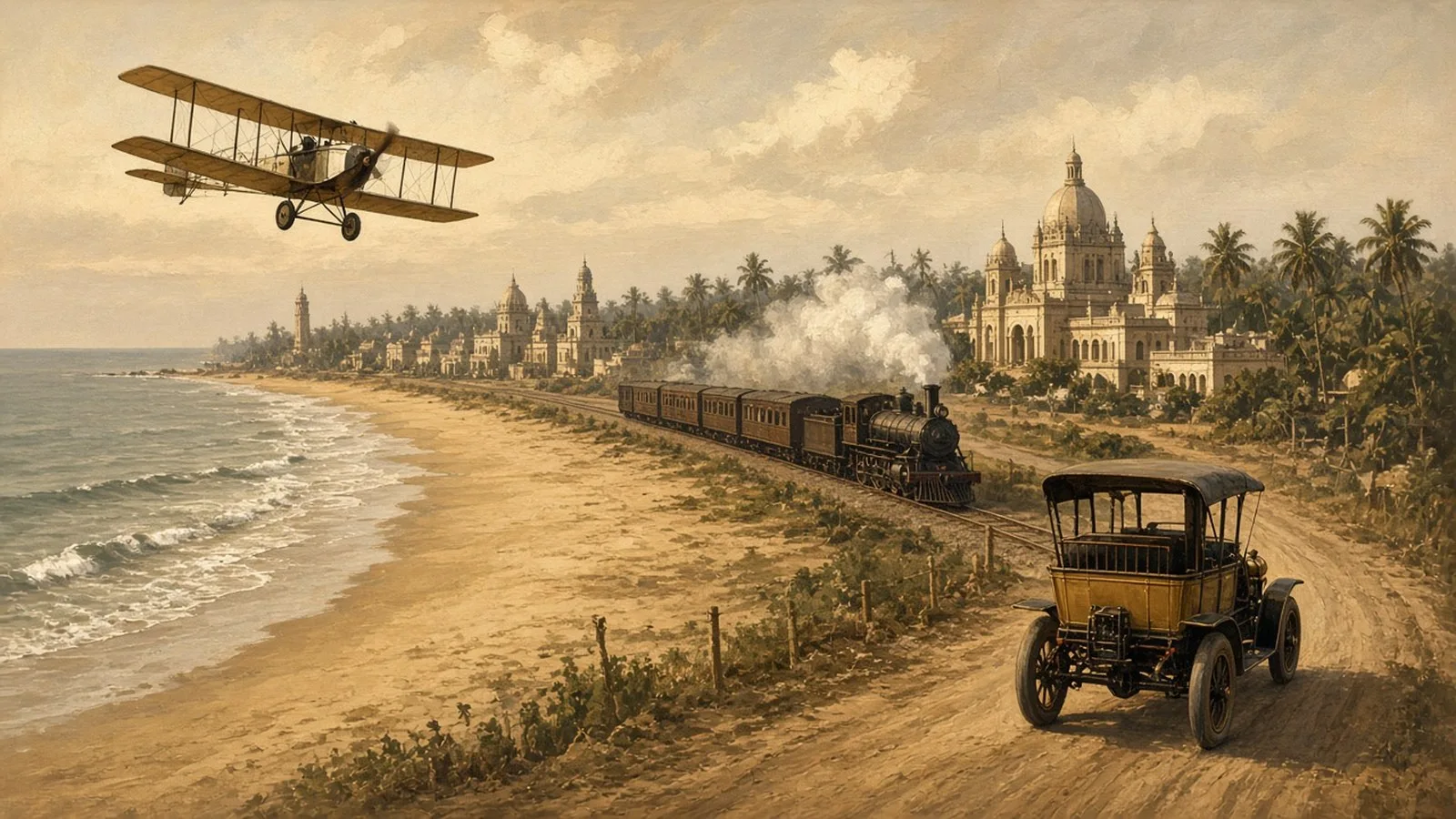
Old Madras liked new machines. In about a century it saw granite carried on rails, South India's first passenger trains, electric trams, a home-built steam car, a hotelier's aeroplane and a hotel with an electric lift. Some were genuine firsts for India; others are claims historians still argue about. Here is what the sources say, with dates and doubts flagged.
1910: a hotelier's biplane over Island Grounds
The most famous Madras first belongs to Giacomo D'Angelis, a confectioner, caterer and hotelier who arrived in Madras in 1880. Historian S. Muthiah described him as coming from Messina in Sicily; other accounts, including Wikipedia and a 2024 article in The Hindu, call him Corsican. By 1900 he was caterer to the Governor, Lord Ampthill.
Inspired by Louis Bleriot's 1909 Channel crossing, D'Angelis had a biplane built to his own design with Simpson and Co., the coachbuilders founded in 1840. Simpson's engineer Samuel John Green is usually credited with the construction, and the poet Subramania Bharati wrote in his journal India that the machine had been made by Tamil workers at Simpson's. The British magazine Flight of 26 March 1910 printed a letter describing "what we believe is the first aeroplane in India".
D'Angelis tested the aircraft at Pallavaram, near St Thomas Mount, and then charged admission for a public demonstration at Island Grounds in March 1910. Madras Musings and The Hindu give the date as 26 March 1910; Wikipedia gives 10 March, and The Times of India notes that the dates vary between the Pallavaram trials and the Island Grounds show. He is said to have taken up a passenger from the crowd.
India's or Asia's first flight? A 2024 Hindu piece argues for Madras, while noting that the magazine Aircraft reported mysterious flights near Calcutta in May 1910. The Times of India prefers "experiment and public demonstration". Safest wording: the earliest recorded powered flight in Madras, and a strong claim to India's first.
1911-1914: Tyck, the Governor and an engineer's plane
Within a year, professional aviators arrived. Belgian pilot Jules Tyck, touring India with Baron de Caters, brought a Bleriot monoplane to Island Grounds in February 1911. According to The Hindu, the show was set for Wednesday, 15 February, but bad weather delayed it; the next morning Tyck climbed to about 2,400 ft as Governor Sir Arthur Lawley and Lady Lawley watched. He flew over the Beach, Mount Road and George Town and received two medals. Madras Musings gives 14 February. A Hindu article by K. R. A. Narasiah even calls Tyck's flight "the first flight in Madras".
These 1911 flights were at Island Grounds, not Pallavaram, which is linked to D'Angelis's 1910 trials.
In 1914, J. W. Madley, the city's waterworks engineer, shipped in an aircraft in parts, assembled it at Island Grounds and flew it over the Red Hills works.
1930: the Madras Flying Club
Flying became a pastime with the Madras Flying Club. At pilot G. Vlasto's invitation, citizens met at the Madras Guards Institute on 19 November 1929. The club was incorporated on 4 March 1930, its first instructional flight took place on 21 July 1930, and Governor Sir George Stanley formally inaugurated it on 20 August 1930. Its first two aircraft were named "Garuda" and "Pushpak".
The founders included W. M. Browning of Burmah Shell, the first president, and S. A. A. Annamalai Chettiar. Sources differ on how many early members were Indian. Chettiar families took to the air early: Rm. Avadaiappa Chettiar is credited with the first private pilot's licence in the Presidency, in 1931, and Capt. V. Sundaram with the club's first commercial licence (1937 in The Hindu; 1936 in other accounts). Its building is said to be the oldest structure inside today's airport.
Meenambakkam: from aerodrome to airport
An aerodrome at Meenambakkam was in use from about 1930. On 15 October 1932, J. R. D. Tata flew the first Tata Air Lines airmail from Karachi to Bombay, and Nevill Vintcent flew the Puss Moth on to Madras via Bellary. This was the first scheduled air service to Madras (some websites wrongly date it to 1915).
After Independence, the Civil Aviation Department took over the airport in 1952, and a new terminal (now used for cargo) was completed around 1954. The modern domestic and international terminals at Tirusulam opened in 1985 and 1989.
Madras in the Second World War skies
During the Second World War the city's airfields changed character. Much of the Flying Club's equipment and staff were taken over for military training, and Meenambakkam was used mainly for military operations. RAF Tambaram was set up as a station during the war and continues today as Air Force Station Tambaram. The Presidency also funded RAF "Madras Presidency" squadrons; one of them, No. 35, was the first in Bomber Command to fly the Halifax.
Cars: a rumour in 1894, a steam car in 1903
Cars came to Madras a little later than to Calcutta and Bombay. According to S. Muthiah, a car may have been seen on Mount Road in 1894, but this is unconfirmed. The first car in regular use in the city, in 1901, belonged to A. J. Yorke of Parry and Co., who drove it daily from Adyar. The first car registered in the South, MC-1, belonged to Francis Spring, later chairman of the Madras Port Trust, and the first Indian-owned car, MC-3, to the contractor T. Namberumal Chetty.
Then came a homegrown machine. In 1903, Samuel John Green of Simpson's built a steam car, which Muthiah calls India's first. A report from July 1903, quoted in Grace's Guide, says it was built "throughout by Indian labour" on the Locomobile pattern, with only the kerosene burner imported, and reached about 16 mph. The Madras Mail called it "a new industry for Madras".
Simpson's went on to build bus bodies. In 1905 a Simpson steam bus ran between Bezwada and Masulipatam, described as possibly the first motor bus service in the country.
Railways: from Red Hills granite to Royapuram
Madras also has a strong claim to India's first railway of any kind. Captain Arthur Cotton of the Madras Engineers proposed rails to carry granite for road building. After a demonstration track near Chintadripet bridge in 1836, the Red Hill Railway was running by 1837: about three and a half miles from the Red Hills quarries to the canal. It was a temporary goods line, mostly animal-hauled, though a sail-powered carriage and steam trials were recorded. The railway historian Simon Darvill (IRFCA) treats it as India's first railway.
Passenger railways came later. The Madras Railway Company was formed in 1845, and work began from Royapuram in 1853. Governor Lord Harris inaugurated Royapuram station on 28 June 1856, and regular services began on 1 July 1856 on the line to Wallajah Road near Arcot; The Hindu gives the length as 67 miles. It was the first line in South India and is often described as the second in India, after Bombay-Thane in 1853.
Royapuram was the city's only station until 1873. Because the original Bombay and Thane buildings are gone, it is widely described, including by The Hindu, as the oldest surviving railway station in India. Restored in 2005, it is still in use.
The city then gained its two landmark termini. Madras Central opened in 1873; its building, finished by Robert Fellowes Chisholm around 1900, became the main terminus in 1907. Egmore, the South Indian Railway terminus, got its Indo-Saracenic building by Henry Irwin in 1908. In 1931 the Beach-Tambaram suburban line was electrified, the start of Chennai's electric commuter trains.
1895: electric trams
Horse-drawn trams ran briefly from 1874 but failed. The revival was electric. The Madras Tramway Company was formed in London in 1885, and by The Hindu's account the first tram ran in February 1895 from the power station at Egmore to Pachaiyappa's College in 12 minutes. Public service is usually dated to 7 May 1895, which makes Madras the first Indian city with electric trams, seven years before Calcutta. At its peak in 1921, 97 cars ran on about 24 km of track along Mount Road, Parry's Corner and Poonamallee Road. After strikes and losses, the last tram ran on 12 April 1953.
1906: the first electric lift, at Hotel D'Angelis
The lift, hot water and tiled floors do not belong to the Connemara or Spencer's. According to Muthiah, they were in Giacomo D'Angelis's own Hotel D'Angelis, opened in 1906 on Mount Road at the corner of Blacker's Road. He wrote that it had "Madras's first electrical hotel lift" plus hot water on tap, electric fans, an ice plant, cold storage and floors of imported tiles. A Hindu Madras Week piece simply calls it the city's first electrical lift.
The hotel was the city's best until the rebuilt Connemara reopened in 1937. After D'Angelis's death, Attilio Bosotto bought it around 1928-1930 and gave it an Art Deco front as Hotel Bosotto; Douglas Jardine's English cricket team stayed there in 1934. The building later housed shops, including a Bata showroom. Most of the old structure behind the facade was pulled down around 2018. The Connemara has a separate first: in 1901 it became the city's first purpose-built hotel building.
Timeline
| Year | Madras first or milestone |
|---|---|
| 1836-1837 | Red Hill Railway carries granite; often called India's first railway |
| 1856 | Royapuram opened 28 June; first South Indian passenger services from 1 July |
| 1873-1874 | Madras Central opens; short-lived horse trams |
| 1895 | Electric trams begin, India's first |
| 1901 | First car in regular use (A. J. Yorke); Connemara's purpose-built hotel building |
| 1903 | Simpson's steam car, built by S. J. Green |
| 1906 | Hotel D'Angelis opens with an electric lift and hot water |
| 1907-1908 | Central becomes main terminus; Egmore building opens |
| 1910 | D'Angelis flies his Simpson-built biplane at Island Grounds (March) |
| 1911 | Jules Tyck's Bleriot flight at Island Grounds (February) |
| 1930 | Madras Flying Club founded; Meenambakkam aerodrome in use |
| 1931 | Beach-Tambaram suburban line electrified |
| 1932 | First scheduled airmail reaches Madras (15 October) |
| 1939-1945 | Wartime use of Meenambakkam; RAF Tambaram set up |
| 1953 | Last tram runs (12 April) |
What you can still see
Royapuram station still stands in North Chennai, Island Grounds still hosts fairs, and Meenambakkam's old terminal survives as a cargo building. For trips beyond the city, see our weekend getaways from Chennai. For the wider story of steam, read how the steam engine changed everything and the Industrial Revolution. For India's heritage lines, see the mountain railways of India.
FAQ
Was the first flight in India made in Madras?
Possibly. Giacomo D'Angelis flew a Simpson-built biplane in Madras in March 1910, often called India's or Asia's first flight. Given 1910 reports from Calcutta and thin records, it is safest called one of the earliest recorded flights in India.
Where did the 1910 and 1911 flights happen?
D'Angelis tested at Pallavaram and gave his public show at Island Grounds. Jules Tyck's 1911 flight was also at Island Grounds.
Which was the first railway station in South India?
Royapuram, inaugurated on 28 June 1856. Services to Wallajah Road near Arcot began on 1 July 1856, and it is widely described as India's oldest surviving station.
Did Madras have trams?
Yes. Electric trams ran from 1895 until 12 April 1953, and Madras was the first Indian city to have them.
Which building had Madras's first lift?
Hotel D'Angelis on Mount Road, opened in 1906, had what Muthiah called the city's first electric hotel lift, along with hot water on tap and imported tiles. The building was the Connemara's rival, not the Connemara itself.
Sources
- The Hindu: Was India's first plane made in Madras? (2024)
- The Hindu: How civil aviation grew in Madras
- The Hindu: Of first flights and old planes
- Madras Musings: Madras aviation - in peace and war
- The Times of India: D'Angelis and early aviation experiments in Chennai
- Sriram V: The old Meenambakkam terminal
- Business Standard (S. Muthiah): The first wheels roll into India
- The Hindu: When the postman knocked (Simpson's history)
- Grace's Guide: Simpson and Co (1903 steam car report)
- IRFCA (Simon Darvill): India's first railways
- The Hindu: Royapuram railway station down the ages
- Wikipedia: Royapuram railway station
- Wikipedia: Madras Railway
- The Hindu: When tram lines were ubiquitous in old Madras
- Wikipedia: Town tramway systems in India (Chennai)
- The Hindu (S. Muthiah): D'Angelis now dust
- The Hindu: Madras Week - monuments, memories and milestones
- Wikipedia: Chennai International Airport