This is Part 14 of HorizonDesk's chronological series on Tamil history, from prehistory to modern Tamil Nadu. The previous instalment was Part 13: The Kalabhra Interregnum – Dark Age or Hidden Age?.
After the thin evidence of the Kalabhra centuries, Tamil history comes back into focus in the late 6th century CE. While the Pandya Kadungon restores his dynasty at Madurai, the Pallavas of Kanchipuram push south to the Kaveri river under Simhavishnu. His son Mahendravarman I then has temples cut straight out of granite hills, something new in the Tamil country, and says so in an inscription. The same king writes a comic play, collects titles celebrating painting and music, converts (by tradition) from Jainism to Shaivism, and fights the first round of a long war with the Chalukyas of the Deccan. This part asks who the Pallavas were and why these two reigns matter.
The Pallavas at a glance
| Question | Short answer |
|---|---|
| Capital | Kanchipuram, in Tondai Nadu (roughly today's northern Tamil Nadu) |
| Earliest records | Copper-plate charters in Prakrit, 3rd–4th century CE; later charters in Sanskrit |
| Origins | Uncertain; Andhra region, local Tondai lineage, and Parthian (Pahlava) theories |
| Simhavishnu | c. 575–600 CE; title Avanisimha; credited with taking the Chola country on the Kaveri |
| Mahendravarman I | c. 600–630 CE; first Tamil rock-cut temples, the play Mattavilasa Prahasana, war with Pulakeshin II |
| Religion | Simhavishnu is described as a Vishnu devotee; Mahendravarman's Jain-to-Shaiva conversion is a tradition |
Historians' dates differ by a few years.
The early Pallavas
Charters in Prakrit and Sanskrit
The oldest Pallava records are not in Tamil. They are copper-plate grants in Prakrit, a vernacular relative of Sanskrit. The Mayidavolu plates from Guntur in Andhra Pradesh record the crown prince Sivaskandavarman granting an Andhra village from his seat at Kanchipura; in the Hirahadagalli plates from Karnataka the same ruler is a "great king of kings" who has performed the Vedic horse sacrifice (ashvamedha). Both are usually dated to the 3rd–4th centuries CE. Around 350 CE the Gupta emperor Samudragupta's Allahabad pillar inscription names "Vishnugopa of Kanchi" among the southern kings he defeated. Later charters switch to Sanskrit, and the king list for these centuries is a tangle of repeated names.
Where did the Pallavas come from?
Nobody knows for certain. The main theories:
- Parthians (Pahlavas). Early scholars linked "Pallava" with the Iranian Pahlava; there is no real evidence, and the idea is now generally rejected.
- A local Tondai lineage. The Sangam poem Perumpanarruppadai praises Tondaiman Ilandiraiyan of Kanchi, and the epic Manimekalai tells of a Tondai king born to a Chola prince and a Naga princess.
- Officials from the Andhra country. Because the earliest charters are in Prakrit and concern Andhra land, K. A. Nilakanta Sastri and many others think the Pallavas began as Satavahana administrators in the Krishna–Guntur region.
The Pallavas themselves claimed descent from the sage Bharadvaja and the Mahabharata hero Ashvatthama, a standard way of borrowing epic prestige.
Simhavishnu: to the Kaveri
With Simhavishnu, son of Simhavarman, the dynasty's history becomes continuous, which is why many historians start the "later" or "imperial" Pallavas with him (c. 575–600 CE). His title was Avanisimha, "lion of the earth".
The evidence comes from his descendants. The 9th-century Velurpalaiyam plates say he "quickly seized the country of the Cholas, embellished by the daughter of Kavira (the Kaveri), whose ornaments are the forests of paddy fields". The 8th-century Kasakudi plates of Nandivarman II add victories over the Kalabhras, Malavas, Cholas, Pandyas, Simhala (Sri Lanka) and Keralas. These are dynastic praise poems written long after his death, and the distant victories are probably inflated. But historians broadly accept that the Chola country up to the Kaveri passed to the Pallavas in his reign, ending Kalabhra power there, as we saw in Part 13. The Cholas, once one of the three crowned dynasties of the Sangam age, survived only as minor chiefs around Uraiyur.
Simhavishnu is described as a Vishnu devotee, and Dandin's later Avantisundarikatha says the poet Bharavi visited his court, a claim not all scholars accept. A royal relief labelled "Simhavinna-pottadhirajan" in the Adivaraha cave at Mamallapuram is often identified as him, but the cave is later, so it is probably a commemorative portrait.
Mahendravarman I, the artist-king
Mahendravarman I (c. 600–630 CE; some say from 590 or 615) is vivid to us largely through the titles (birudas) carved on his monuments.
What his titles tell us
- Vichitrachitta, "the curious-minded" or "the inventive"
- Chitrakarapuli, "a tiger among painters"
- Mattavilasa, echoing the name of his play
- Gunabhara, "bearer of virtues", and Chaityakari, "builder of temples"
- Shatrumalla, Satyasandha, Lalitankura and Avanibhajana
- Sankirnajati, which some link to a rhythmic pattern in music, plus Telugu titles such as Pagapidugu at Pallavaram
Mandagapattu: a temple without brick, timber, metal or mortar
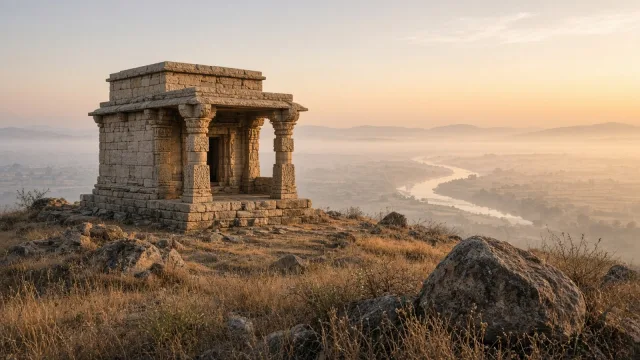
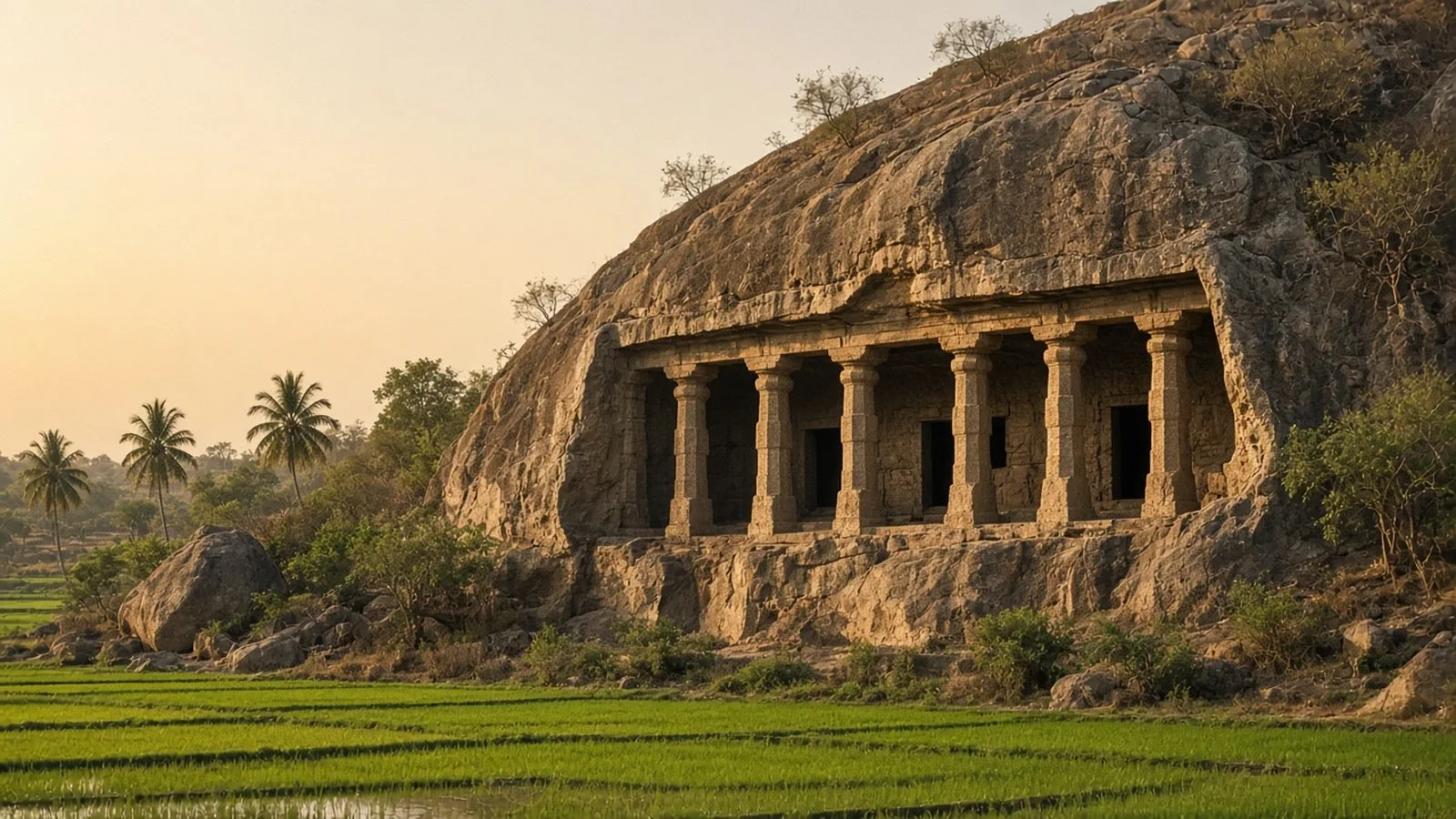
At Mandagapattu in Villupuram district, a small shrine is cut into a granite outcrop. Four lines of Sanskrit in Pallava Grantha script on its facade say that this shrine for Brahma, Ishvara (Shiva) and Vishnu, called the Lakshitayatana, was made by King Vichitrachitta "without brick, without timber, without metal and without mortar".
The boast implies that earlier Tamil temples used exactly those perishable materials, which is why none survive. T. A. Gopinatha Rao, who edited the inscription in Epigraphia Indica, argued that this was the king's first rock-cut shrine. Jain monks had long lived in natural caverns with carved stone beds and Tamil-Brahmi inscriptions, and the Deccan already had rock-cut halls like Ajanta, but in the Tamil country the pillared rock-cut temple is generally credited to Mahendravarman.
A chain of cave temples
Mandagapattu was followed by a series of excavations:
- Pallavaram (Chennai): five shrines and a long list of titles
- Mamandur (near Kanchipuram): a damaged inscription naming his plays and musical interests
- Dalavanur and Siyamangalam: shrines named after his titles Shatrumalla and Avanibhajana
- Mahendravadi: a Vishnu shrine beside the Mahendra tank
- Tiruchirappalli Rock Fort: the Lalitankura-Pallaveshvara-griham, with a celebrated relief of Shiva receiving the Ganga
They share a "Mahendra style", defined by the archaeologist K. R. Srinivasan: massive pillars, square at top and bottom and octagonal in the middle, guardian figures (dvarapalas) and plain facades. The monolithic shrines and great reliefs of Mahabalipuram grew from this foundation a generation later.
The Mattavilasa Prahasana
The Mattavilasa Prahasana ("The Farce of Drunken Revelry") is a one-act Sanskrit and Prakrit comedy attributed to him. In the streets of Kanchi, a tipsy Kapalika ascetic, Satyasoma, and his companion Devasoma lose the skull they use as a begging bowl and accuse a Buddhist monk of stealing it. A Pashupata ascetic judges, and the bowl turns up with a madman who took it from a dog. Mocking holy men who secretly crave wine and pleasure, it is a snapshot of a city where many sects jostled. T. Ganapati Sastri published it in 1917; it had survived in Kerala's Kutiyattam theatre. The Mamandur inscription also mentions another farce, the Bhagavadajjuka, which some scholars credit to Mahendravarman too.
Painting and music
Little of his painting survives. The Jain cave paintings at Sittanavasal were once attributed to his reign, but most scholars now date them to the 9th-century Pandya period.
Music is more contested. At Kudumiyamalai in Pudukkottai district, a rock inscription sets out musical notation in seven sections, one of the oldest such records in India. Its colophon credits a king, a Shiva devotee and pupil of Rudracharya, and a nearby label names the parivadini, a kind of vina. Jouveau-Dubreuil, T. N. Ramachandran and C. Minakshi attributed it to Mahendravarman. Others note that the Kaveri was then the Pallava frontier and the temple's features are Pandya, and assign it to a later Pandya ruler. The question remains open.
From Jain to Shaiva: the Appar tradition
Tradition holds that Mahendravarman was a Jain who turned to Shiva. The source is the Periyapuranam, the 12th-century Tamil hagiography of the 63 Shaiva saints, written five centuries later.
Marulneekkiyar, it says, became a Jain monk named Dharmasena at Pataliputra (today's Tiruppadiripuliyur near Cuddalore). Cured of a crippling illness through his sister Thilakavathiyar at Tiruvadigai, he became the Shaiva poet-saint Appar (Tirunavukkarasar). At the Jains' urging the Pallava king had him shut in a lime kiln, poisoned, set upon by an elephant and thrown into the sea tied to a stone; he survived each ordeal. The king converted, pulled down the Jain monasteries of Pataliputra and built a Shiva temple at Tiruvadigai called Gunaparavichcharam.
Because Gunabhara was one of Mahendravarman's titles, the epigraphist V. Venkayya identified him as this king, and many historians agree. Supporters cite a verse at the Tiruchirappalli cave: "While the king called Gunabhara is a worshipper of the linga, let the knowledge which has turned back from hostile (vipaksha) conduct be spread for a long time in the world". But the verse is a deliberate double meaning built on terms from logic. K. R. Srinivasan noted that the king's first cave honoured the Hindu trinity and another Vishnu, suggesting a ruler open to several faiths who turned to Shiva later. The conversion is best treated as a strong tradition, not an established fact. (Jainism's origins are covered in our Indian history series: Mahavira and the origins of Jainism.)
War with the Chalukyas: Pullalur
Late in the reign, Pulakeshin II (c. 610–642 CE), the Chalukya emperor of Vatapi (modern Badami), whose dynasty later built the temples of Pattadakal, marched south. The Aihole inscription of 634–635 CE, by his court poet Ravikirti, says he caused "the splendour of the lord of the Pallavas" to be "obscured by the dust of his army and to vanish behind the walls of Kanchipura". The Chalukyas also took Vengi in the Krishna–Godavari delta, where Pulakeshin's brother Kubja Vishnuvardhana founded the Eastern Chalukya line.
The Kasakudi plates instead say Mahendravarman "destroyed his chief enemies at Pullalura", usually identified with Pullalur north of Kanchipuram; the enemy is unnamed but generally assumed to be the Chalukyas. With both sides claiming victory, Kanchi probably held while northern territories were lost. The rivalry would run for over a century.
Timeline
| Date (approx.) | Development | How firm? |
|---|---|---|
| 3rd–4th century CE | Prakrit charters of Sivaskandavarman (Mayidavolu, Hirahadagalli) | Scholarly estimate |
| c. 350 CE | Samudragupta's Allahabad inscription names "Vishnugopa of Kanchi" | Fairly firm |
| c. 575 CE | Simhavishnu's accession and conquest of the Chola country | Scholarly estimate |
| c. 600 CE | Accession of Mahendravarman I (some say 590 or 615) | Debated |
| Early 7th century | Mandagapattu and other cave temples; Mattavilasa Prahasana | Fairly firm |
| c. 610–630 CE | Conversion to Shaivism under Appar's influence | Tradition |
| Late 610s–620s | Pulakeshin II's invasion; battle of Pullalur | Scholarly estimate |
| c. 630 CE | Death of Mahendravarman; accession of Narasimhavarman I | Scholarly estimate |
| 634–635 CE | Aihole inscription of Pulakeshin II | Firm |
What we can say with confidence
- Confident: Simhavishnu extended Pallava rule to the Kaveri in the late 6th century; the first rock-cut temples of the Tamil country were excavated under Mahendravarman I; the Mandagapattu inscription records the shift from perishable materials to stone; he fought Pulakeshin II.
- Uncertain: where the Pallavas came from, exact regnal dates, whether Mahendravarman was ever a Jain, whether the Kudumiyamalai music inscription is his, whether he wrote the Bhagavadajjuka, and who really won at Pullalur.
Next part
Part 15, Narasimhavarman I and the Monuments of Mamallapuram, follows the son who avenged his father by taking Vatapi, and the shore-side monuments that made the Pallavas world-famous.
Sources
- T. A. Gopinatha Rao, "Mandagappattu Inscription of Vichitra-chitta", Epigraphia Indica XVII; Tamil Virtual Academy, Mandagapattu cave inscription (Tamil)
- E. Hultzsch, Kasakudi plates of Nandivarman Pallavamalla, South Indian Inscriptions II, no. 73; Velurpalaiyam plates of Nandivarman III (SII II)
- J. Ph. Vogel, Mayidavolu plates of Sivaskandavarman, Epigraphia Indica VI; F. Kielhorn, Aihole inscription of Pulakesin II (DHARMA edition)
- Mahendravikramavarman, Mattavilasa Prahasana, ed. T. Ganapati Sastri (Trivandrum, 1917); Michael Lockwood and A. Vishnu Bhat (trans.), Mattavilasa Prahasana (Christian Literature Society, Madras, 1981)
- C. Minakshi, Administration and Social Life under the Pallavas (University of Madras, 1938)
- R. Gopalan, History of the Pallavas of Kanchi (1928); T. V. Mahalingam, Kanchipuram in Early South Indian History (1969)
- K. R. Srinivasan, Cave Temples of the Pallavas (Archaeological Survey of India, 1964)
- K. A. Nilakanta Sastri, A History of South India (Oxford University Press)
- Sekkizhar, Periyapuranam, The Puranam of Thirunavukkarasar (English translation, Shaivam.org)
- Saurabh Saxena, Puratattva: Tiruchirappalli – Lalitankura-Pallavesvara-griham; Mamandur; Kudumiyanmalai
- The Hindu, Rock of eternity (Mandagapattu); The writing on the cave; Decoding the gramaraga (Kudumiyamalai)