This is Part 11 of HorizonDesk's chronological series on Indian history, from the Stone Age to Independence in 1947.
In Part 10 of this series, we watched Alexander the Great fight Porus on the Jhelum and then turn back at the Beas, leaving behind a string of shaky garrisons. Within a few years those garrisons were gone, and so was the powerful Nanda dynasty of Magadha. The man who swept both away was a young adventurer the Greeks called Sandrokottos and Indians remember as Chandragupta Maurya. With the help of a brahmin strategist known as Chanakya or Kautilya, he founded the Mauryan Empire, the first state to rule most of the subcontinent.
Much of his story is legend, so this part separates evidence from later storytelling.
Patchy evidence, many voices
No inscription of Chandragupta himself survives. What we know comes from four very different kinds of source:
- Greek and Roman writers. Plutarch, Justin, Strabo, Appian and Arrian mention "Sandrokottos" or "Androcottus". Most important are the fragments of Megasthenes, a Greek envoy who lived at the Mauryan court. His book, the Indica, is lost, but long passages survive in Strabo, Arrian and Diodorus.
- Indian traditions. Buddhist chronicles of Sri Lanka, Jain texts such as Hemachandra's 12th-century Parishishtaparvan, and the Puranas all tell the story, each in its own way and centuries after the events.
- Literature. The Sanskrit play Mudrarakshasa ("Rakshasa's Signet Ring") by Vishakhadatta dramatises Chanakya's schemes. It was written perhaps 600 to 1,000 years after Chandragupta, somewhere between the 4th and 8th centuries CE, and is drama, not history.
- One precious inscription. A rock inscription at Junagadh in Gujarat, carved around 150 CE, names Chandragupta's governor in the west (more on this below).
The identification of Sandrokottos with Chandragupta, made by the scholar William Jones in 1793, remains one of the anchors of ancient Indian chronology, because it ties an Indian king to Greek dates.
Who was Chandragupta?
His family background is disputed, and every source has its own agenda. Buddhist texts make him a kshatriya of the Moriya clan of Pipphalivana, a small republic in the Himalayan foothills, and some later traditions link the name to peacocks (mora). A late Brahmanical tradition, preserved by a commentator on the Mudrarakshasa, makes him the son of a Nanda king by a low-caste woman named Mura, from whom "Maurya" was supposedly derived. Justin, writing in Latin, calls him a man "of mean origin". In one Buddhist-derived version, his father died in a border fight and the boy was raised by herdsmen.
Historians treat all of this with caution. What seems likely is that Chandragupta was not from an established royal house, and that he made his name in the troubled north-west after Alexander's invasion.
Plutarch preserves one tantalising detail. "Androcottus, when he was a stripling, saw Alexander himself," he writes, and later said that Alexander could easily have conquered the Ganga kingdom, "since its king was hated and despised on account of his baseness and low birth". Justin adds that Sandrocottus offended the king with bold speech and had to flee. The surviving manuscripts name Alexander, but many scholars accept an old correction to Nandrum, the Nanda king, which fits Indian traditions better. Either way, the meeting is possible but unproven.
Chanakya: the kingmaker
Indian tradition is united on one point: Chandragupta had a mentor. Called Chanakya, Kautilya or Vishnugupta, he was a brahmin said to come from or teach at Taxila, the great north-western city we met in Part 10. In the best-known version, Chanakya was insulted at the Nanda court, untied his topknot and vowed not to tie it again until the dynasty was destroyed. He then found the young Chandragupta, trained him, and planned the campaign.
The Buddhist commentary tradition tells a memorable story: after an early defeat, the pair overheard a mother scolding her child for burning his fingers by eating from the hot centre of a flatbread instead of the cooler edges. Chanakya took the lesson: begin at the frontiers, not at the heart of the kingdom. It is folklore, but it fits the likely strategy: a rise that began in the Punjab and ended at Pataliputra.
Overthrowing the Nandas, c. 322–321 BCE
The Nandas, whose rise we traced in Part 7 on the Mahajanapadas and Magadha, were famous for their wealth and their huge army. Greek writers called the last king Agrammes or Xandrames; Pali sources call him Dhana Nanda, "Nanda of the treasure". He was also widely disliked, apparently for heavy taxes and his low birth.
The order of Chandragupta's campaigns is debated. One view has him first clearing the Macedonian garrisons from the Punjab after Alexander's death in 323 BCE, then marching on Magadha; another reverses the sequence. Britannica puts the seizure of Magadha around 325 BCE and the Punjab about 322, with the Mauryan dynasty dated from about 321. Many historians simply give c. 321 BCE for his accession at Pataliputra (modern Patna), while some scholars prefer dates as late as 317 BCE. The last Macedonian commanders left India by about 317–316 BCE. The fighting against the Nandas was evidently fierce; a Buddhist text, the Milindapanha, remembers a great battle against the Nanda general Bhaddasala.
Seleucus, 500 elephants and a treaty, c. 305–303 BCE
Alexander's eastern lands passed to his general Seleucus I Nicator, who tried to recover the Indian provinces around 305 BCE. No battle account survives, and the result suggests Seleucus came off worse. Strabo records the settlement: Seleucus gave Sandrocottus the lands along the Indus that Alexander had taken from the Persians, "upon terms of intermarriage and of receiving in exchange five hundred elephants".
The ceded territory probably included Arachosia (around Kandahar), Gedrosia (Baluchistan) and the Paropamisadae (around Kabul), though how much of each is debated. "Intermarriage" (epigamia) may mean a royal marriage or simply a right of marriage between the two peoples; the popular idea that Chandragupta married Seleucus's daughter is not stated in any source. The elephants were real enough: they helped Seleucus win the battle of Ipsus in 301 BCE. Plutarch's claim that Chandragupta "overran and subdued all India" with 600,000 men is surely inflated, but the treaty confirms that the Mauryas were now a great power. Seleucus then sent Megasthenes as his ambassador.
Pataliputra through Greek eyes
Megasthenes describes Palibothra (Pataliputra), at the meeting of the Ganga and the Son, as a vast parallelogram about 80 stadia long and 15 wide (roughly 15 by 3 km), protected by a moat and a timber wall with 570 towers and 64 gates. Excavations at Bulandi Bagh in Patna have indeed found long lines of wooden palisade, and at nearby Kumhrar the remains of a great pillared hall, though that hall is usually dated to later Mauryan times.
He also describes a closely managed state: officials who measured land and supervised irrigation, a city administration of 30 officers divided into six boards, careful registration of births and deaths and a heavily guarded king. Some of his claims are clearly mistaken, such as that Indians had no slaves, did not know writing and were divided into seven castes. His account mixes sharp observation with Greek expectations, but it is our only eyewitness view of the early Mauryan court.
A governor, a lake and an inscription
The best Indian evidence for Chandragupta's reach comes from far to the west. On a granite boulder at Junagadh in Saurashtra, already carved with edicts of Ashoka, the Saka ruler Rudradaman recorded around 150 CE how he repaired the dam of the Sudarshana lake after a storm. The inscription says the lake had been built by the vaishya Pushyagupta, provincial governor of the Maurya king Chandragupta, and later fitted with conduits by the Yavana king Tushaspha for Ashoka. This is the only epigraphic mention of Chandragupta by name, and it shows that the Mauryas held Gujarat and invested in irrigation there. (For travel ideas in the region, see our Gujarat travel guide.)
From the Hindu Kush to Bengal and from the Himalayas towards the Deccan, Chandragupta's empire was larger than anything before it. How far south he went is uncertain; Ashoka's later edicts in Karnataka show that the empire eventually reached there, but whether Chandragupta or his son Bindusara pushed it so far is not known.
The Arthashastra: Chanakya's handbook?
In 1905 R. Shamasastry identified a palm-leaf manuscript in Mysore of the Arthashastra, a Sanskrit treatise on statecraft, published in 1909. It covers taxation, spies, law, war and diplomacy with startling frankness, and it names its author as Kautilya, the man who rescued the land from the Nandas. For decades it was read as a manual of Chandragupta's government.
Modern scholarship is more cautious. In 1971 Thomas Trautmann used statistical analysis of word use to argue that the text has several authors and reached its final form well after the Mauryas. Patrick Olivelle, its most recent translator, dates the original composition to roughly 50 BCE–125 CE and a later revision to about 175–300 CE, while recognising that it draws on older material. Others, such as R. P. Kangle, defend a Mauryan core. A fair conclusion is that the Arthashastra preserves an old tradition of statecraft linked to Kautilya's name, but it cannot be read as a direct description of Chandragupta's empire.
A Jain ending at Shravanabelagola
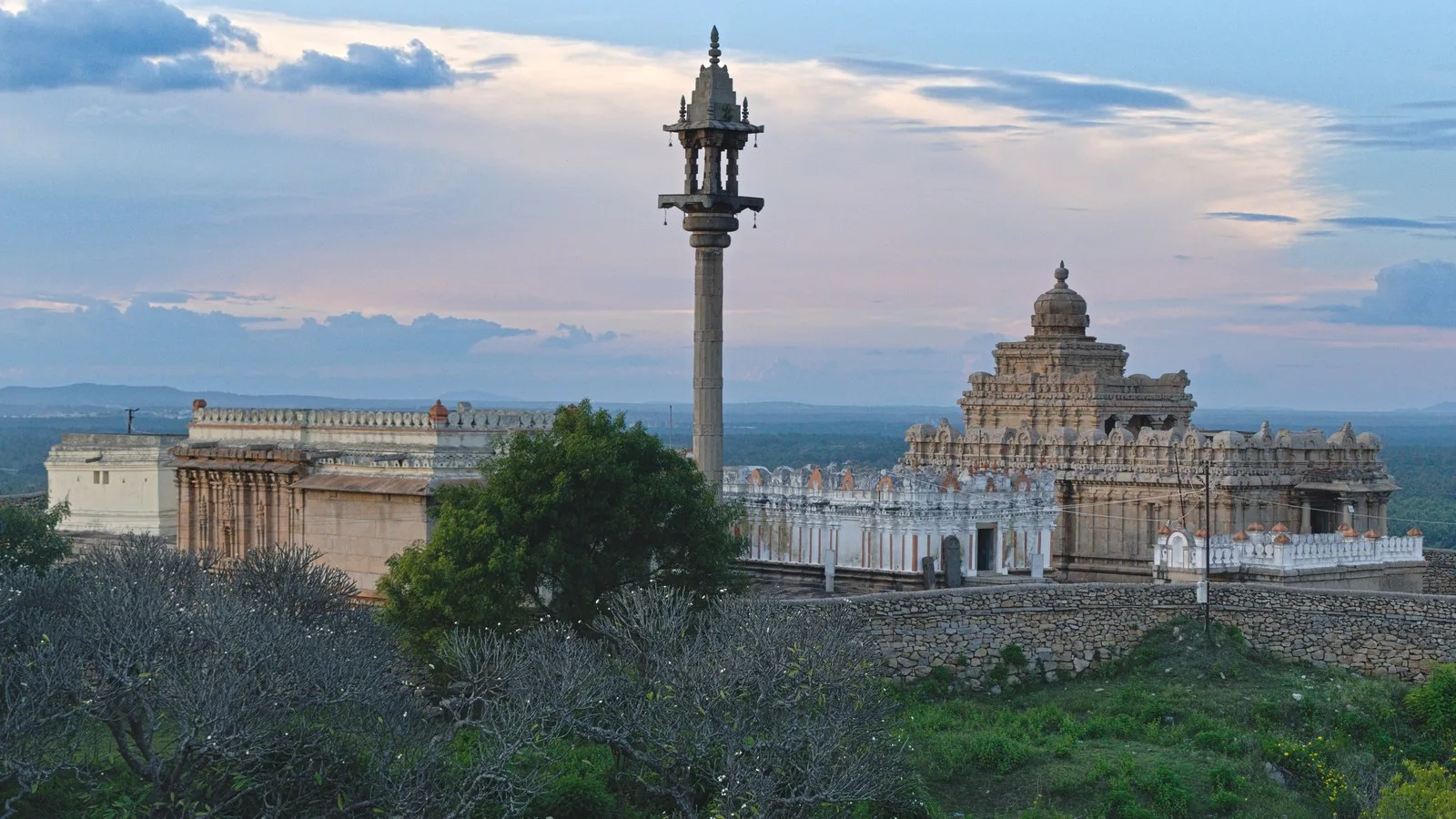
The most moving tradition about Chandragupta comes from the Jains. Digambara accounts say the monk Bhadrabahu foresaw a twelve-year famine in the north and led a body of monks south; Chandragupta gave up his throne, became a monk and followed his teacher to Shravanabelagola in present-day Karnataka. There, on the smaller hill now called Chandragiri, he is said to have ended his life by ritual fasting (sallekhana) around 297 BCE. (We looked at Jain ideas of renunciation in Part 9 on Mahavira and Jainism.)
Inscriptions on Chandragiri from about the 7th century CE onwards recall Bhadrabahu's migration, and several, especially from the 12th century, name Chandragupta beside him. The hill's Chandragupta Basadi has carved stone screens showing scenes from their lives. Some scholars note that the link could involve a later Chandragupta, or a monk named Prabhachandra, but Hemachandra's account also has the king die by fasting, and Britannica gives Shravanabelagola as his place of death. It is a tradition, not proven fact, but an old and consistent one. Today Chandragiri, alongside the giant Gommateshwara statue on the facing hill, is a rewarding stop on any trip through Karnataka.
Chandragupta was succeeded around 297 BCE by his son Bindusara, called Amitrochates by the Greeks, and the empire passed intact to Bindusara's son, Ashoka.
Legacy
Chandragupta's achievement was to turn the Magadhan kingdom into a subcontinental empire within a single generation, and to face down a Hellenistic king on the north-western frontier, winning territory from him by treaty. In modern India he became a symbol of unity, and Chanakya a byword for shrewd politics.
Key takeaways
- Chandragupta Maurya overthrew the Nandas and took Pataliputra around 321 BCE (exact dates debated), with Chanakya as his adviser.
- Greek writers knew him as Sandrokottos; around 305–303 BCE Seleucus ceded the Indus borderlands in return for 500 elephants and a marriage agreement.
- Megasthenes described Pataliputra and Mauryan government; the Junagadh inscription names Chandragupta's governor Pushyagupta and the Sudarshana lake.
- The Arthashastra in its present form is probably later than the Mauryas, and the Mudrarakshasa is a much later drama.
- Jain tradition says he became a monk and died by fasting at Shravanabelagola around 297 BCE.
Next part
In Part 12, we turn to Chandragupta's grandson, Ashoka the Great: the bloody conquest of Kalinga, his turn to Dhamma, and the rock and pillar edicts that let an Indian emperor speak to us in his own words.
Sources
- Encyclopaedia Britannica, Chandragupta and Mauryan Empire
- Strabo, Geography 15.1–2, trans. H. L. Jones (Loeb), Book XV via LacusCurtius (Megasthenes on Palibothra; the Seleucid treaty)
- Plutarch, Life of Alexander, trans. B. Perrin, chapter 62
- Justin, Epitome of Pompeius Trogus, trans. J. S. Watson, 15.4
- Arrian, Indica 10, and Megasthenes fragments in J. W. McCrindle, Ancient India as Described by Megasthenes and Arrian (1877)
- Kielhorn, F. (1905–06), Junagadh Rock Inscription of Rudradaman: the year 72, Epigraphia Indica 8
- Trautmann, T. R. (1971), Kautilya and the Arthasastra: A Statistical Investigation of the Authorship and Evolution of the Text, Brill
- Olivelle, P. (2013), King, Governance, and Law in Ancient India: Kautilya's Arthasastra, Oxford University Press
- Mookerji, R. K. (1943), Chandragupta Maurya and His Times, Madras University
- Thapar, R. (2002), Early India: From the Origins to AD 1300, Penguin and University of California Press
- Singh, U. (2008), A History of Ancient and Early Medieval India: From the Stone Age to the 12th Century, Pearson
- World History Encyclopedia, Chandragupta Maurya
Featured image: Jain basadis and a tall manastambha pillar on Chandragiri hill at Shravanabelagola, Karnataka, at dusk, the hill where Jain tradition places Chandragupta's last days. Photo by Rohit14400, via Wikimedia Commons, CC BY-SA 4.0.