This is Part 1 of HorizonDesk's chronological series on Indian history, from the Stone Age to Independence in 1947.
Long before cities, kings or scripts, the Indian subcontinent was home to people who shaped stone. Their story is told in hand-axes buried in river clays, ash from a distant volcano, tiny stone blades and paintings on sandstone walls. This first instalment runs from the earliest toolmakers, well over a million years ago, to the first farming villages, and flags which dates are firm and which are still argued over.
How archaeologists divide the Stone Age
Indian prehistory is usually split into three broad stages, named after the tools people made:
- Palaeolithic (Old Stone Age): subdivided into the Lower Palaeolithic (large tools such as hand-axes and cleavers), the Middle Palaeolithic (smaller tools made from carefully prepared flakes) and the Upper Palaeolithic (blades and more specialised tools).
- Mesolithic: marked by microliths, tiny stone pieces set into wooden or bone handles to make arrows, sickles and knives.
- Neolithic (New Stone Age): polished or ground stone axes, pottery, domesticated animals, cultivated crops and settled villages.
These labels are not neat boxes on a timeline. Technologies overlapped and appeared at different times in different regions. The dates below come from methods such as luminescence, radiocarbon and cosmogenic-nuclide dating, and each carries a margin of error.
The first toolmakers: Attirampakkam and the Acheulean
The modern study of Indian prehistory began near Chennai. On 30 May 1863 the geologist Robert Bruce Foote picked up a quartzite hand-axe at Pallavaram, then on the outskirts of Madras. It was the first recognised Palaeolithic tool in India. Later that year Foote and his colleague William King found many more tools at Attirampakkam, in the Kortallayar river basin in present-day Tiruvallur district, about 60 km north-west of Chennai.
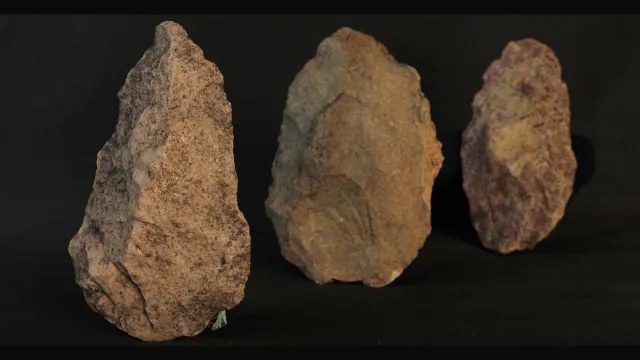
Attirampakkam became famous again in 2011. A team led by Shanti Pappu of the Sharma Centre for Heritage Education reported in Science that the site's oldest Acheulean layers are no younger than 1.07 million years and gave a pooled average age of about 1.51 million years (plus or minus 0.07 million). The team dated the burial of the artefacts themselves using aluminium-26 and beryllium-10 isotopes, supported by palaeomagnetic evidence.
The Acheulean tradition, named after Saint-Acheul in France but originating in Africa, is known for teardrop-shaped hand-axes and cleavers. Its makers were earlier hominins, most likely Homo erectus or a related form, not our own species. India has hundreds of Acheulean sites, from the Hunsgi–Baichbal valleys in Karnataka to the Son and Narmada valleys in central India and Didwana in Rajasthan. The Attirampakkam result matters because it suggests that hominins carrying this technology reached South Asia far earlier than the roughly 600,000–500,000 years ago once assumed.
The Tamil Nadu State Department of Archaeology's Pre-Historic Site Museum at Poondi displays finds from Attirampakkam, the nearby Gudiyam rock shelters and other local sites.
The Soan tradition of the north-west
In the north-west, a different-looking toolkit was identified in the 1930s along the Soan (Sohan) river on the Potwar plateau, now in Pakistan. The geologist Hellmut de Terra and the archaeologist T. T. Paterson described a Soanian industry dominated by pebble tools: choppers flaked on one face and chopping tools flaked on both, along with flakes.
For decades, textbooks presented India's Lower Palaeolithic as two traditions, a pebble-tool "Soan culture" in the north and a hand-axe "Madras culture" in the south. That picture has been heavily revised. Later fieldwork found that the river terraces behind the original Soan chronology were largely erosional, so the old early-and-late Soan sequence is no longer reliable, and pebble tools also occur with Acheulean assemblages. Many researchers now treat the Soanian as a regional tool tradition whose age and relationship to the Acheulean remain uncertain, rather than as a distinct people or period.
A new toolkit: the Middle Palaeolithic
Attirampakkam produced a second major result in 2018. In Nature, Kumar Akhilesh, Shanti Pappu and colleagues used luminescence dating to show that the shift away from big Acheulean tools towards smaller flake tools, including the Levallois technique of preparing a core so that a flake of planned shape could be struck off, began there around 385,000 years ago (with an uncertainty of about 64,000 years) and continued until about 172,000 years ago.
That is far earlier than once presumed for South Asia and roughly contemporary with similar changes in Africa and Europe. The authors argued it challenges models tying India's Middle Palaeolithic to modern humans arriving after about 125,000 years ago. Who made these tools is unknown, as no fossils were found with them.
Jwalapuram and the Toba debate
Around 74,000 years ago, Mount Toba in Sumatra, Indonesia, produced one of the largest volcanic eruptions known in Earth's history. Its ash, called the Youngest Toba Tuff, fell across the Indian subcontinent. In 1998 the anthropologist Stanley Ambrose proposed that the eruption triggered a "volcanic winter" that sharply reduced human populations.
India became a test case. At Jwalapuram, in the Jurreru river valley of Kurnool district, Andhra Pradesh, a team led by Michael Petraglia found Middle Palaeolithic tools both below and above a thick bed of Toba ash. Luminescence ages put the layers at about 77,000 years below the ash and 74,000 years above it. Writing in Science in 2007, they argued that the broadly similar technology on both sides shows hominins persisted in the region through the eruption.
In 2020, members of the same research group reported in Nature Communications on Dhaba, in the Middle Son valley of Madhya Pradesh, where an unchanging stone-tool industry spans roughly 80,000 to 65,000 years ago, across the Toba ash level, with microliths appearing around 48,000 years ago. Studies in East Africa and at Pinnacle Point in South Africa have similarly found no sign of a human catastrophe at that time.
The debate is not settled, because tools alone cannot reveal which species made them. If Homo sapiens made the Jwalapuram and Dhaba tools, modern humans were in India before 74,000 years ago; if archaic humans did, the story is different.
When did Homo sapiens arrive?
This is one of the most contested questions in Indian prehistory. Many genetic studies place the main dispersal of modern humans out of Africa at roughly 50,000–60,000 years ago, and argue that today's South Asians descend largely from that movement. Archaeologists such as the Jwalapuram and Dhaba team argue that modern humans may have arrived earlier, possibly before 74,000 years ago, perhaps in more than one wave.
Fossils are rare. The best-known hominin fossil from India is a partial skull found by the geologist Arun Sonakia in 1982 at Hathnora in the Narmada valley. It has been classified variously as Homo erectus, archaic Homo sapiens or Homo heidelbergensis, and estimates of its age range widely. In nearby Sri Lanka, Fa-Hien Lena cave has yielded evidence of Homo sapiens hunting in the rainforest about 45,000 years ago. A cautious summary is that modern humans were certainly in South Asia by around 45,000–50,000 years ago, and possibly much earlier.
Microliths and the Mesolithic
Microliths are small, often geometric stone pieces, many less than a few centimetres long, made by people who mounted them in handles to create composite tools. They were once seen as the hallmark of the Mesolithic, after the last Ice Age, but their origins are now known to be far older. A 2013 study dated microblades at Mehtakheri in Madhya Pradesh to about 45,000 years ago, Dhaba has microliths from around 48,000 years ago, and Fa-Hien Lena has them from about 48,000–45,000 years ago.
In the Mesolithic proper, hunter-gatherers spread across almost every landscape. Well-known sites include Bagor in Rajasthan, Langhnaj in Gujarat, Adamgarh and Bhimbetka in Madhya Pradesh, and Sarai Nahar Rai, Mahadaha and Damdama in the Ganga plains of Uttar Pradesh. In the far south, microliths are scattered across the red "teri" sand dunes of Thoothukudi and Tirunelveli districts in Tamil Nadu.
Bhimbetka: India's oldest art gallery
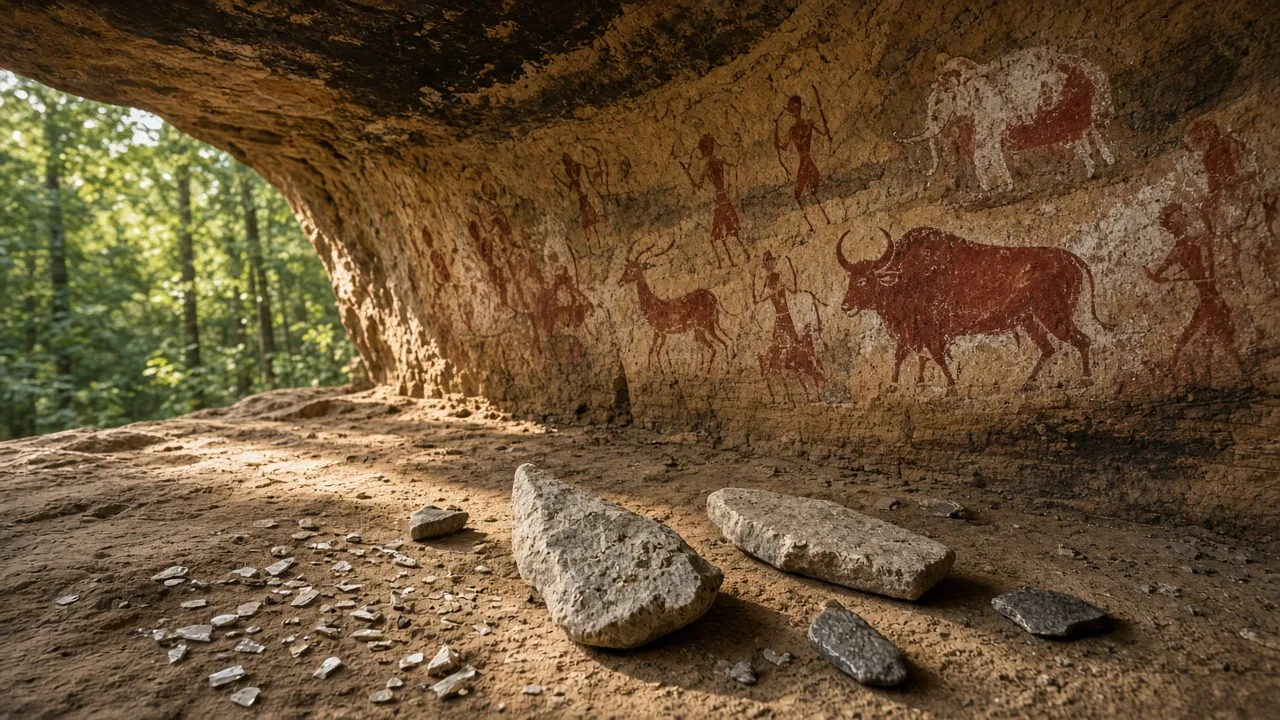
The Rock Shelters of Bhimbetka, in Raisen district south of Bhopal, were discovered for archaeology in 1957 by Vishnu Shridhar Wakankar. UNESCO inscribed them as a World Heritage Site in 2003. According to UNESCO, the property lies in the foothills of the Vindhyan hills, where five clusters of natural rock shelters sit within massive sandstone outcrops, displaying paintings that appear to date from the Mesolithic period through to historical times. The Wakankar foundation counts around 730 shelters, with paintings in about 500 of them.
The paintings, mostly in red and white, show bison, deer, elephants and tigers, hunters with bows, dancing and, in later layers, riders on horses and elephants. UNESCO notes that the traditions of 21 adjacent villages strongly resemble scenes in the art, one reason the site was listed as a living landscape.
Bhimbetka is also an excavated site. Excavations by V. N. Misra in shelter III F-23 in the 1970s found a long sequence from the late Acheulean through to the Mesolithic. In the neighbouring "Auditorium Cave", cup-shaped hollows (cupules) have been found below Acheulean and Middle Palaeolithic deposits. Some researchers, notably Robert Bednarik, argue these are among the world's oldest rock art, possibly more than 100,000 years old, but the dating is indirect and disputed.
The region's story in stone continues thousands of years later at the Ajanta and Ellora caves and Madhya Pradesh's Khajuraho temples.
The Neolithic: polished axes, pit houses and ash mounds
The Neolithic brought farming, herding, pottery and settled life, at very different times across the subcontinent. The best-known early farming village, Mehrgarh, is the subject of Part 2.
In Kashmir, Burzahom, near Srinagar, was excavated by the Archaeological Survey of India (ASI) under T. N. Khazanchi between 1960 and 1971. Its earliest Neolithic people lived in circular or oval pits dug into the soil, roofed with birch-covered timber, adapted to harsh Himalayan winters. They used polished stone axes and bone tools such as needles and harpoons. Later Neolithic layers show pottery, cultivation of wheat, barley and lentil, burials beneath house floors, and the burial of animals, including dogs, with or near humans. The site is on India's UNESCO Tentative List, which describes it as spanning roughly 3000 BCE to 1000 BCE.
In the south, the Southern Neolithic of Karnataka and Andhra Pradesh is known for "ash mounds" at Utnur, Budihal and Sanganakallu, formed by burning cattle dung at pastoral sites. Radiocarbon studies place much of this activity in the third and early second millennia BCE.
In Tamil Nadu, Paiyampalli in Tirupattur district (formerly North Arcot) was excavated by the ASI under S. R. Rao in 1964–65 and 1967–68. It revealed Neolithic pit dwellings with thatched roofs, ground stone axes, bone tools, short stone blades and handmade grey pottery, followed by an overlap with the Iron Age megalithic culture. Radiocarbon dates from the excavation place the Neolithic phase in the second millennium BCE; one widely cited figure is 1390 BCE, plus or minus 200 years. Charred horse gram and green gram point to early cultivation of pulses still grown in the region today.
Why the Stone Age still matters
The Stone Age covers more than 99% of the time hominins have lived in the subcontinent. It shows the region as a crossroads for early humans moving between Africa, Asia and Australia. When Egypt's pharaohs built the pyramids at Giza, around 4,500 years ago, Neolithic people in Kashmir and the Deccan were still using polished stone axes, while Bhimbetka's painters had already been at work for thousands of years.
Next part
In Part 2, we move to Mehrgarh, on the Kachi plain below the Bolan Pass, and India's first farmers: how wheat, barley, cattle and mudbrick houses changed life in the north-west, and why a 2025 radiocarbon study has challenged the long-accepted date for when farming there began.
Sources
- UNESCO World Heritage Centre, Rock Shelters of Bhimbetka
- Ministry of Culture, Government of India, Rock Shelters of Bhimbetka
- Pappu, S. et al. (2011), Early Pleistocene presence of Acheulian hominins in South India, Science 331: 1596–1599
- Akhilesh, K. et al. (2018), Early Middle Palaeolithic culture in India around 385–172 ka reframes Out of Africa models, Nature 554: 97–101
- Petraglia, M. et al. (2007), Middle Paleolithic assemblages from the Indian subcontinent before and after the Toba super-eruption, Science 317: 114–116
- Clarkson, C. et al. (2020), Human occupation of northern India spans the Toba super-eruption ~74,000 years ago, Nature Communications 11: 961
- Smith, E. I. et al. (2018), Humans thrived in South Africa through the Toba eruption about 74,000 years ago, Nature 555: 511–515
- Mishra, S. et al. (2013), Continuity of microblade technology in the Indian subcontinent since 45 ka, PLOS ONE
- Wedage, O. et al. (2019), Specialized rainforest hunting by Homo sapiens ~45,000 years ago, Nature Communications
- UNESCO World Heritage Centre, Tentative List, The Neolithic Settlement of Burzahom
- Archaeological Survey of India, Burzahom (1960–1971) excavation report
- Fuller, D. Q. et al. (2007), Dating the Neolithic of South India, Antiquity
- Venkatasubbaiah, P. C., Neolithic culture of Tamil Nadu, with ASI excavation details of Paiyampalli, Tamil University
- The Hindu, A walk down the history lane (Poondi pre-historic site museum)
- The Hindu, A discovery that changed the antiquity of humankind who lived in Indian subcontinent
- Nature India (2025), Indus Valley farming started later than thought, radiocarbon study shows