Why Khajuraho deserves more than a day trip
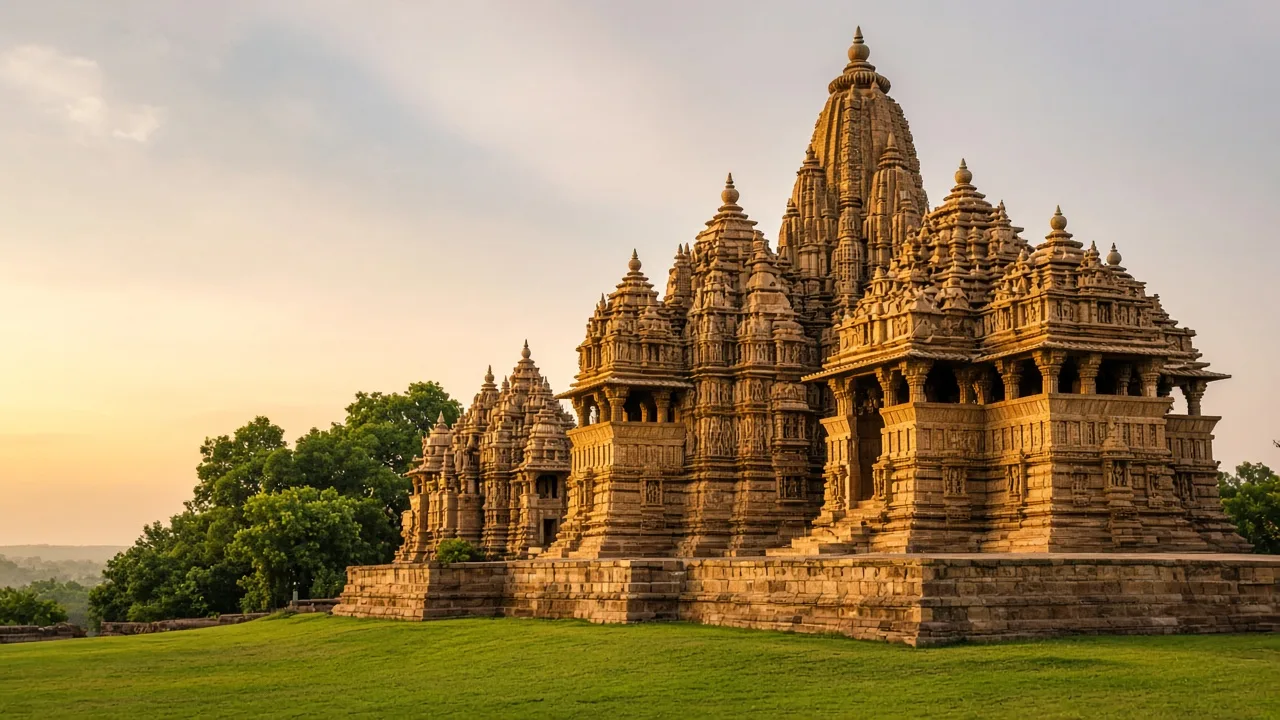
Deep in the Bundelkhand countryside of Madhya Pradesh, a cluster of sandstone temples rises out of lawns and farmland like a carved mountain range. The Khajuraho Group of Monuments is one of India's most celebrated UNESCO World Heritage Sites, inscribed in 1986, and it rewards travellers who slow down. Most people arrive expecting only the famous sensual sculptures; they leave talking about the architecture, the light at sunrise and the sheer density of storytelling cut into stone.
A short history of the Chandela temples
The temples were built by the Chandela dynasty, which reached the height of its power between roughly 950 and 1050 CE. Historical accounts suggest there were once around 85 temples spread across about 20 square kilometres. Only about 20 to 25 survive today, and they belong to two religious traditions, Hinduism and Jainism, which tells you something about the openness of the Chandela court.
After the dynasty declined, Khajuraho's remote location helped protect it, and the temples slipped out of wider attention for centuries. They were brought to broader notice in the 1830s by British surveyor T.S. Burt, and the site is now protected and maintained by the Archaeological Survey of India (ASI).
The temples follow the Nagara style of north Indian architecture: a raised platform, a sequence of halls and a cluster of rising spires (shikharas) that imitate the peaks of Mount Kailash. Sculptures of gods, celestial dancers, musicians, warriors, animals and everyday life cover the walls. The erotic panels are a small fraction of the whole and are best read as part of a larger vision of life, devotion and cosmic order.
What to see
The monuments fall into three groups. Plan at least one full day, ideally two.
- Western Group (ticketed): The main enclosure and the highlight of any visit. The Kandariya Mahadeva Temple, dedicated to Shiva, is the largest and most ornate, with hundreds of sculptures on its exterior. Nearby are the Lakshmana Temple, one of the earliest and best preserved, the Vishvanatha Temple and the Chitragupta Temple, dedicated to the sun god Surya.
- Matangeshwar Temple: Just outside the Western Group enclosure, this is still an active place of worship, with a large lingam. It is a good place to see local devotion rather than just architecture.
- Eastern Group: Home to the Jain temples, including the Parsvanath Temple with its finely carved figures, and the Adinath and Shantinath temples. Several Hindu temples, such as the Javari and Vamana, are also nearby.
- Southern Group: The quieter Duladeo and Chaturbhuj temples, the latter with a striking image of Vishnu that looks beautiful in late afternoon light.
- Sound and light show: Held in the evening at the Western Group lawns, run by Madhya Pradesh Tourism, with shows in English and Hindi.
If you have extra time, Panna National Park, known for its tiger reserve and the Ken River gorges, is within easy driving distance, as are the Raneh Falls.
Best time to visit
October to March is the most comfortable window, with clear days and cool mornings. December and January nights can be chilly, so pack a layer. April to June is very hot, and the monsoon months of July to September bring humidity, though the countryside turns green. The Khajuraho Dance Festival, usually held in February, brings classical dancers to perform with the temples as a backdrop. Dates change each year, so check Madhya Pradesh Tourism before planning around it.
How to get there
- By air: Khajuraho has its own airport, a few kilometres from the temples. Flights mainly connect with Delhi and sometimes Varanasi, and schedules have been seasonal and have changed in recent years, so check the current timetable before booking. From Mumbai, Bengaluru, Chennai, Hyderabad or Kolkata, you will usually connect through Delhi, or fly to Gwalior or Jabalpur and continue by road or rail.
- By rail: Khajuraho railway station has direct trains from Delhi (Hazrat Nizamuddin), including a Vande Bharat service that has been running on most days of the week, and connections from Varanasi and other cities. Jhansi, a major junction about four to five hours away by road, is another option.
- By road: Khajuraho is roughly 175 km from Jhansi and around 400 km from Bhopal. Many travellers combine it with Orchha, about four to five hours away.
Tickets and entry for Indian travellers
Only the Western Group requires an ASI ticket; the Eastern and Southern groups have generally been free. At the time of writing, ASI listings show entry of about Rs 40 for Indian citizens (slightly less, around Rs 35, when booked online), with SAARC and BIMSTEC nationals paying the same. Other foreign visitors pay about Rs 600 (around Rs 550 online). Children below 15 enter free. The site is open from sunrise to sunset.
The evening sound and light show is a separate ticket sold by Madhya Pradesh Tourism, recently listed at about Rs 300 for Indian adults. All fees and rules here are approximate; check the ASI and MP Tourism websites before you travel, as prices and slots can change.
Practical tips
- Arrive at the Western Group at opening time. The soft morning light shows off the carvings and the lawns are quiet.
- Hire an ASI-approved guide at the ticket office for at least the Western Group. The iconography is dense and a good guide makes the panels come alive.
- Remove footwear where required, especially at the Matangeshwar Temple, and dress modestly at active shrines.
- Rent a bicycle or e-rickshaw to reach the Eastern and Southern groups, which are spread out.
- Carry water, sunscreen and a hat; there is little shade between temples.
- Photography for personal use is generally permitted outdoors, but drones need prior permission.
- Two nights is ideal: one full day for the temples and the evening show, and a second morning for Panna or Raneh Falls.