This is Part 21 of 47 in HorizonDesk's chronological series on Indian history, from the Stone Age to Independence in 1947. It follows Part 20: The Pallavas of Kanchi and Mamallapuram.
For four centuries the Deccan plateau, the high, dry heart of peninsular India, was ruled by two great dynasties in turn. The Chalukyas of Badami (c. 540s to 753) stopped the northern emperor Harsha, fought the Pallavas for a century and filled the Malaprabha valley with experimental temples at Badami, Aihole and Pattadakal. Their feudatories, the Rashtrakutas (753 to 973), overthrew them, raided as far as the Ganga and the Kaveri, and carved the Kailasa temple at Ellora down into a basalt hill, one of the boldest works of architecture anywhere.
Most of what we know comes from inscriptions and copper-plate grants, which are royal propaganda. Many dates are approximate and some attributions are debated, so the "c." markers below matter.
Pulakeshin I and the fort at Vatapi
The Chalukyas emerge in the mid-6th century in northern Karnataka. Later records gave them a grand northern descent, but they were probably a local Kannada-country family. Pulakeshin I fortified the hill of Vatapi (modern Badami): a rock inscription there, dated Saka 465 (543 CE), records the fort, and he is said to have performed the ashvamedha horse sacrifice, a claim to full sovereignty. His sons Kirtivarman I and Mangalesha expanded it. A Sanskrit inscription in Badami Cave 3, dated 578 CE, records that Mangalesha had the Vishnu cave excavated, one of the earliest firmly dated Hindu cave temples.
Pulakeshin II: the lord of the south
After a civil war with his uncle Mangalesha, Pulakeshin II (c. 610 to c. 642) took the throne and made the Chalukyas a power across the Deccan. He subdued the Kadambas of Banavasi, the Gangas, the Mauryas of the Konkan coast and the Latas, Malavas and Gurjaras of the north-west. In the east he conquered the Vengi region between the Krishna and Godavari deltas and placed his brother there, as we will see.
His great praise-poem is the Aihole inscription, composed by the Jain poet Ravikirti and carved on the wall of the Meguti Jain temple on a hill above Aihole. It is dated Saka 556, or 634 to 635 CE, and Ravikirti compares himself to Kalidasa and Bharavi. It is dated and close to the events, but it is a eulogy written for the winner.
Its most famous claim is that Pulakeshin defeated Harshavardhana, lord of the north, whose "joy (harsha) melted away" when his elephants fell in battle. The fighting is usually placed on or near the Narmada, which became the effective border between the two empires. The Chinese pilgrim Xuanzang, who visited Pulakeshin's kingdom, independently says Harsha could not subdue this proud southern king. The date is debated: scholars have suggested anything from about 612 to the early 630s, with c. 618 to 619 often given.
The Pallava wars and the fall of Vatapi
To the south lay the Pallavas of Kanchi. Pulakeshin invaded early in his reign, and the Aihole inscription says the Pallava king Mahendravarman I hid behind the walls of Kanchi. The Pallavas answered under Narasimhavarman I Mamalla. Around 642 his army, led by tradition by the general Paranjoti, captured and sacked Vatapi; Pulakeshin II probably died in the fighting or soon after, and Narasimhavarman took the title Vatapikonda, "taker of Vatapi". For about twelve years the Chalukya state was in disarray.
Pulakeshin's son Vikramaditya I (c. 655 to c. 681) restored the kingdom, drove the Pallavas out and campaigned deep into the Tamil country; both sides claimed victories, and the war became a feud passed from father to son.
Vikramaditya II takes Kanchi
The feud peaked under Vikramaditya II (c. 733 to c. 746). Around 740 he captured Kanchi itself. Instead of looting it, he left a Kannada inscription on a pillar of Rajasimha's Kailasanatha temple saying he returned the temple's treasures; Chalukya records claim he gave gifts to its priests. The story from the Pallava side is told in Tamil History Part 16: The later Pallavas and Kanchi Kailasanathar.
Around 739 an Arab raid from Sindh into Gujarat was also repulsed; the Navsari plates credit Avanijanashraya Pulakeshin of a Gujarat branch of the family, though other western rulers made similar claims.
Badami, Aihole and Pattadakal: a laboratory of temples
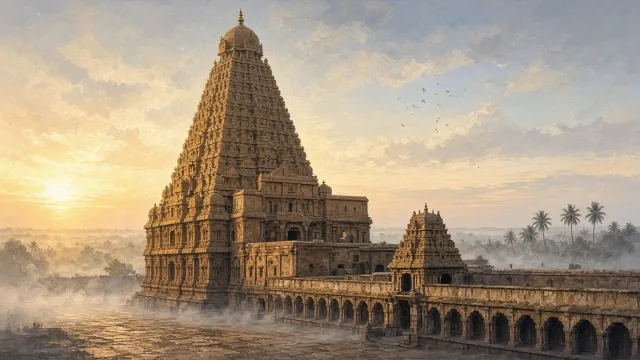
The Chalukyas' lasting fame is architectural. Within about 30 km along the Malaprabha river, their builders tried almost every way of making a Hindu temple.
- Badami: four cave temples cut into the red sandstone cliff above Agastya lake, three Brahmanical (Shiva and Vishnu) and one Jain, famed for the eighteen-armed dancing Shiva.
- Aihole: more than a hundred temples of different dates, often called a "cradle" of Indian temple architecture. The apsidal Durga temple (its name probably comes from a fort, durg, not the goddess), the Lad Khan temple and the Meguti Jain temple show builders experimenting with plans and roofs.
- Pattadakal: a royal coronation site with nine Hindu temples and a Jain sanctuary, inscribed by UNESCO in 1987. It mixes the southern Dravida style, with stepped pyramidal towers, and the northern Nagara style, with curved towers. Its masterpiece, the Virupaksha temple, was built c. 740 by Queen Lokamahadevi to celebrate her husband Vikramaditya II's victory over the Pallavas; the neighbouring Mallikarjuna temple is credited to her sister, Queen Trailokyamahadevi. The Virupaksha closely echoes Kanchi's Kailasanatha, and Pallava-trained craftsmen may have worked on it.
Our Pattadakal visiting guide covers the site as it is today.
The Eastern Chalukyas of Vengi
Pulakeshin II gave the conquered Vengi region in coastal Andhra to his brother Kubja Vishnuvardhana around 624 (the date varies by a few years). His line, the Eastern Chalukyas, outlasted the parent dynasty by centuries. Caught between the Rashtrakutas and later the Cholas, they ended by marrying into the Chola house: their prince Rajendra became the Chola emperor Kulottunga I in 1070. Under them, Telugu began to appear as a written language of inscriptions and, in the 11th century, of literature, with Nannaya's Telugu Mahabharata.
Dantidurga and the Rashtrakuta takeover
The Rashtrakutas were Chalukya feudatories, probably based in Berar or the Ellora region of present-day Maharashtra; their deeper origins, like those of many dynasties, are debated. Around 753 Dantidurga broke with his overlords. His Samangad copper plates, dated 753 to 754, claim he defeated the "Karnataka army" of the Chalukya king Kirtivarman II with only a small force. Within a few years the main Chalukya line was finished.
Krishna I and the Kailasa temple at Ellora
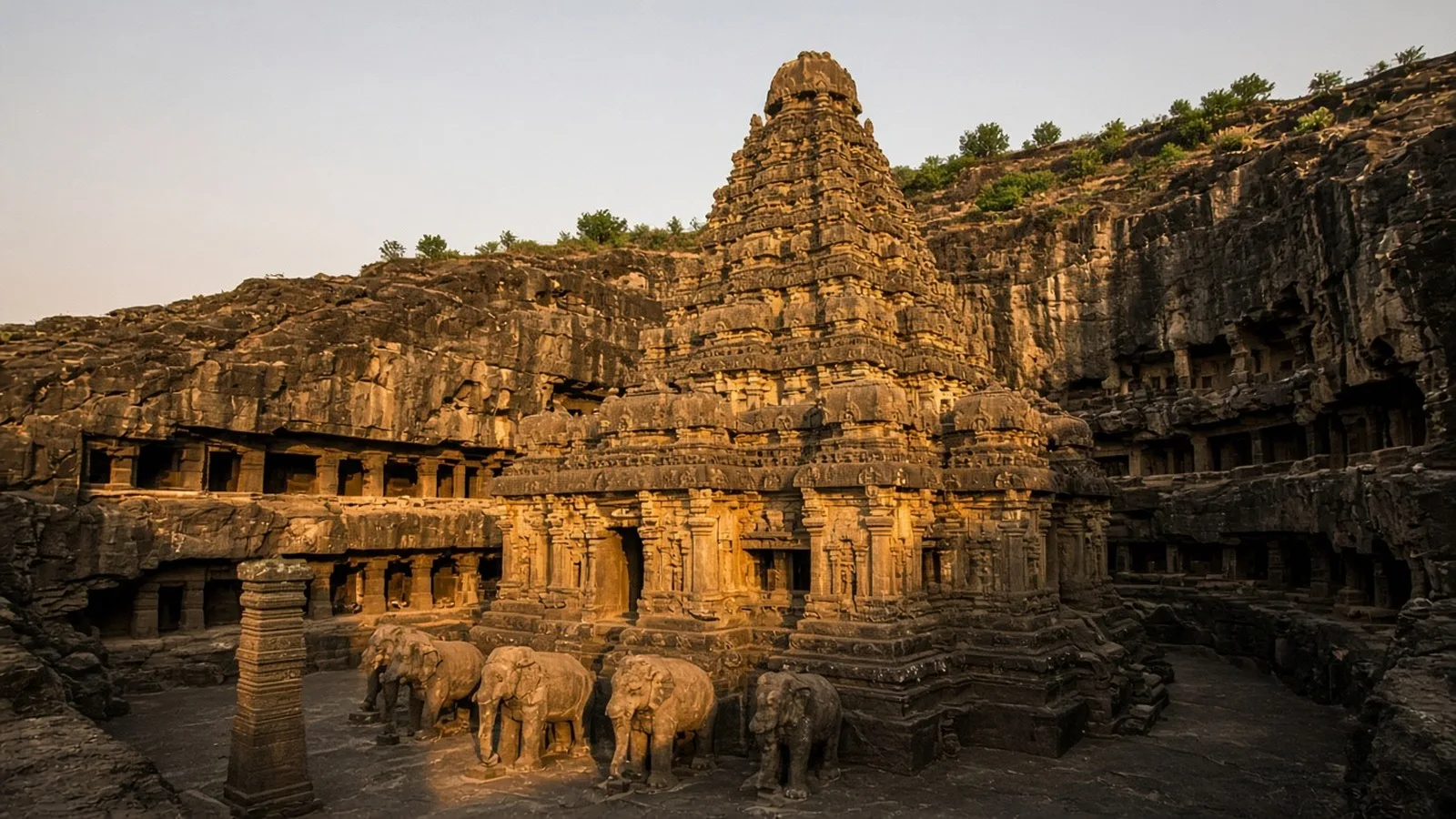
Dantidurga's uncle Krishna I (c. 756 to c. 774) completed the conquest of the Chalukya lands and is generally credited with the most astonishing monument of the age: the Kailasa temple, Cave 16 at Ellora, near Aurangabad (Chhatrapati Sambhajinagar). A later Rashtrakuta grant, the Baroda plates, praises a marvellous temple at "Elapura" built by Krishna, and says even its architect wondered how he had made it; most scholars identify this with Kailasa. Some think work continued under later kings.
Kailasa is not built: it is carved. Workers cut deep trenches into the basalt hillside to isolate a huge block, then sculpted it from the top down into a complete temple, with a gateway, a Nandi pavilion, a multi-storeyed shrine with a Dravida tower, life-size stone elephants around its base, two free-standing pillars and surrounding galleries cut into the cliff. Estimates of the rock removed run to about 200,000 tonnes, though such figures are rough. The temple was meant to evoke Mount Kailasa, the home of Shiva, and its reliefs include the demon king Ravana shaking the mountain. Its plan is close to Pattadakal's Virupaksha, and the debt to Chalukya and Pallava builders is clear.
Ellora as a whole has 34 caves spread over more than 2 km, dug between about 600 and 1000 CE: Buddhist, Hindu and Jain, side by side. UNESCO inscribed it in 1983 and singles out this coexistence. For a visit, see our Ajanta and Ellora travel guide.
Dhruva and Govinda III: raiding the north
The Rashtrakutas soon entered the struggle for Kannauj, the prestige city of the Ganga plain. Dhruva (c. 780 to 793) marched north and defeated both the Gurjara-Pratihara king Vatsaraja and the Pala king Dharmapala of Bengal; Rashtrakuta records say he added the Ganga and Yamuna to his royal emblem. His son Govinda III (793 to 814) repeated the feat, beating the Pratihara Nagabhata II and receiving Dharmapala's submission, by his records' account reaching the Himalayan foothills, and then turned south against the Pallavas, Pandyas and Keralas. These raids won booty and fame rather than lasting territory.
Amoghavarsha I: the scholar-king of Manyakheta
Amoghavarsha I came to the throne as a boy in 814 and reigned until about 878, one of the longest reigns in Indian history. He moved the capital to Manyakheta (modern Malkhed, Kalaburagi district, Karnataka). He is remembered more for culture than for war.
- The Kavirajamarga, the earliest surviving work on poetics in Kannada, was written at his court. It is attributed to the king himself or, as many scholars now argue, to the court poet Srivijaya. It describes the Kannada country as stretching "from the Kaveri to the Godavari".
- He patronised Jain scholars such as Jinasena; the mathematician Mahaviracharya wrote his Ganitasarasangraha in this reign, and the Sanskrit Prashnottara Ratnamalika is often attributed to him.
- The Arab merchant account compiled about 851 (often attributed to Sulaiman) calls the "Balhara", the Rashtrakuta king, one of the four great kings of the world, alongside the caliph and the emperors of China and Byzantium.
Krishna III and Takkolam
After Amoghavarsha the empire stayed powerful but fought on every front. Indra III (c. 914 to 929) briefly occupied Kannauj around 916. The last great king, Krishna III (939 to 967), turned south against the rising Cholas. In 949, at Takkolam near Arakkonam, his army and that of his Ganga ally Butuga II defeated the Chola king Parantaka I; the Chola crown prince Rajaditya was killed on his war elephant. Krishna took the title "conqueror of Kanchi and Tanjore" and his inscriptions appear across northern Tamil Nadu, though how far south he really held power is debated. The Chola side of this story is in Tamil History Part 19: Vijayalaya and the Chola Revival.
Decline and the Chalukyas of Kalyani
The fall was swift. In 972 the Paramara king Siyaka of Malwa sacked Manyakheta. In 973 Tailapa II, a feudatory who claimed descent from the old Chalukyas of Badami, overthrew the last effective Rashtrakuta king, Karka II. His line, known as the Western Chalukyas or Chalukyas of Kalyani (their later capital, today Basavakalyan), ruled much of the Deccan into the late 12th century and fought long wars against the Cholas. His claimed Badami ancestry is uncertain. A Rashtrakuta prince, Indra IV, held out until 982.
Key takeaways
- Pulakeshin I fortified Vatapi (Badami) in 543; Pulakeshin II stopped Harsha near the Narmada, as Ravikirti's Aihole inscription (634 to 635) boasts.
- The Pallavas sacked Vatapi around 642; Vikramaditya II took Kanchi around 740 and spared its Kailasanatha temple.
- Badami, Aihole and Pattadakal (UNESCO 1987) show the Chalukyas blending southern Dravida and northern Nagara temple styles.
- The Eastern Chalukyas of Vengi lasted into the 11th century and merged with the Cholas through Kulottunga I.
- Dantidurga founded Rashtrakuta power around 753; Krishna I is credited with Ellora's monolithic Kailasa temple (UNESCO 1983).
- Amoghavarsha I ruled from Manyakheta, and the Kavirajamarga from his court is the oldest surviving Kannada literary work.
- Krishna III defeated the Cholas at Takkolam in 949, but the Rashtrakutas fell to Tailapa II of the Kalyani Chalukyas in 973.
Next part
In Part 22, we follow the Rashtrakutas north into The Tripartite Struggle: Palas, Pratiharas and Rashtrakutas, the long three-way contest for Kannauj and the Ganga plain.
Sources
- UNESCO World Heritage Centre, Group of Monuments at Pattadakal
- UNESCO World Heritage Centre, Ellora Caves
- Encyclopaedia Britannica, Chalukya dynasty
- Encyclopaedia Britannica, Rashtrakuta dynasty
- Kielhorn, F. (1900-01), "Aihole Inscription of Pulikesin II; Saka-Samvat 556", Epigraphia Indica 6, pp. 1-12
- Archaeological Survey of India, Dharwad and Aurangabad Circles, Badami, Aihole, Pattadakal and Ellora monuments
- Altekar, A. S. (1934), The Rashtrakutas and Their Times, Oriental Book Agency, Poona
- Nilakanta Sastri, K. A. (1955), A History of South India from Prehistoric Times to the Fall of Vijayanagar, Oxford University Press
- Kamath, S. U. (1980), A Concise History of Karnataka, Archana Prakashana
- Michell, G. (2014), Temple Architecture and Art of the Early Chalukyas: Badami, Mahakuta, Aihole, Pattadakal, Niyogi Books
- Thapar, R. (2002), Early India: From the Origins to AD 1300, University of California Press
- Singh, U. (2008), A History of Ancient and Early Medieval India: From the Stone Age to the 12th Century, Pearson