This is Part 20 of 47 in HorizonDesk's chronological series on Indian history, from the Stone Age to Independence in 1947. It follows Part 19: Harshavardhana and Xuanzang's India.
When Xuanzang reached Kanchipuram around 640 CE, he found a large, prosperous city. Its rulers were the Pallavas, who held the northern Tamil country from roughly the 4th to the late 9th century. They fought a century-long war with the Chalukyas of Badami, made Kanchi a great centre of learning, and at Mamallapuram (Mahabalipuram) on the coast left caves, monolithic shrines and reliefs that UNESCO listed as a World Heritage Site in 1984.
Pallava chronology is notoriously difficult. Most dates come from copper plates, inscriptions and links with other dynasties, and historians differ by a decade or more for many reigns, so treat every "c." seriously.
Where did the Pallavas come from?
Nobody knows for certain. The earliest Pallava records are copper plates in Prakrit, such as the Mayidavolu and Hirahadagalli plates of Shivaskandavarman (probably 4th century), issued from Kanchi but found in the Andhra and Bellary regions. Later grants are in Sanskrit, and Tamil passages become common only from the 7th century. Three main theories exist:
- Persian or Parthian origin, from a supposed link between "Pallava" and "Pahlava". Most historians reject it as resting on little more than a similar name.
- Northern or Andhra origin: the Pallavas began as officials or feudatories of the Satavahanas in the eastern Deccan and moved south to Kanchi as Satavahana power faded. Britannica reflects this view, calling them indigenous subordinates of the Satavahanas who moved into Andhra and then Kanchi.
- Local Tamil origin, linking them with the Tondaiyar chiefs of Tondaimandalam, or with the legend of a Chola prince and a Naga princess whose son Ilandiraiyan ruled Kanchi. Attractive, but hard to prove.
By the mid-4th century a king of Kanchi mattered enough to be named by the Guptas: Samudragupta's Allahabad pillar inscription lists Vishnugopa of Kanchi among southern kings he defeated and then released.
The early Pallavas and Kanchi's ghatika
The 4th to 6th centuries are poorly lit. A Jain text, the Lokavibhaga, says it was copied in the 22nd year of a Pallava king Simhavarman, usually read as 458 CE, one of the few fixed dates. Much of the Tamil south was then under the obscure Kalabhras.
Kanchi was already famous for learning. The Kadamba Talagunda inscription tells how the Brahmin Mayurasharman came to study at Kanchi's ghatika, a Brahmanical college, was insulted by a Pallava horseman, took up arms and founded the Kadamba dynasty. Buddhist scholars were linked to the city too: the logician Dignaga is traditionally said to have come from near Kanchi, and Xuanzang names Dharmapala of Nalanda as a native. A later tradition makes Bodhidharma, founder of Chan (Zen), a Pallava prince, but it rests on late sources and is unproven.
Simhavishnu: a regional power
The "imperial" Pallava line begins with Simhavishnu (c. 575 to c. 600, dates vary), who claimed to have defeated the Kalabhras and pushed the frontier to the Kaveri. A relief in the Adivaraha cave at Mamallapuram shows a king, usually identified as Simhavishnu, with two queens. The poet Bharavi, author of the Kiratarjuniya, may have visited his court, according to the later Avantisundarikatha.
Mahendravarman I: poet, painter and cave-maker
His son Mahendravarman I (c. 600 to c. 630) bore titles such as Vichitrachitta ("curious-minded") and Chitrakarapuli ("tiger among painters"). He is credited with the Sanskrit farce Mattavilasa Prahasana, set in Kanchi, in which a drunken Kapalika ascetic accuses a Buddhist monk of stealing his skull-bowl. It mocks Buddhist and Shaiva ascetics alike and is a lively window on the city's religious life.
He introduced rock-cut temples to the Tamil country. His inscription at Mandagapattu boasts that the shrine was made without brick, timber, metal or mortar. Similar pillared caves survive at Mamandur, Dalavanur, Siyamangalam, Mahendravadi, Pallavaram and Tiruchirappalli.
Tamil Shaiva tradition says the king began as a Jain, persecuted the saint Appar (Tirunavukkarasar), and was then converted by him to Shaivism. The story comes from the 12th-century Periya Puranam, written centuries later, so the details are hagiography; but a Tiruchirappalli cave inscription does speak of the king, as Gunabhara, turning to the worship of the linga. See Tamil History Part 14: Simhavishnu and Mahendravarman.
His reign opened the Pallava-Chalukya wars. Pulakeshin II of Badami invaded and came close to Kanchi. Pallava records claim a victory at Pullalur; the Chalukya Aihole inscription says the Pallava king hid behind Kanchi's walls. Both sides probably exaggerated: the Pallavas lost northern territory but kept their capital.
Narasimhavarman I Mamalla and the sack of Vatapi
Narasimhavarman I (c. 630 to c. 668) took revenge. The Kuram plates say he beat Pulakeshin at Manimangala, Pariyala and Suramara. Around 642 CE a Pallava army, led by tradition by the general Paranjoti (later revered as the Nayanar saint Siruthondar), took and sacked the Chalukya capital Vatapi (Badami). Pulakeshin II seems to have died then or soon after. Narasimhavarman took the title Vatapikonda ("taker of Vatapi"), and a Pallava inscription was cut at Badami itself.
He also sent naval expeditions to Sri Lanka to put his ally Manavarma on the throne of Anuradhapura. In his reign Xuanzang described Kanchi with about a hundred Buddhist monasteries and some ten thousand monks, alongside Hindu temples and Jains. His title Mamalla ("great wrestler") gave its name to Mamallapuram.
Mamallapuram: an open-air workshop by the sea
The Group of Monuments at Mahabalipuram, protected by the Archaeological Survey of India, was created over the 7th and early 8th centuries. UNESCO groups it into five kinds of work:
- Mandapas (cave halls) such as the Varaha and Mahishamardini caves, with Vishnu as the boar lifting the earth and Durga fighting the buffalo demon.
- Rathas, monolithic temples each cut from one granite outcrop. The Pancha Rathas carry the names of the Pandavas and Draupadi, but those are later popular labels. They look like samples of different temple forms, and several were left unfinished.
- Open-air reliefs, above all the great relief on two boulders, about 27 m long and 9 m high, crowded with gods, sages, animals and life-size elephants.
- Structural temples of cut stone, culminating in the Shore Temple.
- Excavated remains found under the sand, some exposed by the 2004 tsunami.
The great relief has two names, and the debate continues. One reading sees Arjuna's Penance, the hero doing austerities to win Shiva's weapon. The other sees the Descent of the Ganges, brought down by Bhagiratha's penance; a natural cleft with serpent deities runs down the middle, and water may once have flowed through it from a cistern above. Some scholars think the ambiguity is deliberate. Look for the cat standing on one leg in mock penance, surrounded by mice.
Dating is also debated: some caves and rathas belong to Narasimhavarman I, but inscriptions there use titles shared by several kings, and some scholars credit Rajasimha with major parts of the site. Our Mahabalipuram visiting guide covers the site today.
Rajasimha: the Shore Temple and Kailasanatha
The wars went on. Vikramaditya I of the Chalukyas recovered Vatapi and raided south, and Parameshvaravarman I (c. 670 to c. 700) fought him, with both sides claiming victory. His son Narasimhavarman II Rajasimha (c. 700 to c. 728) ruled in relative peace and built.
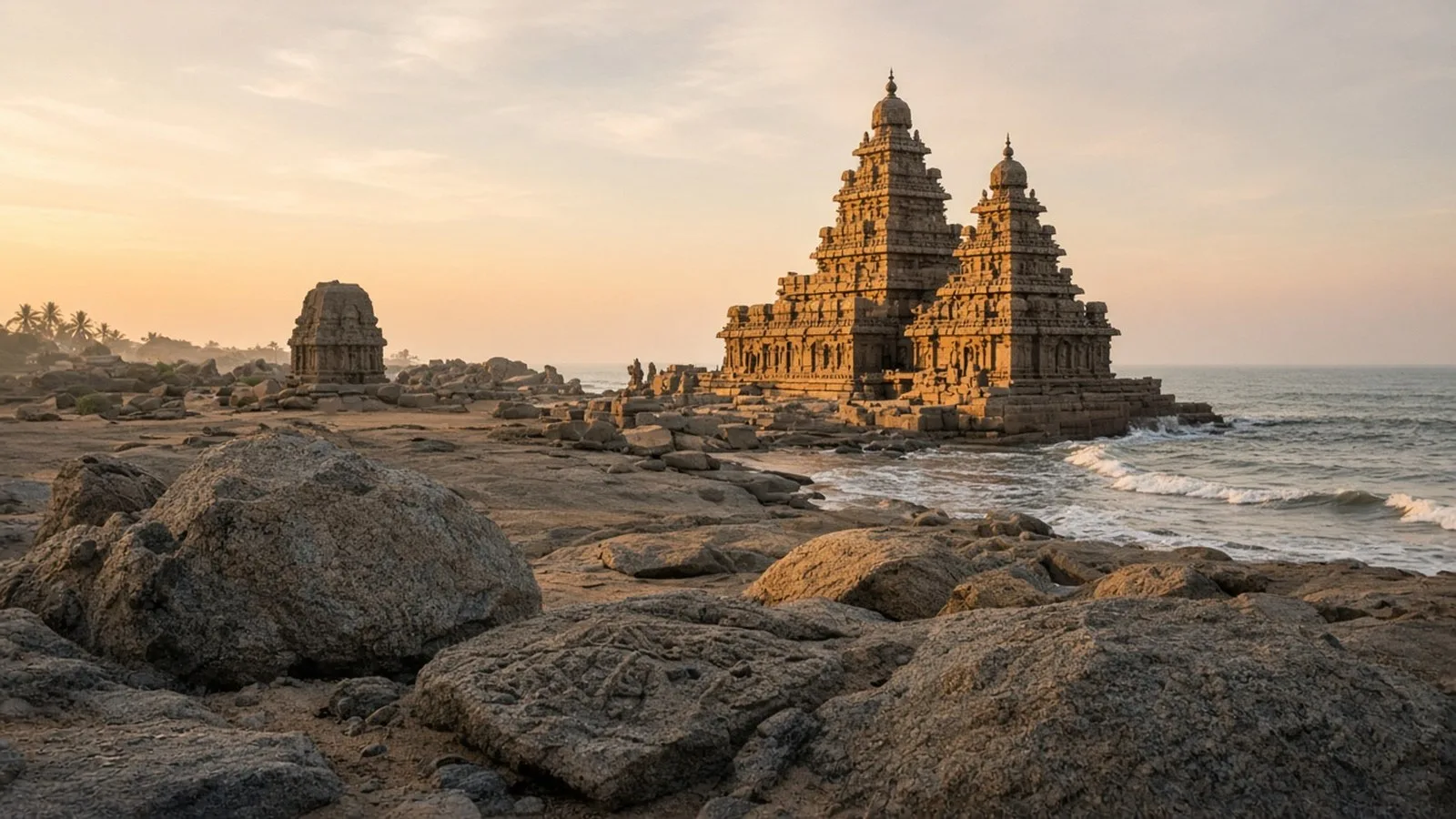
Rajasimha moved Pallava architecture from carving rock to building in cut stone. At Mamallapuram he raised the Shore Temple at the edge of the Bay of Bengal, with two Shiva shrines and, between them, a shrine of the reclining Vishnu. At Kanchi he built the Kailasanatha temple (Rajasimheshvara), largely of sandstone, with a pyramidal vimana and a ring of small shrines around the courtyard; it was completed by his son Mahendravarman III and became a model for later Dravidian temples. The prose writer Dandin is often placed at his court, though this is debated. Chinese records note a Pallava embassy to the Tang court in 720. The story continues in Tamil History Part 16: The later Pallavas and Kanchi Kailasanathar.
Grantha script and the sea routes
The Pallavas wrote Sanskrit in a southern form of Brahmi that developed into the Grantha script, used in the Tamil country for Sanskrit for centuries and a contributor to the later Tamil and Malayalam scripts. Scholars use the label "Pallava script" for the related writing in early Southeast Asian inscriptions, such as Mulavarman's Kutai inscriptions in Borneo (c. 400) and Purnavarman's in western Java. These became ancestors of the Khmer, Old Javanese (Kawi), Mon and other scripts. The label is a convention; it does not mean the Pallavas ruled those lands.
Trade carried these links. Mamallapuram and Nagapattinam were busy ports, and a 9th-century Tamil inscription at Takua Pa in southern Thailand records a tank called Avani-naranam, apparently named after a title of Nandivarman III, placed in the care of a merchant guild. UNESCO notes that Mamallapuram's sculptural style reached Cambodia, Annam (Vietnam) and Java.
Nandivarman II and the later Pallavas
When the main line ended around 731, a boy of about twelve from a collateral branch was chosen as king: Nandivarman II Pallavamalla (c. 731 to c. 796). His accession is shown in labelled panels on the walls of Kanchi's Vaikuntha Perumal temple, a rare piece of illustrated political history. The Chalukya Vikramaditya II captured Kanchi around 740, but left a Kannada inscription in the Kailasanatha temple recording that he returned its treasures. The Rashtrakutas, who replaced the Chalukyas around 753, and the Pandyas of Madurai kept up the pressure. Nandivarman II, a Vaishnava, was a contemporary of Tirumangai Alvar.
Nandivarman III (c. 846 to c. 869) defeated the Pandyas at Tellaru and is the hero of the Tamil poem Nandikkalambakam, but the kingdom was being squeezed on all sides.
Decline: Aparajita and the Cholas
The last important Pallava, Aparajita, defeated the Pandya Varaguna II at Tiruppurambiyam near Kumbakonam (c. 880s), helped by the Ganga king Prithvipati I and the Chola Aditya. The victory served the Cholas more than the Pallavas. Within a few years Aditya I turned on his overlord; Chola records say he defeated Aparajita and took Tondaimandalam, usually dated to the late 9th century (estimates vary). Pallava families survived as minor chiefs. The Chola rise is told in Tamil History Part 19: Vijayalaya and the Chola Revival.
Key takeaways
- Pallava origins are disputed; the leading view ties them to the Satavahana-era Deccan and Andhra before Kanchi, but Parthian and local Tamil theories have supporters.
- Mahendravarman I wrote the Mattavilasa Prahasana, introduced rock-cut temples and, by tradition, was converted from Jainism to Shaivism by Appar.
- Narasimhavarman I Mamalla sacked Vatapi around 642 and gave his name to Mamallapuram.
- Mamallapuram's caves, rathas, great relief and Rajasimha's Shore Temple form a UNESCO World Heritage Site (1984); Rajasimha also built Kanchi's Kailasanatha.
- Pallava Grantha and the related "Pallava script" shaped writing across Southeast Asia.
- The Pallavas fell when Aditya I Chola defeated Aparajita in the late 9th century.
Next part
In Part 21, we turn to the Pallavas' great rivals and their successors: Chalukyas and Rashtrakutas: Badami to Ellora, from the caves of Badami and the temples of Aihole and Pattadakal to the rock-cut Kailasa temple at Ellora.
Sources
- UNESCO World Heritage Centre, Group of Monuments at Mahabalipuram
- Encyclopaedia Britannica, Pallava dynasty
- Archaeological Survey of India, Chennai Circle, Mamallapuram monuments
- Nilakanta Sastri, K. A. (1955), A History of South India from Prehistoric Times to the Fall of Vijayanagar, Oxford University Press
- Minakshi, C. (1938), Administration and Social Life under the Pallavas, University of Madras
- Gopalan, R. (1928), History of the Pallavas of Kanchi, University of Madras
- Srinivasan, K. R. (1964), Cave Temples of the Pallavas, Archaeological Survey of India
- Lockwood, M., Siromoney, G. and Dayanandan, P. (1974), Mahabalipuram Studies, Christian Literature Society
- Thapar, R. (2002), Early India: From the Origins to AD 1300, University of California Press
- Singh, U. (2008), A History of Ancient and Early Medieval India: From the Stone Age to the 12th Century, Pearson