This is Part 9 of England's Royal Dynasties, our daily series on the kings and queens of England and Britain, from the Anglo-Saxon kingdoms to King Charles III.
In Part 8 we lived through 1066: Harold Godwinson's coronation, his victory over Harald Hardrada at Stamford Bridge and his death at Hastings. This part follows the winner. William the Conqueror took a crown on Christmas Day 1066, but it took him years of war to make it secure. By the time he died in 1087, England had a new ruling class, a new language at court, a landscape dotted with castles and the most detailed survey of any kingdom in medieval Europe: the Domesday Book.
How do we know?
For William's reign we have Norman historians such as William of Poitiers and, a generation later, Orderic Vitalis, an English-born monk who wrote in Normandy and was often critical of the Conqueror. The Anglo-Saxon Chronicle carried on in English and includes a famous, unflattering obituary of the king. Above all, we have government records on a new scale, especially Domesday Book, now in The National Archives at Kew. And we have buildings. The White Tower at the Tower of London, begun under William, still stands.
The Bastard of Normandy
William was born at Falaise in Normandy, in 1027 according to Historic Royal Palaces (about 1028 according to The Royal Family's history). He was the illegitimate son of Duke Robert of Normandy and a woman called Herleva, and many contemporaries outside Normandy called him "the Bastard". When his father died on pilgrimage in 1035, William was still a child, and his early years were dangerous: two of his guardians were killed.
He survived, came of age around 1042 and spent years crushing rebels and fending off neighbours, including the King of France. In about 1050 he married Matilda of Flanders, who came from a powerful family; they had at least nine children. By 1066 William was an experienced, ruthless commander who had united Normandy behind him.
King of England
After Hastings William moved carefully. He secured Dover, Canterbury and Winchester, while London declared Edgar Ætheling king. As William closed in, the English leaders submitted, and on Christmas Day 1066 Archbishop Ealdred of York crowned him in Westminster Abbey, using the English order of service.
The day went badly wrong. According to Orderic Vitalis, the shouts of acclamation in English and French alarmed the Norman guards outside, who thought there was an attack and set fire to nearby buildings. Most of the congregation fled. Orderic says that only the bishops, clergy and monks stayed, and they "only just managed to complete the consecration rite over the king who was trembling violently".
In March 1067 William felt secure enough to return to Normandy, leaving his half-brother, Bishop Odo of Bayeux, among those in charge.
Rebellion and the Harrying of the North
It was too soon. For several years England rebelled. After his return William besieged Exeter for 18 days before the city surrendered. Harold's sons raided the south-west. In 1069 a Danish fleet, joined by Edgar Ætheling and English rebels, took York.
William's response was the Harrying of the North (1069–70). He laid waste to the countryside across the north so that neither the Danes nor the rebels could find food. Orderic Vitalis wrote that William "made no effort to restrain his fury and punished the innocent with the guilty", ordering crops, herds and food "brought together and burned to ashes so that the whole region north of the Humber be deprived of any source of sustenance". The Royal Family's history states that the resulting famine lasted at least nine years. Even by the standards of the age, it shocked contemporaries.
Danish ships, allied with English rebels including the famous Hereward the Wake in the Fens, threatened the east coast until a peace treaty with the King of Denmark in June 1070. In 1072 William marched into Scotland and made a truce with King Malcolm III at Abernethy.
Castles and a new aristocracy
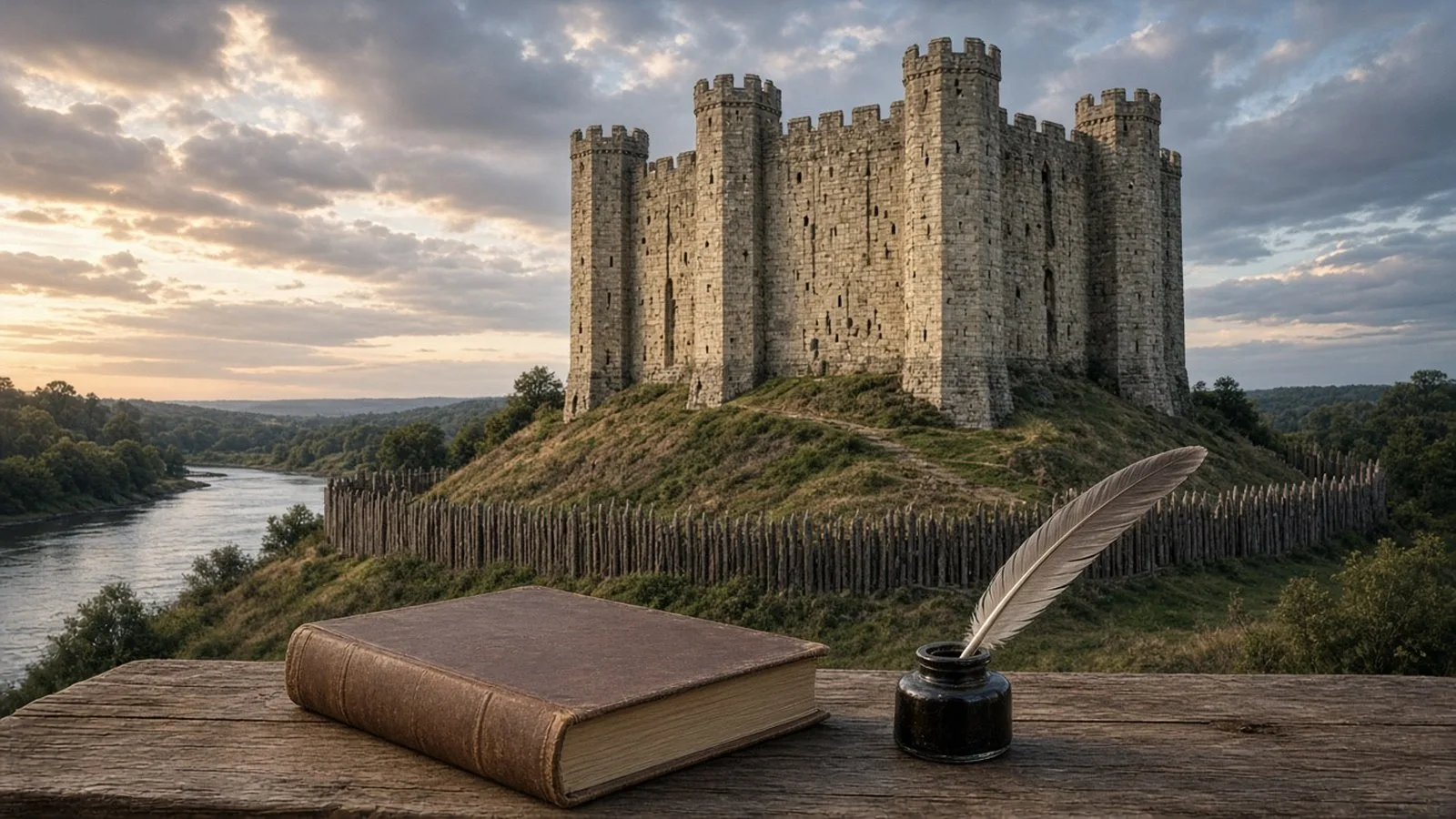
William's most visible weapon was the castle. The first were quickly built earth mounds, called mottes, topped with wooden towers and surrounded by a fenced yard, the bailey. Many were later rebuilt in stone. According to The Royal Family's history, more than 80 castles had been built by the end of his reign.
The greatest was the White Tower at the Tower of London, begun around 1078 in pale stone shipped from Caen, built with English labour and taking about 20 years to complete. Tree-ring dating of its timbers, published by Historic England, points to a first building phase finished by about 1083–90 and a second phase that ran on past 1100. You can read more about it in our Tower of London guide.
The land was redistributed. English nobles who had died at Stamford Bridge and Hastings, or who rebelled, lost their estates to Norman, French and Flemish followers, who held them in return for supplying knights. By the end of the reign, according to The Royal Family's history, only two Englishmen still held large estates directly from the king. The church changed too: the Italian scholar Lanfranc became Archbishop of Canterbury in 1070, and English bishops and abbots were replaced by Normans and Frenchmen. William never learned English, and French became the language of the aristocracy for centuries.
Domesday Book
At his Christmas court at Gloucester in 1085, says the Chronicle, William held "very deep consultation" with his council about England, "how it was occupied, and by what sort of men". He faced the threat of a Danish invasion, the cost of defence and disputes between his own barons over land. The answer was a survey of the whole kingdom.
Royal commissioners rode out to every shire. Local juries answered fixed questions about each estate: who held it in King Edward's time, who held it now, how many people, ploughs, mills and animals it had and what it was worth then and now. The Chronicler complained that "not even an ox, nor a cow, nor a swine was there left, that was not set down in his writ".
The results are two books. Great Domesday, more than 800 pages, covers most of England and was written mainly by one scribe. Little Domesday, with 900 pages, covers Essex, Norfolk and Suffolk in more detail. The National Archives says they record about 13,000 settlements and 270,000 inhabitants. At Lammas (1 August) 1086, at Old Sarum near Salisbury, William made the leading landholders swear loyalty to him personally. The Royal Family's history counts 170 tenants-in-chief at this Oath of Salisbury.
Legend vs evidence
"The first king of England." William was not. Historic Royal Palaces points out that he was the 17th, counting from Athelstan, who became the first king of all the English in 927 (see Part 4 of this series). He was the first Norman king, and every later monarch, including King Charles III, descends from him.
Domesday as a census. Domesday is not a modern census. The 270,000 people it records are mostly heads of households, so historians have to estimate the total population, and their estimates vary. Some places are missing altogether: London, Winchester, Northumberland and County Durham were not included. It is a record of land, lordship and value, made for a king who wanted to know what he owned and what he could tax.
Why "Domesday"? The name was not William's. It came later, from a comparison with the Last Judgement, the "day of doom", because its verdict was final. The King's officials kept on using the book in land disputes for centuries.
Harold's oath and papal approval. William's claim rested on Edward's promise and Harold's oath, and he had papal approval for the invasion. But almost all our accounts of the promise come from the Norman side, written after the victory.
Death and burial
William spent most of his last years in France. In 1076 he suffered the first major defeat of his career against the King of France. In 1078 or 1079 his own eldest son, Robert, wounded him in a skirmish. Queen Matilda died in 1083. In 1087, while sacking the town of Mantes, William was taken ill or injured; one story says the pommel of his saddle struck his stomach. He died near Rouen on 9 September 1087 and was buried at St Étienne in Caen. Robert took Normandy, his second surviving son William Rufus took England, and his youngest son, Henry, received 5,000 pounds of silver.
The Chronicle's obituary, as quoted by The Royal Family, called him "a very stern and violent man, so no one dared do anything contrary to his will", yet added that "the good security he made in this country is not to be forgotten".
Where to see it today
- The Tower of London: the White Tower, William's great keep.
- The National Archives, Kew: Great and Little Domesday, both still on record.
- Battle Abbey, East Sussex (English Heritage): founded by William on the battlefield of Hastings.
- Old Sarum, Wiltshire (English Heritage): the hilltop site of the Oath of Salisbury.
- Abbaye-aux-Hommes, Caen: William's tomb slab in the church of St Étienne.
At a glance
| Rulers | William I, 1066–1087 |
| House | House of Normandy |
| Predecessor | Harold II (Edgar Ætheling proclaimed but never crowned) |
| Successor | William II Rufus |
| Key dates | 25 December 1066 crowned; 1069–70 Harrying of the North; 1070 Lanfranc archbishop; 1072 Abernethy; around 1078 White Tower begun; 1085 Domesday survey ordered; 1086 Oath of Salisbury; 9 September 1087 dies |
| Legacy | Norman aristocracy and castles; Domesday Book; French at court; ties between England and France that would last for centuries |
| Next | William II Rufus and Henry I |
Next in the series
In Part 10 we meet the Conqueror's sons. William II Rufus fought his brother Robert for their father's lands and died in a mysterious hunting accident in the New Forest in 1100. His younger brother Henry I seized the crown within days, captured Robert and ruled for 35 years, until the drowning of his only legitimate son set the stage for civil war. Meanwhile, browse more medieval history and stories from English Heritage sites.
Sources
- The Royal Family, William I 'The Conqueror' (r. 1066–1087)
- Historic Royal Palaces, William I (the Conqueror): England's first Norman King
- The National Archives, Domesday
- The National Archives, What does Domesday Book tell us?
- The Anglo-Saxon Chronicle, eleventh-century entries, Avalon Project, Yale Law School
- Historic England (2007), The Tree-Ring Dating of the White Tower, H M Tower of London