This is Part 13 of HorizonDesk's chronological series on Indian history, from the Stone Age to Independence in 1947.
In Part 12 of this series, we followed Ashoka from the Kalinga war to his edicts of dhamma, and saw his empire weaken under a string of short-lived successors. Around 185 BCE the last Maurya was killed in front of his own army, and India's first great empire was gone.
What came next was not a single successor state but a crowded map. The Shungas and then the Kanvas held the Ganga valley and central India. Greek kings from Bactria, the Indo-Greeks, crossed the Hindu Kush into Gandhara and the Punjab. In Kalinga, the Jain king Kharavela boasted of wide campaigns. The sources are thin and often contradictory, so most dates below are approximate.
The coup of 185 BCE
The story comes mainly from the Puranas and Bana's seventh-century Harshacharita. The last Mauryan king, Brihadratha, was reviewing his troops when his commander-in-chief (senani), Pushyamitra, struck him down and took the throne. Historians date the coup to about 187–184 BCE; "c. 185 BCE" is a convenient round figure.
Pushyamitra was a Brahmin. The Puranas give him 36 years on the throne and list ten Shunga kings ruling for 112 years in all. Curiously, the name "Shunga" appears in only one inscription, a gateway dedication at Bharhut "during the rule of the Sugas", and even that reading is uncertain. Much of the "Shunga empire" is a modern reconstruction from texts, coins and scattered inscriptions.
Pushyamitra: horse sacrifices and a contested reputation
Pushyamitra's realm was the Mauryan heartland: Pataliputra, Ayodhya and Vidisha, perhaps reaching the Narmada. A later inscription from Ayodhya, set up by Dhanadeva, who calls himself sixth in descent from him, describes Pushyamitra as the performer of two ashvamedhas, the Vedic horse sacrifice that announced a king's supremacy. Kalidasa's much later play Malavikagnimitram has his grandson Vasumitra defeating Yavana (Greek) cavalry while guarding the sacrificial horse.
His reputation in Buddhist texts is grim. The Ashokavadana, compiled perhaps in the second century CE, says he set out to destroy Buddhism, attacked the Kukkutarama monastery at Pataliputra and offered a reward for every monk's head at Sakala in the Punjab. Many historians treat this as hostile legend: it has him paying in dinaras, Roman coins not yet in use, and Buddhist sites flourished under the Shungas. John Marshall did argue that some damage at Sanchi and Taxila dates to this period. The fairest summary is that Pushyamitra patronised Brahmanical ritual, Buddhists remembered him as an enemy, and the evidence for systematic persecution is weak.
Vidisha and the later Shungas
Pushyamitra's son Agnimitra governed from Vidisha (ancient Vidisa, beside modern Besnagar) on the Betwa river, in today's Madhya Pradesh, and he is the hero of Kalidasa's play. Vidisha sat on the trade route between the Ganga valley and the Deccan and became the real centre of later Shunga power. After Agnimitra the Puranic list is a bare string of names ending with Bhagavata and Devabhuti, and coins suggest that much of north India was held by local dynasties, such as the Mitras of Mathura and Panchala, with only loose ties to the Shungas.
The Heliodorus pillar: a Greek envoy at Besnagar
The most vivid record of the age stands in a field at Besnagar, about 60 km from Bhopal. Villagers called the stone column "Khamba Baba" and smeared it with vermilion. Alexander Cunningham noted it in the 1870s, but only in 1909, when the crust was cleaned, did the team of H. H. Lake and John Marshall find a Brahmi inscription. In Richard Salomon's translation it says that this Garuda-standard of Vasudeva, the god of gods, was set up by Heliodorus, a Bhagavata (devotee), son of Dion and a man of Taxila, the Greek ambassador from the Great King Antialcidas to King Kasiputra Bhagabhadra, the Saviour, in his fourteenth regnal year. A second line lists three steps to immortality: self-restraint, generosity and attentiveness.
The pillar is usually dated to about 113–100 BCE. A Greek from Taxila, serving an Indo-Greek king, calls himself a devotee of Vasudeva-Krishna: it is among the earliest datable evidence for the Bhagavata cult that grew into Vaishnavism, and excavations in the 1960s found the foundations of an elliptical shrine beside it, one of the oldest temple plans in India. Scholars debate whether Heliodorus "converted" or made a diplomatic offering to a local god, and whether Bhagabhadra was a Shunga king or a local ruler. Either way, Greek and Indian courts were exchanging envoys, not only fighting.
Bharhut and Sanchi: Buddhist art in the Shunga age
Whatever Pushyamitra thought of the monks, the Shunga centuries produced some of India's finest early Buddhist art. At Bharhut, in Satna district, Cunningham found in 1873 the remains of a stupa ringed by a carved stone railing. Its posts are crowded with Jataka tales, yakshas and yakshis, and Brahmi labels naming donors, many of them ordinary townspeople, some from Vidisha. The railing is usually dated to about 125–100 BCE and the gateway to about 100–75 BCE, though some scholars place Bharhut later, and Kharoshthi mason's marks suggest craftsmen from Gandhara. Most of the sculpture is now in the Indian Museum, Kolkata.
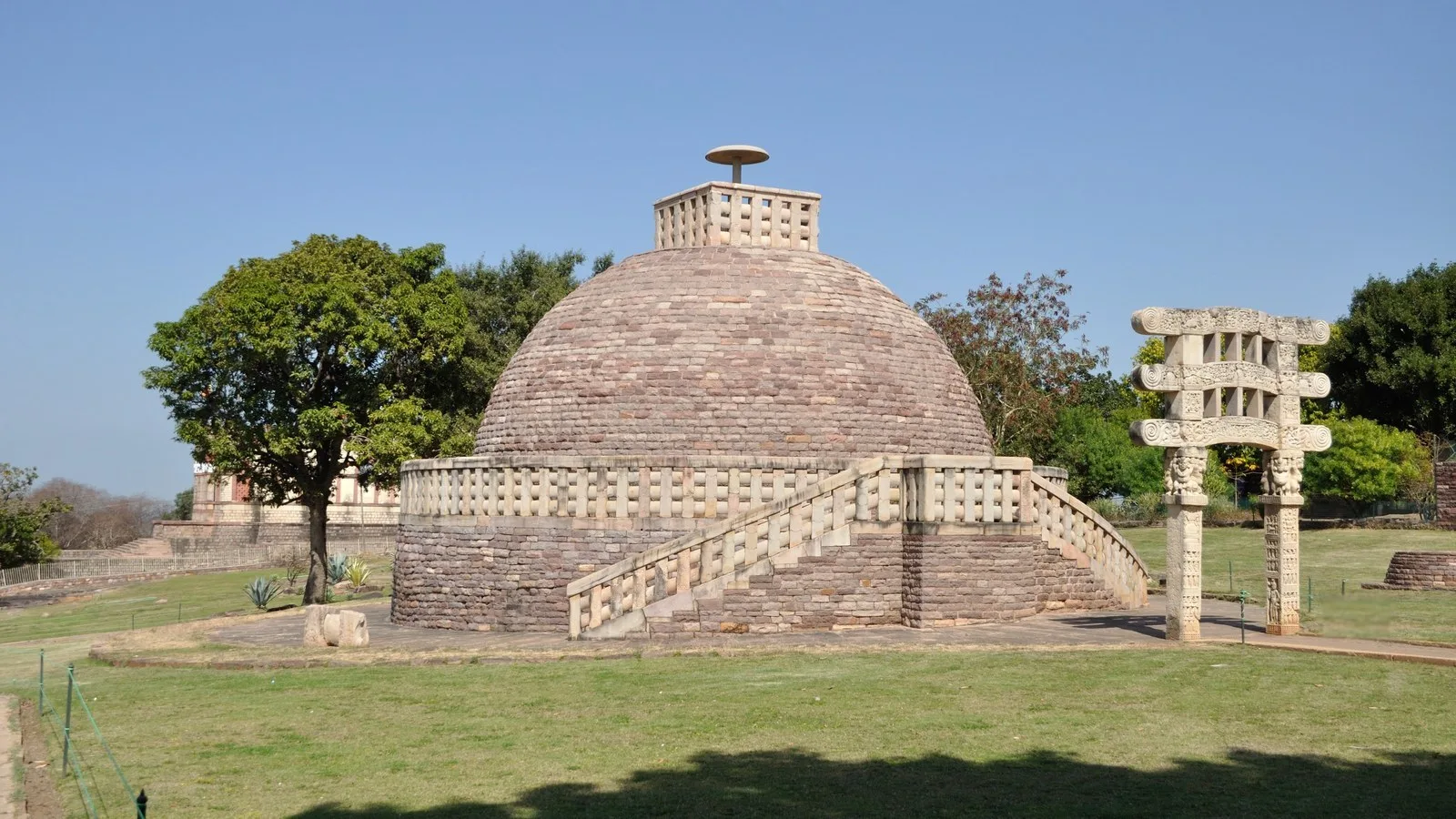
At Sanchi, a short ride from Vidisha, Ashoka's brick stupa was roughly doubled in size during the Shunga period, cased in stone, and given a terrace, stairways, a ground-level railing and a crowning harmika and umbrella. Stupas 2 and 3 were built in the same era; Stupa 2's railing reliefs, from about 115 BCE, are among the oldest narrative carvings in India, and Stupa 3 held relics attributed to the Buddha's disciples Sariputra and Mahamoggallana. The famous carved gateways of the Great Stupa came later, under the Satavahanas. Our Wonders of India guide to the Sanchi Stupa covers the site in detail.
Patanjali and a Sanskrit revival
The grammarian Patanjali, author of the Mahabhashya ("Great Commentary") on Panini's grammar, is usually placed in the mid-second century BCE, partly because of his own examples. To illustrate a tense for recent events, he writes "the Yavana besieged Saketa" and "the Yavana besieged Madhyamika", and to illustrate the present he writes "here we perform sacrifices for Pushyamitra". Whether this Patanjali is the same person as the author of the Yoga Sutras is disputed. The period saw Sanskrit gain ground in learning and ritual while the epics and early law books took shape.
The Kanvas: four kings, forty-five years
The Shunga line ended the way it began. According to Bana, the last king, Devabhuti, was killed in a plot organised by his Brahmin minister Vasudeva around 73–72 BCE. Vasudeva founded the Kanva dynasty, which the Puranas call "servants of the Shungas". Only four Kanva kings are listed, Vasudeva, Bhumimitra, Narayana and Susharman, ruling for about 45 years, until about 28 BCE. Their coins come mostly from around Vidisha, which suggests a small central-Indian kingdom rather than an empire. The Puranas say the last Kanva was overthrown by the founder of the Andhra (Satavahana) line, a power rising in the Deccan, but the exact sequence is unclear.
The Indo-Greeks: from Bactria to the Punjab
While the Shungas held the Ganga valley, Greek kings moved in from the north-west. They were heirs of the Greek settlers Alexander and the Seleucids had left in Bactria (northern Afghanistan), whom we met in Part 10 on Alexander's invasion. Around 250 BCE Bactria broke away from the Seleucid empire, and around 200–180 BCE its king Demetrius I, son of Euthydemus, crossed the Hindu Kush into the Kabul valley and Arachosia. His coins show him wearing an elephant-scalp headdress, a boast of Indian conquest.
Over the next two centuries more than thirty Indo-Greek kings are known, almost entirely from their coins, which were the period's great innovation. Agathocles and Pantaleon issued square bilingual coins with Greek on one side and Brahmi on the other, and later kings paired Greek with Kharoshthi. Coins of Agathocles found at Ai Khanoum carry what are probably the earliest images of Vasudeva-Krishna and Balarama.
Menander and the Questions of King Milinda
The greatest Indo-Greek king was Menander I (reigned c. 165/155–130 BCE), whose capital was probably Sagala, modern Sialkot. Strabo says the Bactrian Greeks, Menander above all, subdued more peoples than Alexander, and the Yuga Purana describes Yavanas taking Saketa and Mathura and reaching the mud walls of Pataliputra. A deep raid into the Ganga valley is widely accepted, though no lasting conquest followed.
Menander lives on in Buddhist literature as Milinda. The Pali Milindapanha ("Questions of Milinda") presents him debating the monk Nagasena on the self, rebirth and karma; in the famous chariot simile Nagasena shows that a "chariot", like a person, is only a name for a set of parts. The text says the king became a Buddhist and retired; Plutarch says instead that he died in camp and that his cities shared his ashes, a story that may echo the Buddha's funeral. Some of his coins carry a wheel that may be the dharmachakra. The Milindapanha grew over centuries, so it is literature rather than a transcript, but it is a striking memory of a Greek king at home in Indian thought.
After Menander, the Indo-Greek realm split into rival kingdoms. Indo-Scythians (Shakas) from Central Asia took over much of the north-west in the first century BCE, and the last Indo-Greek rulers, Strato II and Strato III, disappear in the eastern Punjab around 10 CE. Their legacy was cultural: coinage, portraiture and a Greek-Indian mixing in Gandhara.
Kharavela of Kalinga
Kalinga, the land Ashoka had conquered at such cost, re-emerged under the Chedi (Mahameghavahana) dynasty. Its best-known king, Kharavela, left a seventeen-line Prakrit inscription in Brahmi on the brow of the Hathigumpha ("Elephant Cave") in the Udayagiri hills near Bhubaneswar, a site covered in our Odisha travel guide. It opens with a Jain salutation and lists his deeds year by year: repairing his capital, extending a canal first dug by a Nanda king, defying the Satavahana king Satakarni, bringing back from Magadha a Jain image the Nandas had taken, receiving pearls from the Pandya king, and breaking up a confederacy of Tamil states said to have lasted 113 years.
The inscription is badly weathered. Older readings saw Demetrius retreating to Mathura and identified a Magadhan king in it with Pushyamitra; both are now widely doubted. On the script's evidence Kharavela is usually placed in the first century BCE, though some prefer the second.
A fragmented north
By the end of the first century BCE no single power ruled north India. The Satavahanas held the Deccan, Kalinga had its own kings, local dynasties struck coins from Mathura to Kaushambi, and Shakas and Parthians were replacing the Greeks in the north-west, until the Kushans brought much of it under one rule.
Key takeaways
- Around 185 BCE the general Pushyamitra Shunga killed Brihadratha, the last Maurya, and founded the Shunga dynasty, which ruled the Ganga valley and central India until c. 73 BCE.
- Buddhist stories that Pushyamitra persecuted monks are contested; Buddhist art flourished at Bharhut and Sanchi under Shunga rule.
- The Heliodorus pillar at Besnagar (c. 113–100 BCE) records a Greek envoy of King Antialcidas honouring Vasudeva-Krishna, early evidence of Bhagavata devotion.
- The Kanvas (c. 73–28 BCE) were four Brahmin kings who succeeded the Shungas; the Satavahanas are said to have ended their rule.
- Indo-Greek kings from Demetrius to Menander (Milinda) ruled Gandhara and the Punjab and struck bilingual coins.
- Kharavela's Hathigumpha inscription mentions a confederacy of Tamil states and gifts from the Pandya king, though many readings are debated.
Next part
In Part 14, we turn to the Kushan Empire and Kanishka: how a confederation of Central Asian nomads built an empire from the Oxus to the Ganga, and how Gandhara and Mathura art gave the Buddha a human form.
Sources
- Encyclopaedia Britannica, Shunga dynasty, Kanva dynasty, Menander, Bharhut and Patanjali
- UNESCO World Heritage Centre, Buddhist Monuments at Sanchi
- World History Encyclopedia, Indo-Greek Kingdom
- Rhys Davids, T. W., trans. (1890), The Questions of King Milinda, Sacred Books of the East vol. 35
- Salomon, R. (1998), Indian Epigraphy, Oxford University Press (Heliodorus pillar inscription, pp. 265–267; Hathigumpha inscription)
- Sircar, D. C. (1965), Select Inscriptions Bearing on Indian History and Civilization, vol. 1, University of Calcutta (Hathigumpha inscription of Kharavela)
- Jayaswal, K. P. and Banerji, R. D. (1920), "The Hathigumpha Inscription of Kharavela", Epigraphia Indica 20, Archaeological Survey of India
- Irwin, J. (1974), "The Heliodorus Pillar at Besnagar", Puratattva 8; Khare, M. D. (1967), "Discovery of a Vishnu temple near the Heliodorus pillar, Besnagar", Lalit Kala 13
- Thapar, R. (2002), Early India: From the Origins to AD 1300, University of California Press
- Singh, U. (2008), A History of Ancient and Early Medieval India: From the Stone Age to the 12th Century, Pearson
- Narain, A. K. (1957), The Indo-Greeks, Clarendon Press; Bopearachchi, O. (1991), Monnaies gréco-bactriennes et indo-grecques, Bibliothèque nationale
- Shaw, J. (2013), Buddhist Landscapes in Central India: Sanchi Hill and Archaeologies of Religious and Social Change, Left Coast Press
Featured image: Stupa 3 at Sanchi, Madhya Pradesh, a stupa of the Shunga era (2nd century BCE) with its stone railing and stairway; its single carved gateway was added later. Photo by Biswarup Ganguly, via Wikimedia Commons, CC BY 3.0 (cropped, with a small signboard removed).