This is Part 2 of HorizonDesk's chronological series on Indian history, from the Stone Age to Independence in 1947.
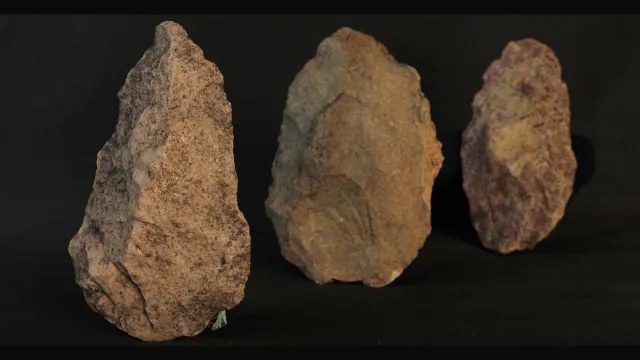
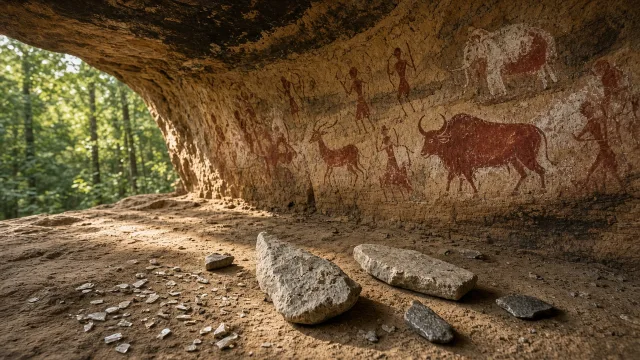
In Part 1 of this series, we followed hunter-gatherers from the earliest hand-axes to the painted rock shelters of Bhimbetka. This instalment covers one of the biggest changes in human history: the move from foraging to farming. People began to sow crops, keep animals, build permanent houses and bury their dead in cemeteries close to home. In the subcontinent, the best-documented early example is Mehrgarh, at the foot of the Bolan Pass in Balochistan, but farming also took root in Kashmir, the Ganga plains, the Deccan, the North-East and Tamil Nadu, each at its own pace.
A word of caution: when farming began in South Asia is actively debated, and a 2025 study has challenged the textbook dates. We set out both views.
What "Neolithic" means
Archaeologists use "Neolithic", or New Stone Age, for communities that combined polished or ground stone tools with food production: cultivated cereals and pulses, domesticated animals and, usually, settled villages. Pottery often appears in the same package, but not always. Mehrgarh's first farmers lived for several generations without making pots, which is why their phase is called "aceramic" (pre-pottery) Neolithic.
The archaeologist V. Gordon Childe coined the term "Neolithic Revolution" almost a century ago; researchers now see it as a gradual process, with hunting and gathering continuing alongside early farming.
Mehrgarh: a village below the Bolan Pass
Mehrgarh lies on the Kachi plain, close to the west bank of the Bolan river where it emerges from the Bolan Pass, about 150 km south-east of Quetta in present-day Pakistan. UNESCO's Tentative List entry, submitted by Pakistan in 2004, describes a complex of low mounds covering roughly 250 hectares. According to that entry, the site was buried under river silts until a flash flood in the 1970s exposed it.
The French Archaeological Mission to Pakistan, led by Jean-François Jarrige and Catherine Jarrige, excavated at Mehrgarh from 1974 to 1986 and returned in the late 1990s. In the 1976–77 season the team found the Neolithic levels in the northern sector known as MR3. The mounds preserve a sequence, divided by Jarrige's team into seven main periods, running from the aceramic Neolithic through the Chalcolithic (copper-using) phases into the third millennium BCE.
Mud-brick houses and granaries
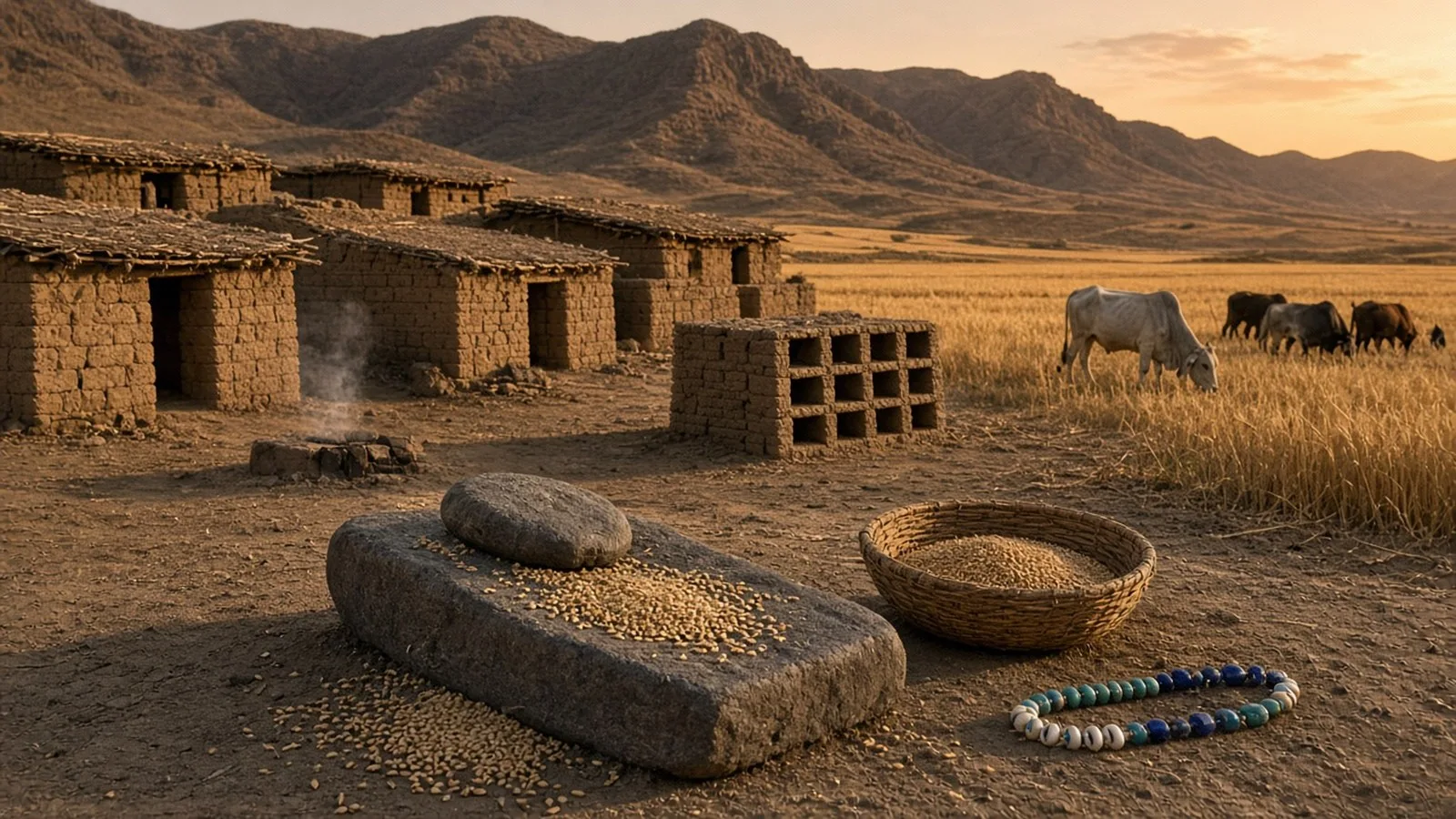
The earliest farmers at Mehrgarh built rectangular houses from long, hand-shaped mud bricks, set in mud mortar. Many houses were divided into four or six small rooms. Jarrige noted that the houses were laid out with regular open spaces between them, unlike the tightly packed rooms of many western Asian Neolithic villages.
In later Neolithic levels the villagers built rows of "compartmented" buildings, blocks of tiny cells that are usually interpreted as storerooms or granaries. Storage on that scale points to surplus grain.
Barley first, then wheat
The mud bricks also preserve evidence of the crops. Builders mixed chaff into the clay, and the plant impressions survive. In a study of 30 bricks, archaeobotanist Lorenzo Costantini identified 5,956 impressions. About 91% came from naked six-row barley, while einkorn and emmer wheat, two-row barley, hulled barley and a free-threshing wheat made up the small remainder. Wild barley still grows in the Bolan region today, so some researchers argue barley may have been brought under cultivation locally. Wheat, whose wild ancestors are not native here, almost certainly came from further west. Wheat became much more important later in the sequence.
Mehrgarh also has what its discoverers called the earliest known cotton in the Old World. In 2002, French researchers led by Christophe Moulherat reported mineralised cotton threads preserved inside a copper bead from a Neolithic grave. They could not say whether the plant was already domesticated, but they suggested the Kachi plain as a possible early home of one of the Old World cottons. Thousands of years later, cotton would become the fibre that drove Britain's Industrial Revolution.
Goats, sheep and the humped zebu
Animal bones show the economy changing over time. The earliest villagers hunted gazelle and wild sheep, goats and cattle, while already keeping some goats; over time, domestic sheep, goats and above all cattle came to dominate.
The cattle are especially important. The zooarchaeologist Richard Meadow found that cattle bones from Mehrgarh became steadily smaller over the Neolithic, a classic signature of animals living and breeding under human control. Bones and figurines show the features of the humped zebu (Bos indicus). Genetic studies support the archaeology: a 2010 study in Molecular Biology and Evolution concluded that zebu cattle are "an exclusive legacy of the South Asia Neolithic", most likely domesticated in the greater Indus region. India's humped cattle are among the subcontinent's oldest gifts to world farming.
Burials, beads and long-distance contacts
Mehrgarh's Neolithic cemetery is one of the richest in South Asia. The dead were laid in pits dug among the ruins of abandoned houses, sometimes with grave goods such as stone tools and ornaments. A 1982 French study recorded young goats deliberately placed beside some of the dead.
The ornaments reveal distant contacts. Beads and pendants were made from marine shell carried up from the Arabian Sea coast, from turquoise, from steatite and from lapis lazuli, a blue stone usually traced to sources in Afghanistan. Jonathan Mark Kenoyer has shown how shell was traded and worked here long before the Indus cities. Asia's trade networks, later famous through routes such as the Silk Road, had deep roots.
The world's earliest dentists?
The most surprising find from Mehrgarh came from teeth. In 2006 a team led by Alfredo Coppa and Roberto Macchiarelli reported in Nature that they had found eleven drilled molar crowns, from nine adults, in the Neolithic MR3 cemetery. The holes, 1.3 to 3.2 mm across, were drilled into the chewing surfaces of living people. Smoothed edges show the owners went on chewing afterwards. Four of the teeth showed decay next to the hole, so the drilling may have been meant to treat or relieve pain, though the motive is not certain.
The researchers linked the practice to bead-making. Flint drill heads at Mehrgarh were used to perforate beads of shell, turquoise, lapis lazuli and carnelian. In experiments, a bow drill tipped with flint bored a comparable hole in human enamel in under a minute. The paper dated the cemetery to 7,500–9,000 years ago and suggested the custom lasted about 1,500 years. As the next section explains, both figures depend on a chronology that is now disputed.
How old is Mehrgarh? The dating debate
For decades, Mehrgarh's farming has been dated to around 7000 BCE, with Jarrige arguing for the 8th millennium BCE. That made it one of the earliest farming villages anywhere outside the Fertile Crescent. Those dates came mostly from charcoal, which can be older or younger than the layer it is found in.
In April 2025, a team led by Benjamin Mutin of Sorbonne University in Paris published a reassessment in Scientific Reports. They radiocarbon-dated tooth enamel from 23 graves spread across all nine levels of the aceramic cemetery. A statistical model of the results puts the start of the cemetery between about 5200 and 4900 BCE and suggests it was used for only two to five centuries. The authors argue that farming reached the Indus borderlands later than thought, spreading from Iran or Central Asia rather than arising independently. They also conclude that pottery appeared only after the mid-fifth millennium BCE.
Not everyone accepts the new timeline. Speaking to Nature India, the archaeologist V. N. Prabhakar of IIT Gandhinagar agreed that the old charcoal dates are outdated and called for direct AMS dating of short-lived charred grains from all levels. He also stressed that other sites in Balochistan and the Indus plains have barely been excavated. The cautious position, for now, is that Mehrgarh's farming village is at least about 7,000 years old, while the older estimate of about 9,000 years is under serious challenge.
From farmers to the threshold of the Indus cities
Mehrgarh did not stand still. In later periods its people made painted pottery, worked copper, and used the potter's wheel, stamp seals and terracotta figurines. By the third millennium BCE the nearby site of Nausharo, about 10 km to the south, shows the shift into the Harappan, or Indus, civilisation. Mehrgarh itself was abandoned around the time the great Indus cities took shape. Its mud-brick architecture, bead technology, crops and cattle form a direct prelude to Harappa and Mohenjo-daro.
Beyond Mehrgarh: India's many Neolithics
Farming in the subcontinent did not spread from a single centre. Researchers recognise several regional traditions.
- Kashmir: At Burzahom, near Srinagar, excavated by the Archaeological Survey of India (ASI) between 1960 and 1971, people lived in pit dwellings and made fine bone tools. At Gufkral an aceramic phase lies at the base of the sequence. These Kashmiri sites grew wheat, barley, lentil and pea and herded sheep and goats, mostly in the third millennium BCE and later.
- The Vindhyas and Belan valley: Excavations led by G. R. Sharma of Allahabad University (1967–78) at Chopani Mando, Koldihwa and Mahagara traced a sequence from late hunter-gatherers to settled villages. Koldihwa yielded rice husk in pottery with radiocarbon dates as early as the seventh millennium BCE, though these are widely doubted because the charcoal may come from older layers. Mahagara revealed about 20 huts and a cattle pen marked with hoof prints.
- The Ganga plains: At Lahuradewa in Uttar Pradesh, rice from the lowest level was AMS-dated to about 6400 BCE. The excavators considered it domesticated, but archaeobotanist Dorian Fuller and others note that the grains overlap with wild rice. They argue it may show early use or cultivation of wild rice, with fully domesticated rice in north India confirmed only around 2000–1800 BCE. Chirand in Bihar, on the north bank of the Ganga, is known for bone and antler tools and a mixed economy of rice, wheat, barley, lentils, cattle, sheep, goats and pigs, mostly from the later third and second millennia BCE.
- The North-East: Daojali Hading in the North Cachar Hills of Assam, excavated in the early 1960s by M. C. Goswami and T. C. Sharma, produced shouldered stone celts, grinding stones and cord-marked pottery. These point to links with southern China and South-East Asia, though its age remains poorly fixed.
- The southern Deccan: In Karnataka and Andhra Pradesh, Neolithic herders left huge ash mounds, built up from burnt cattle dung, at sites such as Utnur, Budihal and Sanganakallu. Radiocarbon work by Fuller, Nicole Boivin and Ravi Korisettar dates many of them to between about 2500 and 1700 BCE. These communities grew native crops: mung bean, horse gram, browntop millet and bristly foxtail millet. Wheat and barley arrived from the north-west later.
- Tamil Nadu: The Southern Neolithic spread into northern Tamil Nadu, around Krishnagiri, Dharmapuri and the former North Arcot district. At Paiyampalli, excavated by the ASI under S. R. Rao in the 1960s, people lived in pit dwellings with thatched roofs. They used polished stone axes and bone tools and ate horse gram and green gram. Radiocarbon dates place this phase in the second millennium BCE, before it merged into the Iron Age megalithic culture. Our Tamil history series covers Tamil Nadu's prehistory in more detail.
Why the first farmers still matter
Farming made possible what came after: larger populations, surpluses, specialised crafts, long-distance trade and, eventually, cities and states. Much of what India still eats and herds goes back to these communities: barley and wheat in the north-west, rice in the Ganga plains, millets and horse gram in the south, and zebu cattle almost everywhere. The arguments over dates show that this chapter is still being written.
Next part
In Part 3, we turn to the Harappan (Indus Valley) Civilisation: the planned cities of Harappa, Mohenjo-daro, Dholavira and Rakhigarhi, with their drains and granaries, seals and an undeciphered script, and trade that reached Mesopotamia.
Sources
- Mutin, B. et al. (2025), New radiocarbon dates of human tooth enamel reveal a late appearance of farming life in the Indus Valley, Scientific Reports 15: 11345
- Nature India (2025), Indus Valley farming started later than thought, radiocarbon study shows
- Coppa, A. et al. (2006), Early Neolithic tradition of dentistry, Nature 440: 755–756
- UNESCO World Heritage Centre, Tentative List, Archaeological Site of Mehrgarh
- Encyclopaedia Britannica, Mehrgarh
- Didier, A. and Sarmiento Castillo, D. (2014), Excavations at Mehrgarh (1974–1985 and 1997–2000), HAL archive (with J.-F. Jarrige, "Mehrgarh Neolithic")
- Moulherat, C. et al. (2002), First evidence of cotton at Neolithic Mehrgarh, Pakistan, Journal of Archaeological Science 29: 1393–1401
- Chen, S. et al. (2010), Zebu cattle are an exclusive legacy of the South Asia Neolithic, Molecular Biology and Evolution 27: 1–6
- Patel, A. K. and Meadow, R. H. (2017), South Asian contributions to animal domestication and pastoralism, Oxford Handbook of Zooarchaeology (Harvard DASH)
- Lechevallier, M., Meadow, R. H. and Quivron, G. (1982), Dépôts d'animaux dans les sépultures néolithiques de Mehrgarh, Pakistan, Paléorient 8
- Kenoyer, J. M. (1995), Shell trade and shell working during the Neolithic and early Chalcolithic at Mehrgarh, in Mehrgarh Field Reports 1974–1985
- e-PG Pathshala (INFLIBNET/UGC), Northwestern, Northern and Northeastern Neolithic of the Indian Subcontinent and Southern Neolithic of India
- Bates, J. (2022), The fits and starts of Indian rice domestication, Frontiers in Ecology and Evolution 10
- Bates, J. et al. (2017), Approaching rice domestication in South Asia: new evidence from Indus settlements in northern India, Journal of Archaeological Science
- Fuller, D. Q., Boivin, N. and Korisettar, R. (2007), Dating the Neolithic of South India, Antiquity 81: 755–778
- Sharma, A. K., Gufkral 1981: an aceramic Neolithic site in the Kashmir Valley, Asian Perspectives 25(2): 23–41
- Archaeological Survey of India, Burzahom (1960–1971) excavation report
- Dikshit, K. N. and Hazarika, M. (2012), The Neolithic cultures of Northeast India and adjoining regions, Journal of Indian Ocean Archaeology 7
- Venkatasubbaiah, P. C., Neolithic culture of Tamil Nadu, with ASI excavation details of Paiyampalli, Tamil University