This is Part 26 of HorizonDesk's chronological series on Tamil history, from prehistory to modern Tamil Nadu. The previous instalment was Part 25: The Later Pandyas (Second Empire) and Jatavarman Sundara Pandyan.
In the early 1290s a Venetian merchant, travelling home from the court of Kublai Khan, sailed into the waters of what Muslim geographers called Ma'bar — the Coromandel coast of Tamil south India. His book, later known as The Travels of Marco Polo, gave Europe its first detailed eyewitness sketch of the Second Pandya Empire at its commercial peak: pearl divers in the Gulf of Mannar, a crowded horse trade at the port of Kayal, and a royal house so crowded with brothers that foreign visitors counted five crowned kings.
Polo did not invent Ma'bar. Persian and Arabic writers already used the name for the coast from roughly Cape Comorin to Nellore. What he added was colour, numbers and names that historians still try to map onto Tamil epigraphy. This part reads his account against Pandya history under Maravarman Kulasekhara I (c. 1268–1310), and marks where the Venetian and the inscriptions agree, where they argue, and where we simply do not know.
Who was Marco Polo, and when was he here?
Marco Polo (c. 1254–1324) left Venice with his father and uncle, reached China, and returned by sea around 1292–95. Most reconstructions place his Indian stops — including Ma'bar — on that homeward voyage, after leaving China and before rounding Arabia. He dictated his book in a Genoese prison around 1298; the text survives in many languages and versions, so small details shift between manuscripts.
A fair scholarly caution, shared by Henry Yule in his classic annotated edition: Polo (or his scribe) sometimes compresses hearsay with autopsy. He may not have walked every place he names. For Ma'bar, though, the density of local detail — pearl seasons, fish-charmers, horse mortality, betel etiquette — suggests he, or a close informant, spent real time on the coast.
Ma'bar: the Pandya coast by another name
Arabic ma'bar means a crossing or ferry. Yule and later writers take it as the Muslim label for the Coromandel, the shore most frequented by Gulf shipping bound for south India and Ceylon. Wassaf, a near-contemporary Persian historian, says Ma'bar ran from Kaulam (Quilon) to Nilawar (Nellore), "nearly 300 parasangs along the sea-coast," and that the local word for king was Devar ("lord").
That geography matches the Pandya world after Jatavarman Sundara Pandya I had pushed northern power as far as Nellore, and after Maravarman Kulasekhara I held the Chola and Tondai lands for decades. Older Tamil ports such as Korkai had already given way, as chief emporium, to Kayal (Polo's Cail) near the Tamraparni mouth in today's Thoothukudi district.
Five brothers and two names: Sonder Bandi and Asciar
Polo opens his Ma'bar chapters with a claim that still drives Pandya scholarship: five kings, own brothers, ruled the province. At the pearl-fishery end of the coast he names Sonder Bandi Davar (Sundara Pandya Devar). At the great western-facing port of Cail he names Ashar / Asciar, "the eldest of the five brother Kings."
K. A. Nilakanta Sastri, in The Pandyan Kingdom (1929), read Asciar as a mangled form of (Kula)sekhara and identified him with Maravarman Kulasekhara I, whom Wassaf calls Kalesa Dewar. Sonder Bandi he linked, more cautiously, to a co-ruler such as Jatavarman Sundara Pandya II (accession c. 1276), active in the 1290s — not to the famous Sundara of the 1250s. Roderich Ptak's study of Yuan and early Ming notices on the Kayal area follows the same outline: Ashar controlling Kayal around 1290; a suandan (Sundara) who may be the co-regent; and Chinese as well as Persian sources that also speak of five rulers in Ma'bar.
Sastri rejected a neat, permanent "five-Pandya constitution." He preferred a main king with princes governing provinces in a quasi-regal style — which is exactly how overlapping Pandya inscriptions of the late thirteenth century look. Polo and Wassaf's "five brothers" are best read as a foreigner's tidy summary of a crowded, competitive co-regency, not as a fixed legal system.
Polo adds a vivid family story: while their mother lived she stopped the brothers from fighting by threatening to mutilate herself before them; after her death they would destroy one another. Within two decades of Polo's visit, Kulasekhara's sons Sundara and Vira did fight a bitter succession war — the opening that invited Malik Kafur south. The mother's tale may be folklore; the fraternal crack was real.
Pearls: the Gulf of Mannar fishery
Polo's pearl chapter is among the most precise passages in the Indian books. Between Ceylon and the mainland, he says, the water is only ten or twelve fathoms deep (sometimes two). Divers work from early April to mid-May, first gathering at a place he calls Bettelar, then moving some sixty miles into the gulf. Merchants hire divers by the season; the king takes a tenth of the catch; fish-charmers (Abraiaman, Brahmans in Polo's spelling) take a twentieth to protect the divers by day and dissolve the charm at night. Divers go down four to twelve fathoms with a net bag at the waist. After mid-May the shells vanish there; another bed, he says, is fished in September–October some 300 miles away.
The king forbids export of any pearl heavier than half a saggio and buys choice stones at double cost, so that "the quantity he has is something almost incredible." None of this contradicts Tamil or later European notices of the Mannar pearl coast. It does not prove Polo himself dived; it does show that his informants knew the industry's calendar and dues.
Kayal (Cail): horses from Hormuz, Kish and Aden
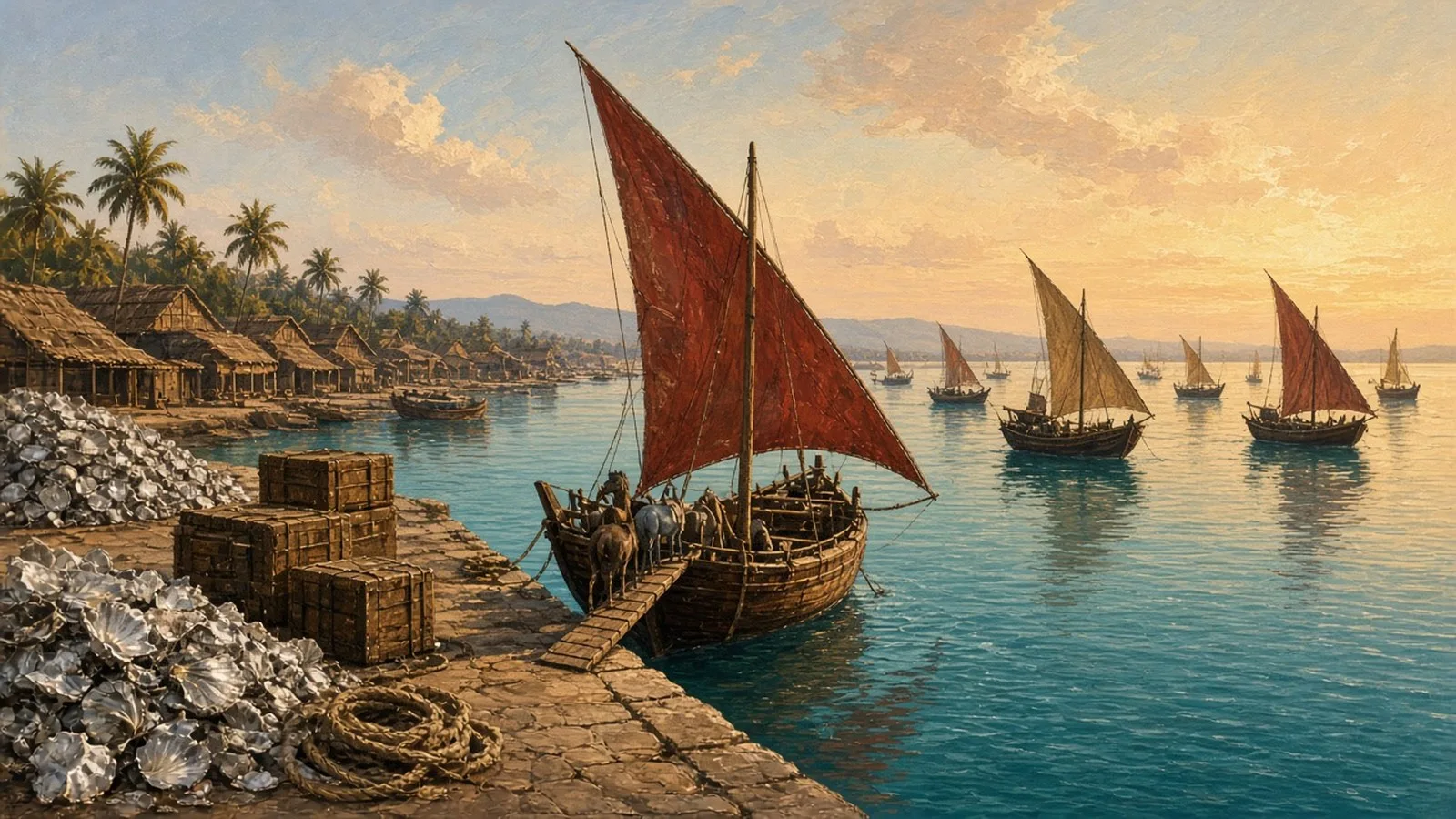
Polo's Cail is the hinge of the whole account. "It is at this city that all the ships touch that come from the west, as from Hormos and from Kis and from Aden, and all Arabia, laden with horses and with other things for sale." The king of Cail, Asciar, "extends great favour to merchants and foreigners."
Yule, helped by the missionary-scholar Robert Caldwell, fixed Cail at Old Kayal on the Tamraparni, about a mile and a half inland of today's shoreline — not at modern Kayalpattinam, which Caldwell's informants called a later settlement that borrowed the old name. Caldwell described ruins, China pottery sherds, pearl-oyster shells and a roadstead still used by native craft. That identification remains the standard one, though the exact medieval shoreline has shifted with river silt.
Horses were the point. South India could not breed warhorses well; every army needed them. Polo says the Ma'bar king wanted to buy more than 2,000 horses a year, and so did each of his four brothers — a staggering demand of order 10,000 — because by year's end scarcely a hundred survived: bad management, no farriers, and merchants who (he claims) preferred the animals to die so the next season's sale was assured. Wassaf independently records a standing Gulf contract: about 1,400 horses a year from Kish alone at a fixed 220 dinars of red gold each, paid even for animals that died on the voyage. Elizabeth Lambourn has called this thirteenth-century appetite "horsemania." The numbers in Polo, Wassaf and Rashid al-Din are close enough to suggest shared commercial intelligence, not pure invention.
Kayal thus sat at the junction of Pandya military need and Ilkhanid–Gulf maritime supply — a far cry from the older Yavana trade of Roman wine amphorae at Arikamedu, yet part of the same long Tamil habit of living by the sea.
Motupalli and the edges of the itinerary
North of Ma'bar Polo describes Mutfili (Motupalli on the Andhra coast), then under a widow-queen of the Kakatiya world, and the famous diamond valleys of the legend later borrowed by Sindbad and others. Mutfili is not a Pandya port; it shows how his Indian chapters skip along the whole east coast. Scholars still debate how much of this northern material he saw himself. For a Pandya-centred history, Motupalli is context: the same monsoon network that filled Kayal with Gulf horses also tied Tamil ports to Telugu, Kerala and Sri Lankan waters.
What Polo got right — and what he could not see
Confident matches. Ma'bar as the Pandya Coromandel; a commercially booming Kayal; a massive horse import from Hormuz–Kish–Aden; a seasonal Mannar pearl fishery with royal dues; several contemporary Pandya rulers, one of whom foreign writers heard as Kulasekhara / Kalesa / Asciar; extraordinary portable wealth in pearls and gems.
Debated or soft. Exact months of Polo's stay; whether he personally visited every named spot; the precise identity of Sonder Bandi among several Sundara Pandyas; whether "five brothers" maps one-to-one onto Sastri's co-regents; Caldwell's fine-grained Kayal topography versus later silt and settlement names; the more sensational social asides (hundreds of wives, duels over betel spit, systematic horse neglect as merchant conspiracy).
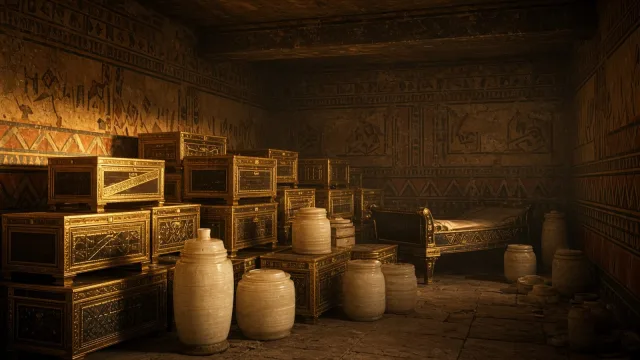
What inscriptions add that Polo misses. Temple gifts, regnal astronomy, Ariya Chakravarti's Sri Lanka raid and the Tooth Relic (c. 1284), the texture of Tamil administration — all thin or absent in the Travels. Polo is a harbour glass, not a court chronicle.
Timeline
| Date (approx.) | Event | Certainty |
|---|---|---|
| 1251 – c. 1268 | Jatavarman Sundara Pandya I; empire at widest | Firm |
| c. 1268 – c. 1310 | Maravarman Kulasekhara I reigns | Fairly firm |
| c. 1276 | Accession of a Jatavarman Sundara Pandya (II) as co-ruler | Fairly firm |
| c. 1284 | Ariya Chakravarti's raid; Tooth Relic taken to Pandya country | Fairly firm |
| c. 1292–95 | Polo's homeward voyage; Ma'bar chapters reflect this window | Approximate |
| c. 1290s | Kayal under "Asciar" / Kulasekhara in foreign notices | Fairly firm |
| c. 1298 | Polo dictates his book in Genoa | Fairly firm |
| c. 1310–11 | Succession war; Malik Kafur's invasion begins | Debated in detail |
What we can say with confidence
- Confident: In the 1290s the Pandya coast was one of the richest trading shores in the Indian Ocean; Polo's Ma'bar is that coast; Kayal was its star horse-and-pearl port; multiple Pandya rulers shared power; Kulasekhara I is the best fit for Asciar / Kalesa Dewar.
- Hedged: Polo's personal itinerary inside Ma'bar; one-to-one name equations for every "brother"; editorial layers in the Travels that may amplify numbers or customs.
Next part
Next we turn to the crisis Polo's mother-of-five-kings story seems to foreshadow: Malik Kafur's invasion and the Madurai Sultanate — how a Delhi army entered the Tamil country, what happened to the Pandya house, and how a short-lived sultanate rose from the wreck.
Sources
- Henry Yule & Henri Cordier, The Book of Ser Marco Polo, vol. 2 (1903) — Project Gutenberg HTML (Ma'bar, pearl fishery, Cail, Mutfili chapters and notes).
- Same edition — Project Gutenberg ebook landing.
- Yule vol. 2 on Internet Archive (scan).
- Digital Silk Road / Toyo Bunko page image of the Ma'bar chapter.
- K. A. Nilakanta Sastri, The Pandyan Kingdom (1929) — Internet Archive.
- Roderich Ptak, "Yuan and Early Ming Notices on the Kayal Area in South India," BEFEO 80 (1993) — Persée.
- S. Krishnaswami Aiyangar, South India and Her Muhammadan Invaders — Internet Archive.
- South Indian Inscriptions, Vol. XXIV — Pandya section (What Is India).
- The Hindu: "A great slice of history" (Srirangam / Pandya memory).
- Frontline: "Poetry in stone" (Madurai temple fabric).
Unlinked but used for orientation: Wassaf and Rashid al-Din as quoted in Yule's notes and in Ptak; N. Sethuraman, The Imperial Pandyas (1978); Elizabeth Lambourn's essay on thirteenth-century south Indian horse imports ("horsemania") — the OpenEdition/TMG landing is JS-challenged from this environment, so it is not linked as a live source here.