This is Part 25 of HorizonDesk's chronological series on Tamil history, from prehistory to modern Tamil Nadu. The previous instalment was Part 24: Chola Bronzes, Art and Temple Architecture, from Nataraja to Thanjavur.
For three centuries the Pandyas of Madurai lived in the shadow of Thanjavur. After the Cholas crushed the first Pandya empire in the tenth century, Pandya princes ruled the far south mostly as Chola subordinates.
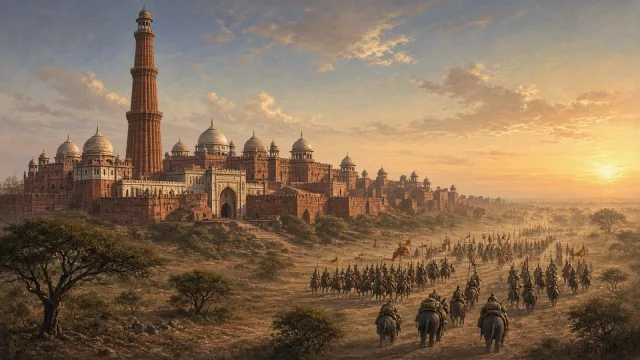
Then, within two generations, the position flipped. Between about 1216 and 1270 Pandya kings burned the Chola capitals, pushed the Hoysalas back to the Mysore plateau, fought the Kakatiyas of the Telugu country, planted their twin-fish banner in Sri Lanka and covered the great temples of Srirangam and Chidambaram in gold. Historians call this the Second Pandya Empire, and its most celebrated ruler was Jatavarman Sundara Pandya I.
A note on sources: almost everything we know comes from temple inscriptions, dated by working out their astronomical details. K. A. Nilakanta Sastri, whose 1929 The Pandyan Kingdom is still the standard account, complained that new kings were "postulated and given up" so often that the chronology had become "a game of ninepins". Many dates below are approximate.
The Second Pandya Empire at a glance
| Ruler | Reign (approx.) | Best known for |
|---|---|---|
| Jatavarman Kulasekhara I | 1190 – c. 1216 | Pandya recovery begins under Kulottunga III |
| Maravarman Sundara Pandya I | 1216 – c. 1238 | Sack of Thanjavur and Uraiyur; Chola kingdom taken and returned |
| Maravarman Sundara Pandya II | c. 1238 – c. 1251 | Quieter reign under strong Hoysala influence |
| Jatavarman Sundara Pandya I | 1251 – c. 1268/70 | Widest extent of the empire; gilding of Srirangam and Chidambaram |
| Jatavarman Vira Pandya (co-ruler) | c. 1253 – c. 1275 | Campaigns in Sri Lanka and Kongu |
| Maravarman Kulasekhara I | c. 1268 – c. 1310 | Long, prosperous reign; Sri Lanka raid; trade boom at Kayal |
How the Pandyas came back
The later Chola kings were still strong around 1190, when Kulottunga III installed his own candidate in Madurai. After him the Chola state weakened fast.
Maravarman Sundara Pandya I: the king who returned a kingdom
Maravarman Sundara Pandya I, who came to the throne in 1216, was the first to turn the tables. His Tirupparankunram inscription of his seventh year says he invaded the Chola country, set fire to Thanjavur and Uraiyur, forced the Chola king Rajaraja III to flee, and celebrated a virabhisheka (a victory anointing) in the Chola coronation hall. He then went to worship Nataraja at Chidambaram.
Then, surprisingly, he gave the Chola kingdom back to the defeated king. Sastri called this "an act of political good sense". It was probably also forced: the Hoysala king Vira Narasimha II marched towards Srirangam around 1222 and later called himself "establisher of the Chola kingdom". The Hoysalas of Karnataka, related by marriage to both royal houses, were now the referees of Tamil politics.
Rajaraja III rebelled, and before 1235–36 Sundara Pandya invaded again, captured the Chola queens and held another victory ceremony. His coins carry the legend Sonadu kondan, "he who took the Chola country".
The Hoysala interlude
Under Maravarman Sundara Pandya II (from about 1238), Hoysala generals settled disputes inside the Pandya kingdom, and the king even named a village after his Hoysala "uncle", Someshvara. The Hoysalas held a base at Kannanur Koppam, just north of Srirangam.
Jatavarman Sundara Pandya I (1251 – c. 1268)
Then came the king who swept all of this away. From the astronomy of his inscriptions, the epigraphist Franz Kielhorn fixed his accession to between 20 and 28 April 1251. His records are easy to spot: he alone uses the title Emmandalamum kondaruliya, "who was pleased to take every country".
The campaigns
His seventh-year inscription (before 1258) lists an astonishing run of wars, in an order that is not certain:
- The Cheras (Kerala): defeated "with a very small force" and made tributary.
- The Cholas: the last Chola king, Rajendra III, was made to pay tribute. The Chola kingdom effectively ended as an independent power under Pandya overlordship.
- The Hoysalas: Sundara Pandya stormed Kannanur Koppam, killed the Hoysala general Singana, and captured horses, elephants and treasure. A long Sanskrit inscription at Srirangam says he "sent to the other world" the Hoysala king Someshvara, who died around 1262. Hoysala power in the Tamil country collapsed. (The Hoysalas themselves are profiled in our guide to the Hoysala temples of Belur and Halebidu.)
- The Kadava chief Kopperunjinga: once the jailer of a Chola emperor, he was besieged at Sendamangalam and restored as a tributary.
- Kanchi and Nellore: in a northern campaign probably before about 1260, Sundara Pandya killed the Telugu Choda ruler Gandagopala, took Kanchipuram, and defeated the forces of the Kakatiya king Ganapati. Tamil verses at Chidambaram say he slaughtered the "Telungas" at Mudugur right up to the banks of the Peraru and drove the Bana chief into the forest. He celebrated a victory anointing at Nellore, in today's Andhra Pradesh.
- Sri Lanka: an early record says the king of the island was compelled to send pearls and elephants as tribute.
For a few years, Pandya supremacy reached from Kanyakumari to Nellore and Cuddapah. Kanchipuram, the old Pallava capital, became a second Pandya capital, and Sundara Pandya called himself "lord of Kanchipura".
Sri Lanka and Vira Pandya
Much of the Sri Lankan fighting was led by Jatavarman Vira Pandya, a prince who ruled alongside Sundara Pandya from about 1253. His inscriptions claim that he killed one of the "two kings of Ceylon", seized his treasure and throne, planted the Pandya double-fish flag on Konamalai (Trincomalee) and on the Trikuta hills, and took elephants as tribute from the other king.
Who the two kings were is debated. The Sri Lankan chronicle, the Culavamsa, mentions no Pandya conquest here; it describes a second invasion by Chandrabhanu, a Javaka (Malay) king, with Tamil soldiers from the Pandya and Chola countries, beaten back by Sinhalese princes. Many historians link Vira Pandya's claim to have taken "the crowned head of Savaka" with Chandrabhanu's family, but the sources are hard to reconcile.
Gold for the gods: Srirangam and Chidambaram
War paid for splendour. At Chidambaram he performed tulabharas (weighing himself against gold given to the temple) and is credited with a golden hall for Nataraja.
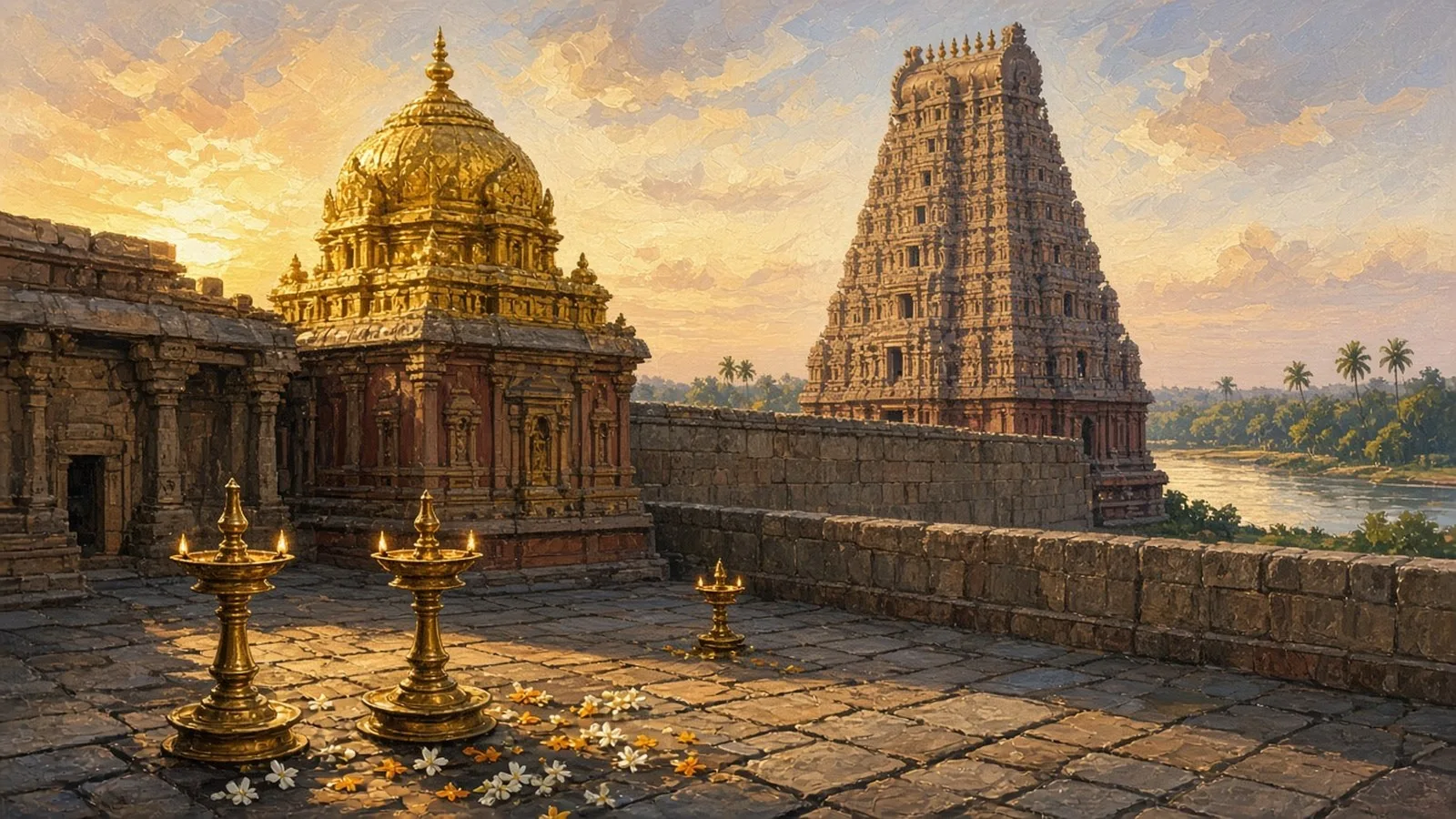
His greatest gifts went to the Vishnu temple at Srirangam. A 30-verse Sanskrit inscription, edited by E. Hultzsch in Epigraphia Indica (vol. III), and later records on the Chandana Mandapa list them:
- the central shrine of Ranganatha covered with gold, which gave the king his surname Hemachchadana Raja ("the king who roofed with gold"), in Tamil Koyil ponmeynda Perumal;
- gilded shrines of Narasimha and Vishvaksena, and gilding of the gopura and the wall still called Sundara Pandyan madil;
- a golden image of Vishnu named after himself, Hemachchadana Raja Hari;
- a golden ship for a festival, three golden domes, a feeding hall with gold vessels, and an emerald necklace taken from a "Kathaka" king. Sastri read this as the Kadava chief Kopperunjinga; others think of the ruler of Cuttack in Orissa.
The temple chronicle Koyil Olugu adds a famous scene: the king, armed and seated on his elephant on a boat-shaped balance on the Kaveri, weighed against gold. Sastri noted that the inscriptions do not confirm the elephant, so treat it as tradition.
In Madurai, the eastern gopura of the Meenakshi temple, the oldest of its four great towers, carries inscriptions calling it the Sundarapandya Tirugopuram. Frontline attributes it to Jatavarman Sundara Pandya; other accounts credit Maravarman Sundara Pandya I.
Many kings at once: the co-regency puzzle
One feature of the Second Empire puzzles every reader: there are too many kings. Between about 1237 and 1286, inscriptions name at least seven Pandya rulers, among them two Sundara Pandyas, Vira Pandya, Vikrama Pandya and Kulasekhara, often with overlapping regnal years and claiming the same victories. The names alternate between the titles Jatavarman and Maravarman.
Early scholars proposed a fixed system of "five Pandya rulers" in every generation, and Marco Polo and the Persian historian Wassaf both describe five brothers ruling. Sastri rejected a regular five-king system: he saw a main line of kings, with princes governing provinces in a subordinate, "quasi-regal" style. N. Sethuraman's later astronomical recalculations refined the list without ending the debate.
Under a strong emperor the system extended his reach; under weak ones it bred rivalry.
Kayal and the wealth of the coast
The empire's pearl fisheries were famous, and its chief port was Kayal (near modern Kayalpattinam, Thoothukudi), successor to ancient Korkai. Ships from Hormuz, Kish and Aden brought, above all, horses, which the south could not breed well and every army needed.
Wassaf records a standing agreement under which a Gulf merchant prince, Jamaluddin, shipped 1,400 horses of his own breeding to Ma'bar every year from the island of Kish, plus as many more as he could buy around the Gulf, at a price fixed "from of old" at 220 dinars of red gold each. The Pandya treasury even paid for horses that died or were injured on the voyage. Explorations around Kayalpattinam have turned up 13th-century Chinese celadon and porcelain, and in 1861 the missionary-scholar Robert Caldwell found a hoard of 13th-century coins there, including one struck for Peter of Aragon in Spain.
Maravarman Kulasekhara I and the seeds of decline
Jatavarman Sundara Pandya's last firm records date to about 1269–70. By then Maravarman Kulasekhara I (from about 1268) was ruling, and he reigned for over forty years. He reconquered Kollam (Quilon) in Kerala, held the Chola and Tondai lands, and around 1284 sent his general Ariya Chakravarti into Sri Lanka. The Culavamsa says the general carried off the Buddha's Tooth Relic to the Pandya country; King Parakramabahu III later travelled to the Pandya court and recovered it by negotiation.
Wassaf calls Kulasekhara a "fortunate and happy sovereign" whose land no foreign enemy entered. But cracks showed: a 34th-year record (c. 1301) describes the country in "confusion" during his illness, feudatories such as the Vanadarayars grew powerful, and his sons Sundara Pandya and Vira Pandya disputed the succession.
Around 1310, says Wassaf, Sundara killed his father after Vira was preferred as heir; losing the war that followed, he fled to Alauddin Khalji's Delhi. Within a year Malik Kafur's army was in the Tamil country.
Timeline
| Date | Event | Certainty |
|---|---|---|
| 1190 | Accession of Jatavarman Kulasekhara I | Fairly firm |
| 1216 | Accession of Maravarman Sundara Pandya I | Firm |
| c. 1219–23 | Thanjavur and Uraiyur burnt; Chola kingdom taken and returned | Fairly firm |
| c. 1222 | Hoysala Narasimha II marches towards Srirangam | Fairly firm |
| before 1235–36 | Second Pandya invasion of the Chola country | Fairly firm |
| April 1251 | Accession of Jatavarman Sundara Pandya I | Firm (astronomical) |
| before 1258 | Wars against Cheras, Cholas, Hoysalas (Kannanur Koppam), Kopperunjinga | Firm in outline; order uncertain |
| c. 1258–60 | Gandagopala killed, Kanchi taken, battle of Mudugur, victory anointing at Nellore | Approximate |
| c. 1262 | Death of Hoysala Someshvara | Fairly firm |
| 1260s | Vira Pandya's campaign in Sri Lanka; flag at Konamalai | Approximate |
| c. 1268–70 | End of Jatavarman Sundara's reign; Maravarman Kulasekhara I rules | Approximate |
| c. 1284 | Ariya Chakravarti's raid; Tooth Relic taken to the Pandya country | Fairly firm |
| c. 1310 | Death of Kulasekhara I; succession war | Debated details |
What we can say with confidence
- Confident: the Pandyas replaced the Cholas as the leading Tamil power; Jatavarman Sundara Pandya I acceded in 1251, briefly ruled up to Nellore, beat the Hoysalas and gilded Srirangam; Kayal was a major horse-trade port.
- Debated: the exact order and dates of his campaigns; the identity of the Sri Lankan kings and the "Savaka" prince; how the many contemporary Pandya rulers shared power; the elephant tulabhara story; and which Sundara Pandya built Madurai's eastern gopura.
Next part
Part 26, Marco Polo in the Pandya Kingdom, follows the Venetian traveller to the Coromandel coast around 1292: the pearl divers, the horse traders of Kayal, the "five brother kings", and what a medieval European made of Tamil country.
Sources
- K. A. Nilakanta Sastri, The Pandyan Kingdom from the Earliest Times to the Sixteenth Century (Luzac, London, 1929), chapters X–XIII
- K. A. Nilakanta Sastri, The Colas (2nd ed., University of Madras, 1955), on the end of the Chola state
- South Indian Inscriptions, Vol. XXIV, Pandya inscriptions of the Ranganathasvamy temple, Srirangam (tulabhara, gilding, temple committee)
- E. Hultzsch (ed.), Epigraphia Indica, Vol. III (1894–95), No. 2: Ranganatha inscription of Sundara-Pandya
- Wilhelm Geiger (trans.), Culavamsa, Part II, chapters 88 and 90 (Chandrabhanu; Ariya Chakravarti and the Tooth Relic)
- The Hindu, Let the temples keep their secrets (Sundara Pandya's gold gifts at Srirangam)
- The Hindu, Koil Ozhugu, authentic documentation of history
- The Hindu, A great slice of history (co-ruling Pandya brothers; Sethuraman's chronology)
- Frontline, Poetry in stone (Meenakshi temple gopuras)
- Wisdom Library, Rule of Pandyas (Pandya inscriptions in Tondaimandalam; Kanchi as second capital)
- Duraiswamy Dayalan, Ancient Seaports on the Eastern Coast of India, Acta Via Serica 4.1 (2019) (Kayal)
- Henry Yule (trans.), The Travels of Marco Polo, Vol. 2 (Project Gutenberg), on Maabar and Cail
- Unlinked: S. Krishnaswami Aiyangar, South India and Her Muhammadan Invaders (1921); N. Sethuraman, The Imperial Pandyas: Mathematics Reconstructs the Chronology (1978); Noboru Karashima (ed.), A Concise History of South India (2014)