This is Part 15 of HorizonDesk's chronological series on Tamil history, from prehistory to modern Tamil Nadu. The previous instalment was Part 14: The Rise of the Pallavas – Simhavishnu and Mahendravarman I.
Mahendravarman I had watched a Chalukya army reach the walls of Kanchipuram. His son Narasimhavarman I carried the war the other way, all the way to the Chalukya capital of Vatapi in the Deccan. Remembered by the title Mamalla, "the great wrestler" or "great hero", he is the king most often linked with Mamallapuram (Mahabalipuram), the port south of modern Chennai whose rock-cut temples, carved boulders and giant open-air relief are now a UNESCO World Heritage Site. This part looks at his wars, his links with Sri Lanka and China, and the monuments, separating what inscriptions show from what tradition and scholars argue over.
Narasimhavarman I at a glance
| Question | Short answer |
|---|---|
| Reign | c. 630–668 CE (dates vary by a few years) |
| Father / son | Mahendravarman I / Mahendravarman II |
| Titles | Mamalla (Mahamalla); Vatapikonda, "who took Vatapi" (a later usage) |
| Greatest victory | Defeat of the Chalukya king Pulakeshin II and capture of Vatapi (modern Badami), c. 642 CE |
| Foreign links | Help for the Sri Lankan prince Manavamma; the Chinese pilgrim Xuanzang visits Kanchi |
| Monuments | Rathas, cave halls and great relief at Mamallapuram, many of them with debated dates |
The war for Vatapi
Background
As Part 14 showed, the Chalukya king Pulakeshin II (c. 610–642 CE) had already pushed to Kanchipuram under Mahendravarman I, and his Aihole inscription of 634–635 CE boasts that he made the Pallava king hide behind his city walls. Early in Narasimhavarman's reign the Chalukyas seem to have come south again, with a different result.
Pariyala, Manimangala and Suramara
The main Pallava account is in the Kuram copper plates, issued by Narasimhavarman's grandson Paramesvaravarman I. In typically flowery style they say Narasimhavarman "wrote the syllables of vijaya (victory)" on Pulakeshin's back, "as on a plate", in the battles of Pariyala, Manimangala, Suramara and others, and that he "destroyed Vatapi". The Udayendiram plates of Nandivarman II repeat the list against "Vallabharaja", a Chalukya title.
Manimangalam is a village near Tambaram, on the south-western edge of Chennai, so the first battles were fought close to Kanchi itself: the Pallavas defended their heartland before going on the offensive. Pariyala and Suramara have not been securely identified.
The fall of Vatapi
The Pallava army then marched more than 500 km north-west to Vatapi. The best evidence is at Badami itself. On a rock behind the Mallikarjuna temple is a worn Sanskrit inscription in the Pallava Grantha script. Of the king's name only the title Mahamalla survives; it is dated in his 13th regnal year and appears to mention the city's pillar of victory (jayastambha). The 9th-century Velurpalaiyam plates agree that Narasimhavarman "took the pillar of victory standing in the centre of Vatapi".
The Saka date in the Badami record is mostly lost, and the editors of South Indian Inscriptions XI could only place it between 638 and 647 CE. The usual date for the capture is c. 642. Many historians think Pulakeshin II died in this war or soon after, but no source says how. The Pallavas probably held Vatapi for about a dozen years until Pulakeshin's son Vikramaditya I recovered it, c. 655. Narasimhavarman is popularly called Vatapikonda, "who took Vatapi", though this appears to be a later usage. The Chalukyas went on to build the temples of Pattadakal, where scholars see the influence of Pallava temple design a century later.
Paranjothi and the Siruthondar tradition
Tamil tradition names the general who led the march: Paranjothi of Tiruchengattankudi. The Periyapuranam, the 12th-century lives of the 63 Shaiva saints (Nayanars), says he served the Pallava king, sacked Vatapi and returned with elephants, horses and treasure, then gave up arms to become the saint Siruthondar. A popular belief adds that he brought back the "Vatapi Ganapati" image of Ganesha worshipped at Tiruchengattankudi. Historians such as R. Gopalan used this story, but no inscription names Paranjothi, so it is best treated as tradition recorded five centuries later. Kalki's popular Tamil novel Sivakamiyin Sabatham is set in these years, but it is fiction.
Sri Lanka and Manavamma
Sri Lanka's Pali chronicle, the Culavamsa, tells of an exiled Sinhalese prince, Manavamma, who took refuge with a king called Narasiha in India and fought beside him when "Vallabha" invaded. In gratitude Narasiha gave him an army to win the throne of Anuradhapura. The first expedition collapsed when the troops heard that Narasiha was ill; a second, sent many years later, succeeded. Wilhelm Geiger and others identify Narasiha with Narasimhavarman I and Vallabha with Pulakeshin II. The Kasakudi plates likewise say Narasimhavarman outdid Rama by conquering Lanka. But Manavamma's dates, and which Pallava king sent the second expedition, are debated.
Xuanzang in Kanchi
Around 640 CE the Chinese Buddhist pilgrim Xuanzang (Hiuen Tsiang) reached Kanchipuram, which he called the capital of Dravida. He describes a city about 30 li (a Chinese distance unit) round, fertile land, a brave and truthful people who "highly esteem learning", about a hundred Buddhist monasteries with 10,000 monks, some eighty Hindu temples and many Jains (Nirgranthas). He notes that the philosopher Dharmapala was born in Kanchi, a reminder of how long Buddhism had flourished there. He does not name the king, but it was Narasimhavarman's reign. His biography treats the Kanchi coast as the jumping-off point for Sri Lanka; hearing of unrest on the island, he turned back.
Mamallapuram, the port
The Archaeological Survey of India (ASI) explains the name Mamallapuram as "the city of Mamalla". The town is older than the title: the Vaishnava poet-saint (Alvar) Tirumangai praises Kadalmallai, "Mallai by the sea", and Bhutattalvar was said to be born at Mallai. ASI also links it with ports mentioned by the Periplus and Ptolemy in the 1st–2nd centuries, though identifying those names with this site is not certain. Like Arikamedu before it, it connected the Tamil coast with Sri Lanka and South-East Asia.
Temples cut from the rock
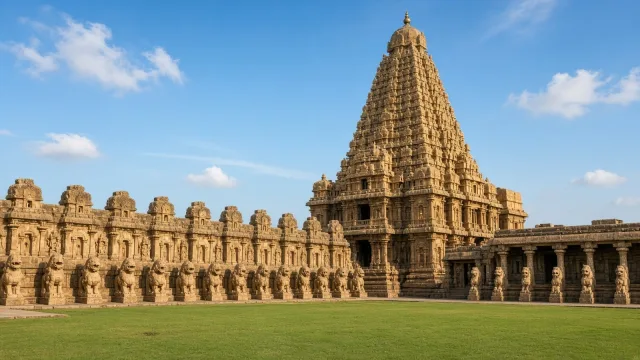
The Five Rathas
At the southern end of the site, five shrines were carved top-down from a single long granite outcrop. They are called rathas ("chariots") because they resemble temple processional cars, and their names after the five Pandava brothers of the Mahabharata are a later local custom.
- Draupadi ratha: a small square shrine with a curved, thatch-like roof; Durga inside, a lion beside it
- Arjuna ratha: a two-storeyed tower (vimana), with a large Nandi bull nearby
- Bhima ratha: rectangular, with a barrel-vaulted roof
- Dharmaraja ratha: the tallest, a three-storeyed vimana carrying inscribed Pallava titles
- Nakula–Sahadeva ratha: apsidal, shaped like an elephant's back, beside a life-size stone elephant
They read like a catalogue of temple forms later built across South India. Several are unfinished.
The mandapas
The cave halls (mandapas) show the heavy pillars of Mahendravarman's time growing slender and resting on seated lions, a change the archaeologist K. R. Srinivasan used to date them.
- Varaha mandapa: Vishnu as the boar Varaha lifting the earth, Trivikrama, Gajalakshmi and Durga
- Mahishasuramardini mandapa: Durga on her lion battling the buffalo demon, facing Vishnu asleep on the serpent
- Adivaraha cave: royal portraits, discussed in Part 14
- Govardhana relief: Krishna lifting a mountain to shelter herders and cattle
The great relief: Arjuna's Penance or Descent of the Ganga?
Two huge boulders, roughly 27 m long and 9 m high, are covered with gods, sages, hunters, life-size elephants, deer and even a cat mimicking an ascetic. Serpent deities (nagas) rise in the natural cleft between the rocks, and A. H. Longhurst found channels showing that water was once made to flow down it.
What the scene shows has been argued over for more than a century:
- Arjuna's Penance: the hero Arjuna fasting to win a divine weapon from Shiva, the name long used locally and by the ASI.
- Descent of the Ganga: King Bhagiratha's penance to bring the heavenly river to earth, with the cleft as the Ganga, proposed by Jouveau-Dubreuil and Victor Goloubew in the 1910s. UNESCO uses this name.
- Both, and more: Padma Kaimal and Michael Rabe argue the relief is deliberately ambiguous and also praises the Pallava royal line.
The Shore Temple came later
The famous Shore Temple is not Mamalla's. It is a structural temple built of cut stone blocks rather than carved from living rock, and it is generally credited to Narasimhavarman II Rajasimha (c. 700–728 CE). Its reclining Vishnu shrine may be earlier.
Who made the monuments?
This is Mamallapuram's great riddle:
- Mamalla as main patron: the town's name, his titles and later Pallava charters lead most scholars, and the ASI and UNESCO, to credit him with most rathas, caves and reliefs.
- Mahendravarman I: T. N. Ramachandran and Marilyn Hirsh argued the work began under the father, though none of his inscriptions are found here.
- Several reigns: Michael Lockwood and colleagues argued that some inscriptions, including a curse verse, belong to Paramesvaravarman I and that work continued under several kings.
- Rajasimha: R. Nagaswamy argued that titles such as Atyantakama, found on the Dharmaraja ratha and elsewhere, are Rajasimha's, making him the creator of most monuments; critics doubt one reign could produce so much.
A fair summary: work began under Mamalla (or slightly earlier) and continued for about a century to Rajasimha, while individual dates remain open. For visiting today, see our Mahabalipuram monuments guide; for the Deccan's earlier rock-cut halls, see Ajanta and Ellora.
Mahendravarman II
Narasimhavarman died around 668 CE. His son Mahendravarman II seems to have ruled for only two or three years, and the Kuram plates record nothing specific about him. Vikramaditya I renewed the war, which fell to Mahendravarman II's son Paramesvaravarman I.
UNESCO and the 2004 tsunami
The Group of Monuments at Mahabalipuram was inscribed on the World Heritage List in 1984. UNESCO calls the great relief a unique artistic achievement whose style influenced Cambodia, Vietnam and Java.
The Indian Ocean tsunami of 26 December 2004 exposed buried history:
- South of the Shore Temple, the ASI excavated a large collapsed granite temple, built on sand, with a fragmentary Tamil inscription and Pallava-style sculpture.
- To the north, a 70 m stone wall running into the sea and worked blocks offshore revived the unproven European tale of "Seven Pagodas" swallowed by the waves.
- At Saluvankuppam to the north, the waves uncovered a 10th-century Rashtrakuta inscription that led to a Murugan temple: a Pallava stone shrine over an older brick one, which some date to the Sangam age.
Timeline
| Date (approx.) | Development | How firm? |
|---|---|---|
| c. 630 CE | Accession of Narasimhavarman I | Scholarly estimate |
| 634–635 CE | Aihole inscription of Pulakeshin II | Firm |
| c. 640 CE | Xuanzang visits Kanchipuram | Fairly firm |
| Late 630s–640s | Battles of Manimangala and others; fall of Vatapi (usually c. 642) | Fairly firm |
| 638–647 CE | Badami "Mahamalla" inscription, 13th regnal year | Firm (date range) |
| Mid-7th century | Pallava help for Manavamma in Sri Lanka | Debated |
| 7th century | Rathas, mandapas and great relief | Dates debated |
| c. 655 CE | Vikramaditya I recovers Vatapi | Scholarly estimate |
| c. 668 CE | Death of Narasimhavarman; Mahendravarman II | Scholarly estimate |
| c. 700–728 CE | Rajasimha; the Shore Temple | Fairly firm |
| 12th century | Periyapuranam tells the Paranjothi–Siruthondar story | Tradition |
| 1984 | UNESCO World Heritage listing | Firm |
| 2004–2007 | Post-tsunami finds and excavations | Firm |
What we can say with confidence
- Confident: Narasimhavarman I bore the title Mamalla; he defeated Pulakeshin II and occupied Vatapi, attested at Badami and in Pallava charters; Xuanzang visited Kanchi in his reign; most of Mamallapuram's monuments are 7th–8th-century Pallava work; the Shore Temple belongs to Rajasimha.
- Uncertain: exact regnal dates, how Pulakeshin died, Paranjothi's role, the dates of the Sri Lankan expeditions, the subject of the great relief, and which king made each monument.
Next part
Part 16, The Later Pallavas and the Kailasanathar Temple of Kanchi, follows the renewed Chalukya wars, the temple-building of Rajasimha, the Kailasanathar temple at Kanchipuram and the last century of Pallava power.
Sources
- UNESCO World Heritage Centre, Group of Monuments at Mahabalipuram (inscribed 1984); Archaeological Survey of India, Group of Monuments Mahabalipuram
- Badami rock inscription of Narasimhavarman I and editor's introduction, South Indian Inscriptions XI
- E. Hultzsch, A Pallava grant from Kuram, SII I, no. 151; Manimangalam inscriptions, SII III; Velurpalaiyam plates of Nandivarman III, SII II
- F. Kielhorn, Aihole inscription of Pulakesin II (DHARMA edition)
- Samuel Beal (trans.), Si-yu-ki: Buddhist Records of the Western World, Vol. 2; chapter on Dravida
- Wilhelm Geiger (trans.), Culavamsa, Part I, chapter 47 (Manavamma)
- C. Minakshi, Administration and Social Life under the Pallavas; R. Gopalan, History of the Pallavas of Kanchi; T. V. Mahalingam, Kanchipuram in Early South Indian History
- K. R. Srinivasan, Cave Temples of the Pallavas (ASI, 1964); K. A. Nilakanta Sastri, A History of South India
- Michael Lockwood, Mamallapuram and the Pallavas (1982); R. Nagaswamy, Mahabalipuram (Oxford University Press, 2008); Michael Rabe, The Great Penance at Mamallapuram (2001); Padma Kaimal, "Playful Ambiguity and Political Authority in the Large Relief at Mamallapuram", Ars Orientalis 24 (1994)
- Sekkizhar, Periyapuranam, The Puranam of Siruthonda Nayanar (English translation, Shaivam.org)
- Saurabh Saxena, Puratattva: The Great Penance; The Riddle of Authorship
- The Hindu, A warrior from a remote village who conquered a great city of Chalukyas (Paranjothi); How epigraphist S. Rajavelu used inscriptions to unearth temples (Saluvankuppam)
- Frontline, The secret of the Seven Pagodas (2005); S. Badhreenath et al., Saluvankuppam coastal temple, Current Science 100(7), 2011