This is Part 2 of World Wars, our series on the First and Second World Wars, from the July Crisis of 1914 to the world that emerged in 1945. New parts appear every Monday, Wednesday and Friday.
In Part 1 we saw how Europe spent four decades dividing itself into two armed camps, the Triple Alliance and the Triple Entente, while racing to build dreadnoughts and conscript armies. This part follows the five and a half weeks that turned that rivalry into war: from two pistol shots in a Balkan city on 28 June to Britain's declaration of war on 4 August.
28 June 1914: two shots in Sarajevo
Archduke Franz Ferdinand, the 50-year-old nephew and heir of the Austro-Hungarian emperor Franz Joseph, came to Sarajevo, the capital of Bosnia-Herzegovina (today's Bosnia and Herzegovina), as Inspector General of the army after watching military manoeuvres. His wife, Sophie, Duchess of Hohenberg, was with him. The date was sensitive: 28 June is Vidovdan, the anniversary of the Battle of Kosovo in 1389, a day of deep meaning for Serb nationalists. Austria-Hungary had annexed Bosnia in 1908.
Waiting along the riverside Appel Quay was a small group of young conspirators, most of them Bosnian Serbs linked to the nationalist movement known as Young Bosnia. Accounts usually count six or seven. According to Britannica, they had been trained and armed with the help of the Serbian secret society Unification or Death, better known as the Black Hand, whose leader was the head of Serbian military intelligence, Colonel Dragutin Dimitrijević ("Apis"). How much the Serbian government knew is still debated; most historians think the prime minister, Nikola Pašić, had at most a vague warning and did not control the Black Hand.
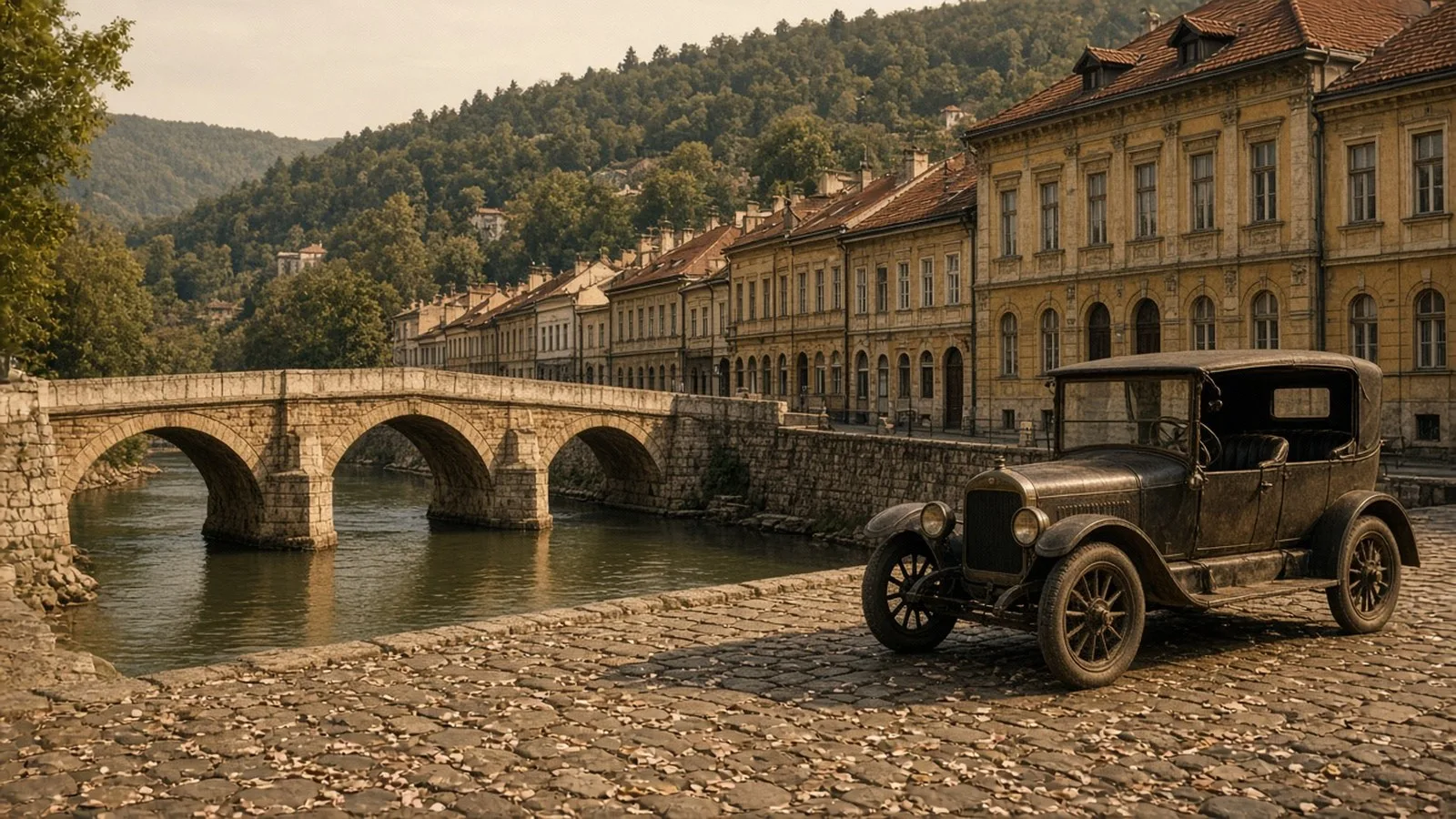
The first attempt failed. Nedeljko Čabrinović threw a bomb that bounced off the archduke's car and exploded under the next vehicle, wounding officers and bystanders. After a reception at the town hall, Franz Ferdinand decided to visit the wounded in hospital, but his driver was not properly told of the change of route. At a corner near the Latin Bridge over the Miljacka river, the car turned into a side street, stopped and began to reverse. Gavrilo Princip, aged 19, was standing a few steps away. He fired twice. Sophie was hit in the abdomen and Franz Ferdinand in the neck; both died within the hour. Princip later said he had aimed his second shot at the military governor, General Oskar Potiorek, not at the duchess.
According to the UK government's History of Government blog, drawing on Foreign Office files at The National Archives, a telegram from the British consul in Sarajevo reached London at about 4 pm that Sunday, reporting that the heir and his consort had been assassinated "by means of an explosive nature". Few people, the same account notes, expected the murder to matter much outside the Balkans.
Princip was arrested on the spot. Too young at 19 to be executed under Austro-Hungarian law, he was sentenced to 20 years and died of tuberculosis at Theresienstadt (Terezín, Czech Republic) in April 1918.
The "blank cheque": 5-6 July
In Vienna, the foreign minister Count Leopold Berchtold and the chief of the general staff Franz Conrad von Hötzendorf saw the murder as the chance to crush Serbia, which they regarded as a threat to the survival of their multinational empire. The Hungarian prime minister, István Tisza, at first opposed a war, but by mid-July he had been won over.
Vienna knew that attacking Serbia might bring in Russia, Serbia's protector, so it first asked its own ally. On 5 July the envoy Count Alexander Hoyos brought letters to Berlin. Kaiser Wilhelm II, meeting the Austrian ambassador at Potsdam, promised Germany's full support, and on 6 July the chancellor Theobald von Bethmann Hollweg confirmed it. Historians call this the "blank cheque": an assurance that Germany would stand behind whatever Austria-Hungary did, even if Russia intervened. German leaders hoped the war would stay local, but accepted the risk of a larger one.
The ultimatum: 23-28 July
At 6 pm on 23 July, the Austro-Hungarian minister in Belgrade handed Serbia an ultimatum: a list of demands with a deadline, this time just 48 hours. The timing was deliberate. As the Open University's chronology by historian Annika Mombauer notes, Vienna waited until the French president Raymond Poincaré and his prime minister had left St Petersburg after a state visit, so that France and Russia could not easily coordinate a response.
The note demanded that Serbia suppress anti-Austrian propaganda and organisations, dismiss officers named by Vienna, and allow Austro-Hungarian officials to take part in the investigation on Serbian soil. Most historians agree it was designed to be rejected; the IWM describes Vienna as "intent on starting a war with Serbia". Serbia's reply on 25 July accepted almost everything except Austro-Hungarian officials joining the inquiry inside Serbia. Serbia had also ordered mobilisation a few hours earlier. Vienna broke off relations the same evening.
On 26 July the British foreign secretary, Sir Edward Grey, proposed a mediation conference; Berlin and Vienna ignored it. On 28 July Austria-Hungary declared war on Serbia, and its guns shelled Belgrade the next day. Only now, on 29-30 July, did Bethmann Hollweg try to restrain Vienna, and the Kaiser suggested a "halt in Belgrade": occupy the Serbian capital and negotiate.
Mobilisation and the timetable trap: 29 July-3 August
Mobilisation means calling up reservists and moving millions of men by rail to the frontiers. It took weeks, and every general staff believed that whoever mobilised first would win the opening battles.
Russia, the slowest to mobilise, started early: it took "preparatory" measures from 26 July and, after much hesitation by Tsar Nicholas II, ordered general mobilisation on 30 July. For Germany this was decisive. Its single war plan, drawn up under Alfred von Schlieffen and revised by Helmuth von Moltke, assumed a two-front war: knock out France within about six weeks by marching through Belgium, then turn east before Russia was ready. In that plan, German mobilisation led straight to attack. There was no separate "Russia only" plan.
The dominoes fell quickly:
- 31 July: Germany sends ultimatums to Russia (stop mobilising) and France (state your intentions).
- 1 August: Germany declares war on Russia; France and Germany order general mobilisation.
- 2 August: German troops enter Luxembourg; Germany demands free passage through Belgium.
- 3 August: Germany declares war on France; Italy, despite the Triple Alliance, announces it will stay neutral.
According to Moltke's own later account, when the Kaiser asked on 1 August whether the army could march east only, Moltke told him it was impossible without throwing the deployment into chaos.
Belgium and Britain's choice: 4 August
Britain had no binding alliance with France or Russia, and Asquith's Liberal cabinet was deeply divided. Germany's demand to cross Belgium, whose neutrality the great powers, including Britain and Prussia, had guaranteed in the Treaty of London of 1839, changed the mood. Belgium refused on 2-3 August. On 3 August Grey made his case to the House of Commons. On the morning of 4 August German troops crossed the Belgian border.
At about 2 pm Britain sent Germany an ultimatum demanding an assurance that Belgian neutrality would be respected, with a deadline of 11 pm London time (midnight in Berlin). According to the British ambassador in Berlin, Sir Edward Goschen, Bethmann Hollweg protested that Britain was going to war over "a scrap of paper". No assurance came, and at 11 pm on 4 August 1914 Britain was at war with Germany. Grey later recalled in his memoirs saying, as he watched the lamps being lit outside the Foreign Office, "The lamps are going out all over Europe; we shall not see them lit again in our life-time."
Belgium gave Britain a moral and legal reason, but the IWM stresses that strategy mattered too: a German victory over France would have put a hostile great power on the Channel coast.
India: at war without being asked
When King George V declared war, he did so for the whole British Empire. India, Australia, Canada, New Zealand, South Africa and the colonies were all at war from 11 pm on 4 August. India's Viceroy, Lord Hardinge, did not consult any Indian body. Many princes offered men and money, most nationalist leaders backed the war, and within weeks Indian troops were sailing from Bombay (Mumbai) and Karachi; we follow them in Part 5. Within six weeks the war reached India's own coast, when the German cruiser Emden shelled Madras (Chennai) in September 1914, the subject of Part 4.
Myth vs evidence: who was to blame?
- The sandwich myth. A popular story says Princip had given up and was buying a sandwich at Schiller's delicatessen when the car stopped in front of him. He was near the shop, but no good contemporary evidence supports the sandwich, which appears only in much later retellings.
- "War by timetable". The historian A. J. P. Taylor argued in 1969 that railway timetables dragged statesmen into war. Most historians now stress choices: governments decided to mobilise, and Germany chose a single plan that required invading Belgium.
- War guilt. Article 231 of the Treaty of Versailles (1919) blamed Germany and its allies, and Germany spent years contesting it. In 1961 Fritz Fischer argued that German leaders deliberately used the crisis to pursue European dominance. Christopher Clark's The Sleepwalkers (2012) spreads responsibility across all the capitals, including Belgrade, St Petersburg and Paris. Annika Mombauer and others argue that the main responsibility still lies in Berlin and Vienna, which chose to risk a continental war; Sean McMeekin stresses Russia's early mobilisation; Niall Ferguson has argued that British intervention turned a continental war into a world war. There is no consensus, but few historians today blame one country alone, and few deny that the blank cheque and the ultimatum were decisive.
- Cheering crowds. Photographs of cheering crowds in Berlin, Paris and London are real, but research on diaries and local records suggests feelings were more mixed, from enthusiasm to fear and resignation.
For a shorter overview of how the assassination and the alliances combined, see our explainer on how World War I began.
At a glance: the July Crisis
| Dates | 28 June to 4 August 1914 (about 37 days) |
| Places | Sarajevo (Bosnia and Herzegovina), Vienna, Berlin, Belgrade, St Petersburg, Paris, Brussels, London |
| Trigger | Assassination of Archduke Franz Ferdinand and Sophie by Gavrilo Princip, 28 June |
| Key steps | Blank cheque 5-6 July; ultimatum 23 July; Austria-Hungary declares war on Serbia 28 July; Russian general mobilisation 30 July; Germany declares war on Russia 1 Aug and France 3 Aug; invasion of Belgium and British declaration 4 Aug |
| Key leaders | Franz Joseph, Berchtold, Conrad (Austria-Hungary); Wilhelm II, Bethmann Hollweg, Moltke (Germany); Nicholas II, Sazonov (Russia); Poincaré (France); Pašić (Serbia); Asquith, Grey (Britain) |
| Stayed out | Italy (neutral until 1915) |
| India | At war automatically from 11 pm, 4 August 1914 |
Next in the series
Part 3: 1914: The Schlieffen Plan, the Marne and the Race to the Sea. Germany's armies swing through Belgium towards Paris, the French and British stop them on the Marne, and both sides race north to the coast, leaving the trench line of the Western Front.
Sources
- The outbreak of the First World War in 1914, Imperial War Museums
- 4 August 1914: factsheet and timeline (PDF), Imperial War Museums
- Voices of the First World War: The Shot That Led to War, Imperial War Museums
- Gavrilo Princip, Encyclopaedia Britannica
- The July Crisis: a chronology, Annika Mombauer, OpenLearn (The Open University)
- 'The lamps are going out': tweeting the July Crisis, History of Government blog, UK Government (Foreign Office files, The National Archives FO 371/1899)
- 1914: To arms, National Army Museum
- Clark, C. (2012), The Sleepwalkers: How Europe Went to War in 1914; Fischer, F. (1961), Griff nach der Weltmacht; Mombauer, A. (2002), The Origins of the First World War: Controversies and Consensus; MacMillan, M. (2013), The War That Ended Peace