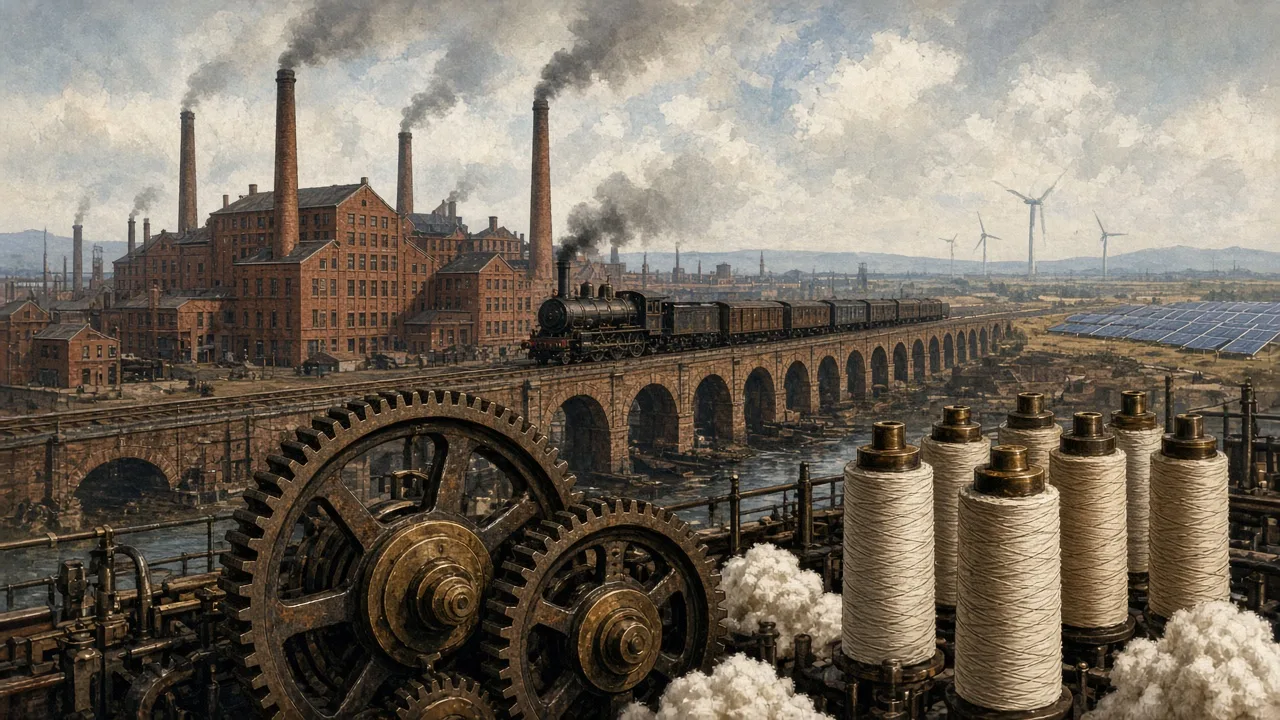
For most of human history, economies grew painfully slowly. Most people farmed, energy came from muscle, wind, water and wood, and living standards changed little from one generation to the next. Then, beginning in Britain in the second half of the 18th century, a cluster of inventions in textiles, energy and transport set off the Industrial Revolution. It created factories, railways and modern cities, and it began the shift to sustained economic growth that still defines our world. For India, the story is more complicated: the same revolution that made Britain rich also reshaped Indian industry under colonial rule.
Why Britain, and why then?
Historians have long debated why industrialisation took off first in Britain, usually dated from around the 1760s. Commonly cited factors include:
- Cheap, accessible coal to fuel steam engines and ironworks.
- Relatively high wages, which some economists argue gave businesses an incentive to replace labour with machines.
- Expanding markets and capital, helped by overseas trade and colonial empire.
- A culture of tinkering and patents, with engineers and entrepreneurs who could profit from inventions.
No single cause explains it, and scholars still argue about the relative weight of each. What is clear is that a series of breakthroughs reinforced one another.
Cotton: the first factory industry
Textiles led the way. In the 18th century, Indian cotton cloth, from fine Bengal muslins to printed calicoes, was prized in Britain and Europe. British manufacturers set out to make cotton cloth competitively at home, and mechanisation was their answer.
- The spinning jenny, invented by James Hargreaves around 1764 (patented in 1770), let one worker spin several threads at once.
- The water frame, patented by Richard Arkwright in 1769, used water power to spin stronger yarn and helped create early mill-based factories.
- Later inventions such as the spinning mule and power looms increased output further.
Production moved from homes and small workshops into factories, where workers kept time with machines rather than the seasons.
Steam: the engine of change
Steam engines existed before the Industrial Revolution, mainly to pump water from mines, but they were inefficient. According to Britannica, James Watt added a separate condenser around 1765, greatly improving efficiency, and patented the idea in 1769. Over the following decades, improved steam engines powered factories, mines and eventually transport, freeing industry from dependence on riverside water wheels.
Railways and a shrinking world
Steam on rails transformed transport. The Liverpool and Manchester Railway opened on September 15, 1830, linking a major port with a great cotton manufacturing city, and is widely regarded as the first modern inter-city railway. Railways spread rapidly through Britain, Europe and North America, cutting travel times and freight costs dramatically.
India's railway age followed soon after. The country's first passenger train ran on April 16, 1853, from Bori Bunder in Bombay to Thane, a distance of about 34 km, operated by the Great Indian Peninsula Railway. Railways in colonial India were built largely to serve British commercial and administrative interests, moving raw materials to ports and troops across the country, but they also laid the foundation of what became one of the world's largest rail networks.
The human cost
Industrialisation brought new wealth, but early factory life was harsh. Workers, including children, often laboured long hours in dangerous conditions. Fast-growing industrial towns suffered from overcrowding, pollution and disease. These conditions fuelled demands for reform, trade unions and new political ideas, and eventually led to factory laws limiting working hours and child labour.
What it meant for India
The Industrial Revolution's impact on India remains one of the most debated topics in economic history. India had long been one of the world's great textile producers. As British mills mass-produced cheaper machine-made cloth, and as colonial trade policies favoured British manufacturers, many traditional Indian textile producers lost markets. Many historians describe this process as "deindustrialisation", though they differ on its timing, scale and how much was due to technology versus colonial policy. Estimates of India's share of world output in this period are often quoted, but they rest on reconstructed data and should be treated as approximate.
India's own modern industry took root in the second half of the 19th century, with cotton mills in Bombay and Ahmedabad and jute mills around Calcutta, paving the way for Indian industrialists in the decades that followed.
Timeline: key moments
- c. 1764: James Hargreaves invents the spinning jenny.
- c. 1765: James Watt devises the separate condenser.
- 1769: Watt patents his improvement; Arkwright patents the water frame.
- 1829: Stephenson's Rocket wins the Rainhill Trials.
- September 15, 1830: The Liverpool and Manchester Railway opens.
- April 16, 1853: India's first passenger train runs from Bori Bunder to Thane.
- Late 19th century: Modern cotton and jute mills expand in India.
Why it matters today
The Industrial Revolution is the foundation of the modern economy, and its themes are front and centre in today's debates.
- Technology and jobs. Hand-loom weavers were displaced by machines, while new kinds of jobs were created. Today, similar questions surround automation and artificial intelligence: who gains, who loses and how fast workers can adapt.
- Energy transitions. The first industrial era ran on coal. Today, India and the world are trying to manage a new energy transition towards solar, wind and other clean sources while still meeting growing demand.
- Climate change. The rise in greenhouse gas emissions that drives climate change began with industrial-era fossil fuel use, which shapes current debates about responsibility between developed and developing countries.
- Manufacturing as a growth strategy. Policies such as "Make in India" and production-linked incentives reflect the long-standing belief that manufacturing can create jobs and wealth at scale, the lesson Britain, and later Japan, the US and China, demonstrated.
- Infrastructure pays off. The railway boom showed how transport networks unlock trade. India's investments in dedicated freight corridors, expressways and high-speed rail continue that logic.
The Industrial Revolution did not simply give us machines. It changed how people work, where they live and how nations compete, and that transformation is still unfolding.