This is Part 1 of England's Royal Dynasties, our daily series on the kings and queens of England and Britain, from the Anglo-Saxon kingdoms to King Charles III.
The story of the English crown begins when there was no England and no English king. Around the year 400, the southern two-thirds of the island of Great Britain was still a province of the Roman Empire. Two and a half centuries later it was divided among rival kingdoms ruled by Germanic-speaking warlords, whose families would produce the first kings "of the English".
This opening part explains how that happened and why so much of the popular story rests on a few late, partisan sources. A quick note on names: Britain is the island, which today holds England, Scotland and Wales; the United Kingdom adds Northern Ireland. "England" simply means "land of the Angles", a name that only took hold centuries after the events below.
The Romans leave (around 410)
Rome had ruled Britain since Claudius invaded in AD 43, building roads, towns such as Londinium (London) and the frontier of Hadrian's Wall, begun in AD 122. For the empire's wider story, see our explainer on the rise and fall of the Roman Empire.
By the early fifth century the western empire was overstretched. Usurpers took Britain's troops to the continent, while Picts, Irish raiders (the Romans' Scotti) and Germanic-speaking seafarers attacked the island. Around 409–410 Roman administration collapsed.
The usual marker is the so-called Rescript of Honorius. The Greek historian Zosimus, writing roughly a century later, says the emperor Honorius wrote to the cities of Britain telling them to see to their own defence. Many historians accept this as the formal end of Roman Britain; others argue the passage really concerns Bruttium in southern Italy, whose Greek name is almost identical. Either way, no Roman army came back. Coins stopped arriving, towns and villas decayed, and Britain entered the sub-Roman period under local British leaders, many of them Christian and Latin-using.
Three sources, all with limits
Almost everything written about this era comes from three texts, none of them neutral.
- Gildas, a British monk, wrote On the Ruin of Britain probably in the first half of the sixth century. It is a sermon, not a history: he blames the Britons' sins, describes a proud tyrant (superbus tyrannus) who invited Saxon mercenaries, and mentions a British victory at Mount Badon. He gives almost no names or dates.
- Bede, a Northumbrian monk at Jarrow, finished his Ecclesiastical History of the English People in 731. He is careful by medieval standards and helped popularise dating by AD, but he wrote nearly 300 years after the migrations, as a churchman telling a story of conversion.
- The Anglo-Saxon Chronicle was compiled in Wessex in the late ninth century, under or around the time of King Alfred. Its early entries were reconstructed long after the fact and tend to glorify the West Saxon royal house.
Archaeology, place names and, recently, ancient DNA offer an independent check.
Angles, Saxons and Jutes: invasion or takeover?
Bede says the newcomers came from "the three most powerful nations of Germany": Saxons, Angles and Jutes. In his scheme, Jutes settled Kent and the Isle of Wight; Saxons founded Essex (East Saxons), Sussex (South Saxons) and Wessex (West Saxons); and Angles founded East Anglia, Mercia and Northumbria. Their homelands lay in today's northern Germany and southern Denmark. The tidy division is probably too neat; Frisians and others crossed too.
Historians long argued between two pictures: a mass invasion that drove out the Britons, or a small warrior elite whose language and customs the natives gradually adopted.
Ancient DNA has shifted the debate. A 2022 study in Nature led by Joscha Gretzinger analysed genomes from 460 medieval north-west Europeans, including 278 people from England. It found a large increase in continental northern European ancestry in early medieval England and concluded there had been large-scale migration across the North Sea. Some individuals from eastern England derived up to 76% of their ancestry from the continental North Sea zone, but the share varied widely between regions and even within the same cemetery. So the answer appears to be substantial migration plus mixing, varying from region to region.
Legend vs evidence: Hengist, Horsa and Arthur
According to Bede and the Chronicle, the brothers Hengist and Horsa landed in Kent around 449, invited by a British king the Chronicle calls Wurtgern (Vortigern), to fight the Picts, then turned on their hosts. The Chronicle dates the arrival of Cerdic, founder of Wessex, to 495. Most historians treat these as foundation legends: the names mean "stallion" and "horse" in Old English, and the dates were fitted together centuries later.
King Arthur is even harder to pin down. Gildas, the closest writer to the period, never mentions him. Arthur first appears as a war leader in the Historia Brittonum of about 829–830, which lists twelve battles, and in the tenth-century Welsh Annals. Camelot, the Round Table and the Grail came later, from Geoffrey of Monmouth (1130s) and medieval romance writers. Some scholars think a real British leader may lie behind the stories; many think Arthur is legendary. No contemporary evidence proves he existed.
How the kingdoms formed
What emerges by about 600, when Bede's narrative becomes detailed, is a patchwork of kingdoms. Some were Anglo-Saxon; others, such as Dumnonia (Devon and Cornwall), Gwynedd and Powys in Wales, Rheged in the north-west and Strathclyde, remained British.
The seven best-known English kingdoms were:
| Kingdom | Roughly modern area | Notable early ruler (as reported) |
|---|---|---|
| Kent | Kent | Æthelberht (d. 616) |
| Sussex | Sussex | Ælle (late 5th century) |
| Essex | Essex, Middlesex, London | Sæberht (d. c. 616) |
| Wessex | Hampshire, Wiltshire and the south-west | Ceawlin (late 6th century) |
| East Anglia | Norfolk and Suffolk | Rædwald (d. c. 624) |
| Mercia | The Midlands | Penda (d. 655) |
| Northumbria | Northern England and south-east Scotland | Edwin, Oswald, Oswiu |
Northumbria itself united two earlier kingdoms, Deira (around York) and Bernicia (based at Bamburgh), while smaller kingdoms such as Lindsey and the Hwicce were swallowed by bigger neighbours.
Why "Heptarchy" is a simplification
These kingdoms are often called the Heptarchy, Greek for "rule of seven". The idea goes back to medieval writers such as Henry of Huntingdon in the twelfth century, and the label was popularised by sixteenth-century antiquaries. It is convenient shorthand, but there were never exactly seven kingdoms at once, and borders moved constantly.
Over-kings, wars and the bretwalda
Kings fought constantly over tribute and land. Bede lists seven kings who held imperium, an overlordship, over the southern English: Ælle of Sussex, Ceawlin of Wessex, Æthelberht of Kent, Rædwald of East Anglia and the Northumbrians Edwin, Oswald and Oswiu. The Chronicle later calls such a figure a bretwalda, perhaps "ruler of Britain" or "wide ruler". Whether this was a real office or just a word for the strongest king is debated.
It was a violent century. Penda of Mercia and his ally, the Christian Briton Cadwallon of Gwynedd, killed Edwin around 633; Penda then killed Oswald in 642, before falling to Oswiu in 655.
Kings, councils and law
An Anglo-Saxon king was first a war leader who rewarded loyal warriors with land, gold and feasts in his timber hall. Succession was not strictly father-to-eldest-son: any male of royal blood, an ætheling, could hope to be chosen.
Kings took advice from leading nobles and churchmen. Later sources call this assembly the witan or witenagemot ("meeting of the wise"). It was no parliament, but it witnessed charters and helped recognise new kings.
The earliest surviving written laws in English are those of Æthelberht of Kent, from around 600. Bede says the king had them written down in English, following Roman example. They survive only in a twelfth-century manuscript, the Textus Roffensis, and consist largely of compensation tariffs (wergild) for injuries and offences, from a broken tooth to a killing.
Religion: Rome, Iona and Whitby
The first settlers were pagan, worshipping gods such as Woden and Thunor (remembered in Wednesday and Thursday), while British and Irish churches carried on in the west and north.
In 597 Pope Gregory the Great sent a monk named Augustine to Kent. Æthelberht's Frankish wife, Bertha, was already Christian and worshipped at St Martin's church in Canterbury. Æthelberht accepted baptism, gave Augustine land in Canterbury, and Augustine became the first Archbishop of Canterbury, which is why Canterbury, not London, remains the senior see of the Church of England.
In the north, a second wave came from the Irish monastery of Iona. King Oswald, who had spent his exile there, invited the monk Aidan, who founded a monastery on Lindisfarne in 635. Roman and Irish-trained clergy disagreed over details, notably how to calculate Easter. At the Synod of Whitby in 664, King Oswiu decided in favour of the Roman practice. In 668 the pope appointed Theodore of Tarsus as archbishop, and he organised the English Church into dioceses. Northumbria went on to produce the Lindisfarne Gospels and Bede himself.
Sutton Hoo: a king's ship in the earth
In 1939, on Edith Pretty's estate near Woodbridge in Suffolk, the local archaeologist Basil Brown uncovered the imprint of a ship about 27 metres long beneath a burial mound. Its chamber held a gold buckle, gold-and-garnet shoulder clasps, a sword, Byzantine silver and the famous helmet. According to the National Trust, coins date the burial to around 625, and the garnets probably came from Sri Lanka.
No body survived in the acidic soil, but chemical traces show one was there. The leading candidate is Rædwald of East Anglia, who died about that time, though this cannot be proved. Fittingly, Bede says Rædwald kept both a Christian altar and a pagan one.
Places to visit today
- Sutton Hoo, Suffolk (National Trust): the royal burial mounds and an exhibition; the original treasures are in the British Museum, London.
- Hadrian's Wall, Northumberland and Cumbria: part of the UNESCO "Frontiers of the Roman Empire" site.
- Canterbury, Kent: St Martin's church, the ruins of St Augustine's Abbey and the cathedral form a UNESCO World Heritage Site.
- Lindisfarne (Holy Island), Northumberland: reached by a tidal causeway; the visible priory ruins are later.
- Bamburgh, Northumberland: a castle, mostly later medieval and Victorian, on the rock of the Bernician kings' fortress.
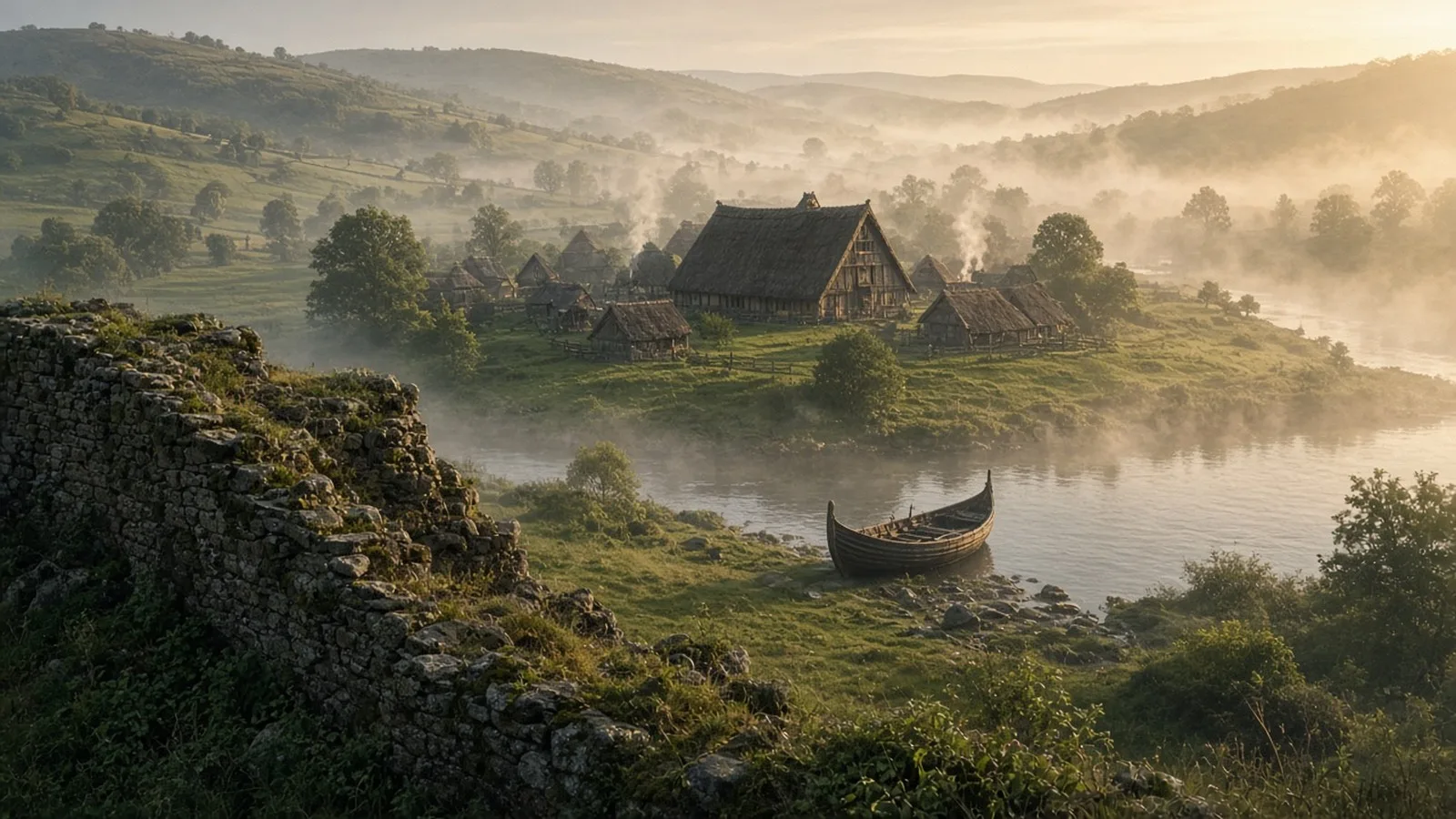
- West Stow, Suffolk: a reconstructed early Anglo-Saxon village built on an excavated settlement site.
At a glance
| Period | c. 410 to c. 800 |
| Before | Roman Britain (AD 43 to c. 410) |
| Main kingdoms | Kent, Sussex, Essex, Wessex, East Anglia, Mercia, Northumbria |
| Key dates | c. 410 end of Roman rule; c. 449 traditional arrival of Hengist and Horsa; 597 Augustine reaches Kent; c. 625 Sutton Hoo ship burial; 635 Lindisfarne founded; 664 Synod of Whitby; 731 Bede finishes his History |
| Key sources | Gildas, Bede, the Anglo-Saxon Chronicle, archaeology, ancient DNA |
| Next | Offa of Mercia and Egbert of Wessex |
Next in the series
By the eighth century, two kingdoms were pulling ahead of the rest. In Part 2 we meet Offa of Mercia, traditionally credited with the great earthwork of Offa's Dyke along the Welsh border and styled "king of the English" in some charters, and Egbert of Wessex, whom the Chronicle names as the eighth bretwalda, as the race to rule the English begins. Until then, browse more medieval history on HorizonDesk.
Sources
- BBC History, Edward James, Overview: Anglo-Saxons, 410 to 800
- BBC History, The Venerable Bede (673–735)
- Bede, Ecclesiastical History of the English People, Book I, Fordham University Internet Medieval Sourcebook
- The Anglo-Saxon Chronicle, fifth-century entries, Avalon Project, Yale Law School
- National Trust, A brief history of Sutton Hoo
- Gretzinger, J. et al. (2022), The Anglo-Saxon migration and the formation of the early English gene pool, Nature 610: 112–119
- UNESCO World Heritage Centre, Canterbury Cathedral, St Augustine's Abbey, and St Martin's Church
- UNESCO World Heritage Centre, Frontiers of the Roman Empire