On the morning of June 28, 1914, a young nationalist shot dead Archduke Franz Ferdinand, heir to the Austro-Hungarian throne, in Sarajevo. Within about five weeks, Europe's great powers were at war. The conflict that followed killed millions, toppled empires and redrew the map of the world. It also drew in India on an enormous scale: more than a million Indian servicemen served overseas. More than a century later, historians still debate how a single assassination spiralled into a world war, and the answer offers lessons that feel uncomfortably current.
A continent primed for conflict
Historians usually point to several long-term pressures that made Europe in 1914 combustible:
- Rival alliance blocs. Germany and Austria-Hungary were closely allied, while France and Russia had their own alliance, and Britain had looser understandings with both. A local crisis could quickly involve multiple powers.
- Militarism and arms races. Great powers built up large conscript armies and, in the case of Britain and Germany, competed in building battleships. Detailed mobilisation plans meant that military timetables could pressure political decisions.
- Imperial rivalry. Competition for colonies and influence, including in Africa and Asia, fed mistrust among the powers.
- Nationalism. In the Balkans especially, nationalist movements challenged the Austro-Hungarian and Ottoman empires, and Serbia's ambitions alarmed Vienna.
None of these alone made war inevitable, and historians differ on how much weight to give each. But together they created a system in which a crisis was hard to contain.
The assassination in Sarajevo
Bosnia-Herzegovina had been annexed by Austria-Hungary in 1908, angering Serb nationalists. On June 28, 1914, Franz Ferdinand and his wife, Sophie, were visiting Sarajevo when they were shot by Gavrilo Princip, a young Bosnian Serb linked to a group of conspirators who had received support from a secret Serbian nationalist network. Both Franz Ferdinand and Sophie died.
The July Crisis: five weeks to war
What followed is known as the July Crisis. Austria-Hungary, with assurances of support from Germany, decided to take a hard line against Serbia. According to the Imperial War Museums and the Open University's chronology:
- On July 23, Austria-Hungary delivered a 48-hour ultimatum to Serbia.
- Serbia accepted most of the demands but rejected the proposal for an Austrian-led inquiry on its territory.
- On July 28, Austria-Hungary declared war on Serbia.
- Russia, which saw itself as a protector of Serbia, began mobilising its forces.
- On August 1, Germany declared war on Russia.
- On August 3, Germany declared war on France and moved to invade Belgium as part of its war plan.
- On August 4, Britain declared war on Germany after Germany violated Belgian neutrality.
In just over a month, a regional crisis in the Balkans had become a European war, and soon a global one, as empires mobilised colonies and dominions, and as the Ottoman Empire, Japan, Italy and later the United States joined in.
India in the Great War
Because India was under British rule, it was drawn into the war from the start. The Commonwealth War Graves Commission (CWGC) notes that the Indian Army grew from some 150,000 men in 1914 to nearly 1.4 million by 1918, and that more than one million personnel from Indian forces served overseas. They fought on the Western Front in France and Belgium, in Mesopotamia (modern Iraq), Gallipoli, Egypt and Palestine and East Africa.
The human cost was heavy. The CWGC commemorates around 74,000 Indian servicemen who died in the First World War. The UK government has also highlighted India's material contribution, including millions of tonnes of supplies and large numbers of animals. India Gate in New Delhi was built as a memorial to Indian soldiers who died in the war and related campaigns.
Many Indians hoped that wartime loyalty would be rewarded with greater self-government. When those hopes were largely disappointed, frustration fed into the growth of the national movement in the years after the war.
Timeline: key moments
- 1908: Austria-Hungary annexes Bosnia-Herzegovina.
- June 28, 1914: Archduke Franz Ferdinand and Sophie are assassinated in Sarajevo.
- July 23, 1914: Austria-Hungary issues its ultimatum to Serbia.
- July 28, 1914: Austria-Hungary declares war on Serbia.
- August 1, 1914: Germany declares war on Russia.
- August 4, 1914: Britain declares war on Germany.
- March 1915: The Indian Corps fights its first major action at Neuve Chapelle on the Western Front.
- November 11, 1918: The armistice ends fighting on the Western Front.
- June 28, 1919: The Treaty of Versailles is signed.
Why it matters today
The outbreak of World War I is one of the most studied events in international relations because it shows how quickly things can go wrong.
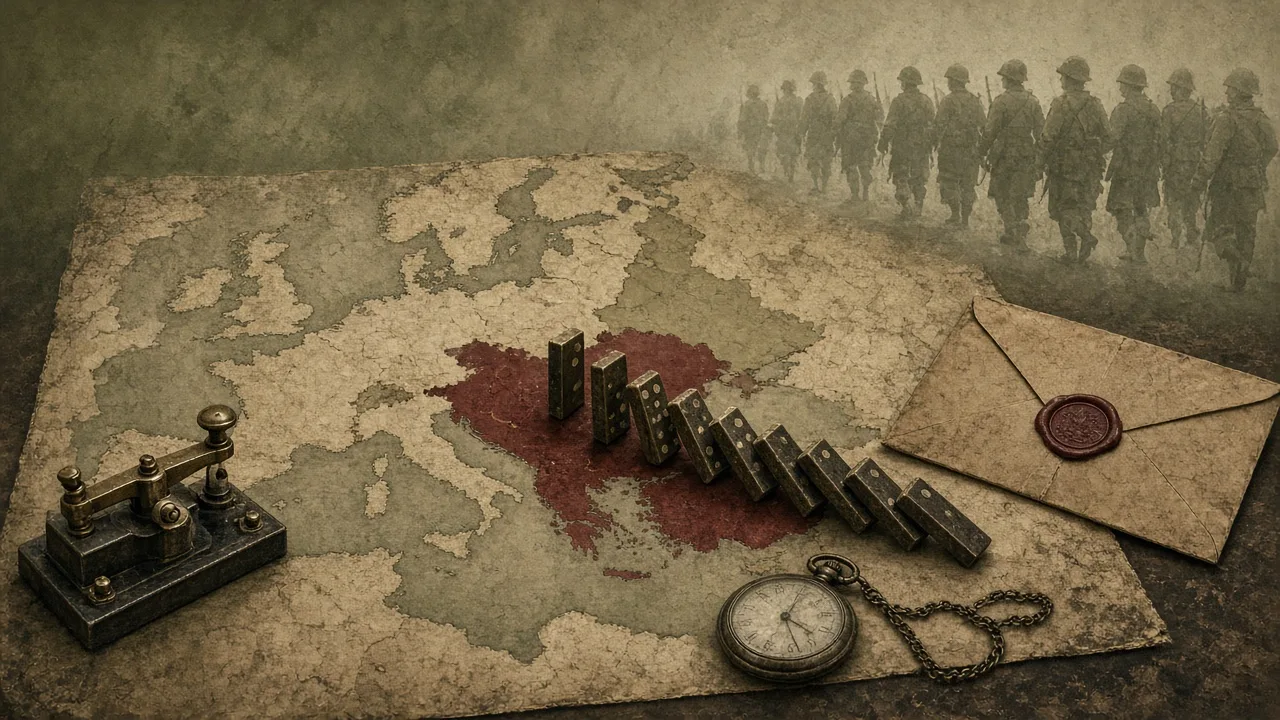
- Escalation can outrun intentions. Many leaders in 1914 seem to have expected a short or limited war. Alliance commitments, mobilisation plans and miscommunication turned a regional crisis into a catastrophe. Modern diplomacy places great weight on crisis communication for this reason.
- Economic interdependence is not a guarantee of peace. Europe in 1914 was deeply connected by trade and investment, yet war still came. That lesson is often cited in debates about today's great-power rivalries.
- Wars reshape economies. The war ended the gold standard as it had worked before 1914 for many countries, drove up government debt and inflation and accelerated technologies from aviation to radio.
- India's forgotten contribution. Indian soldiers' role in the war was long overlooked in popular histories. Recognition of their service has grown in recent years, through CWGC memorials in Europe and centenary commemorations.
- The roots of later conflicts. The collapse of the Austro-Hungarian, Ottoman, Russian and German empires and the post-war settlements shaped the Middle East, Europe's borders and the tensions that led to World War II.
World War I did not begin with a single decision but with a chain of them. Understanding that chain is the best defence against repeating it.
Sources
- Imperial War Museums: Outbreak of the First World War
- Open University OpenLearn: The July Crisis, a chronology
- CWGC: 5 facts about Indian forces in WW1 and WW2
- CWGC: Cemeteries and memorials commemorating Indian Army personnel
- GOV.UK: India and UK commemorate fallen soldiers in World War 1
- Britannica: World War I