Five hundred years ago, most educated Europeans believed that the Earth sat motionless at the centre of the universe, that heavy objects fell faster than light ones and that ancient authorities such as Aristotle and Galen had largely settled how nature worked. By the end of the 17th century, that picture had been overturned. The period historians call the Scientific Revolution, roughly from 1543 to 1687, gave the world a Sun-centred solar system, laws of motion and gravity, and a new method built on observation, experiment and mathematics. It also drew on knowledge from many cultures, including India.
The old picture of the cosmos
Medieval European thinking about nature was built on Greek foundations, especially Aristotle's physics and the astronomy of Ptolemy, in which the Sun, Moon and planets circled a fixed Earth. These ideas had been preserved, debated and improved by scholars in the Islamic world, who also transmitted Indian numerals and mathematical ideas to Europe. Universities taught them alongside Christian theology, and for centuries they seemed to explain everyday experience well enough.
A Sun-centred universe
The first major challenge came in 1543, when the Polish astronomer Nicolaus Copernicus published On the Revolutions of the Heavenly Spheres, arguing that the Earth and planets orbit the Sun. The same year, Andreas Vesalius published a detailed study of human anatomy based on dissection, correcting errors inherited from Galen. Many historians use 1543 as a convenient starting point for the Scientific Revolution.
Copernicus's idea did not win quick acceptance. The Danish astronomer Tycho Brahe made the most precise naked-eye observations of his age, and his assistant Johannes Kepler used them to show that planets move in ellipses, not perfect circles. Kepler published his first two laws of planetary motion in 1609 and his third in 1619.
Galileo and the telescope
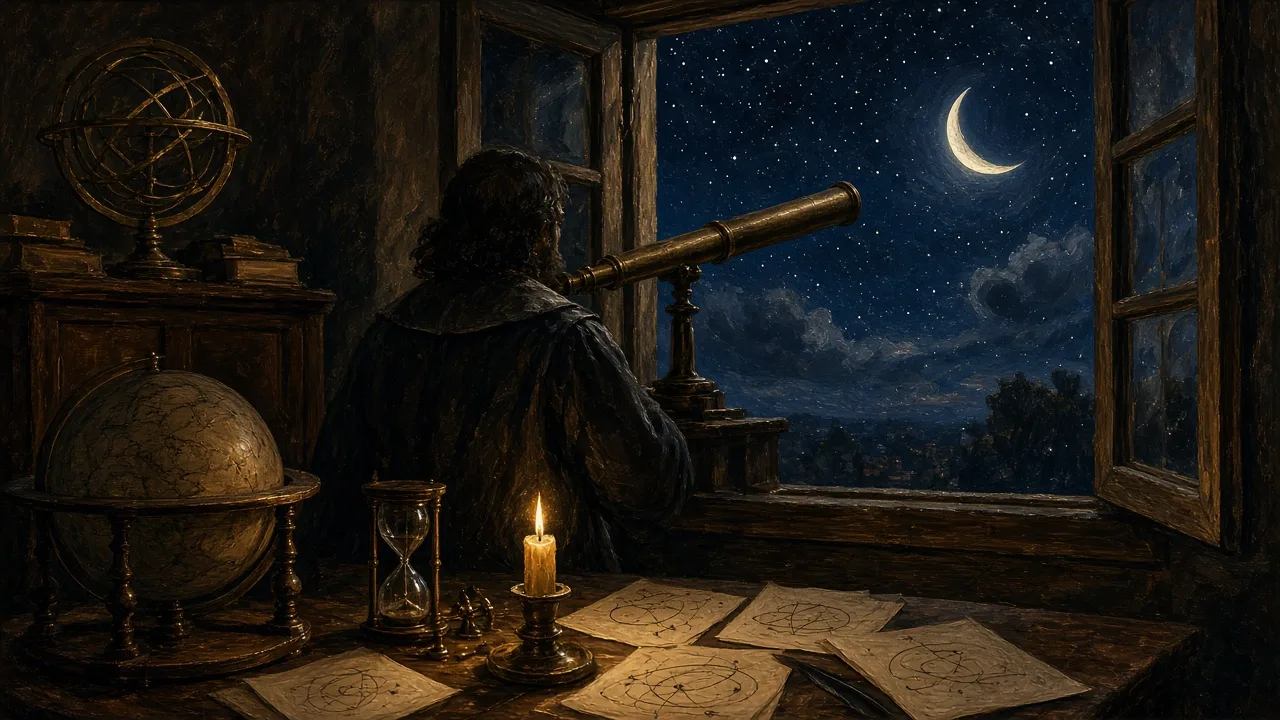
In 1609, the Italian scientist Galileo Galilei built an improved telescope and turned it to the sky. In 1610, he reported mountains on the Moon, countless stars invisible to the naked eye and four moons orbiting Jupiter, evidence that not everything circled the Earth. He also studied motion and falling bodies through careful experiments.
Galileo's support for the Sun-centred system brought him into conflict with the Catholic Church. After publishing his Dialogue Concerning the Two Chief World Systems in 1632, he was tried by the Roman Inquisition in 1633, forced to recant and spent the rest of his life under house arrest. His case remains one of history's best-known clashes between science and authority, though historians stress that its politics were complex.
New methods and new institutions
Philosophers also argued about how knowledge should be gained. In England, Francis Bacon called for careful observation and experiment, while in France, René Descartes championed mathematical reasoning and doubt. William Harvey showed in 1628 that blood circulates around the body, and microscopes revealed a hidden world of tiny organisms.
Science also became more organised. The Royal Society of London was founded in 1660 and began publishing its journal, Philosophical Transactions, in 1665, one of the earliest scientific journals. The French Academy of Sciences followed in 1666. Sharing results, testing claims and publishing them for others to check became central to scientific practice.
Newton's grand synthesis
The revolution reached a climax in 1687, when Isaac Newton published his Principia. Newton set out three laws of motion and the law of universal gravitation, showing that the same force that makes an apple fall also keeps the Moon in orbit around the Earth and the planets around the Sun. He also developed calculus, as did the German thinker Gottfried Wilhelm Leibniz independently. Newton's framework dominated physics for more than two centuries, until Einstein's theories refined it.
Timeline: key moments
- 1543: Copernicus publishes his Sun-centred model; Vesalius publishes his anatomy.
- 1609: Kepler publishes his first two laws of planetary motion.
- 1610: Galileo reports the moons of Jupiter and other telescope discoveries.
- 1620: Francis Bacon's Novum Organum sets out a method of inquiry.
- 1628: William Harvey describes the circulation of the blood.
- 1633: Galileo is tried by the Roman Inquisition.
- 1660: The Royal Society is founded in London.
- 1687: Newton publishes the Principia.
The India connection
The Scientific Revolution did not happen in isolation. The decimal place-value system and zero, developed in India and transmitted through the Islamic world, made the complex calculations of astronomers like Kepler and Newton far easier.
India also had its own advanced mathematical tradition at the time. In Kerala, a school of astronomer-mathematicians founded by Madhava of Sangamagrama in the 14th century developed infinite series for functions such as sine, cosine and arctangent, results that resemble parts of calculus developed in Europe centuries later. Some researchers, including a team at the University of Manchester in 2007, have suggested that this knowledge may have reached Europe through Jesuit missionaries in Kerala. That idea remains unproven, as no direct documentary evidence of transmission has been found.
In the early 18th century, Maharaja Sawai Jai Singh II built large stone observatories in several Indian cities. The Jantar Mantar in Jaipur, with about 20 main fixed instruments, is now a UNESCO World Heritage site and a reminder of India's own long tradition of observational astronomy.
Why it matters today
- Evidence over authority. The idea that claims should be tested by observation and experiment underpins modern science, medicine and technology.
- Open sharing speeds progress. Journals and societies made knowledge public and checkable, a model that today's research still follows.
- Science is global. Indian numerals, Islamic astronomy and Greek geometry all fed into what became modern science.
- Questioning is uncomfortable but necessary. Galileo's trial shows how new ideas can clash with established power.
- Big theories can be refined. Newton's laws still put spacecraft in orbit, even though Einstein later showed their limits.
Frequently asked questions
When was the Scientific Revolution?
It is usually dated from 1543, when Copernicus published his Sun-centred model, to 1687, when Newton published the Principia, though some historians use broader or different dates.
Who were the key figures of the Scientific Revolution?
Major figures include Copernicus, Kepler, Galileo, Vesalius, Bacon, Descartes, Harvey, Boyle, Leibniz and Newton, along with the many instrument makers and observers who supported their work.
Did Indian mathematics influence the Scientific Revolution?
Indian numerals and the decimal system, transmitted through the Islamic world, were vital. Kerala mathematicians developed infinite series centuries before similar work in Europe, but whether that work directly reached Europe remains unproven.