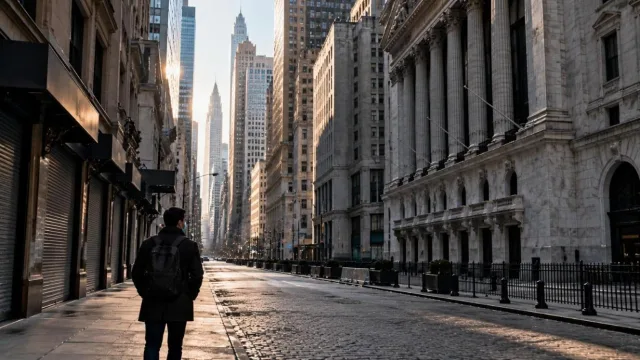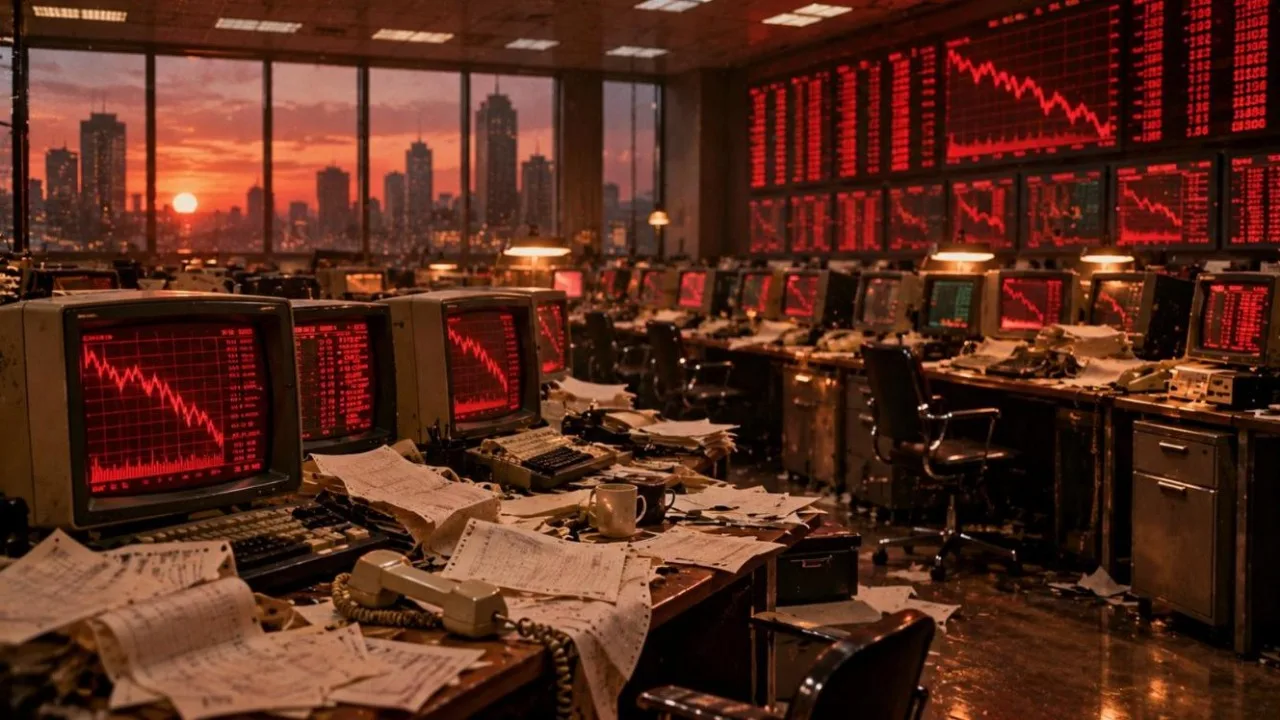
On Monday, 19 October 1987, the Dow Jones Industrial Average fell 508 points, or 22.6%, in a single trading session. It remains the largest one-day percentage decline in the index's history. Markets around the world crashed too. Yet unlike 1929, no depression followed. In Part 8 of Great Financial Crises, we look at Black Monday and why it ended differently.
The run-up
US stocks had been in a powerful bull market since 1982, helped by falling inflation, lower interest rates, a wave of takeovers and growing foreign investment. According to the Federal Reserve's history essay, the Dow had gained 44% in about seven months by late August 1987, raising concerns about a bubble.
Warning signs grew in the autumn: interest rates were rising, the US trade deficit was larger than expected and the dollar was falling.
The week before
On Friday, 16 October 1987, the Dow fell 4.6%, or 108 points, which at the time was the largest one-day point drop ever. Over the weekend, worried investors prepared to sell.
Black Monday
Selling began in Asia and Europe and hit New York at the open. The New York Stock Exchange was overwhelmed. Many stocks could not open for trading for some time, and order systems were swamped. Prices in the futures market and the stock market became disconnected.
By the close, the Dow had fallen 508 points to about 1,739. Markets in Hong Kong, Australia, the UK and elsewhere also suffered heavy losses, and Hong Kong's exchange closed for several days.
What caused it?
There was no single trigger. The Fed's essay highlights several factors:
- Portfolio insurance: a popular strategy that automatically sold stock index futures as prices fell, meant to protect portfolios. When many institutions did this at once, the selling fed on itself.
- Market structure: stocks, options and futures were traded on different exchanges with different settlement timelines, which could force liquidations and add stress.
- Economic worries: a larger-than-expected trade deficit and a falling dollar unsettled investors.
- High valuations after a sharp rise.
Computerised trading strategies, rising interest rates and herd behaviour are also commonly cited. Economists still debate the precise mix.
The Fed's response
Alan Greenspan had become chairman of the Federal Reserve just two months earlier. Before markets opened on Tuesday, 20 October, the Fed issued a one-sentence statement saying it "affirmed today its readiness to serve as a source of liquidity to support the economic and financial system."
Behind the scenes, the Fed encouraged banks to keep lending to securities firms on normal terms. According to the Fed's essay, the ten largest New York banks nearly doubled their lending to securities firms in the week of 19 October. The Fed also added liquidity through open market operations, and short-term interest rates fell.
Recovery
Within two trading sessions, the Dow regained 288 points, or 57% of its Black Monday loss. Less than two years later, US stock markets surpassed their pre-crash highs. Crucially, the crash was not followed by a recession or a banking crisis.
Reforms
- Circuit breakers: exchanges introduced automatic trading halts after large declines. Today, US markets pause trading when the S&P 500 falls 7%, 13% or 20% in a day.
- Clearing and settlement: regulators improved coordination across stock, options and futures markets.
- Portfolio insurance fell out of favour.
Why it ended differently from 1929
- The Fed acted quickly as a lender of last resort, avoiding a liquidity crisis.
- Deposit insurance and stronger banks meant no wave of bank runs.
- Investors used less leverage than in 1929.
- The wider economy was fairly healthy.
Lessons for investors today
- Markets can fall violently without warning. Diversification and an appropriate allocation to stocks matter.
- Automated strategies can amplify moves when everyone uses the same approach.
- Panic selling is costly. Investors who held on recovered within about two years.
- Central bank support matters in stopping a market crash from becoming an economic crisis.
In Part 9, we travel to Japan, where a giant asset bubble burst in 1990 and led to decades of slow growth.
Sources
Great Financial Crises: the full series
- Part 1: Tulip Mania (1637)
- Part 2: The Mississippi and South Sea Bubbles (1720)
- Part 3: The Panic of 1907
- Part 4: The Wall Street Crash and Great Depression
- Part 5: Weimar Hyperinflation (1923)
- Part 6: The 1970s Oil Shocks and Stagflation
- Part 7: The Latin American Debt Crisis (1982)
- Part 8: Black Monday (1987) (you are here)
- Part 9: Japan's Bubble and Lost Decades
- Part 10: The Savings and Loan Crisis
- Part 11: The Mexican Peso Crisis (1994)
- Part 12: The Asian Financial Crisis (1997)
- Part 13: Russia's Default and LTCM (1998)
- Part 14: The Dot-Com Bubble (2000)
- Part 15: Argentina's Collapse (2001)
- Part 16: The Global Financial Crisis (2008)
- Part 17: Iceland's Banking Collapse (2008)
- Part 18: The Eurozone Debt Crisis
- Part 19: The Covid Crash (2020)
- Part 20: The 2023 Banking Turmoil
This series is for education only and is not investment advice. Figures are taken from the sources listed and other commonly cited historical records, and may vary slightly between sources.