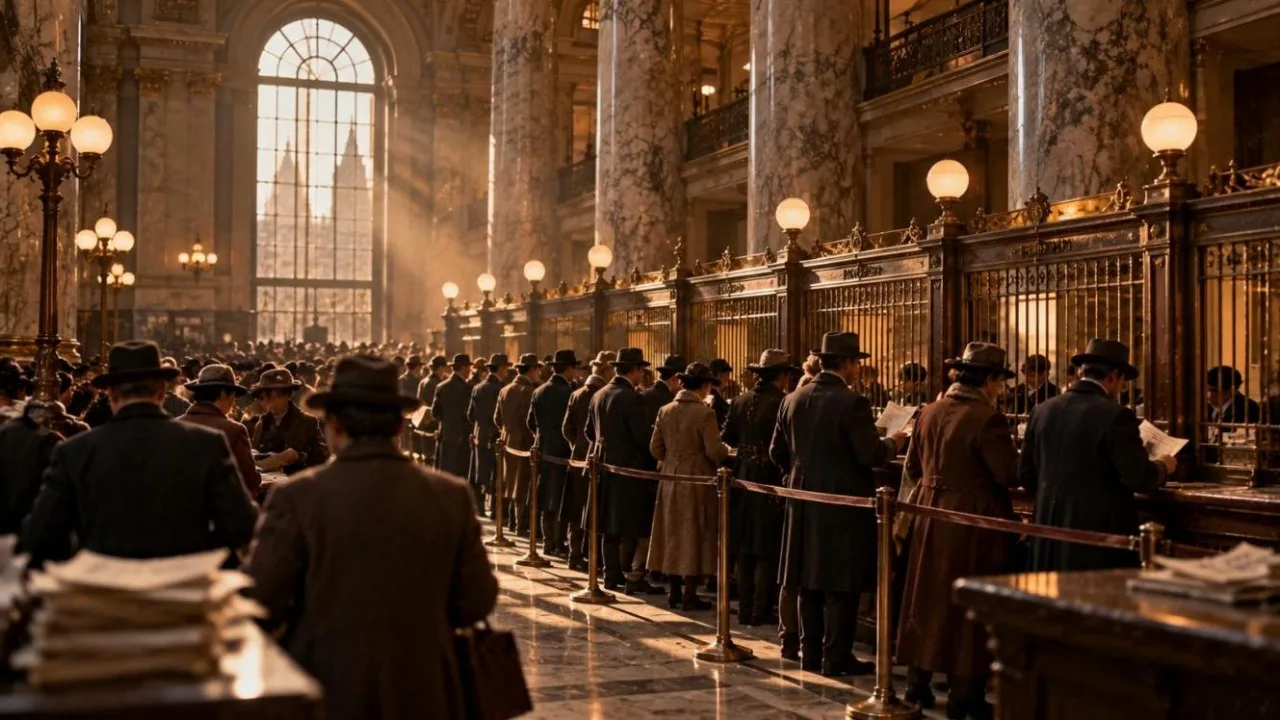
Today, when banks get into trouble, central banks act as the lender of last resort. In 1907, the United States had no central bank. When panic hit New York, the job of stopping it fell largely to one man: banker J. Pierpont Morgan. In Part 3 of Great Financial Crises, we look at the Panic of 1907 and how it led to the creation of the Federal Reserve.
A fragile system
In the early 1900s, the US banking system was fragmented. There were thousands of banks and no central authority to supply cash in emergencies. Money tended to become scarce each autumn, when farmers withdrew funds to pay for harvests.
A fast-growing part of the system was the trust company. Trusts were state-chartered institutions that took deposits like banks but faced lighter regulation. According to the Federal Reserve's history essay, New York trusts held only about 5% of deposits as cash reserves, compared with about 25% for national banks. They also made unsecured, same-day loans to stockbrokers, helping finance trading on the New York Stock Exchange. Crucially, they were outside the New York Clearing House, the group of banks that could help each other in a crisis.
The trigger: a failed copper corner
In October 1907, F. Augustus Heinze and Charles W. Morse tried to "corner" the shares of United Copper, buying up so much stock that short sellers would be forced to buy from them at high prices. On 16 October the scheme failed, and the share price collapsed.
Heinze and Morse were connected to several banks, and depositors began to pull their money out. The New York Clearing House supported its member banks but forced out the managers linked to the scheme.
The run on Knickerbocker Trust
On 18 October, news spread that Charles T. Barney, president of the Knickerbocker Trust Company, one of the largest trusts in New York, had ties to Morse. Depositors queued to withdraw their money. On 21 October, the Clearing House refused to help Knickerbocker, and Morgan initially declined too.
On 22 October, after depositors withdrew nearly $8 million, Knickerbocker suspended operations. Panic spread to other trusts, especially the Trust Company of America. The call money rate, the interest rate for short-term loans to brokers, jumped from 9.5% to 70% on 22 October and reached 100% two days later. At times, no lender would offer money at any price.
Morgan steps in
Morgan, then 70 years old, gathered bankers in his library in New York. He organised pools of money from banks and wealthy financiers to support trusts that were judged solvent and to lend to the stock exchange so brokers could continue operating. At one point, he reportedly locked bankers in his library overnight until they agreed to a rescue plan for the trust companies.
The US Treasury, under Secretary George Cortelyou, also deposited government funds in New York banks to increase liquidity.
Clearing house certificates
On 26 October, the New York Clearing House began issuing clearing house loan certificates, which banks could use to settle balances with each other instead of cash. Banks also restricted the conversion of deposits into cash. This created a premium on cash that attracted gold from abroad and helped the market recover. The Federal Reserve's essay describes these certificates as forerunners of the Fed's discount window loans.
The damage
- More than 36% of deposits at New York City trust companies were withdrawn between late August and mid-December 1907, while deposits at national banks rose.
- Industrial production fell 17% in 1908, and real GNP fell 12%, according to the Federal Reserve's history essay. Only the Great Depression was more severe.
- The economy recovered relatively quickly, in a little over a year.
From panic to the Federal Reserve
The panic showed that relying on a private banker to save the system was dangerous. Morgan would not live forever, and his help was selective. In 1908, Congress passed the Aldrich-Vreeland Act, allowing emergency currency, and created the National Monetary Commission to study banking reform.
After years of debate, President Woodrow Wilson signed the Federal Reserve Act in December 1913, creating the Federal Reserve System, with the power to provide an "elastic currency" and act as a lender of last resort to banks.
Why it matters
The Panic of 1907 is a classic example of a liquidity crisis. Many of the institutions hit were not necessarily insolvent, but they could not turn their assets into cash fast enough when depositors demanded it. Without a lender of last resort, fear spread from one institution to the next.
Lessons for investors today
- Shadow banking can be risky. Like today's lightly regulated lenders, trusts grew fast with thin cash buffers.
- Confidence is everything. Rumours about a single executive were enough to start a run.
- Liquidity and solvency are different. A healthy institution can still fail if it cannot meet withdrawals.
- Safety nets matter. Central banks and deposit insurance were built to stop exactly this kind of panic.
In Part 4, we look at the 1929 crash and the banking crises that turned it into the Great Depression.
Sources
- Federal Reserve History – The Panic of 1907
- FDIC – Deposit insurance history, 1900–1919
- Gotham Center for New York City History – The Panic of 1907
Great Financial Crises: the full series
- Part 1: Tulip Mania (1637)
- Part 2: The Mississippi and South Sea Bubbles (1720)
- Part 3: The Panic of 1907 (you are here)
- Part 4: The Wall Street Crash and Great Depression
- Part 5: Weimar Hyperinflation (1923)
- Part 6: The 1970s Oil Shocks and Stagflation
- Part 7: The Latin American Debt Crisis (1982)
- Part 8: Black Monday (1987)
- Part 9: Japan's Bubble and Lost Decades
- Part 10: The Savings and Loan Crisis
- Part 11: The Mexican Peso Crisis (1994)
- Part 12: The Asian Financial Crisis (1997)
- Part 13: Russia's Default and LTCM (1998)
- Part 14: The Dot-Com Bubble (2000)
- Part 15: Argentina's Collapse (2001)
- Part 16: The Global Financial Crisis (2008)
- Part 17: Iceland's Banking Collapse (2008)
- Part 18: The Eurozone Debt Crisis
- Part 19: The Covid Crash (2020)
- Part 20: The 2023 Banking Turmoil
This series is for education only and is not investment advice. Figures are taken from the sources listed and other commonly cited historical records, and may vary slightly between sources.